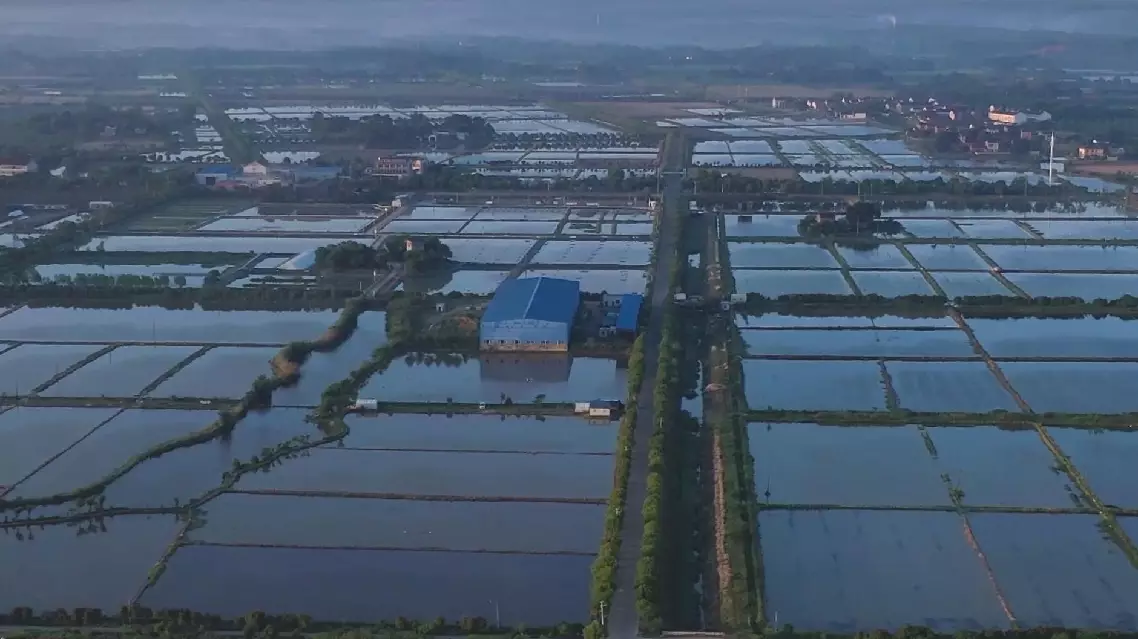
In the fertile paddy fields of Cambodia's Takeo Province, Chinese researchers are helping local farmers adopt an innovative eco-farming technique that combines rice cultivation with giant river prawn aquaculture, a model that promises to increase incomes while protecting the environment.
Rice is the cornerstone of Cambodia's agricultural economy, serving as the staple food for more than 15 million people and cultivated across approximately 3 million hectares nationwide.
Yet for generations, many farmers have remained dependent on unpredictable weather patterns, constrained by limited access to funding, technology, and technical expertise.
Now, scientists from China's Shanghai Ocean University are introducing a sustainable solution inspired by the Lancang-Mekong River system: rice-prawn co-culture.
The model leverages Cambodia's natural rainy season, which runs from June to October. During these months, paddy fields are often submerged by floods, forcing farmers to rely on harvesting wild aquatic species to supplement their livelihoods.
While this practice supplies roughly 60 percent of fish and shrimp-based food for local rural households, the absence of scientific management has kept yields consistently low for both rice and aquatic products.
"Cambodia has a natural rainy season, with daily rainfall from around June to October each year. Under these conditions, rice-shrimp co-culture and rice-shrimp rotation are particularly well-suited for the country. That's why we wanted to combine the two approaches, ensuring rice supply while producing the popular giant river prawn," said Professor Wu Xugan from Shanghai Ocean University.
Rice-prawn co-culture is an ecological farming model that allows rice planting and aquaculture to coexist in the same water space. The shrimp help loosen the soil, control pests, and provide natural fertilizer for the rice, while the rice purifies the water and offers shade for the shrimp.
The result is more than just clever farming. Land is used more efficiently, chemical fertilizers and pesticides are reduced, and a single field can yield two harvests at once.
"The rice-prawn co-culture system is currently being implemented mainly in Takeo Province, involving 52 farming households and covering about 50 hectares of land. The overall results have been positive. It has increased their income by about 3,000 U.S. dollars per hectare," said Wu.
Local farmers are actively embracing the new farming technique.
"Calculated on an annual basis, we can sell shrimp at about 17 U.S. dollars per kilogram. That would be equivalent to 17,000 U.S. dollars in annual revenue. In this way, it yields higher returns than just growing rice," said Sab Sarun, a local farmer.
Chinese scientists promote eco-farming technique in Cambodia to boost farmer incomes