Tax measures proposed in 2026-27 Budget
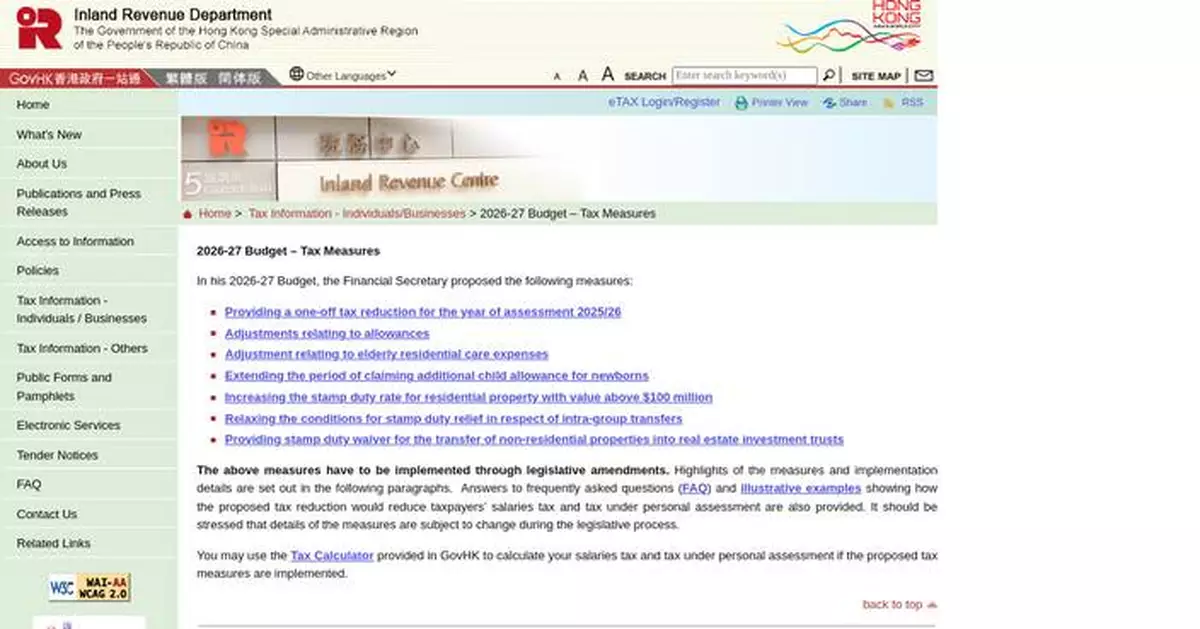
In the Budget delivered today (February 25), the Financial Secretary proposed the following tax measures:
(1) Providing a one-off tax reduction for the year of assessment 2025/26
A one-off reduction of profits tax, salaries tax and tax under personal assessment for the year of assessment 2025/26 by 100%, subject to a ceiling of $3,000 per case, will be provided. This measure will benefit about 2.12 million taxpayers liable to salaries tax and tax under personal assessment and about 171 000 businesses. The Government tax revenue will be reduced by about $5.8 billion.
The measure will reduce the amount of tax payable by taxpayers for the year of assessment 2025/26. Taxpayers only need to file their profits tax returns and tax returns for individuals for the year of assessment 2025/26 as usual. Upon enactment of the relevant legislation, the Inland Revenue Department will effect the reduction in the final assessment. The reduction will only be applicable to the final tax for the year of assessment 2025/26, but not to the provisional tax of the same year. Taxpayers should pay the provisional tax on time as stipulated in the demand notes that have been issued to them. The provisional tax paid will be applied in payment of the final tax for the year of assessment 2025/26 and the provisional tax for the year of assessment 2026/27. The excess balance, if any, will be refunded.
The reduction is not applicable to property tax. Nevertheless, eligible individuals with rental income may enjoy such a reduction under personal assessment.
A taxpayer who is separately chargeable to salaries tax and profits tax can enjoy tax reduction under both tax types. A taxpayer having business profits or rental income may elect for personal assessment in their tax returns for individuals for the year of assessment 2025/26. The reduction will then be calculated based on the tax payable under personal assessment, amount of which may be different from the amount of tax reduction a taxpayer would have got had he / she not elected for personal assessment. The actual amount will be assessed case by case.
(2) Increasing allowances and deduction ceiling for elderly residential care expenses
The Budget proposed to increase the basic allowance, married person's allowance, single parent allowance, child allowance, additional child allowance for newborns, dependent parent/grandparent allowance and additional allowance, and raise the deduction ceiling for elderly residential care expenses starting from the year of assessment 2026/27.
Besides, the 2025 Policy Address proposed to extend the claim period of additional child allowance for newborns from one year to two years. This measure and the above Budget proposals will be effective starting from the year of assessment 2026/27.
(3) Increasing the ad valorem stamp-duty rates for residential property transactions valued above $100 million
The ad valorem stamp-duty rates on residential properties valued above $100 million will be raised from 4.25% to 6.5%. The new rates apply to instruments executed on or after February 26, 2026 for the sale and purchase or transfer of residential properties.
Before the proposal is passed by the Legislative Council, the Inland Revenue Department will continue to charge stamp duty at the prevailing rate of 4.25% for residential property transactions concerned. Once the bill is passed by the Legislative Council and the amendment ordinance comes into effect upon gazettal, the purchasers or vendors concerned have to pay the difference of the stamp duty within 30 days.
(4) Relaxing the criteria for stamp duty relief in respect of intra-group transfer of assets
The criteria for stamp duty relief in respect of intra-group transfer of assets under section 45 of the Stamp Duty Ordinance (Cap. 117) will be relaxed to expand the scope of eligible associated body corporates. The proposal applies to instruments for sale and purchase or transfer of assets executed on or after February 25, 2026.
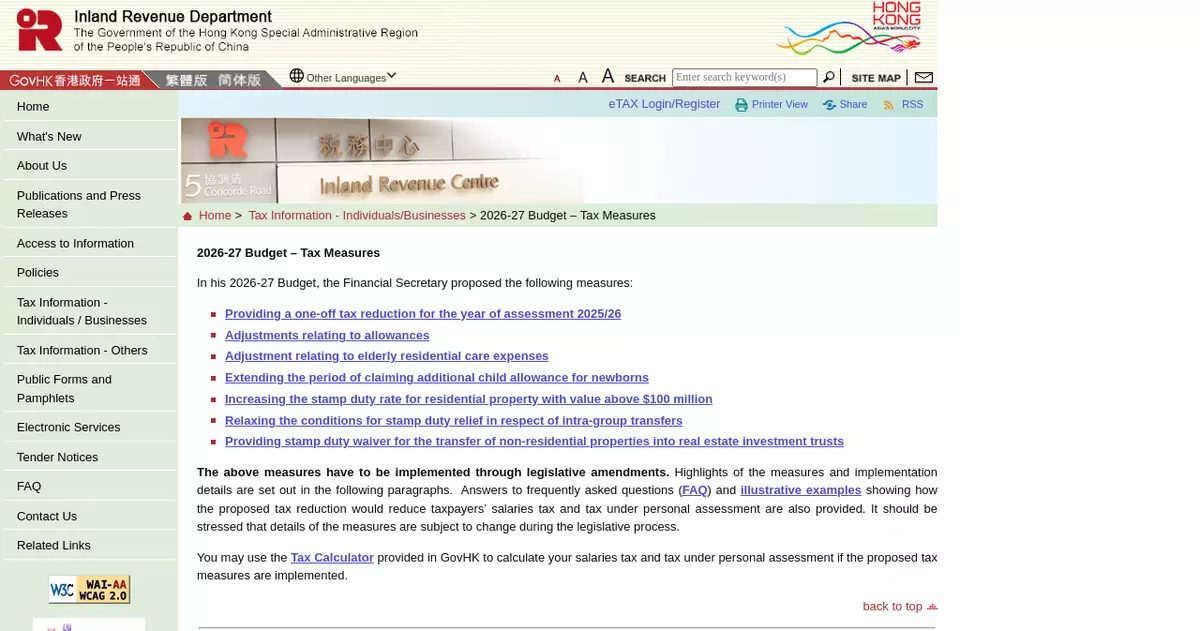
The measures above will be effected after the relevant ordinances have been amended. Details of the measures and examples of tax calculations are available on the website of the Inland Revenue Department and can be obtained through the fax hotline 2598 6001.
Source: AI-found images
Remarks by FS at Budget press conference
The Financial Secretary, Mr Paul Chan; the Secretary for Financial Services and the Treasury, Mr Christopher Hui; the Permanent Secretary for Financial Services and the Treasury (Treasury), Mr Andrew Lai; and the Government Economist, Ms Irina Fan, held a press conference on the Budget at Central Government Offices, Tamar, today (February 25). Following are the remarks by Mr Chan:
Reporter: Good afternoon, Mr Chan, some English questions. Firstly, the Government has ruled out using the Exchange Fund in 2021, warning of severe consequences at the time. Could you explain why the Government thinks it's okay to use the Exchange Fund now? And also, what are the potential risks you see in making this move, and could you also explain the Government's motivation in streamlining the Government's various funds in this Budget? Secondly, on tax policy, the Government said they will set up a committee chaired by you to review Hong Kong's tax policy. What is the Government's direction in this committee? And are you planning to increase the tax base? And if so, could you give some specifics on how you're going to go about it? Thank you.
Financial Secretary: Thank you. The main purpose of the Exchange Fund is to defend Hong Kong's financial stability and our financial system. Last year, the Exchange Fund made an investment income of over $300 billion. Now we are transferring from the Exchange Fund about half of it, $150 billion, in two instalments commencing from 2026-27. Having regard to the current size of the Exchange Fund, which is over $4,100 billion, and considering that we are just taking half of their income earned last year back to the Government, while also for investment purposes, we think this is a considered and prudent move. We are very confident that, given our various measures in place and the strong buffer of the Exchange Fund, we would be able to weather volatility or even attacks on our financial system.
In terms of tax policy, what I have proposed is to set up a group of advisors comprising mainly people from the business and professional sectors. The purpose of this advisory committee is to look at the tax competitiveness of Hong Kong. Over the years, various jurisdictions rolled out different incentives and tax measures, seeking to compete for investments and businesses. Globally, under the OECD (Organisation for Economic Co-operation and Development), there are also certain global requirements on minimum tax known as BEPS (Base Erosion and Profit Shifting) 2.0. Taking this into consideration, we think we should set up an advisory committee with a focus on how to use tax policy as a competitive tool, so as to attract businesses and investment to grow our economy. It is not going to touch our current tax system to widen the tax base. Therefore, things like GST (goods and services tax) and VAT (value-added tax) would not be included in the ambit of this committee.
Reporter: The Budget earmarks $220 million to establish the first national manufacturing innovation centre outside the Chinese Mainland. So could you please clarify the centre's positioning, proposed location, operational model and the expected timeline for implementation? Which advanced manufacturing sectors or new quality productive forces, will it prioritise? And given that this will be the first such centre outside the Chinese Mainland, what is different from existing national manufacturing innovation centres within the Mainland? Will it focus, in particular, on strengthening international co-operation? Thank you.
Financial Secretary: The National 15th Five-Year Plan is still at a recommendation stage, but high-quality development is the underlying tone. For high-quality development, there are two major underlying guiding principles. One is green development. The other is technological innovation and technology self-reliance.
Hong Kong plays a unique role in this respect. Thanks to the "one country, two systems" arrangement, we are in the best position to attract top talent from all over the world so that they could use Hong Kong as a base to do research, to collaborate and to look for application scenarios. That is why we set up this centre. The positioning is to look at frontier technology, particularly AI, healthtech, and attract both international as well as Mainland top scientists, engineers and researchers to come to Hong Kong. Thank you.
(Please also refer to the Chinese portion of the remarks.)

Source: AI-found images