The University of Cincinnati is suing Brendan Sorsby, accusing the former Bearcats quarterback of breaching his name, image and likeness contract following his transfer to Texas Tech.
The university filed the lawsuit in the U.S. District Court for the Southern District of Ohio on Wednesday.
According to the lawsuit, Sorsby signed an NIL agreement in July 2025 covering the 2025 and ’26 seasons and that there would be a $1 million buyout if Sorsby transferred, payable within 30 days. Sorsby announced on Dec. 15 that he was entering the transfer portal and announced on Jan. 4 that he would be attending Texas Tech.
Sorsby received the most lucrative deal of the portal period — a reported $5 million — to return to his home state for his final season.
“Cincinnati Athletics is proud to partner with its student-athletes and honors the contractual commitments it makes to them. We expect student-athletes and their representatives to do the same,” the university said in a statement. “In his lucrative NIL agreement with Cincinnati Athletics, Brendan Sorsby committed to stay and play for two seasons as a proud Bearcat representative. He also agreed that if he left the university before that time, he would pay the university a specific amount for the substantial harm that his breach would cause. Cincinnati Athletics intends to enforce that contractual commitment.”
Sorsby's agent, Ron Slavin, said pursuing legal action against his client is misguided and that Sorsby intends to fight the lawsuit and any resulting damages.
Sorsby passed for 2,800 yards, 27 touchdowns and five interceptions last season. He also ran for 580 yards and nine TDs. The Bearcats started 7-1 before losing their final five games.
Slavin said Sorsby was paid $875,800 by Cincinnati under its revenue-sharing structure for the 2025 season.
“In that time, he generated millions in value for the program. Attempting to recover those funds now sends the wrong message to current and future student-athletes and risks damaging the long-term credibility of Cincinnati football,” Slavin wrote in an email. “This is further disappointing given that Brendan parted ways with UC in what was a mutually agreeable manner. The money the university seeks to recover from him is nothing more than an unlawful penalty under Ohio law.”
This is at least the third case this year in which a school has sought a legal remedy related to an NIL deal with a quarterback.
Duke sued Darian Mensah were engaged in a legal fight until reaching a settlement last month. Mensah signed a two-year contract in July 2025 before he led the Blue Devils to their first outright Atlantic Coast Conference title since 1962. A judge granted Duke’s request for a temporary restraining order to block Mensah from doing anything beyond entering his name into the transfer portal until both sides came to an agreement.
Mensah ended up transferring to Miami.
Demond Williams Jr. had planned to transfer from Washington, then changed his mind two days later as the Huskies were preparing to file a lawsuit to enforce a buyout of nearly $4 million.
Sorsby began his career at Indiana before transferring to Cincinnati. In 35 career games, including 31 starts, he has passed for 7,208 yards and 60 touchdowns, along with 1,295 rushing yards and 22 TDs.
Sorsby and the Red Raiders, who won the Big 12 last season and reached the College Football Playoff for the first time in school history, will play at Cincinnati on Oct. 24 during the university's 100th homecoming celebration.
Get poll alerts and updates on the AP Top 25 throughout the season. Sign up here. AP college football: https://apnews.com/hub/ap-top-25-college-football-poll and https://apnews.com/hub/college-football
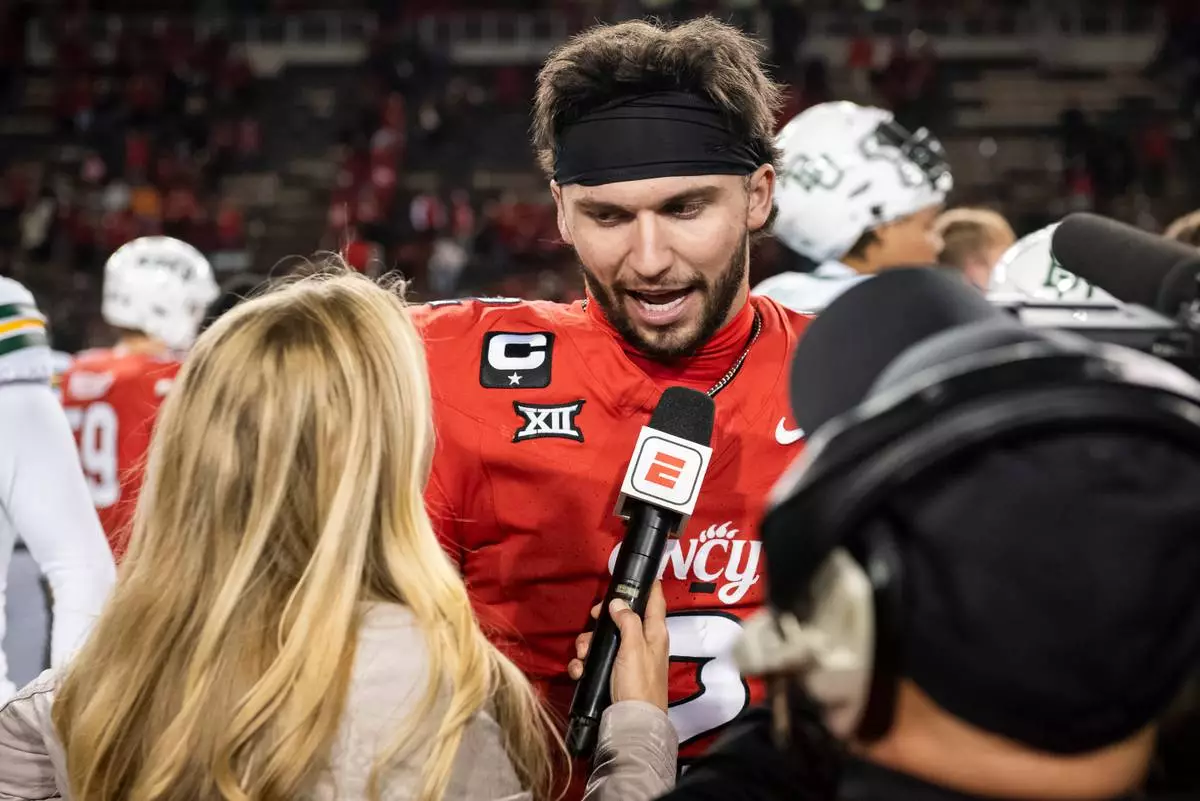
FILE - Cincinnati quarterback Brendan Sorsby (2) is interviewed after a NCAA college football game against Baylor, Saturday, Oct. 25, 2025, in Cincinnati. (AP Photo/Tanner Pearson,File)
WASHINGTON (AP) — Vice President JD Vance announced Wednesday that the Trump administration would “temporarily halt” some Medicaid funding to the state of Minnesota over fraud concerns, as part of what he described as an aggressive crackdown on misuse of public funds.
Vance, who made the announcement with Dr. Mehmet Oz, the administrator for the Centers for Medicare and Medicaid Services, said the administration was taking the action “in order to ensure that the state of Minnesota takes its obligations seriously to be good stewards of the American people’s tax money.”
Oz, who referred to people committing fraud as “self-serving scoundrels,” said the federal government would hold off on paying $259.5 million to Minnesota in funding for Medicaid, the health care safety net for low-income Americans.
“This is not a problem with the people of Minnesota, it’s a problem with the leadership of Minnesota and other states who do not take Medicaid preservation seriously,” Oz said.
Wednesday’s move is part of a larger Trump administration effort to spotlight fraud around the country. That effort comes after allegations of fraud involving day care centers run by Somali residents in Minneapolis prompted a massive immigration crackdown in the Midwestern city, resulting in widespread protests. President Donald Trump, in his State of the Union address on Tuesday, announced Vance would spearhead a national “war on fraud.”
Trump also recently nominated Colin McDonald to serve as the first assistant attorney general in charge of a Justice Department division dedicated to rooting out fraud.
Oz said the administration was simultaneously notifying Minnesota’s Democratic Gov. Tim Walz as he was making the announcement publicly.
“We will give them the money, but we’re going to hold it and only release it after they propose and act on a comprehensive corrective action plan to solve the problem,” Oz said.
He said Walz would have 60 days to respond and advised health care providers and Medicaid beneficiaries who were concerned to contact Walz’s office.
Walz, former Vice President Kamala Harris’ 2024 running mate, said in a pair of social media posts that the administration’s move had nothing to do with fraud.
“This is a campaign of retribution. Trump is weaponizing the entirety of the federal government to punish blue states like Minnesota,” Walz said. “These cuts will be devastating for veterans, families with young kids, folks with disabilities, and working people across our state.”
A spokesperson for Minnesota Attorney General Keith Ellison, whose office investigates Medicaid fraud, referred questions to the state Department of Human Services, which administers Medicaid in the state. A department spokesperson said the agency was preparing a statement.
Earlier Wednesday, Ellison held a news conference to promote legislation that would give his office more staff and new legal tools to combat Medicaid fraud.
Oz said the Centers for Medicare and Medicaid Services were also taking action to crack down on fraud in Medicare, the health care system relied upon by millions of older adults.
He said CMS for six months would block any new Medicare enrollments for suppliers of durable medical equipment, prosthetics, orthotics or other supplies used to treat chronic conditions or assist in injury recovery.
The Office of the Inspector General for the U.S. Department of Health and Human Services found last year that Medicare improperly paid suppliers nearly $23 million for durable medical equipment from 2018 through 2024. But it found that most of that was before January 2020, when changes to the system were implemented.
Oz also announced a new crowdsourcing effort he said would help “crush fraud” by soliciting Americans’ tips and suggestions.
“All of us are smarter than any one of us,” he said.
In a news release accompanying the announcement, CMS said the funding being paused in Minnesota included some $244 million in unsupported or potentially fraudulent Medicaid claims and about $15 million in claims involving “individuals lacking a satisfactory immigration status.”
Immigrants who are not living in the U.S. legally, as well as some lawfully present immigrants, are not allowed to enroll in the Medicaid program that provides nearly-free coverage for health services.
CMS said in the release that if Minnesota fails to satisfy its requirements, it may defer up to $1 billion in federal funds to the state over the next year. CMS spokesperson Catherine Howden said the agency's review of potential fraud cases would include sampling claims to see if they comply with federal requirements, and potentially requesting more information about specific claims.
Akeiisa Coleman, the senior program officer for Medicaid at the Commonwealth Fund, said CMS was taking a “highly unusual step" in deferring funding. She said if the state doesn't have enough funds available, it may have to halt payments to providers, which could affect care.
The administration has threatened to cut off funding for various programs for some Democratic-run states over fraud concerns over the last few months.
One judge blocked those actions and required that payments flowing to Minnesota and four other states — California, Colorado, Illinois and New York — for a variety of social service programs. The government had said that there was “reason to believe” that those states were granting benefits to people in the country illegally. It did not initially explain where that information came from, but a government lawyer told the judge it was largely in reaction to news reports about possible fraud.
Another judge said she would not let it cut off funding for administrative costs for 22 states that have refused to hand over information about applicants and recipients of food aid through the Supplemental Nutritional Assistance Program.
The latest action was prompted in part by a series of fraud cases, including a nonprofit called Feeding Our Future accused of stealing pandemic aid meant for school meals. Prosecutors have put the losses from that case at $300 million.
Since then, Trump has targeted the Somali diaspora in Minnesota with immigration enforcement actions and has made a series of disparaging comments about the community. During his State of the Union address on Tuesday, Trump said “pirates” have “ransacked Minnesota.”
Federal agencies have also been enlisted to assist in targeting fraud in Minnesota.
Last December, the U.S. Treasury Department issued an order requiring money wire services that people use to send money to Somalia to submit additional verification to the Treasury.
The Center for Medicare and Medicaid Services told Minnesota in January that it intended to freeze parts of payments for some Medicaid programs that were deemed high-risk. The state said that those cuts would add up to more than $2 billion annually if they lasted and made an administrative appeal.
Associated Press writers Geoff Mulvihill in Philadelphia, Steve Karnowski in Minneapolis and Fatima Hussein in Washington contributed to this report.
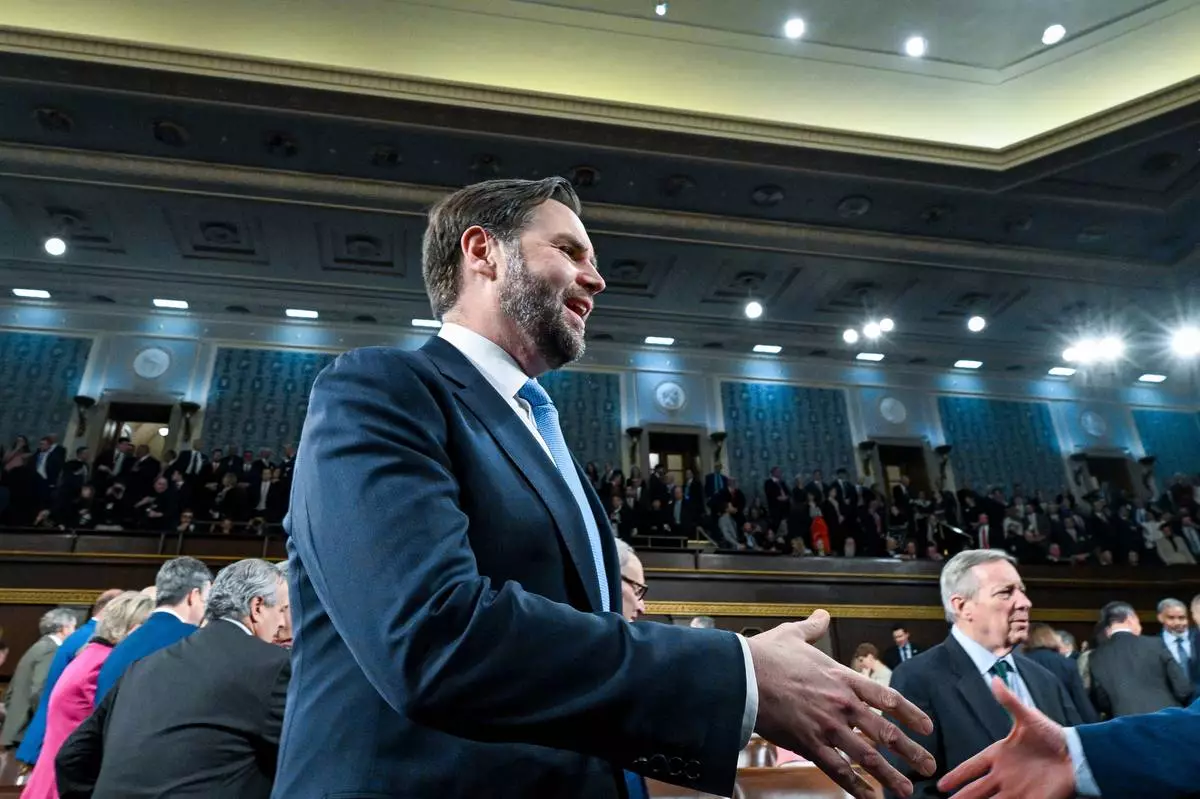
Vice President JD Vance arrives before President Donald Trump delivers the State of the Union address to a joint session of Congress in the House chamber at the U.S. Capitol in Washington, Tuesday, Feb. 24, 2026. (Kenny Holston/The New York Times via AP, Pool)