|
– Selected routes now support QR code boarding –
SINGAPORE, Feb. 26, 2026 /PRNewswire/ -- Trip.com, a global online travel service provider, has partnered with East Japan Railway Company, Central Japan Railway Company, West Japan Railway Company, and Kyushu Railway Company to launch the sale of Shinkansen tickets across Japan for international travellers.
In recent years, Japan has emerged as one of the most popular travel destinations in Asia, attracting growing interest from travellers around the world. Through its multilingual global platform, Trip.com enables international visitors to purchase Shinkansen tickets in advance in their preferred language, offering greater convenience when planning travel within Japan.
With this service, travellers can select their departure and arrival stations, travel date, train, and seat type—non-reserved, reserved, or Green Car—and purchase Shinkansen tickets online via Trip.com. Depending on the ticket type, passengers can either pass through ticket gates using a QR code or collect physical tickets from ticket vending machines at stations.
**The Tokaido Shinkansen, Sanyo Shinkansen, and Kyushu Shinkansen are available exclusively via QR code boarding.
By securing Shinkansen tickets online prior to departure, international travellers can reduce concerns related to on-site ticket purchases and language barriers, ensuring a smoother and more stress-free travel experience within Japan. Another key feature of the service is the ability to book Shinkansen tickets together with other travel products, such as flights and accommodation, all in one place.
Trip.com will continue to work closely with Japan's major transportation providers to create a seamless travel environment, enabling travellers from around the world to explore destinations across Japan with greater ease and comfort.
– Selected routes now support QR code boarding –
SINGAPORE, Feb. 26, 2026 /PRNewswire/ -- Trip.com, a global online travel service provider, has partnered with East Japan Railway Company, Central Japan Railway Company, West Japan Railway Company, and Kyushu Railway Company to launch the sale of Shinkansen tickets across Japan for international travellers.
In recent years, Japan has emerged as one of the most popular travel destinations in Asia, attracting growing interest from travellers around the world. Through its multilingual global platform, Trip.com enables international visitors to purchase Shinkansen tickets in advance in their preferred language, offering greater convenience when planning travel within Japan.
With this service, travellers can select their departure and arrival stations, travel date, train, and seat type—non-reserved, reserved, or Green Car—and purchase Shinkansen tickets online via Trip.com. Depending on the ticket type, passengers can either pass through ticket gates using a QR code or collect physical tickets from ticket vending machines at stations.
**The Tokaido Shinkansen, Sanyo Shinkansen, and Kyushu Shinkansen are available exclusively via QR code boarding.
By securing Shinkansen tickets online prior to departure, international travellers can reduce concerns related to on-site ticket purchases and language barriers, ensuring a smoother and more stress-free travel experience within Japan. Another key feature of the service is the ability to book Shinkansen tickets together with other travel products, such as flights and accommodation, all in one place.
Trip.com will continue to work closely with Japan's major transportation providers to create a seamless travel environment, enabling travellers from around the world to explore destinations across Japan with greater ease and comfort.
** The press release content is from PR Newswire. Bastille Post is not involved in its creation. **

Trip.com Partners with JR Companies to Offer Nationwide Shinkansen Tickets to International Travellers

Trip.com Partners with JR Companies to Offer Nationwide Shinkansen Tickets to International Travellers
|
- Only a quarter (26%) of business leaders have sent employees for customer and service excellence training in the past two years, while about a quarter (27%) say they are not planning for any training investment in this area.
- Even with over two-thirds (68%) of business leaders reporting confidence in their teams' ability to deliver customer and service excellence, nearly one in five (17%) report low confidence, highlighting a gap between expectations and workforce readiness.
- Business leaders identify proactive service that anticipates customer needs (44%) as the leading trend shaping customer and service excellence, followed by AI-enabled service delivery such as chatbots and virtual assistants (42%), and human-centric service design (38%).
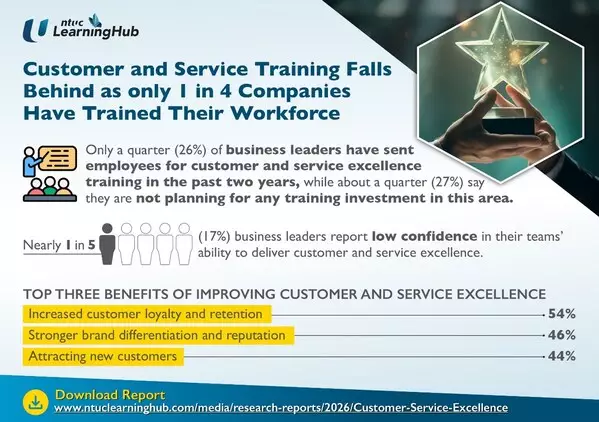
SINGAPORE, Feb. 26, 2026 /PRNewswire/ -- While customer expectations evolve across sectors, training adoption is low. Only about a quarter (26%) of business leaders have sent staff for relevant training in the past two years, while about one in four (27%) say they are not planning for any training investment in this area.
Organisational confidence reflects this readiness gap. Despite over two-thirds (68%) of business leaders expressing some confidence in their teams' ability to deliver customer and service excellence, nearly one in five (17%) report low confidence (16% not very confident, 1% not confident at all) in their team's current capabilities, indicating that expectations continue to outpace workforce readiness.
These are some of the key findings from NTUC LearningHub's Industry Insights Report on Customer and Service Excellence, which surveyed a total of 200 business leaders to explore the current landscape of customer and service excellence across key sectors in Singapore.
Business leaders identify proactive service that anticipates customer needs (44%) as the leading trend shaping customer and service excellence, followed by Artificial Intelligence or AI-enabled service delivery (42%), and human-centric service design (38%). Furthermore, these strategic shifts are translating into measurable benefits, with business leaders citing improved customer loyalty and retention (54%), stronger brand differentiation and reputation (46%), and attracting new customers (44%) as top benefits of improving service excellence.
Additionally, technology is widely viewed as a key enhancer of customer and service excellence. Over nine in ten business leaders rate technology as important (29% very important, 63% quite important) in strengthening their service capabilities and only a minority (8%) view technology as having little to no importance. AI-powered chatbots and virtual concierges (38%) enhance responsiveness and availability, while self-service platforms (36%) improve convenience and allow customers to resolve issues independently.
Sustainability is also regarded as an important contributor to customer and service excellence, with more than four in five business leaders rating it as very important (22%) and quite important (64%). Businesses are embedding sustainability into service delivery through digital-first processes such as paperless billing (39%) and reinforcing operational and social responsibility through sustainable technology adoption (26%), waste reduction initiatives (24%) and community sustainability programmes (24%).
However, the report underscores that technology and sustainability initiatives alone are not sufficient to deliver service excellence, as workforce capabilities are critical in customer and service excellence. Business leaders have also identified key training areas that are essential for service employees today to deliver service excellence outcomes. Effective communication (56%) is the top training priority, followed by customer experience strategy and transformation (49%), service recovery and complaint handling (47%), emotional intelligence (43%), and personalising customer experience (38%).
Encouragingly, there is strong recognition of the value of formal skills validation. Nearly nine in ten (85%) business leaders consider industry-recognised certifications in customer and service excellence to be either very important or quite important for validating employee competencies.
Commenting on the report's findings, Mr Tay Ee Learn, Assistant Chief Executive and Chief Sector Skills Officer, NTUC LearningHub, says, "Customer and service excellence today requires more than systems and technology. It depends heavily on the human capabilities, confidence and judgement of frontline and operational teams. While many organisations are investing in digital tools and sustainability initiatives, the findings show that workforce readiness has not kept pace. Without timely and structured investment in capability building, employees may struggle to deliver consistent, human-centred experiences, particularly in complex or high-value service situations. Building strong service capabilities through targeted training and industry-recognised certifications is therefore critical to strengthening employee confidence, improving service consistency, and ensuring that technology-enabled service models deliver meaningful outcomes for both customers and businesses."
To download the Industry Insights Report on Customer and Service Excellence, please visit https://www.ntuclearninghub.com/media/research-reports/2026/customer-service-excellence. To find out more about the courses, training, and grants, please contact NTUC LearningHub at www.ntuclearninghub.com.
About NTUC LearningHub
NTUC LearningHub is the leading Continuing Education and Training provider in Singapore which aims to transform the lifelong employability of working people. Since our corporatisation in 2004, we have been working with employers and individual learners to provide learning solutions in areas such as Infocomm Technology, Generative AI & Cloud, Healthcare, Retail & Food Services, Employability & Literacy, Business Excellence, Workplace Safety & Health, Security, Human Resources & Coaching and Foreign Workers Training.
To date, NTUC LearningHub has helped over 34,000 organisations and achieved more than 3.2 million training places across more than 1,000 courses with a pool of about 1,000 certified trainers. As a Total Learning Solutions provider to organisations, we also forge partnerships to offer a wide range of relevant end-to-end training. Besides in-person training, we also offer instructor-led virtual live classes (VLCs) and asynchronous online learning. The NTUC LearningHub Learning eXperience Platform (LXP)—a one-stop online learning platform—offers timely, bite-sized and quality content for learners to upskill anytime and anywhere. Beyond learning, LXP also serves as a platform for jobs and skills development for both workers and companies.
For more information, visit www.ntuclearninghub.com.
- Only a quarter (26%) of business leaders have sent employees for customer and service excellence training in the past two years, while about a quarter (27%) say they are not planning for any training investment in this area.
- Even with over two-thirds (68%) of business leaders reporting confidence in their teams' ability to deliver customer and service excellence, nearly one in five (17%) report low confidence, highlighting a gap between expectations and workforce readiness.
- Business leaders identify proactive service that anticipates customer needs (44%) as the leading trend shaping customer and service excellence, followed by AI-enabled service delivery such as chatbots and virtual assistants (42%), and human-centric service design (38%).
SINGAPORE, Feb. 26, 2026 /PRNewswire/ -- While customer expectations evolve across sectors, training adoption is low. Only about a quarter (26%) of business leaders have sent staff for relevant training in the past two years, while about one in four (27%) say they are not planning for any training investment in this area.
Organisational confidence reflects this readiness gap. Despite over two-thirds (68%) of business leaders expressing some confidence in their teams' ability to deliver customer and service excellence, nearly one in five (17%) report low confidence (16% not very confident, 1% not confident at all) in their team's current capabilities, indicating that expectations continue to outpace workforce readiness.
These are some of the key findings from NTUC LearningHub's Industry Insights Report on Customer and Service Excellence, which surveyed a total of 200 business leaders to explore the current landscape of customer and service excellence across key sectors in Singapore.
Business leaders identify proactive service that anticipates customer needs (44%) as the leading trend shaping customer and service excellence, followed by Artificial Intelligence or AI-enabled service delivery (42%), and human-centric service design (38%). Furthermore, these strategic shifts are translating into measurable benefits, with business leaders citing improved customer loyalty and retention (54%), stronger brand differentiation and reputation (46%), and attracting new customers (44%) as top benefits of improving service excellence.
Additionally, technology is widely viewed as a key enhancer of customer and service excellence. Over nine in ten business leaders rate technology as important (29% very important, 63% quite important) in strengthening their service capabilities and only a minority (8%) view technology as having little to no importance. AI-powered chatbots and virtual concierges (38%) enhance responsiveness and availability, while self-service platforms (36%) improve convenience and allow customers to resolve issues independently.
Sustainability is also regarded as an important contributor to customer and service excellence, with more than four in five business leaders rating it as very important (22%) and quite important (64%). Businesses are embedding sustainability into service delivery through digital-first processes such as paperless billing (39%) and reinforcing operational and social responsibility through sustainable technology adoption (26%), waste reduction initiatives (24%) and community sustainability programmes (24%).
However, the report underscores that technology and sustainability initiatives alone are not sufficient to deliver service excellence, as workforce capabilities are critical in customer and service excellence. Business leaders have also identified key training areas that are essential for service employees today to deliver service excellence outcomes. Effective communication (56%) is the top training priority, followed by customer experience strategy and transformation (49%), service recovery and complaint handling (47%), emotional intelligence (43%), and personalising customer experience (38%).
Encouragingly, there is strong recognition of the value of formal skills validation. Nearly nine in ten (85%) business leaders consider industry-recognised certifications in customer and service excellence to be either very important or quite important for validating employee competencies.
Commenting on the report's findings, Mr Tay Ee Learn, Assistant Chief Executive and Chief Sector Skills Officer, NTUC LearningHub, says, "Customer and service excellence today requires more than systems and technology. It depends heavily on the human capabilities, confidence and judgement of frontline and operational teams. While many organisations are investing in digital tools and sustainability initiatives, the findings show that workforce readiness has not kept pace. Without timely and structured investment in capability building, employees may struggle to deliver consistent, human-centred experiences, particularly in complex or high-value service situations. Building strong service capabilities through targeted training and industry-recognised certifications is therefore critical to strengthening employee confidence, improving service consistency, and ensuring that technology-enabled service models deliver meaningful outcomes for both customers and businesses."
To download the Industry Insights Report on Customer and Service Excellence, please visit https://www.ntuclearninghub.com/media/research-reports/2026/customer-service-excellence. To find out more about the courses, training, and grants, please contact NTUC LearningHub at www.ntuclearninghub.com.
About NTUC LearningHub
NTUC LearningHub is the leading Continuing Education and Training provider in Singapore which aims to transform the lifelong employability of working people. Since our corporatisation in 2004, we have been working with employers and individual learners to provide learning solutions in areas such as Infocomm Technology, Generative AI & Cloud, Healthcare, Retail & Food Services, Employability & Literacy, Business Excellence, Workplace Safety & Health, Security, Human Resources & Coaching and Foreign Workers Training.
To date, NTUC LearningHub has helped over 34,000 organisations and achieved more than 3.2 million training places across more than 1,000 courses with a pool of about 1,000 certified trainers. As a Total Learning Solutions provider to organisations, we also forge partnerships to offer a wide range of relevant end-to-end training. Besides in-person training, we also offer instructor-led virtual live classes (VLCs) and asynchronous online learning. The NTUC LearningHub Learning eXperience Platform (LXP)—a one-stop online learning platform—offers timely, bite-sized and quality content for learners to upskill anytime and anywhere. Beyond learning, LXP also serves as a platform for jobs and skills development for both workers and companies.
For more information, visit www.ntuclearninghub.com.
** The press release content is from PR Newswire. Bastille Post is not involved in its creation. **
Customer and Service Training Falls Behind as only 1 in 4 Companies Have Trained Their Workforce