LONDON--(BUSINESS WIRE)--Feb 26, 2026--
Rising investor demand drove London office yields to their lowest level since 2023, according to data from CoStar, a global leading provider of online real estate marketplaces, information and analytics in the property markets.
This press release features multimedia. View the full release here: https://www.businesswire.com/news/home/20260226000995/en/
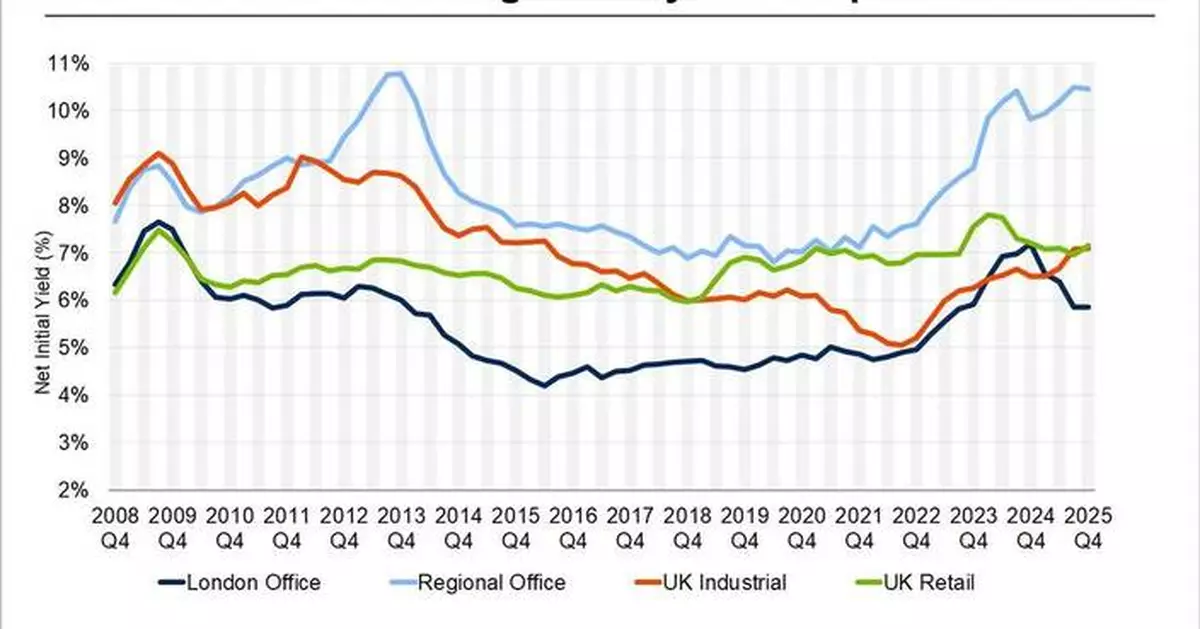
Based on a three-period trailing average, the transaction-based office yield in London decreased by 130 basis points last year, settling at 5.9% at the end of the fourth quarter of 2025.
The average regional yield increased by 70 basis points to 10.5%, marking its highest level since 2013. This widened the yield spread between London and the regions to 460 basis points, the widest in 12 years.
Industrial yields rose to an eight-year high of 7.1%, up 60 basis points since the end of 2024, pushing them to more than 100 basis points above London office yields. Boosted by the online shopping trend, average retail and industrial yields have reached parity for the first time since 2018.
“London’s increasing popularity with investors chimes with data showing a strong rebound in its occupier market,” said Mark Stansfield, senior director of market analytics at CoStar Europe. “The capital was the primary driver of the rebound in national office net absorption in the second half of 2025 and led the way throughout the year.”
“A gap has also opened up between office yields in central London and the central business districts of the ‘Big Six’ regional cities: Birmingham, Bristol, Edinburgh, Glasgow, Leeds and Manchester,” said Stansfield. “Average yields across the two segments stand at 5.4% and 9%, respectively, with the 360-basis-point spread one of the widest on record.”
The full analysis can be found here.
For more information about the company and its products and services, please visit www.costargroup.com.
About CoStar Group
CoStar Group (NASDAQ: CSGP) is a global leader in commercial real estate information, analytics, online marketplaces, and 3D digital twin technology. Founded in 1986, CoStar Group is dedicated to digitizing the world’s real estate, empowering all people to discover properties, insights, and connections that improve their businesses and lives.
CoStar Group’s major brands include CoStar, a leading global provider of commercial real estate data, analytics, and news; LoopNet, the most trafficked commercial real estate marketplace; Apartments.com, the leading platform for apartment rentals; Homes.com, the fastest-growing residential real estate marketplace; and Domain, one of Australia’s leading property marketplaces. CoStar Group’s industry-leading brands also include Matterport, a leading spatial data company whose platform turns buildings into data to make every space more valuable and accessible; STR, a global leader in hospitality data and benchmarking; Ten-X, an online platform for commercial real estate auctions and negotiated bids; and OnTheMarket, a leading residential property portal in the United Kingdom.
CoStar Group’s websites attracted over 139 million average monthly unique visitors in the fourth quarter of 2025, serving clients around the world. Headquartered in Arlington, Virginia, CoStar Group is committed to transforming the real estate industry through innovative technology and comprehensive market intelligence. From time to time, we plan to utilize our corporate website as a channel of distribution for material company information. For more information, visit CoStarGroup.com.
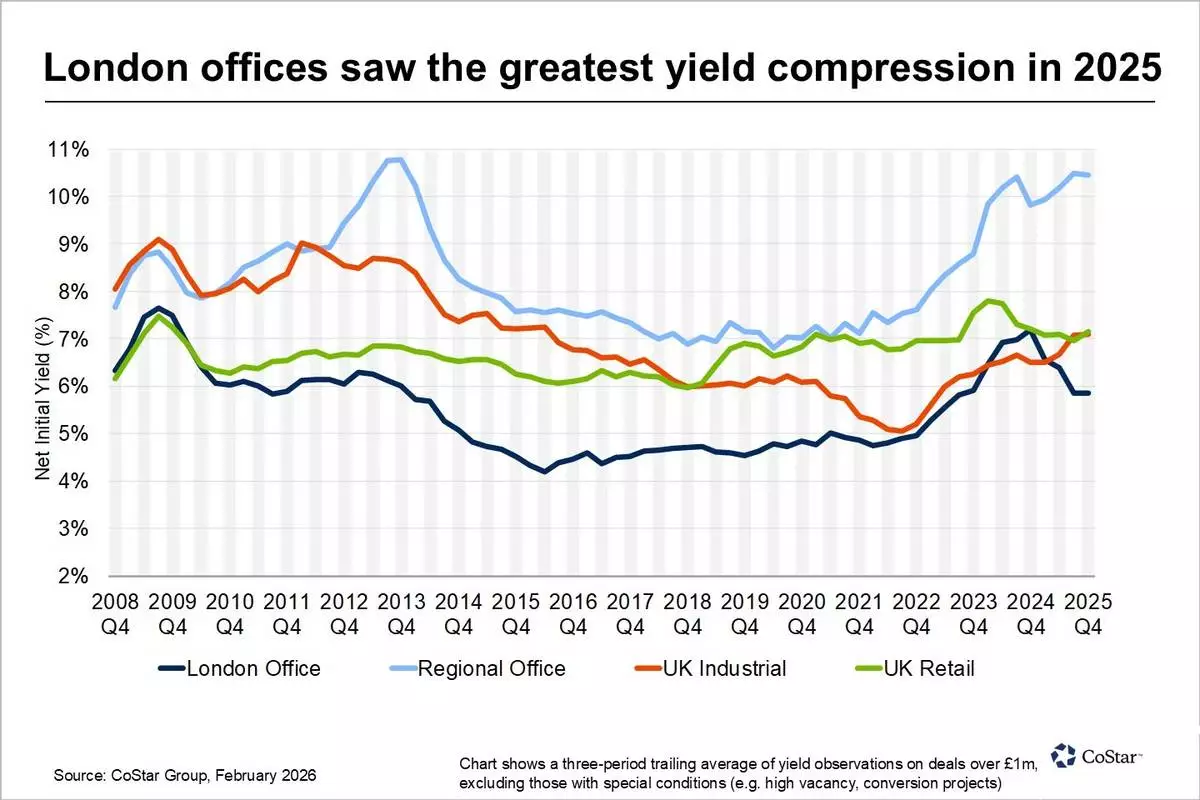
London offices saw the greatest yield compression in 2025
GENEVA (AP) — Iran and the United States prepared to meet Thursday in Geneva for nuclear negotiations viewed as a last chance for diplomacy as America has gathered a fleet of aircraft and warships to the Middle East to pressure Tehran into a deal.
U.S. President Donald Trump wants a deal to constrain Iran’s nuclear program, and he sees an opportunity while the country is struggling at home with growing dissent following nationwide protests last month. Iran meanwhile has maintained it wants to continue to enrich uranium even as its program sits in ruins, following Trump ordering an attack in June on three of the Islamic Republic's nuclear sites, part of a bruising 12-day war last year.
If an American attack happens, Iran has said all U.S. military bases in the Mideast would be considered legitimate targets, putting at risk tens of thousands of American service members. Iran has also threatened to attack Israel, meaning a regional war again could erupt across the Middle East.
“There would be no victory for anybody — it would be a devastating war,” Iranian Foreign Minister Abbas Araghchi told India Today in an interview filmed Wednesday just before he flew to Geneva.
“Since the Americans' bases are scattered through different places in the region, then unfortunately perhaps the whole region would be engaged and be involved, so it is a very terrible scenario.”
Araghchi again will sit across from Steve Witkoff, a billionaire real estate developer and friend of Trump who serves as a special Mideast envoy for the president. The two men held multiple rounds of talks last year that collapsed after Israel launched its war against Iran in June. These latest talks are again being mediated by Oman, a sultanate on the eastern edge of the Arabian Peninsula that's long served as an interlocutor between Iran and the West.
Araghchi met Oman's Foreign Minister Badr al-Busaidi after arriving in Geneva on Wednesday night. The men “reviewed the views and proposals that the Iranian side will present to reach an agreement on the Iranian nuclear program, based on the guiding principles agreed upon in the previous round of negotiations,” a report from the state-run Oman News Agency said. Al-Busaidi will pass on Iran's offer to American officials on Thursday, it added.
An Associated Press journalist saw al-Busaidi after he met with the director-general of the International Atomic Energy Agency, the United Nations' nuclear watchdog. The Omani diplomat flashed a thumbs up to a question about whether he was hopeful for the talks.
Al-Busaidi returned Thursday to the Omani diplomatic residence on the shores of Lake Geneva . A convoy believed to be carrying American diplomats later arrived to the compound. Iran's Foreign Ministry spokesman Esmail Baghaei told Iranian state television that Araghchi would soon leave for the talks.
In this round of negotiations after the June war, Trump has pushed to halt Iran's enrichment of uranium entirely, as well as address Tehran's ballistic missile program and its support of regional militant forces. Iran has maintained the talks must remain focused only on nuclear issues.
U.S. Secretary of State Marco Rubio told reporters Wednesday that Iran is “always trying to rebuild elements” of its nuclear program. He said that Tehran is not enriching uranium right now, “but they’re trying to get to the point where they ultimately can.”
Iran has said it hasn't enriched since June, but it has blocked IAEA inspectors from visiting the sites America bombed. Satellite photos analyzed by The Associated Press also has shown activity at two of those sites, suggesting Iran is trying to assess and potentially recover material there.
The West and the IAEA say Iran had a nuclear weapons program until 2003. Before the June attack, it had been enriching uranium up to 60% purity — a short, technical step away from weapons-grade levels of 90%.
U.S. intelligence agencies assess that Iran has yet to restart a weapons program, but has “undertaken activities that better position it to produce a nuclear device, if it chooses to do so.” While insisting its program is peaceful, Iranian officials have threatened to pursue the bomb in recent years.
“The principle’s very simple: Iran cannot have a nuclear weapon,” U.S. Vice President JD Vance told reporters at the White House on Wednesday.
Vance said Trump is “sending those negotiators to try to address that problem” and “wants to address that problem diplomatically.”
“But, of course, the president has other options as well,” Vance added.
If the talks fail, uncertainty hangs over the timing of any possible attack.
If the aim of potential military action is to pressure Iran to make concessions in nuclear negotiations, it’s not clear whether limited strikes would work. If the goal is to remove Iran’s leaders, that will likely commit the U.S. to a larger, longer military campaign. There has been no public sign of planning for what would come next, including the potential for chaos in Iran.
There is also uncertainty about what any military action could mean for the wider region. Tehran could retaliate against the American-allied nations of the Persian Gulf or Israel. Oil prices have risen in recent days in part due to those concerns, with benchmark Brent crude now about $70 a barrel. Iran in the last round of talks said it briefly halted traffic in the Strait of Hormuz, the narrow mouth of the Persian Gulf through which a fifth of all oil traded passes.
Satellite photos shot Tuesday and Wednesday by Planet Labs PBC and analyzed by the AP appeared to show that American vessels typically docked in Bahrain, the home of the U.S. Navy’s 5th Fleet, were all out at sea. The 5th Fleet referred questions to the U.S. military’s Central Command, which declined to comment. Before Iran’s attack on Qatar in June, the 5th Fleet similarly scattered its ships at sea to protect against a potential attack.
Gambrell reported from Dubai, United Arab Emirates, and Melanie Lidman from Jerusalem. Associated Press writer Will Weissert in Washington contributed to this report.
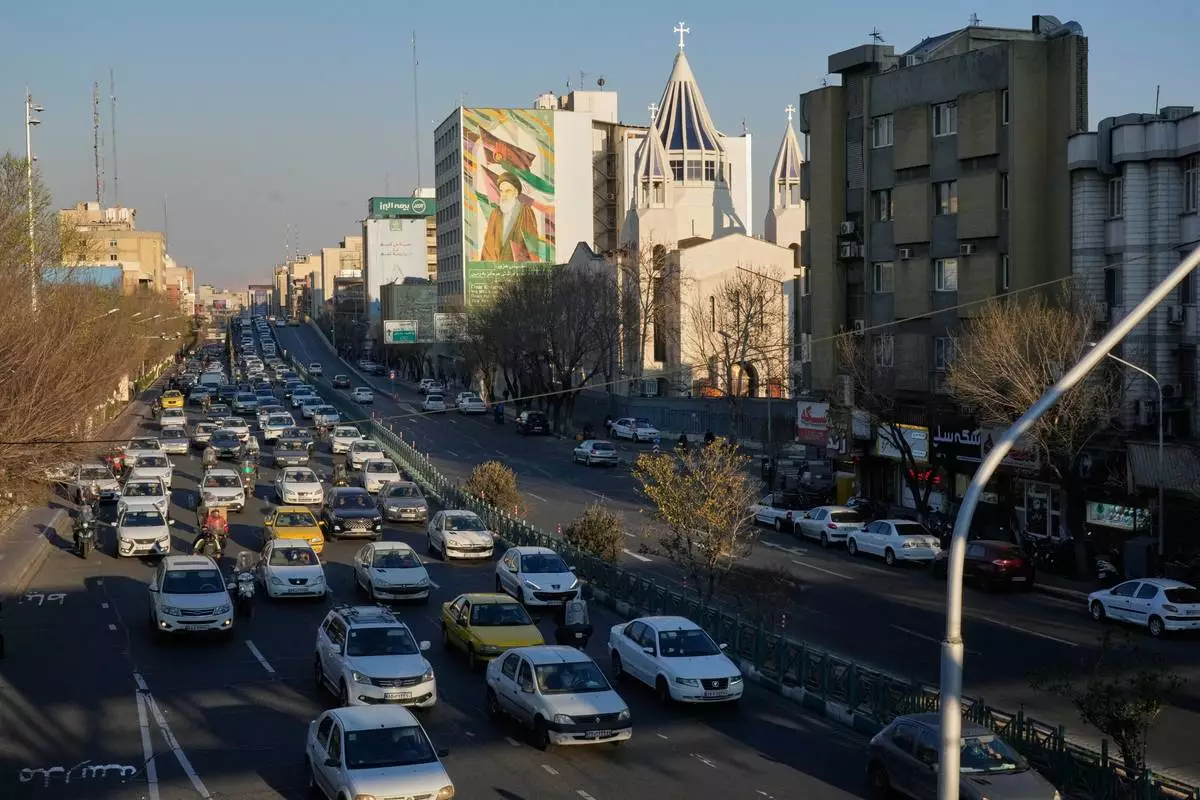
Vehicles drive past the Saint Sarkis church and a painting of the late Iranian revolutionary founder Ayatollah Khomeini in downtown Tehran, Iran, Wednesday, Feb. 25, 2026. (AP Photo/Vahid Salemi)

A woman walks past a painting on the wall of a girls school at Enqelab-e-Eslami, or Islamic Revolution, street in downtown Tehran, Iran, Wednesday, Feb. 25, 2026. (AP Photo/Vahid Salemi)

Commuters drive past Saint Sarkis church and a mural of the late Iranian revolutionary founder Ayatollah Khomeini in downtown Tehran, Iran, Wednesday, Feb. 25, 2026. (AP Photo/Vahid Salemi)