
Skip to Content Facebook Feature Image

Residents want local governments to end contracts that let ICE train on their gun ranges

News

Residents want local governments to end contracts that let ICE train on their gun ranges
News

News

Residents want local governments to end contracts that let ICE train on their gun ranges

2026-02-25 16:04 Last Updated At:16:10

ESCONDIDO, Calif. (AP) — Immigration and Customs Enforcement officers training at a local gun range largely went unnoticed by residents of one Southern California city for more than a decade, until President Donald Trump’s immigration crackdown and the recent fatal shootings of U.S. citizens by federal agents.

The arrangement in Escondido, a city of about 150,000 people north of San Diego surrounded by farms and horse ranches, has sparked weeks of demonstrations. Residents are demanding that the city stop allowing ICE agents to train at the local police department range, reflecting growing discontent across the country with the administration's immigration actions.

More Images
The entrance to the city's firing range is shown on Wednesday, Feb. 18, 2026 in Escondido, Calif. (AP Photo/Amy Taxin)

The entrance to the city's firing range is shown on Wednesday, Feb. 18, 2026 in Escondido, Calif. (AP Photo/Amy Taxin)

A sing advertises an upcoming rally on Wednesday, Feb. 18, 2026 in Escondido, Calif. (AP Photo/Amy Taxin)
A sing advertises an upcoming rally on Wednesday, Feb. 18, 2026 in Escondido, Calif. (AP Photo/Amy Taxin)

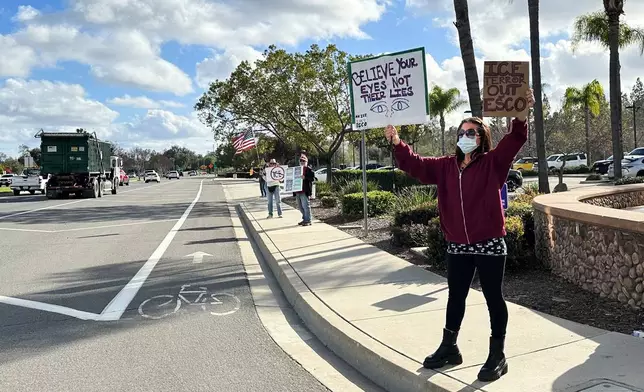
Demonstrators hold signs outside a police station on Wednesday, Feb. 18, 2026 in Escondido, Calif. (AP Photo/Amy Taxin)

Demonstrators hold signs outside a police station on Wednesday, Feb. 18, 2026 in Escondido, Calif. (AP Photo/Amy Taxin)

Motorists drive under a city sign on Wednesday, Feb. 18, 2026 in Escondido, Calif. (AP Photo/Amy Taxin)

Motorists drive under a city sign on Wednesday, Feb. 18, 2026 in Escondido, Calif. (AP Photo/Amy Taxin)

“We don’t want ICE anywhere near Escondido or fraternizing with the police,” said Richard Garner, 71, while rallying against the deal outside the city’s police station.

A majority of Americans in recent polls have said Trump has “gone too far” in sending federal immigration agents into American cities. Beyond the mass street demonstrations in Minneapolis, people in communities from New York to California are objecting to longstanding contracts between ICE and local governments for services ranging from the use of training facilities to parking spaces. The agency has also angered local communities caught off guard by ICE's plans to occupy giant warehouses, some that could house as many as 10,000 immigration detainees.

Amid the debate, funding for the Department of Homeland Security has been put on hold. Democrats are saying they will not help approve more money until new limits are placed on federal immigration operations following the fatal shootings of U.S. citizens Alex Pretti and Renee Good last month in Minneapolis.

Escondido's City Council is scheduled to discuss the contract with ICE at a meeting Wednesday.

Unlike many California cities, Escondido had an especially close alliance with ICE in the past that allowed immigration officers to work at police headquarters and coordinate on vehicle stops. That partnership ended after California passed a law in 2017 limiting such collaboration with immigration officials.

Protesters in Escondido said they were unaware of the contract allowing ICE to train at the gun range in the city's hillsides until advocates found the agreement online. They said they fear word of the deal will make immigrants afraid to report crimes to local police, weakening public safety in a city where Latinos make up about half the population.

Some say they don’t want to give ICE agents a reason to come to their community or lend support to an agency they don't trust will follow U.S. laws. The concern is high, both among immigrants and U.S. citizens who worry about masked federal immigration agents ′ use of deadly force.

Police Capt. Erik Witholt said Escondido provides the space under a deal signed by ICE in 2024 and renewed this year, though ICE has been training at the outdoor range off a winding road outside Escondido’s downtown for more than a decade.

The city will receive $22,500 a year for up to three years under the agreement involving the San Diego branch of ICE’s Homeland Security Investigations, which investigates crimes including human trafficking and drug smuggling.

“We don’t train with them. We don’t train them," Witholt said, adding 22 agencies use the site and each brings its own range master, targets and ammunition.

The Department of Homeland Security, which oversees ICE, did not comment on the backlash and would not confirm locations where its officers train, citing security concerns.

But several of those locations have been brought to light as communities demand an end to such agreements.

In Cottage Grove, Minnesota, 20 miles (32 kilometers) southeast of Minneapolis, Ruth Jones and other residents have been asking the community to end its contract allowing ICE to use its regional training center. But Mayor Myron Bailey said the center was built with state bond funding and is rented out to some 60 law enforcement agencies and other groups, including ICE.

“Contractually we cannot discriminate against any public agency,” Bailey said in a statement.

In Islip, New York, community members urged local officials last year to rescind a longstanding contract to use a rifle range for training, but the local government also kept the deal.

Hartford, Connecticut, has moved to end a contract for ICE employees to use a city-owned parking lot.

Not everyone in Escondido is opposed to the city's contract with ICE. Luke Beckwith, 26, said he feels access to the site should be left up to police.

“I personally don’t care,” Beckwith said. “It’s bringing revenue to the city.”

Edgar, who is from Mexico and asked that his last name be withheld over deportation fears, said barring ICE from the city's gun range will not remove the threat for immigrants like himself.

“If they want to come, they will come,” he said.

The entrance to the city's firing range is shown on Wednesday, Feb. 18, 2026 in Escondido, Calif. (AP Photo/Amy Taxin)

The entrance to the city's firing range is shown on Wednesday, Feb. 18, 2026 in Escondido, Calif. (AP Photo/Amy Taxin)

A sing advertises an upcoming rally on Wednesday, Feb. 18, 2026 in Escondido, Calif. (AP Photo/Amy Taxin)

A sing advertises an upcoming rally on Wednesday, Feb. 18, 2026 in Escondido, Calif. (AP Photo/Amy Taxin)

Demonstrators hold signs outside a police station on Wednesday, Feb. 18, 2026 in Escondido, Calif. (AP Photo/Amy Taxin)

Demonstrators hold signs outside a police station on Wednesday, Feb. 18, 2026 in Escondido, Calif. (AP Photo/Amy Taxin)

Motorists drive under a city sign on Wednesday, Feb. 18, 2026 in Escondido, Calif. (AP Photo/Amy Taxin)

Motorists drive under a city sign on Wednesday, Feb. 18, 2026 in Escondido, Calif. (AP Photo/Amy Taxin)

MEUDON, France--(BUSINESS WIRE)--Feb 25, 2026--

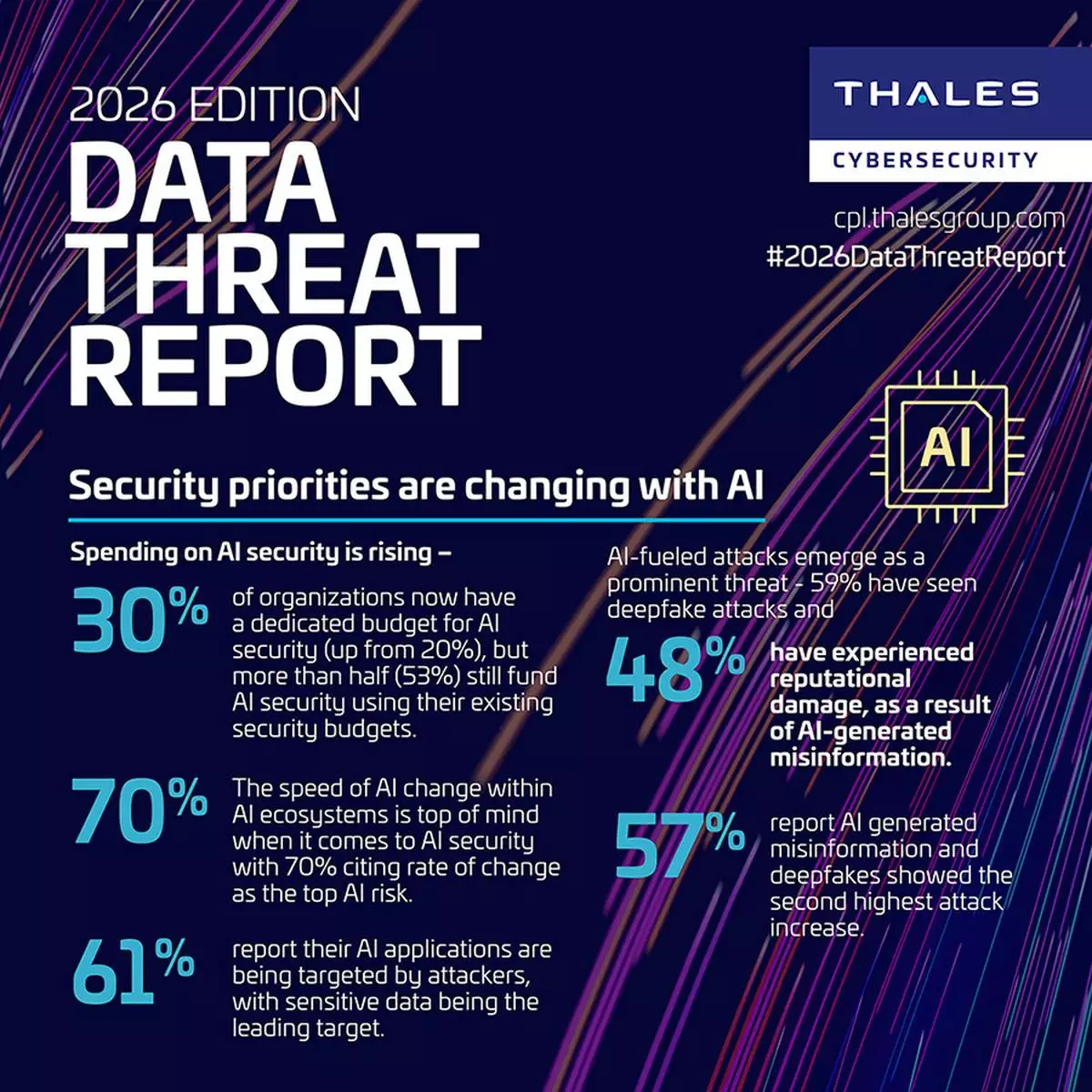
According to the Thales 2026 Data Threat Report, organizations across various markets including automotive, energy, finance and retail say the rapid pace of AI-driven transformation is now their biggest security challenge. Based on the report’s research, conducted by S&P Global 451 Research, 61% cite AI as their top data security risk. The concern is not only about malicious AI, but about the access it is being granted as it shifts from a tool to a trusted insider.

This press release features multimedia. View the full release here: https://www.businesswire.com/news/home/20260225599723/en/

As enterprises embed AI into workflows, analytics, customer service, and development pipelines, these systems are being granted broad, automated access to enterprise data, often with fewer controls than those applied to human users in a corporate environment.

“Insider risk is no longer just about people. It is also about automated systems that have been trusted too quickly,” says Sebastien Cano, Senior Vice President, Cybersecurity Products at Thales. “When identity governance, access policies, or encryption are weak, AI can amplify those weaknesses across corporate environments far faster than any human ever could.”

Visibility Gaps Are Widening as AI Expands Data Reach

The report reveals a troubling disconnect between AI adoption and data control. Only 34% of organizations know where all their data resides, whatever the level of criticality, and just 39% can fully classify it. Meanwhile, nearly half (47%) of sensitive cloud data remains unencrypted.

As AI systems ingest and act on data across cloud and SaaS environments, limited visibility makes enforcing least-privilege access increasingly difficult, that is granting only the strictly necessary access rights. This increases the extent of exposure if credentials are compromised.

Identity infrastructure is now the primary attack surface. Credential theft remains the leading attack technique against cloud management infrastructure, cited by 67% of organizations experiencing cloud attacks. At the same time, 50% rank secrets management among their top application security challenges, reflecting the growing complexity of governing machine identities, API (interfaces de programmation applicative) keys, and tokens at scale.

AI Is Powering More Convincing Attacks

While organizations race to adopt AI, attackers are doing the same. Nearly 60% of companies report experiencing deepfake-driven attacks, and 48% report reputational damage tied to AI-generated misinformation or impersonation campaigns.

As AI introduces new risks, it also increases existing ones. Human error already contributes to 28% of breaches, and with automation layered on top, small mistakes can scale faster and spread wider.

Security Investment Is Shifting, But Not at the Pace of the new Risks

While organizations recognize the need to adapt, investment is not keeping pace with the rapid expansion of AI-driven access and automation. 30% now dedicate specific budgets to AI security, reflecting growing awareness. However, the majority (53%) still depend on traditional security programs built primarily for human users and perimeter-based controls. As machines increasingly authenticate, access, and act autonomously, many security strategies have yet to adjust to this shift in operating models.

“As AI becomes deeply embedded into enterprise operations, continuous data visibility and protection are no longer optional,” said Eric Hanselman, Chief Analyst at S&P Global 451 Research. “Organizations must treat data security strategy as foundational to innovation, not separate from it.” i

Trust Must Evolve as Machines Gain Access

AI is not replacing traditional threats; rather, it is intensifying them by increasing their speed, scale, and reach. As automated systems gain broader access to enterprise data, organizations must rethink identity, encryption, and data visibility as core infrastructure. The organizations that embed strong governance into their AI strategies will be better positioned to innovate securely and avoid turning AI into their newest insider threat.

For more information, please download the full report and join our webinar hosted by Eric Hanselman, Chief Analyst at S&P Global 451 Research .

About Thales

Thales (Euronext Paris: HO) is a global leader in advanced technologies for the Defence, Aerospace, and Cyber & Digital sectors. Its portfolio of innovative products and services addresses several major challenges: sovereignty, security, sustainability and inclusion.

The Group invests more than €4 billion per year in Research & Development in key areas, particularly for critical environments, such as Artificial Intelligence, cybersecurity, quantum and cloud technologies.

Thales has more than 83,000 employees in 68 countries. In 2024, the Group generated sales of €20.6 billion.


©Thales

©Thales

Recommended Articles