Cross‑border travel through the Urumqi Tianshan International Airport in northwest China's Xinjiang Uygur Autonomous Region hit record levels during the just-concluded Spring Festival holiday, with the regional travel hub recording a 124-percent increase over the previous year's festive period.
The airport saw more than 17,000 inbound and outbound travelers passing through during the Spring Festival period, China's biggest annual holiday marking the Chinese New Year -- with peak travel days during the official holiday period from Feb 15 to 23 seeing daily volumes exceed 2,500.
Kazakhstan was the top outbound destination, accounting for 25.7 percent of traffic, followed by Russia at 13.6 percent and Hong Kong at 13.3 percent, highlighting the airport's growing regional connectivity.
Operating around the clock, the airport ensured efficient clearance for over 12,000 Chinese citizens and more than 4,000 foreign nationals.
"As gatekeepers of the nation, we combine firm law enforcement with warm-hearted service. Our mission is to streamline clearance procedures and ensure every traveler's journey is safe, smooth, and heartwarming," said Wang Shuaibin, an official of Urumqi's entry-exit border inspection station.
The Urumqi Tianshan International Airport's passenger and cargo capacities received a major boost when a new terminal began operations in April last year, the latest step as a key part of a major expansion project at the airport which began in 2019.
Last year, the airport served over 1.1 million inbound and outbound passenger trips and 14,000 international and regional flights, both setting records, as the airport added new international routes and received a boost from China's visa-free policies.
This year's Spring Festival, which marks the start of the Year of the Horse, fell on Feb. 17. The 40-day Spring Festival travel rush, also known as 'Chunyun' -- the world's largest annual human migration, during which millions of Chinese journey back to their hometowns to reunite with family or embark on tourism excursions -- runs until March 13

Urumqi airport sees record number of cross-border passengers during Spring Festival holiday
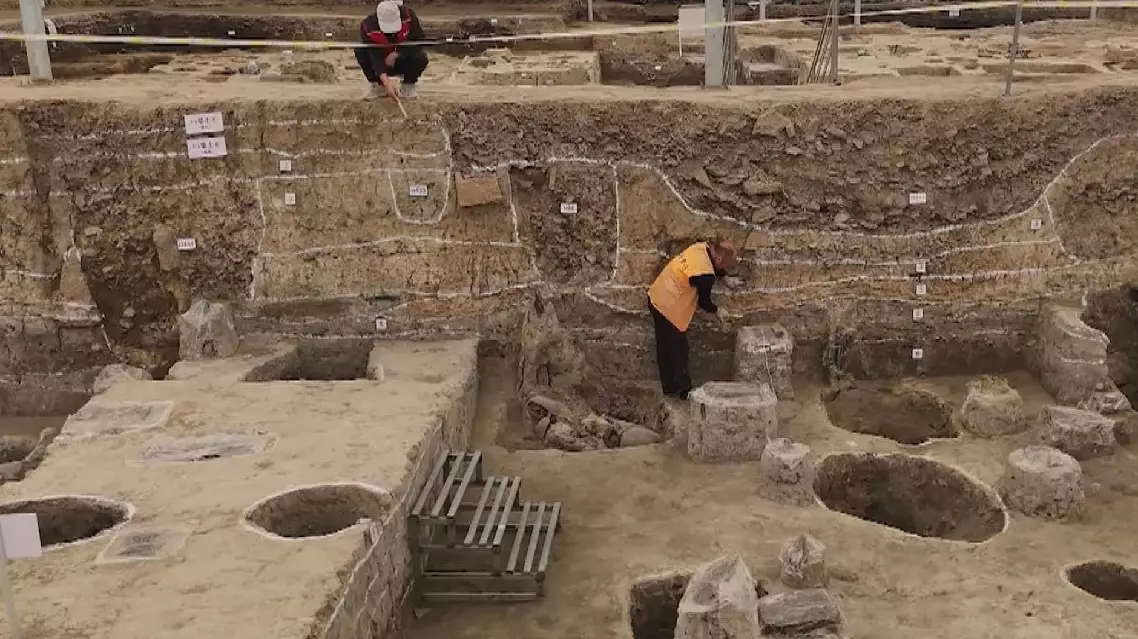
Based on preliminary results released recently, four ancient sites in the Yangtze River Basin have been shortlisted for the final evaluation of China's top 10 archaeological discoveries of 2025.
The four sites span from prehistoric times to the Han Dynasty (202 BC-AD 220) and the Six Dynasties period (222-589). Together, they offer evidence of early human activity as well as remnants of ancient capitals at their peak.
The Chuandong Site is located in Puding County, southwest China's Guizhou Province. Last year, large quantities of artifacts made of stone, bone, and horn were unearthed there, indicating prehistoric human activity dating back more than 55,000 years.
The Shenduntou Site, a typical Zhou Dynasty (1046BC-256BC) copper smelting site in the lower Yangtze River region in east China's Anhui Province, was part of the early Wu Kingdom's official industrial system. It holds great significance for the study of the development of bronze civilization in the Yangtze River basin.
Another shortlisted site, the Jinan City Site, lies in the northern suburbs of Jingzhou City, central China's Hubei Province. Covering an area of approximately 16 square kilometers, it is the largest capital city site from the pre-Qin period (before 221 B.C.) in southern China.
Outside the ancient city, multiple other sites and tombs have been discovered, spanning a total area of over 1,000 square kilometers. The sheer scale of the city ruins and surrounding burial grounds reflect the social landscape of the ancient Chu State at the height of its power.
The final shortlisted site comprises the remains of the capital of the ancient Yue State and the Kuaiji Commandery from the Han to the Six Dynasties period, located in the city of Shaoxing in east China's Zhejiang Province.
This site provides important clues for understanding the layout of the Yue capital and its ritual system. It also offers key evidence for studying the continuity of Chinese civilization and the development of construction techniques in southern China's wetland area.
The unique humid climate and extensive river systems of the Yangtze River Basin have shaped the distinctive cultural character of these sites, reinforcing the view that the Yangtze River Basin is a vital part of the diverse yet unified pattern of Chinese civilization.
Four sites in Yangtze River Basin shortlisted for final evaluation of China's top 10 archaeological discoveries of 2025