Iran’s move to resume international flights after weeks of suspension following U.S. and Israeli strikes signals confidence in the temporary ceasefire, a Chinese Middle East expert told China Global Television Network (CGTN) on Saturday.
Iran's Imam Khomeini International Airport, the country's largest hub, resumed international passenger flights on Saturday, the first time since the war with the United States and Israel began about two months ago.
Wang Jin, director of the Center for Strategic Studies at Northwest University in China, said the reopening of skies serves as a barometer of peace and a sign that stability is beginning to return to the region.
"I think it means that certainty is coming back to this region and the ceasefire actually continues, because when we are talking about the resumption of airplanes, we are talking about the confidence for peace is coming back. We're talking about the stability of the regional situation is coming back. China is one part of the decision. China cannot be alone when all the airplanes are suspended. China cannot be left with the resumption of the airplanes. China is hoping to share with the benefits of the ceasefire. It's good news for not only China, but also good news for everybody," Wang said.
Iran shut down its airspace after joint U.S. and Israeli strikes on Feb. 28, halting civilian aviation nationwide. The country began gradually reopening on April 18, starting with eastern airspace and smaller airports.
Iran’s Civil Aviation Authority has said flight services will return to normal once technical and operational preparations by military and civilian authorities are completed.
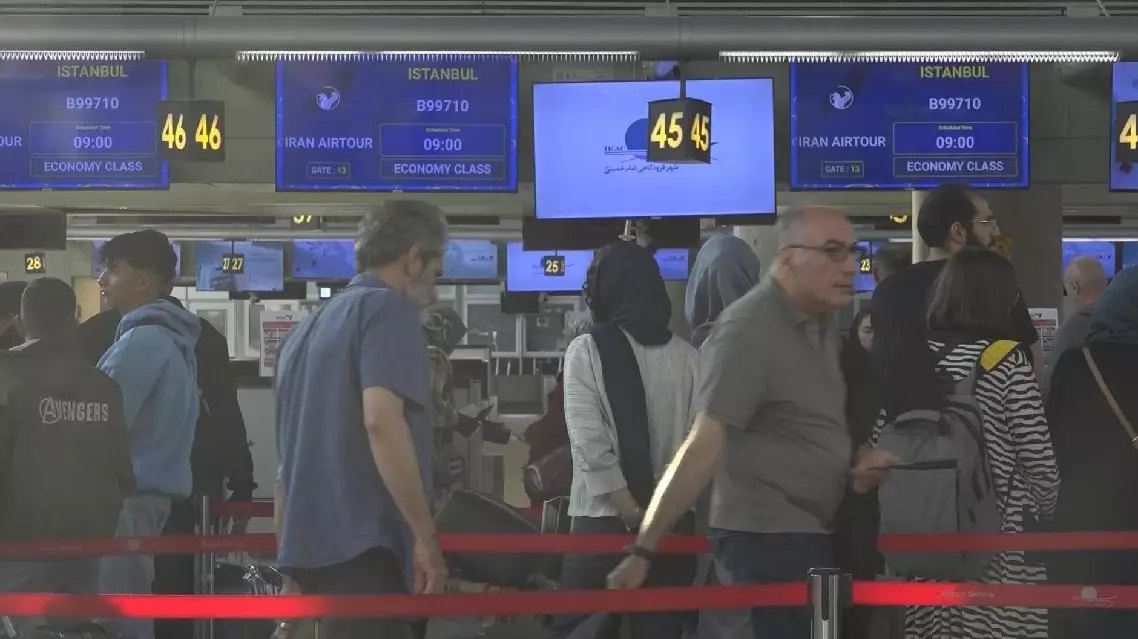
Iran's flight resumption signals confidence in ceasefire: expert
Multiple Chinese tech companies, including Tencent, DeepSeek, Moonshot AI, and MiniMax, have rapidly rolled out iterative upgrades to their open-source large language models (LLMs), positioning themselves as core suppliers and a key driving force for the global open-source AI ecosystem.
Tencent's open-sourced Hunyuan model has significantly reduced AI inference and deployment costs, enabling small and medium-sized enterprises to build customized AI applications without substantial investment.
DeepSeek just released and open-sourced its highly anticipated V4 model, which shows strong performance in programming, world knowledge, and logical reasoning. The new model's Pro edition matches the best open-source models in agentic coding and significantly leads in general knowledge, second only to the closed-source Gemini 3.1 Pro, according to the tech startup based in Hangzhou City, east China's Zhejiang Province.
The Beijing-based Moonshot AI's Kimi model introduces advanced task decomposition, allowing multiple AI agents to collaborate on complex workflows, making it particularly suited for demanding industrial scenarios.
The Shanghai-based MiniMax has achieved notable breakthroughs in code generation and program comprehension, strengthening its utility for software development.
"Open-source routes represented by DeepSeek's V4 model lower enterprise adoption costs, expand the developer ecosystem, and enhance supply chain autonomy. Open-source large language models will accelerate the transition of AI from standalone tools to foundational industrial infrastructure," said Zhong Xinlong, associate researcher at the Future Industry Research Center of the China Center for Information Industry Development.
These domestic advances are also gaining international traction. According to the Open Source AI: Spring 2026 report published by Hugging Face, the world's largest open-source AI community, Chinese-developed models accounted for about 41 percent of LLM downloads on its platform over the past year.
The report identifies China as one of the most active and fastest-growing regions for open-source AI models globally.
Chinese open-source LLMs undergo rapid iteration, driving global AI development