Facilitated by favorable nation-level policies and strategies, Chinese businesses are working to promote large-scale commercialization of humanoids, propelling humanoid robots out of laboratories and into factories, family homes and classrooms.
Since embodied intelligence was highlighted in China's 2025 Government Work Report as a new engine of economic growth, humanoid robots have been flexing their skills for years, running marathons, fighting close-range battles, and performing stunts on television.
Beyond their position as a technology spectacle, humanoids are clocking in for real jobs in China, and robot data centers are providing them their compulsory trainings.
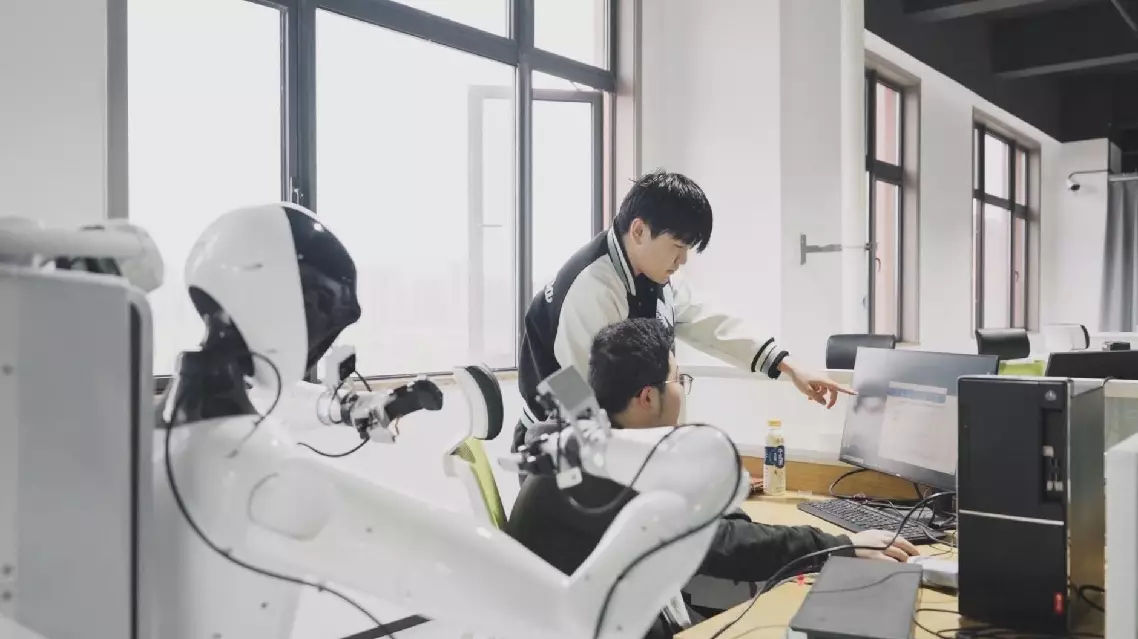
One of the robot schools is the data factory of Agibot, one of China's major humanoid producers, in Shanghai. Resembling a miniature "human world," trainers are teaching robots all kinds of daily and professional tasks, and it's open sourced. The data generated here can be used by many other companies to train their own robots.
Nearly 1,000 humanoids are learning their tricks here every day. By guiding each motion of the robots, human trainers are generating what the engineers call the "expert data" for the robots to master their skills.
"I think that data, hardware and algorithms improve together in a positive spiral. The more data we have, the better our models and algorithms will be. In this way, we will have better means to enable the entire community of developers to make greater contributions, and to enable the overall technological development of the community to become faster," said Wang Sukai, an algorithm expert from Agibot.
Their open approach is paying off. Global shipments of humanoid robots surged to around 18,000 units in 2025, more than five times the figure from the year before, with Chinese firms dominating the market. Agibot alone shipped over 5,100 units last year, which is nearly 40 percent of the global total.
"China now has an 'engineer dividend' built upon the 'dividend of human resources'. Our teams bring strong innovation experience from making smart vehicles, drones, laser radars and more. We also benefit from very remarkable advantages in terms of a complete industrial chain. The sensor ecosystems from EV, sensor, and computing power can be recalibrated for robotics. We get rent discounts and talent subsidies, too. And finally, our customers joined us early, and we are now experiencing rapid growth with more stable products," said Wang Chuang, president of Agibot General Business Division.
And as demand grows, schools are rethinking what they teach. In Shanghai, vocational schools are introducing robotic engineering programs.
"At the national level, AI education is being promoted with great efforts. Exposing human resources early to embodied intelligence gives them a deeper understanding and stronger ability to apply it later on," said Yin Hua, principal of Shanghai Fengxian Secondary Vocational School.
Regarding the widespread concerns on unemployment, analysts argue that AI and robots are not exterminating jobs, but facilitates a technology up-skilling.
"We are designing these robots to address a fundamental challenge within the human society. We are having smaller families. We are having lesser young folks that can be dedicated to sort of a heavy blue-collar jobs. As long as we have sufficient coverage from a policy standpoint, from an up-skilling standpoint. And we are already seeing some enterprises very keen to train up their existing workforces. We are on a right track," said Su Lian Jye, chief AI analyst of technology research and advisory group Omdia.
Chinese companies seek to propel humanoids into factories, homes