The landmark China-Laos Railway continues to serve as a vital bridge between the two countries, playing a crucial role in not only transporting passengers and freight along its route, but also transforming regional economies and reinvigorating daily life while generating new cross-border momentum.
Stretching over 1,000 kilometers from Kunming in southwest China's Yunnan Province to the Lao capital of Vientiane, the railway became operational in December 2021. Since then it has carried out over 90,000 passenger train trips and transported more than 66 million passengers as of February this year. As China charts its next stage of development, enhancing connectivity is emerging as a powerful engine of growth for the country and the wider region.
During the recent Spring Festival holiday period -- the largest annual holiday marking the start of the Chinese New Year -- the railway saw a sharp rise in international visitors eager to experience China's most important traditional celebration.
For Khampilom Vannaphone, a Lao student based in China, the railway represents far more than just a line on the map. He views it as an essential lifeline linking his studies abroad with the place he calls home.
"When I go home for the holidays, I take the China-Laos Railway. And each time, I can see how fast my hometown is developing, with more Chinese tourists visiting," he said.
Beyond passengers, the railway is also facilitating trade flows and injecting fresh momentum into the economies of the border areas.
Through this transport corridor, Chinese products are able to directly reach Southeast Asian markets more efficiently than ever before, while agricultural produce going in the other direction is also gaining popularity within China.
For instance, imports of tropical fruits, especially durians, have surged, driven by robust consumer demand, while logistics companies also hail the importance of being able to easily transport temperature-sensitive or time-sensitive goods, such as those in the cold chain sector, via the rail.
"Rail transport is stable and highly efficient especially for cold chains. Using the Lancang-Mekong Express Line of the China-Laos Railway, it takes about 26 hours to transport the goods from Thailand to Kunming. This year, we expect the transport volume to increase significantly compared to last year," said Lei Wenwu, deputy general manager of the Yunnan Datai International Trade Company.
The railway is also helping build a stronger connection between people.
A vocational school in Mengla County of the Xishuangbanna Dai Autonomous Prefecture has become a popular destination for Lao students, with over 800 Lao youths now studying there.
"Before the railway began operating, most of our Lao students came from just a few northern provinces near China. Today, we welcome students from all 18 provinces across the country, including the capital, Vientiane," said Zhou Bo, the school's principal.
As China and Laos mark the 65th anniversary of diplomatic relations this year, such connectivity is expected to unlock even greater regional potential, as officials eye up even more areas for cooperation.
"Guided by the vision of building a China-Laos community with a shared future, we aim to further promote tourism, deepen economic exchanges, expand port opening and enhance people-to-people exchanges," said Pongdong Paxaphacdy, Consul General of Laos in Kunming.
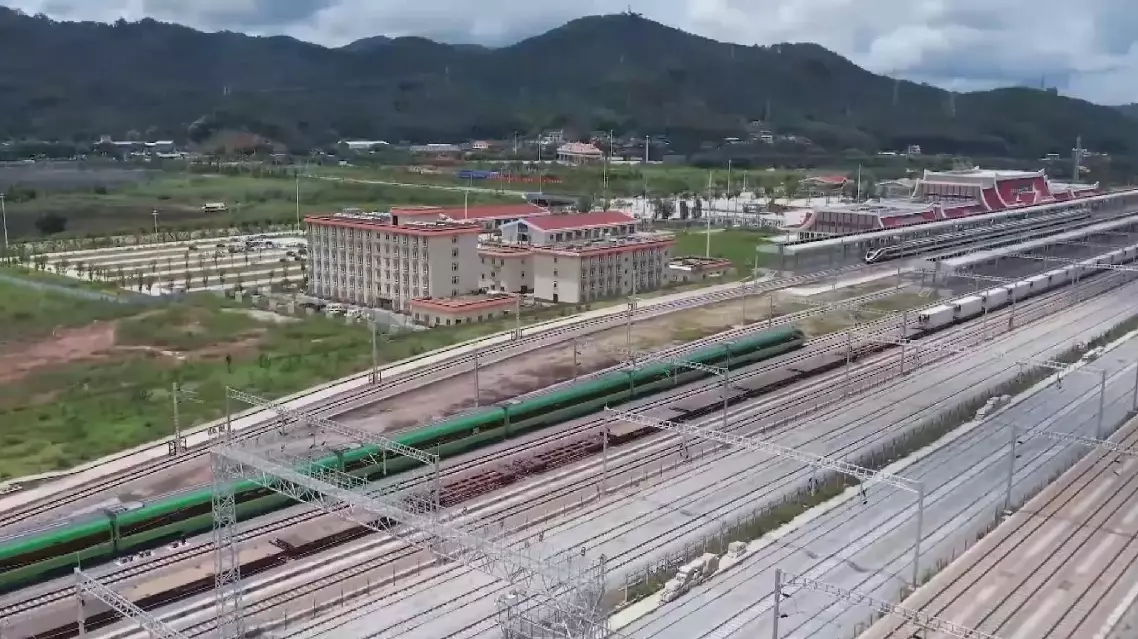
China-Laos Railway lays tracks for cross-border exchanges, boosts regional economy