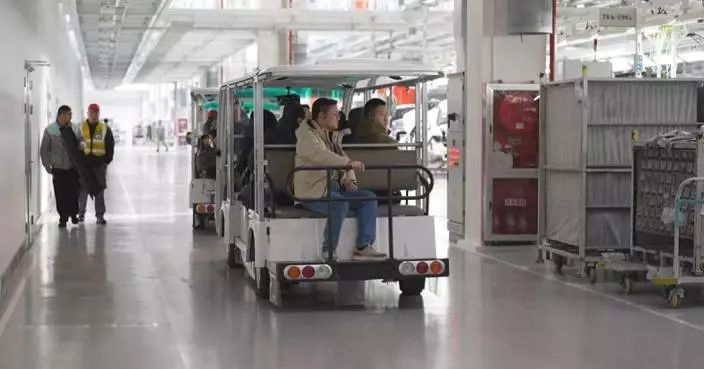
Millions of Chinese are returning to work after the nine-day Spring Festival holiday that ended on Monday, and their return journeys are making a new peak in the festival travel rush.
The festival travel rush, also referred to as chunyun, is often described as the world's largest annual human migration. The 40-day travel period runs from Feb. 2 to March 13 this year.
To ensure the vast group of migrant workers return to their destination cities smoothly and efficiently, local authorities across China have offered various convenient services.
In Guyuan City, northwest China's Ningxia Hui Autonomous Region, a point-to-point transport service has picked up local workers from their homes and shuttled them directly to their destinations, with services even extending to dropping them off at their company gates.
On Wednesday, 101 migrant workers from Guyuan flew on a charter flight arranged by the municipal government to Fujian in east China, their host province. On the same day, over 300 workers from Xiji, Pengyang and other counties embarked on cross-province journeys by government-chartered buses for them to return to their posts.
"This is my fifth year working away from my hometown. The salary and benefits are satisfying. My local government coordinated with the factory in advance, and they arranged to pick us up. It's quite gratifying," said An Shuang, a migrant worker.
Shenzhen, one of China's most popular recipient cities for migrant workers, is seeing a massive influx of people returning to their jobs.
On Tuesday, the G2137 train from Tongren City, southwest China's Guizhou Province, arrived safely at Shenzhenbei Railway Station, carrying 289 workers back to the city. In the coming days, Shenzhen will operate 126 more point-to-point chartered trains and buses to transport over 6,000 migrant workers back to their work posts.
"Every year after the Spring Festival holiday, we want to get back to work, like me. I'm already a day late. But having this charter train really makes things much more convenient," said a migrant worker surnamed Gong.
While efforts to transport migrant workers are in full swing, post-Spring Festival recruitment campaigns are also heating up.
Ganzhou City of east China's Jiangxi Province has organized a large job fair, attracting 412 companies offering over 21,000 positions in electronics, textiles and garments, new energy, and services. Counties like Anyuan, Yudu, Shicheng, and Dayu of the province have also hosted various employment promotion events.
"I've checked out quite a few companies. I graduated in another city, but I want to find a job in my hometown. This time, I saw that there are many positions available," said Ouyang Yilin, a job seeker.
"I used to think opportunities were better elsewhere, but after looking around today, I realized the workshops in our county's enterprises are more advanced than what I imagined and the dorms are more comfortable than rented rooms. The key thing is it's close to home, so I can take care of the elderly and kids. I really hope I can find a good job in my hometown and stay here," said Ye Shuping, another job seeker.
To help companies and job seekers connect more efficiently, the Taizhou municipal government in east China's Jiangsu Province has sent professionals into enterprises to promote positions via live-streaming.
A company in Taizhou City’s Jiangyan District was in want of 150 workers, and the gap seemed tough to fill in quickly. The local government stepped in and sent a professional livestreaming team to help with recruitment. The result was a huge success: the live broadcast drew a total of 18,000 views and helped the company find enough workers soon.
"Our factory was short of fitters and welders. We reported this to the government departments, and they organized a livestreaming recruitment drive for us. Soon we hired people we wanted," said Liu Hua, an office director of the company.
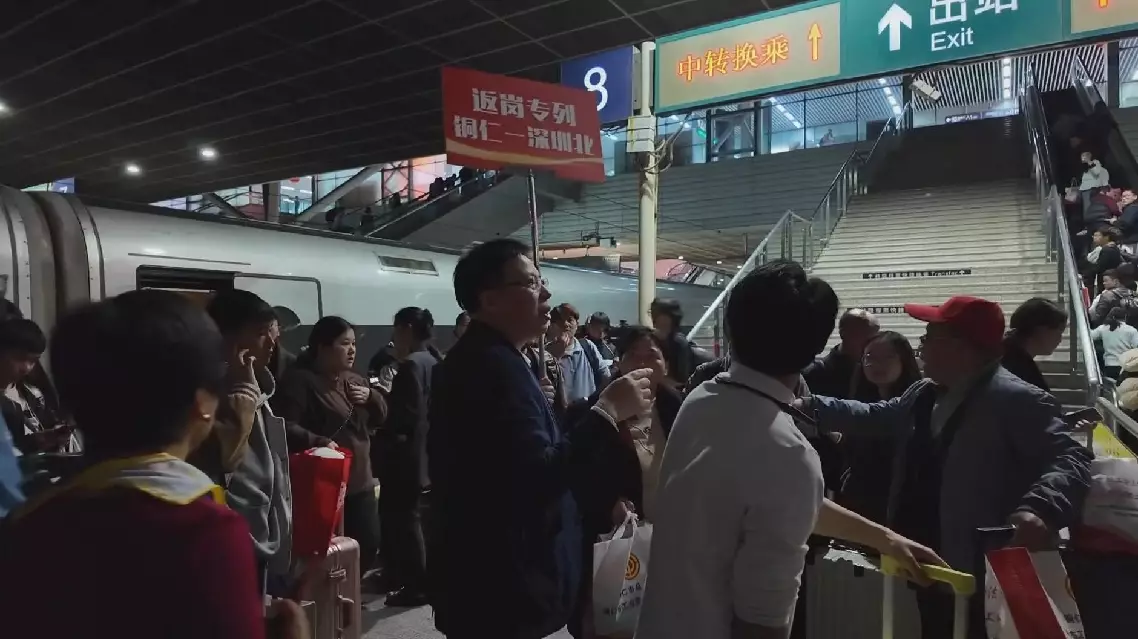
Migrant workers return to work after Spring Festival