WASHINGTON (AP) — Election-year legislation to impose strict new proof-of-citizenship requirements on voting appears stalled in the Senate, for now, despite President Donald Trump’s call in his State of the Union speech that Republicans in Congress pass the bill “before anything else.”
Trump’s push for the bill, backed by House conservatives and his most loyal supporters ahead of the midterm elections, has put new pressure on Senate Majority Leader John Thune as he tries to navigate an effort from inside and outside Congress to bypass normal Senate procedure. Thune has said he supports the legislation and that his GOP conference is still discussing how to pass it.
Senate Republicans “aren’t unified on an approach,” Thune said on Wednesday after Trump's speech.
In an effort to get around Democratic opposition, Trump and others have pushed a so-called “talking filibuster,” which would bring the Senate back to the days of the movie “Mr. Smith Goes to Washington,” when senators talked indefinitely to block legislation. Today, the Senate mostly skips the speeches and votes to end debate, which takes 60 votes in the Senate where Republicans have a 53-47 majority.
Republicans wouldn’t have to change the rules to force a talkathon. They could simply keep the Senate open and make Democrats deliver speeches for days or weeks to delay taking up the legislation. But Thune would still need enough support from his caucus to move forward with that approach, and he said this week that “we aren’t there yet.”
The tension has put the affable, well-liked Thune in a tough spot with Trump and many of his voters who argue that the legislation is necessary for a GOP victory in the midterm elections. Trump has already made clear that he will blame Democrats, and potentially Thune, if they lose their majorities in Congress in November — even though Republicans won control of Congress and the White House in 2024 without the bill's requirements.
Democrats oppose the bill because “they want to cheat,” Trump claimed in his speech on Tuesday.
“We have to stop it, John,” Trump said, calling out Thune by name.
Trump and his supporters, including Utah Sen. Mike Lee, say the talking filibuster would allow them to pass the legislation — called the Safeguard American Voter Eligibility, or SAVE America Act — without any Democratic votes. But the maneuver could end up creating more problems for Republicans.
Under a talking filibuster, Democrats would have to stay on the floor and give speeches for an indefinite amount of time to block the bill. Each senator is only allowed two speeches on a particular piece of legislation, so the idea is that Democrats would eventually run out of speeches or quit due to exhaustion, allowing Republicans to proceed with a simple majority vote.
“We won’t pass the SAVE America Act unless we start by making filibustering senators speak,” Lee said on social media. "This will take time and effort, but we’d be crazy not to give it the effort it deserves.”
The reality on the floor would be more complicated. Democrats would be able to throw up procedural roadblocks, including restarting the clock for speeches if enough Republicans weren’t also present on the floor. That means nearly all 53 Republicans would need to remain close to the Senate during the filibuster, while only one Democrat would have to keep speaking. The process could last for weeks, given that there are 47 Democrats in the Senate.
Even if Republicans managed to break the first filibuster, Democrats could then offer an unlimited number of amendments on anything they wish, forcing Republicans to take hard votes in an election year and potentially adding some of their own priorities to the legislation if they have some bipartisan support. Each amendment would bring a new round of speeches as well.
“We’d have to have 50 to defeat every amendment,” Thune said. “And that’s not a where we are right now.”
As Thune has discussed the possibility with his conference in recent weeks, some Republicans have expressed worry that the process could lead to rules changes that could lead the Senate to “go nuclear” and eventually vote to erode the legislative filibuster.
Most Senate Republicans have said they do not want to lower the 60-vote threshold for ending debate on legislation, even though it has been lowered for presidential and judicial nominations.
“I agree with the SAVE Act,” Sen. Thom Tillis of North Carolina said after Trump’s speech. “But I’m not going to nuke the filibuster.”
Sen. John Curtis, R-Utah, said that “the reason or method doesn’t matter — it’s breaking the filibuster.”
Other Republicans could also block the process. Republican Sen. Lisa Murkowski of Alaska has said she opposes the SAVE Act, and Kentucky Sen. Mitch McConnell, the former GOP majority leader, has opposed similar legislation in the past.
GOP senators who support the maneuver were also realistic about the difficulty of the talking filibuster approach.
“You’d have to have a deep commitment among almost all of our members,” said Missouri Sen. Eric Schmitt, who supports it.
Sen. Rick Scott, R-Fla., called it “hard but doable.”
The voting bill would require Americans to prove they are citizens when they register to vote, mostly through a valid U.S. passport or birth certificate. It would also require a valid photo identification before voters can cast ballots, which some states already demand. The House approved it earlier this month on a mostly party-line vote, 218-213.
Republicans said the legislation is needed to prevent voter fraud, but Democrats warn it will disenfranchise millions of Americans by making it harder to vote. Voting experts have warned that more than 20 million U.S. citizens of voting age do not have proof of their citizenship readily available, and almost half of Americans do not have a U.S. passport. Critics also said the bill’s enactment could cause chaos in this year’s elections and confuse voters because some of it would take effect immediately.
Federal law already requires that voters in national elections be U.S. citizens, but there’s no requirement to provide documentary proof when registering, though they do affirm under oath at the risk of prosecution that they are eligible.
Experts said voter fraud is extremely rare, and very few noncitizens ever slip through the cracks. About one in 10 Americans doesn’t have readily available paperwork proving they are citizens.
The legislation also would require states to share their voter information with the Department of Homeland Security as a way to verify the citizenship of the names on the voter rolls. That has drawn pushback from elections officials, including some Republicans, as potentially intrusive on people’s privacy.
Trump said in his speech on Tuesday that the bill would be “country-saving.”
Echoing his false claims of voter fraud when he lost the 2020 election, Trump said that Democrats “want to cheat, they have cheated, and their policy is so bad that the only way they can get elected is to cheat.”
Associated Press writers Lisa Mascaro and Matt Brown in Washington contributed to this report.
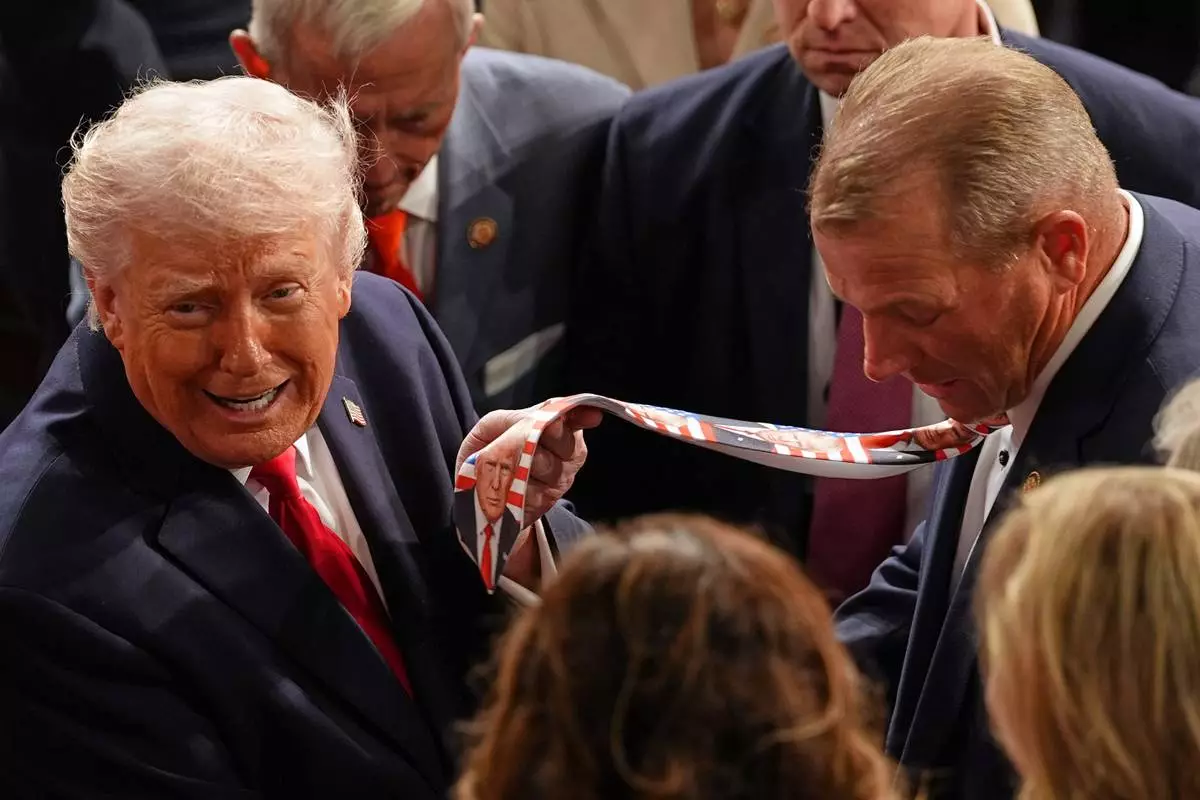
FILE - President Donald Trump holds up a tie designed with his face, worn by Rep. Troy Nehls, R-Texas, as he exits the House chamber after delivering the State of the Union address at the U.S. Capitol in Washington, Feb. 24, 2026. (AP Photo/Matt Rourke, File)
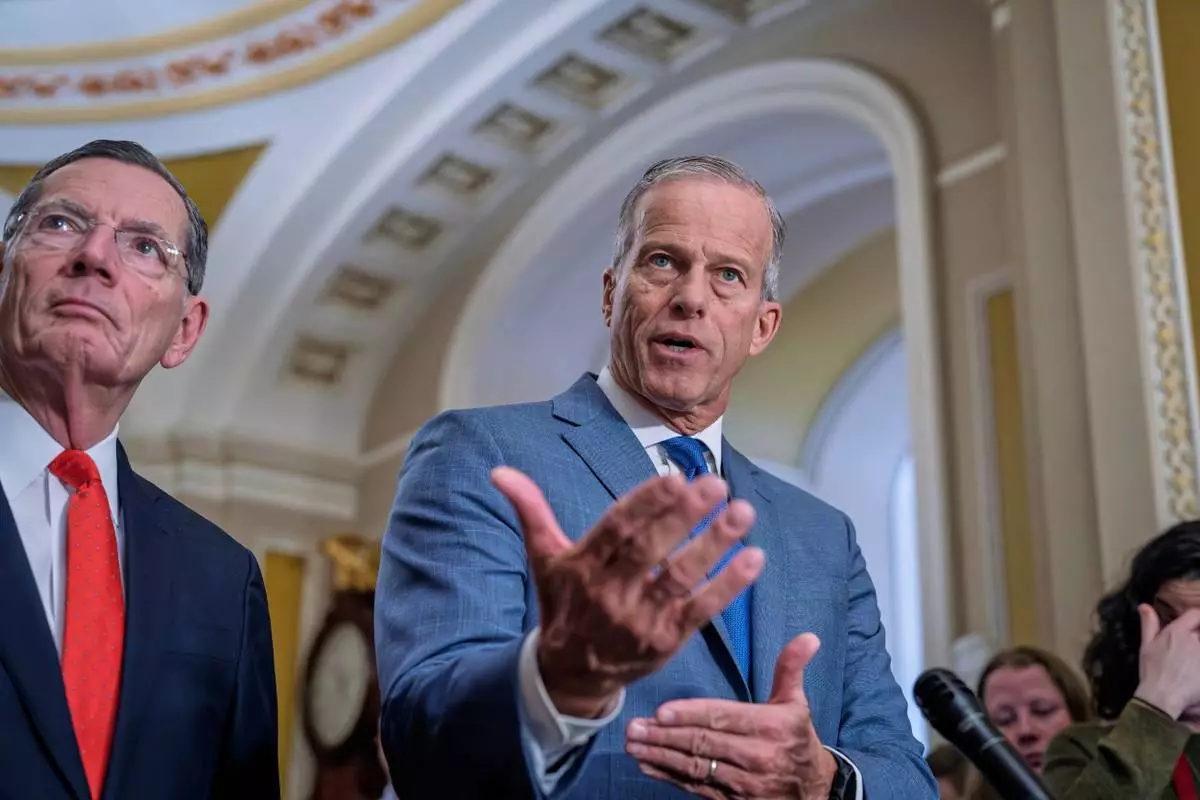
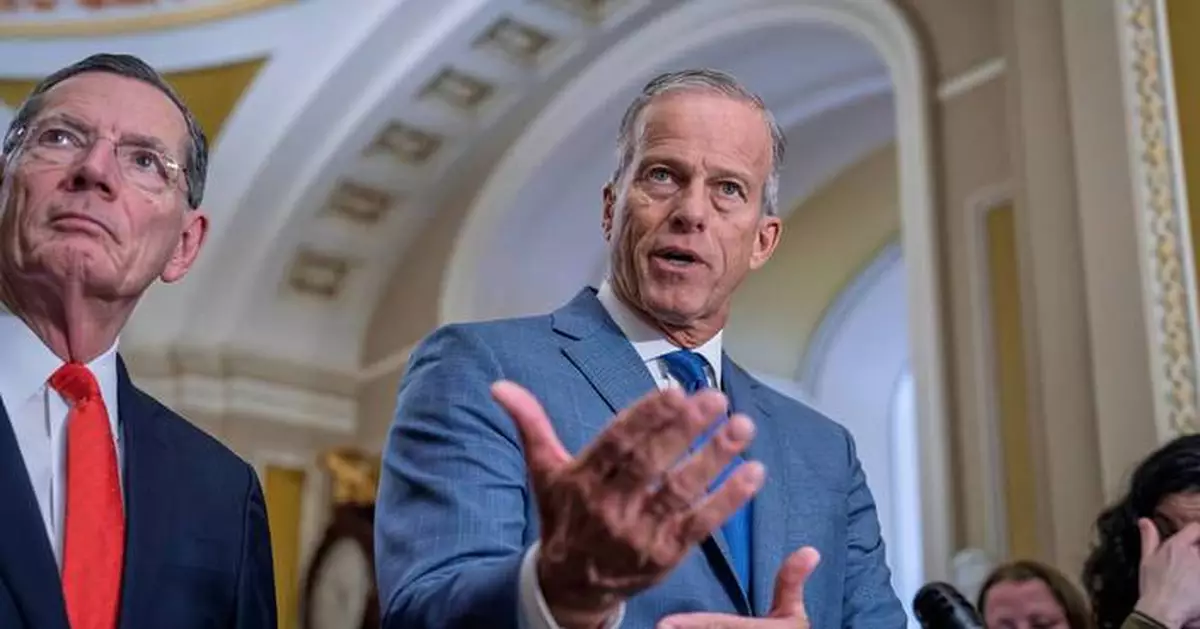
Senate Majority Leader John Thune, R-S.D., joined at left by Sen. John Barrasso, R-Wyo., the GOP whip, reflects on President Donald Trump's State of the Union address as he meets with reporters at the Capitol in Washington, Wednesday, Feb. 25, 2026. (AP Photo/J. Scott Applewhite)