China has delivered more than 100 million government-backed vocational training opportunities in the past five years, in a nationwide push aimed at bolstering employment and economic stability.
A notable example comes from south China's Guangdong Province, where a vocational program called Cantonese Cuisine Chefs is making a difference. Chen Jian, Shunde Master Chef 2024, spent two decades in the tourism industry before the program redirected his path, today he runs his own private kitchen.
Trained in Shunde, a district of Foshan widely regarded as the cradle of Cantonese cuisine, he is part of a thriving food industry that employs around 100,000 people and is celebrated for its iconic dishes and award-winning chefs.
"The tourism downturn pushed me to change careers. Traveling also made me fall in love with Cantonese food. This program connected me with mentors who taught me everything: how to cook, choose ingredients, and even how to run a business," said Chen.
Chen's mentor Sun Yongkang has dedicated over 40 years to teaching hundreds of students and is now eager to expand training to rural regions.
"The trainings are free, and the government also gives them a stipend. The catering industry helps boost the national economy, promote consumption, and even drive the development of agricultural production and industrialization," said Sun, master of Chinese culinary arts.
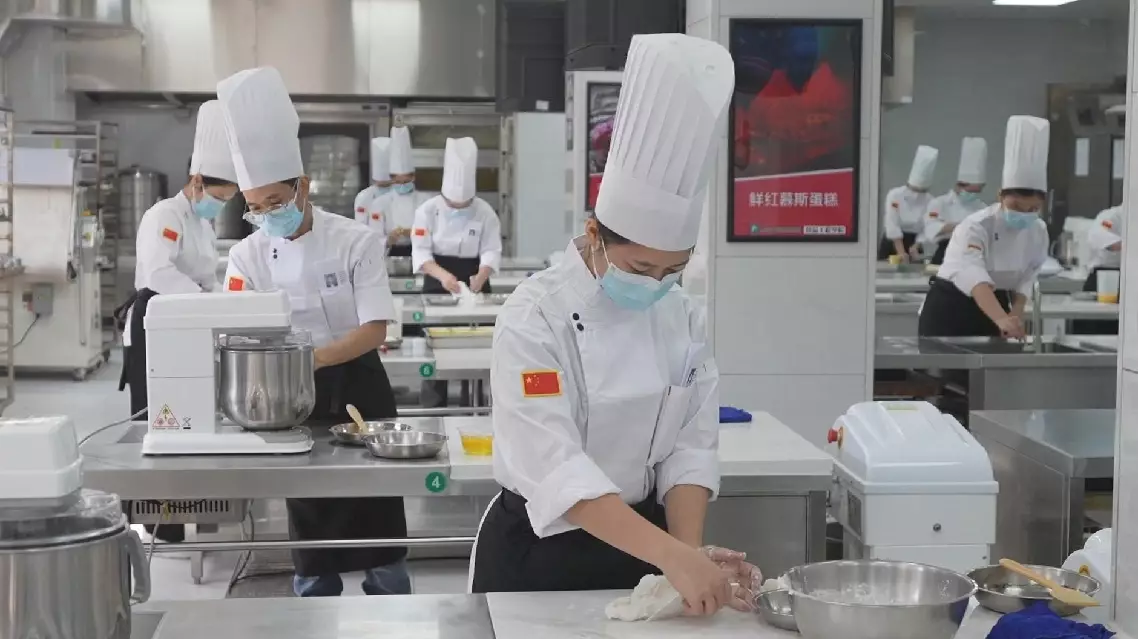
Meanwhile, Chinese pastries, from dim sum staples to festival desserts, anchor a global industry worth more than 11 billion U.S. dollars annually, with standardized certification exams now essential to ensure training aligns with real-world hiring needs.
"I must master the timing and technique. It's quite challenging. However, getting this certificate will improve my job prospects," said He Shaoling, a vocational college student.
Since 2021, over 25,000 chefs have been certified through this process. The program's influence has already gone global, with the same exams now offered in Australia and Thailand.
"From frozen pastry to industrial food production, we need skilled workers. In regions with large Chinese communities, our Cantonese cuisine standards are used for certification," Zhou Famao, president of the Guangdong Catering Technicians Association.
Over the past five years, China has created over 60 million new urban jobs and provided close to 100 million skill-training opportunities. The Cantonese Cuisine Chef Program alone has supported roughly one million jobs and new business ventures.
Looking ahead, China's next Five-Year Plan (2026-2030) aims to ramp up support for start-ups and create jobs in emerging sectors from the digital economy and advanced manufacturing to modern services. Skills training will become more targeted, with added support for disadvantaged groups, ultimately building a more inclusive and dynamic labor market for all.
China delivers over 100 mln vocational training opportunities to bolster jobs, stability