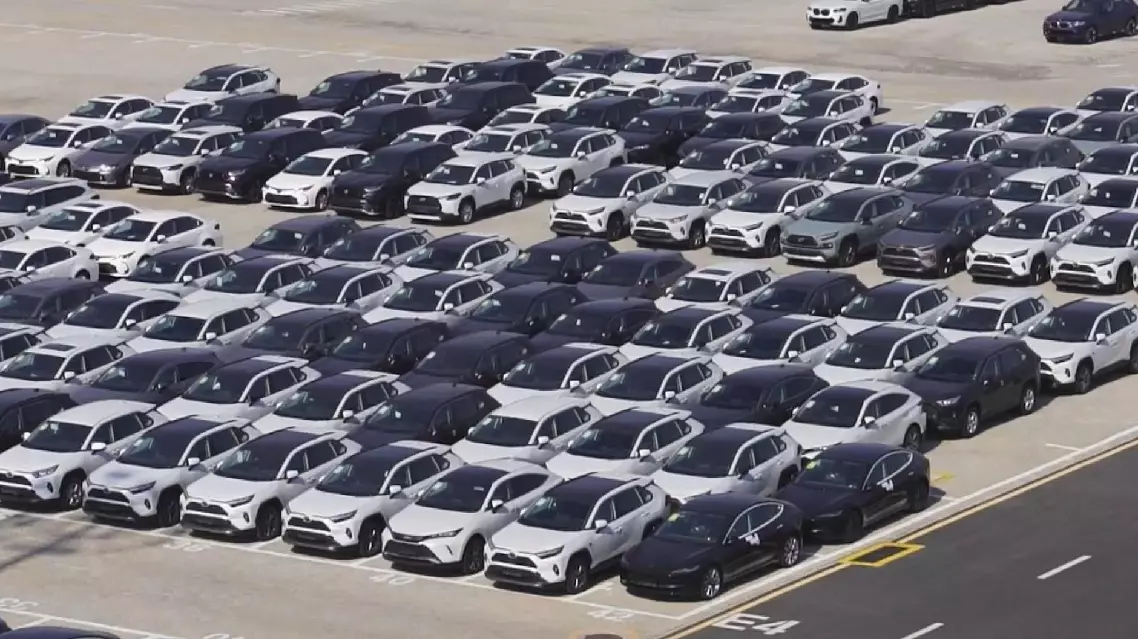
German automotive giants are moving to expand long-term cooperation with China, as the country's automotive industry has reached new milestones in global exports and technological innovation over recent years.
Ties between China and Germany have been in the spotlight since German Chancellor Friedrich Merz arrived in Beijing on Wednesday for a two-day official visit to China -- the first of its kind since Merz took office in May 2025. The entourage accompanying Merz on the China visit included top executives from Volkswagen, Mercedes-Benz, and BMW, who signaled their companies' intention to deepen collaboration with China.
During the visit, Merz test-rode a new Mercedes-Benz S-Class featuring an intelligent driving system developed by a Chinese tech firm. Following the demonstration, Mercedes-Benz signed an upgraded Strategic Cooperation Memorandum of Understanding (MOU) to deepen its partnership with this Chinese company.
The spirit of cooperation extended across the sector, with BMW and China's CATL signing an MOU to drive supply chain decarbonization. Volkswagen also reaffirmed that China has evolved into a global core innovation hub, noting that success in the Chinese market is now fundamental to global competitiveness.
"This is not a coincidence, but a result of the combined effect of the global economic landscape, China's comprehensive strengths, and the development needs of all countries. It reflects both the global attraction of the Chinese market and the inevitable trend of win-win outcome in international economic and trade cooperation," said Li Shaohua, deputy secretary-general of the China Association of Automobile Manufacturers (CAAM).
As German firms root deeper in China, Chinese automotive brands and tech providers are finding fresh momentum on the world stage. In 2025, China's auto exports exceeded 7 million units, reaching a new high in export scale. In 2026, the overseas expansion of China's automobile industry is set to embrace fresh opportunities.
Cao Xudong, CEO of the Chinese AI tech firm Momenta said that Mercedes‑Benz became the first international automaker to invest in Momenta. Over the years, its business has maintained an average annual growth rate of more than 80 percent, and it is also emerging as a new highlight in overseas markets.
"Take Mercedes-Benz as an example. Our cooperation with Mercedes-Benz at L2 (the combined driver assistance system level) has yielded significant results, and our collaboration with it at L4 (the autonomous driving level) continues to deepen. Recently, we've also launched the world's first luxury autonomous taxi in Abu Dhabi, the United Arab Emirates," Cao said.
According to CAAM, China's competitive edge now lies in its world-leading, comprehensive new energy vehicle supply chain, spanning upstream raw materials, midstream batteries, motors and electronic control systems, and downstream intelligent cockpits and driving software, supported by unmatched supporting capacity and rapid response capabilities.
"This means that China's automobile industry must not only 'go global' by selling cars to the rest of the world, but also 'go in' to achieve an internationalized layout across the entire industrial chain, including technical standards, brand value, and manufacturing," Li Shaohua added.
German automakers signal long-term commitment to cooperation with China