Humanoid robots have stepped into public view across various sectors in China over the past year, whether in industrial manufacturing or street corner shops.
Since early 2025, videos of these robots have trended on social media. They have performed folk dances at the Spring Festival gala, labored on factory floors, run marathons and even stepped into boxing rings.
Over the past year, China's humanoid robot industry moved from a phase of technological novelty to one of increasingly wide social deployment.
In Beijing, some convenience stores equipped with robots working as waiters have quietly made their debut.
From greeting customers, taking orders to delivering goods, the entire process can be completed by robots independently.
"It's faster in movements than the last time I came for shopping about two months ago. It has been constantly training its brain every day. The more data it has, the more accurately it can perform, and thus it will be faster," said a customer.
Nowadays, more than 100 such robots have been put into use across the country, covering multiple scenarios such as convenience stores and pharmacies.
"The pharmacy is only a warehouse in operation 24 hours a day. It doesn't need a storefront, as it mainly deals with delivery staff and online orders. There are two or three such pharmacies nearby. If you place an order to buy medicine, it's possible that robots pick it for you," said Fu Qiang, co-founder of Galbot, a cutting-edge startup building robot with embodied artificial general intelligence.
In a factory producing connectors for home appliances in Wenzhou City, east China's Zhejiang Province, four wheeled humanoid robots shuttle between the production lines every day, delivering the products to the quality inspectors.
"The temperature in the injection molding workshop is extremely high in summer. Now with the help of robots, we just need to sit in air-conditioned room and focus on doing our work," said Zhang Tianqi, a quality inspector in the factory.
From pilot projects in individual factories to large-scale implementation, humanoid robots are accelerating their pace to enter industrial production.
"With the widespread use of humanoid robots, I think some new jobs will emerge. For instance, robot algorithm engineers, robot operation and maintenance engineers, after-sales engineers, and industry solution engineers. New services and new business forms in the future will bring about new jobs, definitely a result far more than substitution effect," said Wu Zhi, a project leader with Ubtech, a humanoid robot developer in China.
"Whether in industry or in the service sector, if humanoid robots are put into use, human workers will be accordingly required to know artificial intelligence and operate intelligent devices. There will also be more and more such intelligent robots doing these arduous tasks for us. So I believe that the application of this advanced technology will make our life better," said Zhao Xiaoguang, a researcher with the Institute of Automation under the Chinese Academy of Sciences.
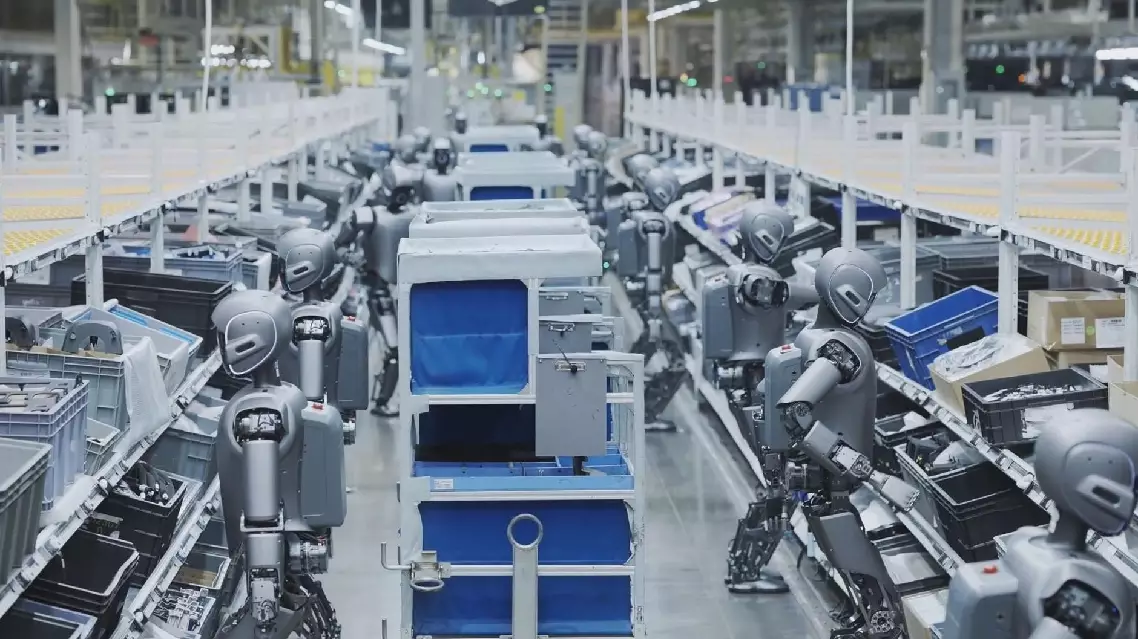
China's humanoid robots step toward practical use