BARCELONA, Spain--(BUSINESS WIRE)--Mar 1, 2026--
At MWC® 2026, Lenovo™ introduces a new generation of adaptive AI devices and forward-looking concepts designed for business professionals, creators, students, and gamers. Headlined by new modular PC architecture, a glasses-free 3D laptop concept, a foldable gaming handheld device, and the initial rollout of Lenovo Qira, Lenovo’s showcase reflects a broader shift in personal computing toward systems that adapt intelligently to people and their environments.
This press release features multimedia. View the full release here: https://www.businesswire.com/news/home/20260301217460/en/
Across its portfolio, Lenovo continues to focus on delivering technology that is more personalized, proactive, and protected, while building a unified AI ecosystem that works naturally across devices.
“The AI era will not be defined by a single device or application, but by intelligent systems that work seamlessly across everything we use,” said Luca Rossi, President, Intelligent Devices Group, Lenovo. “We are demonstrating how Lenovo and Motorola are bringing that vision to life, combining adaptive hardware innovation with a single, unified system-level AI integration that works naturally across PCs, smartphones, tablets, wearables, and beyond. From premium mobile devices and transformative form factors, to the rollout of Lenovo Qira, we are building the widest AI portfolio that delivers more connected, more intuitive personal computing experiences designed around people.”
Lenovo Qira: Personal Ambient Intelligence
Lenovo Qira is a Personal Ambient Intelligence built at the system level and integrated directly into Lenovo and Motorola devices rather than layered on as a standalone application. Operating across supported PCs, tablets, smartphones, and wearables, Lenovo Qira is designed to help maintain continuity between tasks and devices while assisting based on user intent.
In the coming weeks, Lenovo Qira will roll out across more than 20 devices within Lenovo’s PC portfolio, spanning Yoga™, IdeaPad™, Legion™, and ThinkPad™ families, through a combination of over-the-air updates and preloads. This includes the launch of the Idea Tab Pro Gen 2 as Lenovo’s first tablet to feature the experience. First wave support on PCs includes six languages across nine regions: English (U.S., U.K., India), Spanish (U.S./Latin America, Spain), French (France), Italian (Italy), German (Germany), and Portuguese (Brazil).
Lenovo Qira is designed to continuously evolve, expanding across more devices while enabling new experiences and partnerships. In 2026, that evolution will extend to additional languages and devices, including its debut on Motorola smartphones, further advancing a unified AI ecosystem across Lenovo and Motorola.
Breakthrough Concepts: Exploring Adaptive Form Factors
ThinkBook ™ Modular AI PC Concept
Lenovo is showcasing a modular AI PC concept that explores a selectively modular approach to business computing built around the idea of “carry small, use big.”
The concept features a 14-inch ultra-thin base system designed to support interchangeable display configurations, detachable input components, and modular I/O elements. A secondary display can attach in multiple orientations or replace the keyboard, enabling workspace expansion to approximately 19 inches while maintaining portability. The concept illustrates how modular architecture could support evolving workflows and extended device lifecycles in AI-ready environments.
Yoga Book Pro 3D Concept
Lenovo is also presenting a glasses-free 3D laptop concept designed to enable creators to view and manipulate depth directly on screen.
By combining dual displays, AI-powered 2D-to-3D conversion, gesture interaction, and intuitive creative controls, the concept reduces friction in immersive content creation and highlights Lenovo’s exploration of spatial computing experiences.
Legion Go Fold Concept
A foldable gaming handheld concept further expands Lenovo’s exploration of adaptable hardware.
The device transitions from a compact handheld format into a larger immersive screen and supports multiple usage modes, including handheld play, split-screen multitasking, expanded display gaming, and desktop-style interaction. The concept demonstrates how flexible display technology could enable hybrid gaming and productivity experiences in a single device.
Commercial Portfolio: AI-Ready Platforms for Modern Work
Lenovo continues evolving its commercial PC portfolio to support organizations adopting AI-enabled workflows at scale.
The updated ThinkPad T-Series introduces enhancements focused on serviceability, usability, and AI readiness, with select models achieving class-leading iFixit repairability scores. These updates reinforce Lenovo’s commitment to lifecycle value, reduced downtime, and sustainable fleet management.
The ThinkPad X13 Detachable extends flexible, mobile-first productivity with integrated pen support and field-replaceable components in a lightweight design suited for frontline and hybrid professionals.
Lenovo is also expanding into rugged mobility with the introduction of the ThinkTab X11, a durable Android tablet designed for demanding industrial and frontline environments.
For small and medium-sized businesses, the ThinkBook 14 2-in-1 Gen 6 delivers multimode versatility and AI-enabled collaboration features, while the ThinkVision ™ M16 portable monitor provides lightweight screen expansion to support flexible workstyles.
Across its commercial portfolio, Lenovo integrates security, manageability, and lifecycle services to help organizations adopt AI-enabled devices with confidence and control.
Consumer and Gaming Portfolio: Intelligent Experiences for Everyday Use
For creators, students, and gamers, Lenovo’s latest devices balance performance, portability, and intelligent features designed to simplify everyday experiences.
The Yoga 9i 2-in-1 Aura Edition (14”, 11) combines premium convertible design with immersive OLED visuals and intelligent features that streamline creative workflows. The Yoga Pro 7a (15”, 11) and IdeaPad Slim 5i Ultra (14”, 11) expand Lenovo’s AI-enabled laptop portfolio, balancing performance and portability for productivity and content creation.
In tablets, the Idea Tab Pro Gen 2 introduces intelligent learning and productivity experiences in a versatile form factor and marks Lenovo’s first tablet to feature Lenovo Qira.
Within gaming, Lenovo expands its lineup with the Legion 7a (15”, 11) gaming laptop and the Legion Tab (8.8”, 5), a high-performance gaming tablet featuring a 3K display and advanced cooling.
Advancing Smarter AI for All
At MWC 2026, Lenovo underscores a clear strategy towards the democratization of AI. By combining forward-looking hardware exploration with the deployment of Lenovo Qira, Lenovo continues shaping a more connected and intuitive computing future, one where intelligent systems adapt to people, not the other way around.
For more details about all Lenovo’s new devices, solutions, and proofs of concept announced at MWC 2026, visit theLenovo MWC 2026 Press Kit:
About Lenovo
Lenovo is a US$69 billion revenue global technology powerhouse, ranked #196 in the Fortune Global 500, and serving millions of customers every day in 180 markets. Focused on a bold vision to deliver Smarter Technology for All, Lenovo has built on its success as the world’s largest PC company with a full-stack portfolio of AI-enabled, AI-ready, and AI-optimized devices (PCs, workstations, smartphones, tablets), infrastructure (server, storage, edge, high performance computing and software defined infrastructure), software, solutions, and services. Lenovo’s continued investment in world-changing innovation is building a more equitable, trustworthy, and smarter future for everyone, everywhere. Lenovo is listed on the Hong Kong stock exchange under Lenovo Group Limited (HKSE: 992) (ADR: LNVGY). To find out more visit https://www.lenovo.com, and read about the latest news via our StoryHub.

Lenovo Unveils Adaptive AI PCs, Modular Concepts, and Lenovo Qira Rollout at MWC 2026
The U.S. and Israel pounded targets across Iran, bombing the country’s ballistic missile sites and wiping out warships as part of an intensifying military campaign following the killing of Supreme Leader Ayatollah Ali Khamenei.
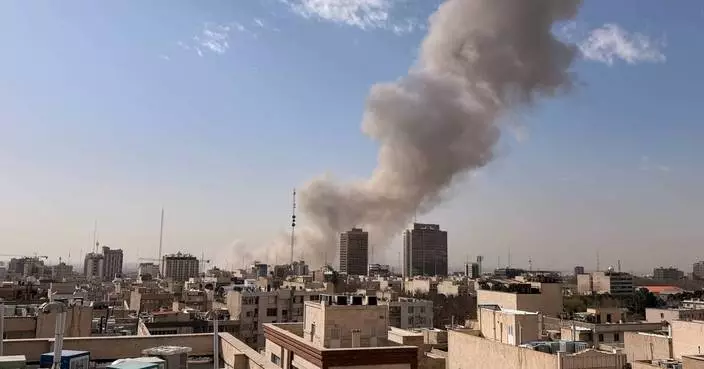
Blasts rattled windows across the country and sent plumes of smoke high into the sky above Tehran. More than 200 people have been killed since the start of the strikes that killed Khamenei and other senior leaders, Iranian leaders have said.
Iran retaliated by firing missiles and drones at Israel and at U.S. military installations around the Gulf, and also at the Saudi capital and the global business hub of Dubai. Earlier Sunday, Iran selected a 66-year-old cleric to join the three-member leadership council that will govern the country until a new supreme leader is selected.
A senior White House official says that “new potential leadership” in Iran has suggested they are open for talks with the United States. The official, speaking on condition of anonymity to discuss internal administration deliberations, said President Donald Trump says he is “eventually” willing to talk, but for now the military operation “continues unabated.”
Here is the latest:
Bahrain’s miliary said it has intercepted 61 Iranian missiles and 34 drones since Iran started attacking the country following U.S.-Israeli strikes on Tehran over the weekend.
Bahrain, which hosts the U.S. 5th fleet, is among the Arab Gulf countries that Iran hit in response to U.S.-Israeli strikes that triggered the war.
The Bahraini military said the Iranian missile and drone targeted civilian facilities and private properties in attacks constituting a “flagrant violation of the principles of international and humanitarian law.”
Qatar’s Interior Ministry has urged residents to remain indoors as the war between the U.S., Israel and Iran enters its third day on Monday.
In a social media post, the ministry called for residents not to get out only for “cases of absolute necessity,” and to stay away from windows and exposed areas.
Qatar, which hosts the U.S. largest military base in the Mideast, is one of the Arab Gulf countries that Iran hit in response to US-Israeli strikes that triggered the war.
Associated Press journalists in Beirut were jolted awake by a series of loud explosions that shook buildings and caused windows to shatter, while war planes could be heard low overhead as Israel launched a series of strikes in retaliation for missiles fired across the border by the Lebanese militant group Hezbollah.
Lebanese government officials had urged Hezbollah not to enter the fray in support of Iran, fearing another damaging war. The country has not recovered from the last Israel-Hezbollah war, which nominally ended with a U.S.-brokered ceasefire in November 2024. Israel has continued to launch near-daily strikes in Lebanon since then, which it said aim to stop Hezbollah from regrouping.
Prime Minister Nawaf Salam in a statement following the strikes said, “We will not allow the country to be dragged into new adventures, and we will take all necessary measures to apprehend those responsible and protect the Lebanese people.”
The U.S. and Israeli attacks on Iran have sent a chill through world markets, with U.S. futures falling more than 1%. Shares opened sharply lower in Tokyo early Monday and oil prices soared. Japan’s Nikkei 225 index lost 2.3% shortly after the open and shares also fell in Australia.
Traders were betting the supply of oil from Iran and elsewhere in the Middle East would slow or grind to a halt.
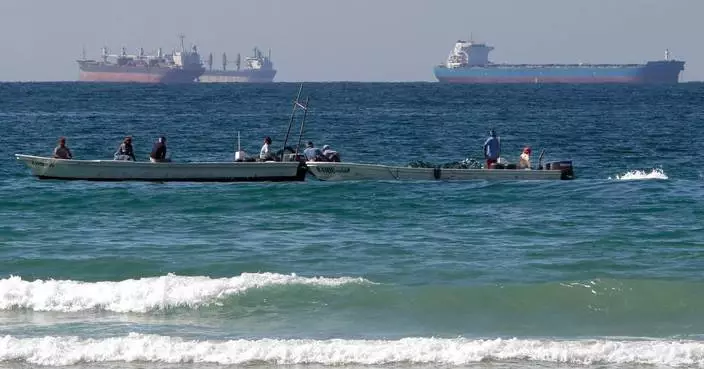
Attacks throughout the region, including on two vessels transiting the Strait of Hormuz, the narrow mouth of the Persian Gulf, disrupt the region’s ability to export oil. Prolonged attacks would likely result in higher prices for crude oil and gasoline.
Israel launched a barrage of strikes on Lebanon’s capital, Beirut, after the Lebanese militant group Hezbollah fired missiles across the border early Monday.
It was the first time in more than a year that Hezbollah has claimed a strike against Israel. The Israeli military said it intercepted a projectile that crossed the border, saying that several others fell in open areas. No injuries or damage were reported.
Hezbollah said in a statement that the strikes were carried out in retaliation for the killing of Iran’s Supreme Leader, Ali Khamenei, and for “repeated Israeli aggressions,” describing it as “a legitimate defensive response, and the responsible parties must put an end to the Israeli‑American aggression against Lebanon.”
Oil prices rose sharply when market trading began late Sunday, as U.S. and Israeli attacks on Iran and retaliatory strikes sent disruptions through the global energy supply chain.
A barrel of Brent crude oil, the international standard, was trading at around $79 per barrel Sunday night, according to FactSet, up about 8% from Friday.
Traders were betting the supply of oil from Iran and elsewhere in the region could slow or grind to a halt. Attacks throughout the region, including on two vessels traveling through the Strait of Hormuz, the narrow mouth of the Persian Gulf, could restrict countries’ ability to export oil to the rest of the world. Against that backdrop, countries that are part of the OPEC+ oil cartel announced they would boost production of crude oil.
Higher global energy prices could lead to consumers paying more for gasoline at the pump and shelling out more for groceries and other goods, at a time when many are already feeling the impacts of elevated inflation.
A projectile crossed from Lebanon into Israeli territory early Monday, the Israeli military said, triggering sirens in several areas of northern Israel. The Israeli military added that it intercepted the projectile, saying that several others reportedly fell in open areas. No injuries or damage were reported.
The incident prompted residents in southern Lebanon to move northward, fearing Israeli retaliation.
There was no official comment from Lebanese authorities or from Hezbollah, the militant group that is a key member of Iran’s Axis of Resistance and has previously fought wars with Israel. While Hezbollah has condemned U.S. and Israeli strikes on Iran and vowed to “confront aggression,” it has not yet escalated militarily.
Tensions along the Israel–Lebanon frontier remain high under the 2024 ceasefire framework, which followed months of cross‑border exchanges and a full-scale war after Hezbollah began firing rockets toward Israel on Oct. 8, 2023, in solidarity with Gaza.
The three U.S. service members killed in the operation targeting Iran were Army soldiers who were deployed to Kuwait as part of a unit that oversees supplies and logistics, according to a person familiar with the situation.
The person was not authorized to comment publicly and spoke on condition of anonymity. The development was reported earlier by NBC News and The Washington Post.
U.S. Central Command on Sunday announced that three service members were killed and five others were seriously wounded. They are the first American casualties in a major offensive that President Donald Trump said could likely lead to more losses in the coming weeks.
By Konstantin Toropin
U.S. President Donald Trump is making his way back in the nation’s capital after a weekend at his Mar-a-Lago estate while the U.S. and Israel launched joint strikes on Iran.
Aides said Trump held calls with leaders around the Middle East and was briefed on the mass shooting in Austin over the weekend.
He also attended a closed-door Republican fundraiser at Mar-a-Lago on Saturday night.
But the president didn’t hold a Mar-a-Lago press conference to talk about Iran, nor did he speak to reporters aboard Air Force One while flying back.
So far, Trump has only talked about Iran in video messages he posted on social media, and in short spurts after taking phone calls from individual reporters. Those calls weren’t recorded for audio or video.
Iranian Foreign Minister Abbas Araghchi warned the United Nations that the killing of Supreme Leader Ayatollah Ali Khamenei “opens a dangerous Pandora’s box."
Araghchi wrote in a letter to the U.N. on Sunday that the killing of Supreme Leader Ayatollah Ali Khamenei “constitutes a grave and unprecedented breach of the most fundamental norms governing relations among States.”
He once again called on the world body and the Security Council to take measure to ensure accountability from the U.S. and Israel for their role in the killing.
“Such conduct does not merely violate established principles of international law; it recklessly opens a dangerous Pandora’s box, eroding the bedrock of sovereign equality and the stability of the international system,” he added.
Australian Foreign Minister Penny Wong has ruled out Australia taking part in military strikes against Iran.
“We didn’t participate in these strikes and we wouldn’t anticipate participating in the future,” Wong told Nine Network television on Monday.
Australia is a close ally of the United States and sent troops to join U.S. and British forces in the 2003 invasion of Iraq.
Wong said Australia supported U.S. and Israeli military action aimed at preventing Iran from acquiring a nuclear capability.
Iranian health ministry official said teams are evacuating a general hospital in Tehran.
The evacuation of Ghandi hospital late Sunday came shortly after strikes shook the neighborhood in northern Tehran, striking a transmitter used for Iranian state television signals and parts of a state television building, according to witnesses. The building and transmitters are located near the hospital.
The semiofficial Tasnim news agency posted videos that showed broken glass littering parts of the hospital, as well as debris that covered the street, and damaged buildings.
Health Ministry official Hossein Kermanpour said on X that Ghandi hospital was targeted and evacuated. He didn’t elaborate but posted videos of emergency teams evacuated patients.
U.S. Secretary of State Marco Rubio, Defense Secretary Pete Hegseth, CIA director John Ratcliffe and Joint Chiefs of Staff Chairman Dan Caine will brief Congress on the U.S. military operation against Iran next week, the White House said Sunday.
Spokesman Dylan Johnson said the four would speak to “the full membership of both chambers of Congress on Tuesday, March 3.”
He added that Pentagon officials had briefed congressional staffers on the conflict for more than 90 minutes on Sunday.
Iranian missile debris lightly injured four people, including three children, in the town of Ain Terma in the Damascus countryside on Sunday evening, Syria’s state news agency SANA said.
The injured, a father and his three daughters, were transferred to a hospital, SANA said, citing the director of Ambulance and Emergency at the Health Ministry. It added that their injuries were minor and treated immediately.
Top diplomats of six Gulf states called on Iran to immediately halt its attacks on their territories which they said violated their sovereignty and threatened to undermine regional security and stability.
The foreign ministers of Qatar, Saudi Arabia, the United Arab Emirates, Kuwait, Oman, Bahrain had a virtual emergency meeting Sunday following the U.S-Israel strikes on Iran that triggered Iranian barrage of missiles on U.S bases and other civilian infrastructure, including airports, hotels and in some cases, residential areas. The foreign ministers condemned the attacks they said targeted their territories and Jordan.
The Gulf top diplomats said their countries retain “their legal right to respond and the right to self-defense,” according to international laws.
Prime Minister Keir Starmer said the U.K. will not join in strikes on Iran but has agreed to let the U.S. use British bases for attacks on Iran’s missiles and their launch sites.
Starmer said Sunday that Iran was striking at British and its allies’ interests, and “the only way to stop the threat is to destroy the missiles at source.”
Britain had previously refused to allow the United States to use U.K. bases to attack Iran.
Starmer said Sunday he was authorizing their use because of the threat from Iran’s attacks on countries across the region. He said “we are not joining these strikes but we will continue with our defensive actions in the region.”
Starmer said Royal Air Force jets have intercepted Iranian strikes as part of defensive operations in the region.
U.S. President Donald Trump said of U.S. service members killed that America will ’avenge their deaths.”
The president made the comments in a roughly six minute video he posted on social media Sunday afternoon. He called the three service members “true American patriots who have made the ultimate sacrifice for our nation, even as we continue the righteous mission for which they gave their lives.”
The president went on and added: “Sadly, there will likely be more, before it ends. That’s the way it is. Likely be more.”
The State Department is allowing non-essential U.S. diplomats and families of all government personnel to leave Bahrain, Kuwait and Qatar as U.S. and Israeli strikes on Iran and Iranian retaliation continue.
In updated travel advisories issued on Sunday, the department said it had moved to reduce its diplomatic footprint in Doha, Kuwait City and Manama “due to security concerns.”
It added that private American citizens should reconsider travel to Bahrain, Kuwait and Qatar because of the “threat of armed conflict” and significant disruptions to commercial air travel in the region.
An Israeli military official says a variety of factors created near-perfect conditions for Israel and the U.S. to kill much of Iran’s leadership in the opening strike of the war.
The official says that months of planning and close coordination with the U.S., combined with real-time intelligence that the targets were gathered together, allowed the two allies to strike in the joint operation on Saturday morning.
The official says the airstrikes targeted three locations, all within 60 seconds of one another, killing Iran’s supreme leader and some 40 senior officials, including the head of Iran’s Revolutionary Guard. He said that striking in broad daylight added an additional element of surprise.
The official said Israel and the U.S. agreed that striking the leadership was the best way to open the operation. Otherwise, he said they would quickly disperse and go into hiding once the attacks began. He spoke on condition of anonymity to discuss the covert operation.
“We had a great opportunity, great intel, great execution,” he said.
By Josef Federman
Israel’s top general praised his military’s early gains in fighting with Iran, while warning the public that “many more days of combat lie ahead.”
After a day marked by warning sirens, strikes and at least nine deaths from one Iranian attack, Lt. Gen. Eyal Zamir mourned fatalities in the town of Beit Shemesh and hailed “significant achievements” that he said Israel and the U.S. had made thus far. The two countries’ strikes on Iran took out high ranking security officials and Supreme Leader Supreme Leader Ayatollah Ali Khamenei.
“Patience and resilience are required now. We are operating in close cooperation with our ally. Coordination with the U.S. military is closer than ever,” Zamir, the army’s chief of the general staff, said.
U.S. President Donald Trump has discussed a timeline for the fighting in Iran during a phone interview with a British newspaper.
“We figured it will be four weeks or so,” Trump told the Daily Mail. “It’s always been about a four-week process, so, as strong as it is -- it’s a big country -- it’ll take four weeks, or less.”
The U.S. military said three service members have been killed, the first known American casualties from the conflict. Trump called those killed “great people.”
“You know, we expect that to happen, unfortunately,” Trump told the newspaper. “Could happen continuous — it could happen again.”
Loud booms and explosions rocked Jerusalem on Sunday night as another batch of Iranian missiles attempted landfall.
Shelters were full and some residents concurred that the booms were the loudest they’d heard since the start of the war.
It was not immediately clear whether the booms were the sounds of missiles landing or of interceptions.
The diplomat who mediated indirect nuclear talks held last week in Geneva between the U.S. and Iran has called for negotiations to resume, saying that the “door to diplomacy remains open."
Oman's Foreign Minister Badr al-Busaidi said in a post on X that there had been a “genuine progress toward an unprecedented agreement” during the last round of talks.
“I still believe in the power of diplomacy to resolve this conflict,” he said. “The sooner talks are resumed the better it is for everyone.”
Oman’s Duqm Port earlier Sunday was struck by Iranian exploding drones, wounding one worker.
Britain, France and Germany — known as the E3 — said they are ready to work with the U.S. and partners to help stop Iran’s retaliatory attacks.
British Prime Minister Keir Starmer, French President Emmanuel Macron and German Chancellor Friedrich Merz said in a joint statement that they are “appalled” by Iran’s “reckless” strikes on their allies which are threatening their service members and citizens in the region.
“We will take steps to defend our interests and those of our allies in the region, potentially through enabling necessary and proportionate defensive action to destroy Iran’s capability to fire missiles and drones at their source. We have agreed to work together with the U.S. and allies in the region on this matter,” the statement said. It did not provide further details.
The Philippine Embassy in Israel confirmed the death of a Filipino national in a missile attack in Tel Aviv on Saturday.
Mary Ann V. de Vera, 32, a caregiver from Basista, Pangasinan, had been working in Israel since 2019. Her identity was confirmed through biometric records at the Abu Kabir Forensic Institute, where her husband also positively identified her remains.
Ambassador Aileen Mendiola conveyed condolences to the family and assured them of the Philippine government’s full assistance, the embassy said in a statement.
President Emmanuel Macron said the conflict has prompted France to reinforce its military posture and its defensive support for allies in the Middle East. He did not elaborate.
Noting that a drone hit a hangar Sunday at a French naval base, he said France needs to "be able to adapt our posture to the evolution of the last few hours." France has military bases in the Gulf.
Chairing an emergency defense meeting in Paris, Macron said top security officials would discuss the risks the conflict creates for France, and its economic consequences. Macron spoke with the leaders of several countries around the Mideast over the weekend.
On Monday, Macron heads to a nuclear submarine base where he is expected to update France’s nuclear weapons doctrine to take into account the evolving global security context.
White House press secretary Karoline Leavitt said in a post on X that U.S. President Donald Trump has spoken to the leaders of Israel, Bahrain and United Arab Emirates, without providing further details.
Trump has spoken to leaders throughout the region since the start of U.S.-Israeli strikes on Iran.
Israel Defense Forces spokesperson Brig. Gen. Effie Defrin told a briefing that 100 fighter jets simultaneously struck government targets in the Iranian capital on Sunday.
He said the targets included buildings belonging to Iran’s air force, its missile command and its internal security force, which violently quashed anti-government protests in January. “Our message to the Iranian regime is clear,” he said. “No one is immune.”
Defrin also said Israel has activated an additional 100,000 reservists to fortify Israel’s borders. He said there was a special focus on the Lebanese militant group Hezbollah, which so far has stayed on the sidelines of the latest war.
“We are keeping a close eye on Hezbollah,” he said.
The United Arab Emirates has closed its embassy in Iran and announced the withdrawal of its diplomatic mission after strikes from the Islamic Republic hit the country.
The announcement from the Gulf country’s Foreign Ministry comes as Iranian retaliatory attacks targeting U.S. bases in the Mideast have hit Dubai airport and other civilian buildings, forced the closure of its airspace, and disrupted daily life.
“The Foreign Ministry as confirmed that this decision reflects its firm and unwavering position against any aggression that threatens its security and sovereignty,” the statement said.
Turkish President Recep Tayyip Erdogan has issued a message of condolence over the death of Iran’s Supreme Leader Ali Khamenei in U.S.–Israeli airstrikes.
In a post on X, Erdogan emphasized Turkey’s commitment to peace and stability in the region, adding that Ankara would continue working toward a “return to diplomacy” to help end the conflict.
Cuban President Miguel Díaz-Canel said his administration extended its “deepest condolences” to Iran’s people and its government for what he called the assassination of Supreme Leader Ayatollah Ali Khamenei.
“This heinous act constitutes an unscrupulous violation of all norms of international law and human dignity,” he wrote in a post on X. “In Cuba, he will be remembered as an outstanding statesman and leader of his people who contributed to the development of friendly relations between Cuba and Iran.”
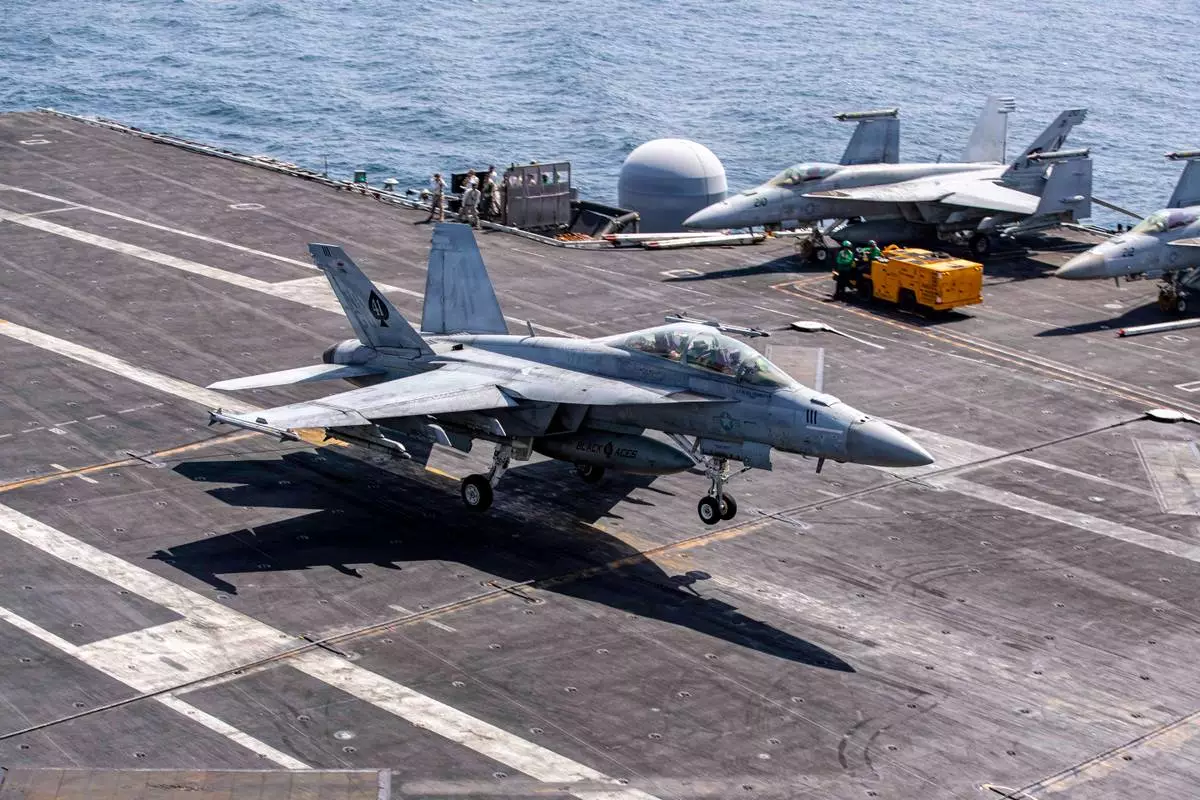
This image provided by U.S. Central Command shows a F/A-18E Super Hornet makes an arrested landing on the USS Abraham Lincoln (CVN 72) after a mission in support of Operation Epic Fury, on Saturday, Feb. 28, 2026. (U.S. Navy via AP)
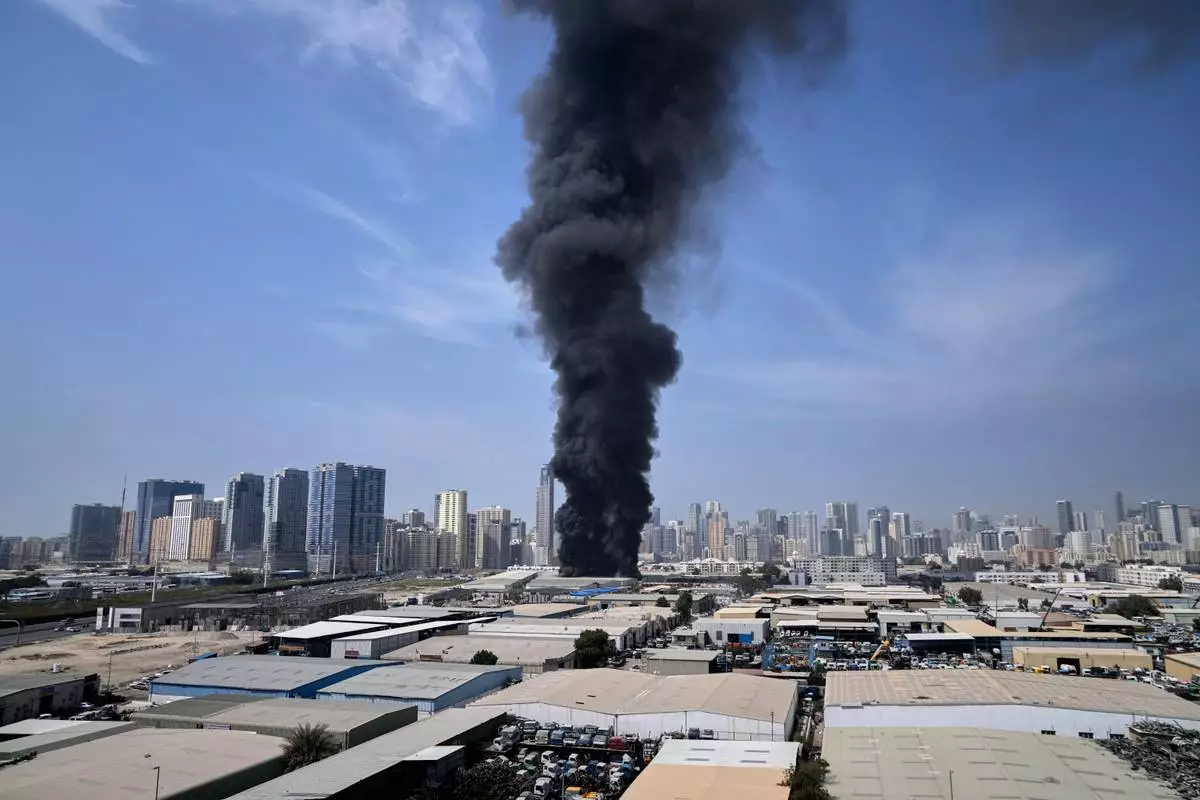
A black plume of smoke rises from a warehouse at the industrial area of Sharjah City in the United Arab Emirates following reports of Iranian strikes in Dubai, United Arab Emirates, Sunday, March 1, 2026. (AP Photo/Altaf Qadri)
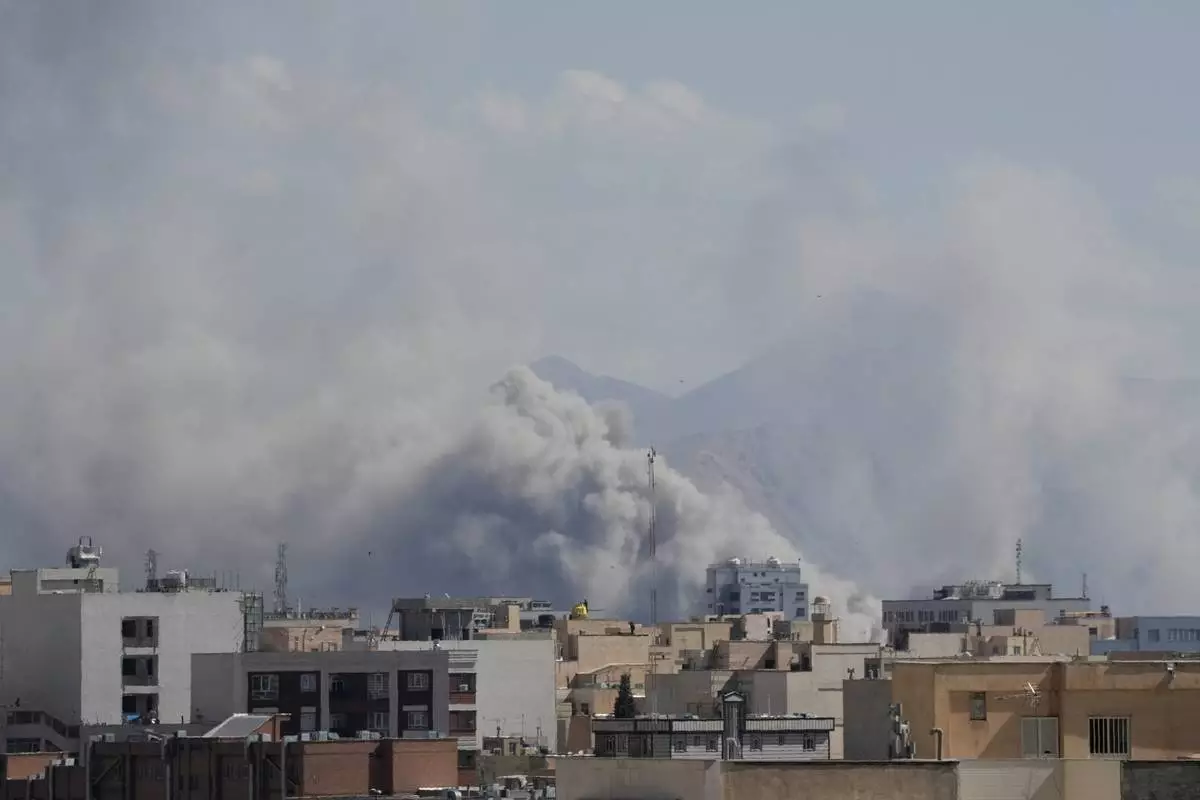
Smoke rises up after a strike in Tehran, Iran, Sunday, March 1, 2026. (AP Photo/Vahid Salemi)
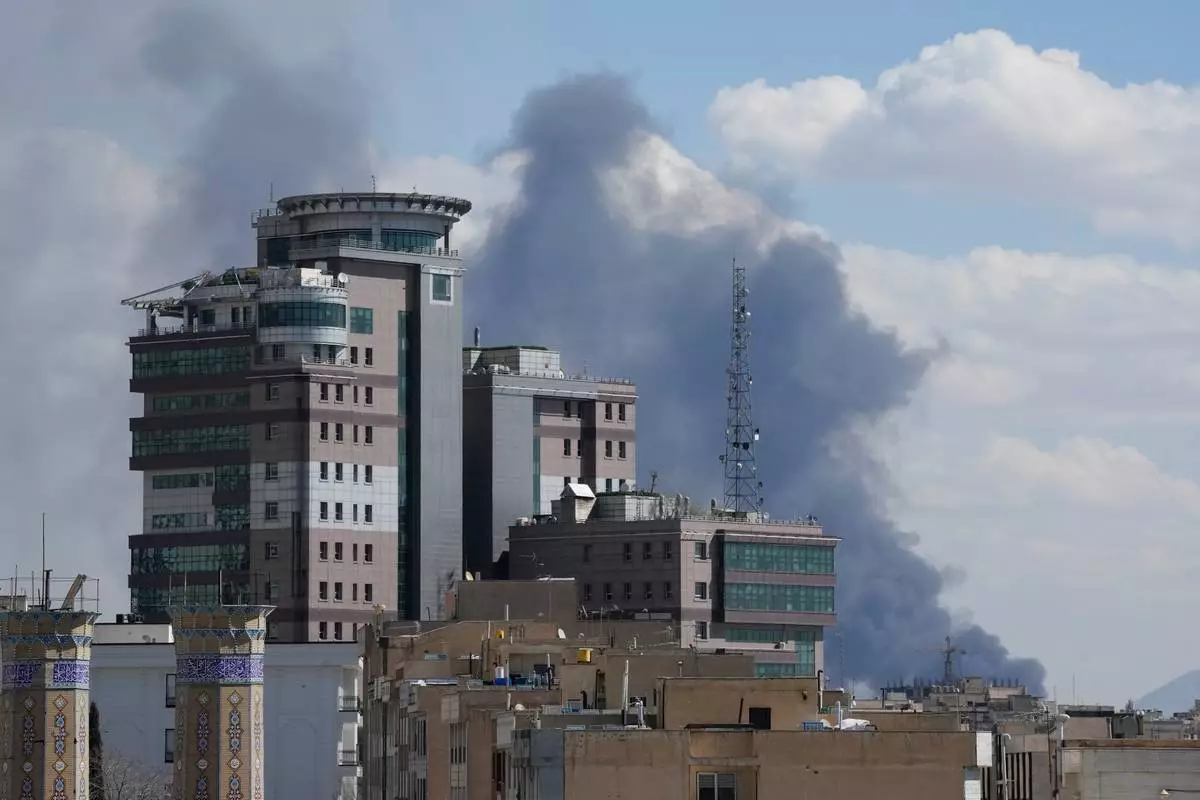
Smoke rises up after a strike in Tehran, Iran, Sunday, March 1, 2026. (AP Photo/Vahid Salemi)
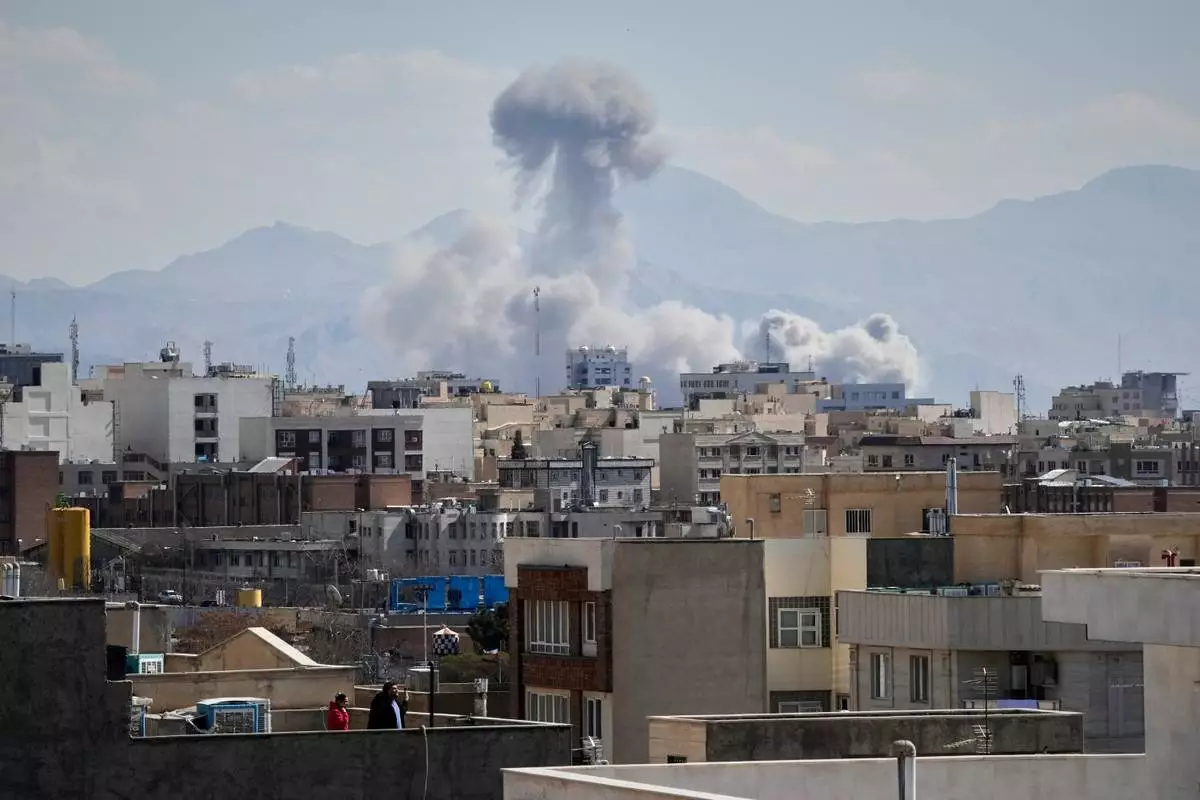
People watches from a rooftop as a plume of smoke rises after a strike in Tehran, Iran, Sunday, March 1, 2026. (AP Photo/Vahid Salemi)
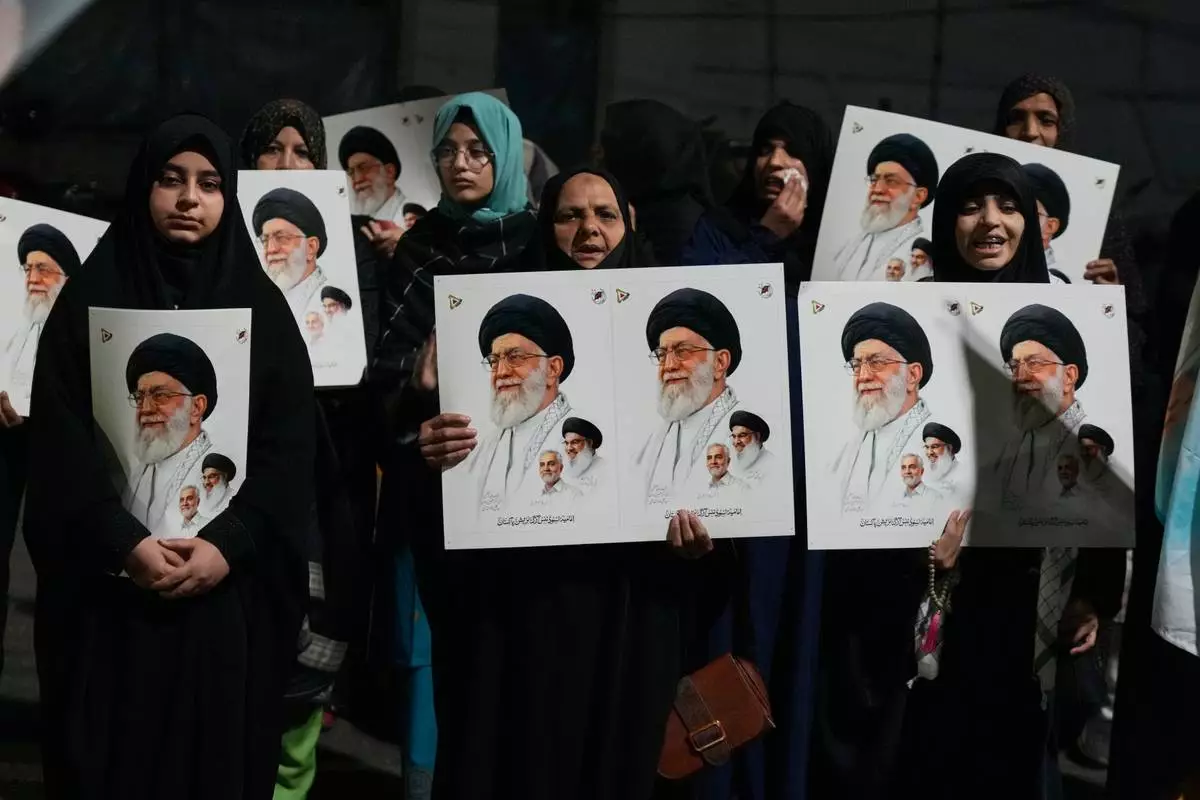
Shiite Muslims hold placards and chant slogans during a protest against the U.S. and Israel, and to show solidarity with Iran, in Lahore, Pakistan, Saturday, Feb. 28, 2026. (AP Photo/K.M. Chaudary)
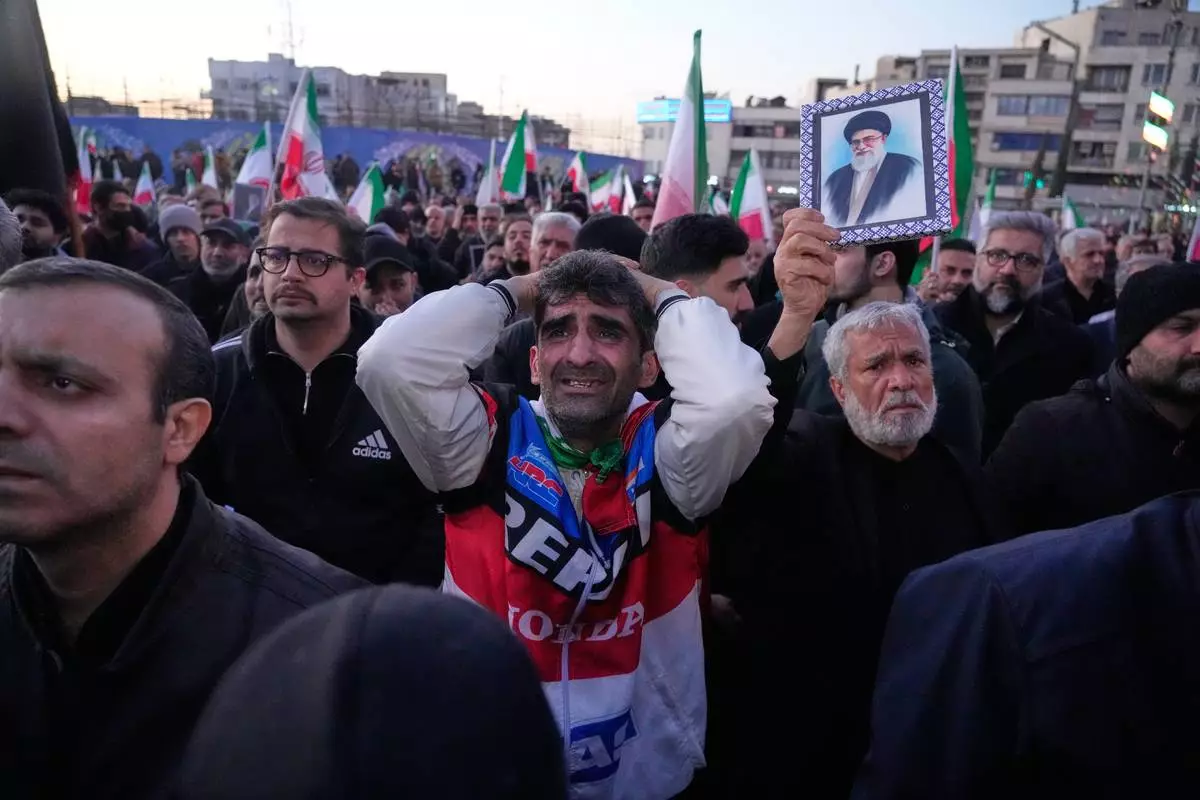
Government supporters mourn during a gathering after state TV officially announced the death of Iranian Supreme Leader Ayatollah Ali Khamenei, shown in the poster, in Tehran, Iran, Sunday, March 1, 2026. (AP Photo/Vahid Salemi)
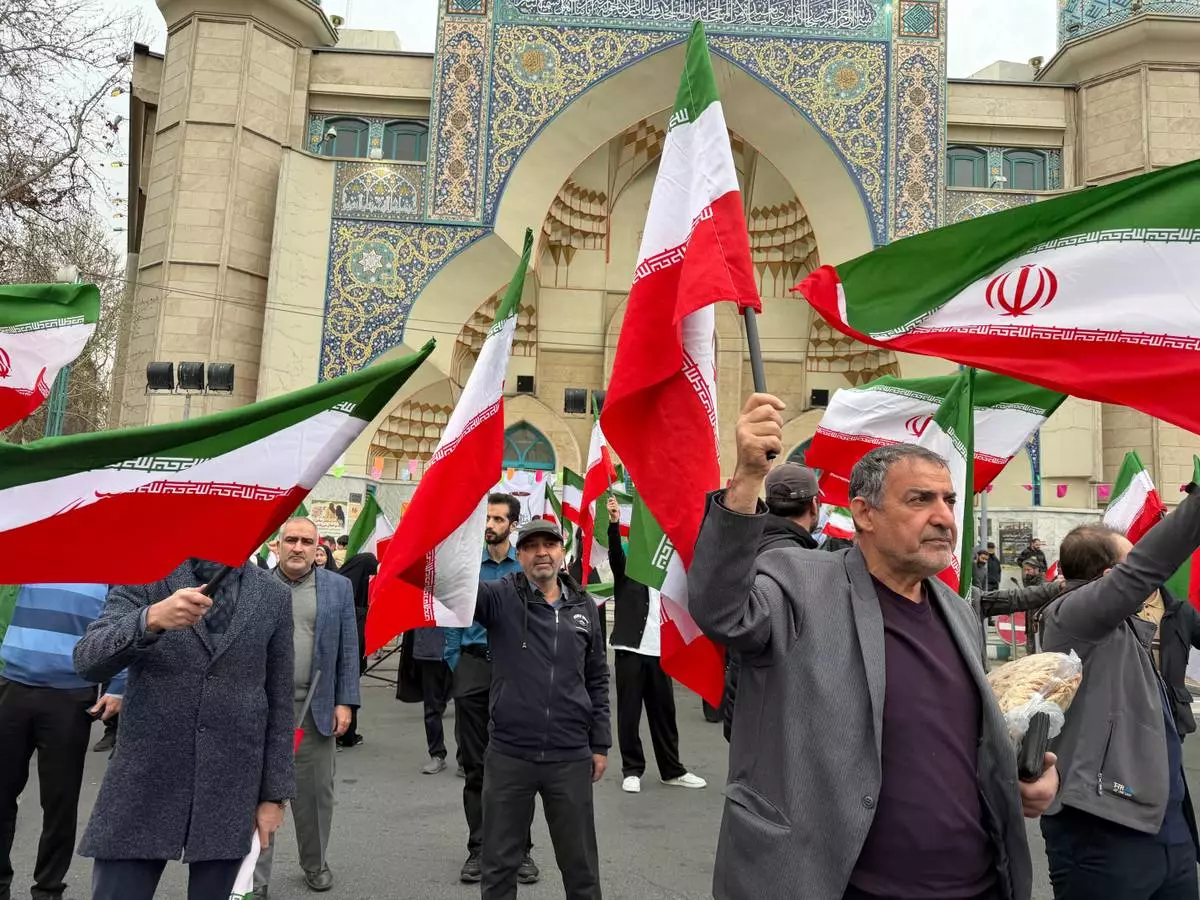
A group of men wave Iranian flags as they attend a demonstration in support of the government and against U.S. and Israeli strikes in Tehran, Iran, Saturday, Feb. 28, 2026. (AP Photo/Vahid Salemi)
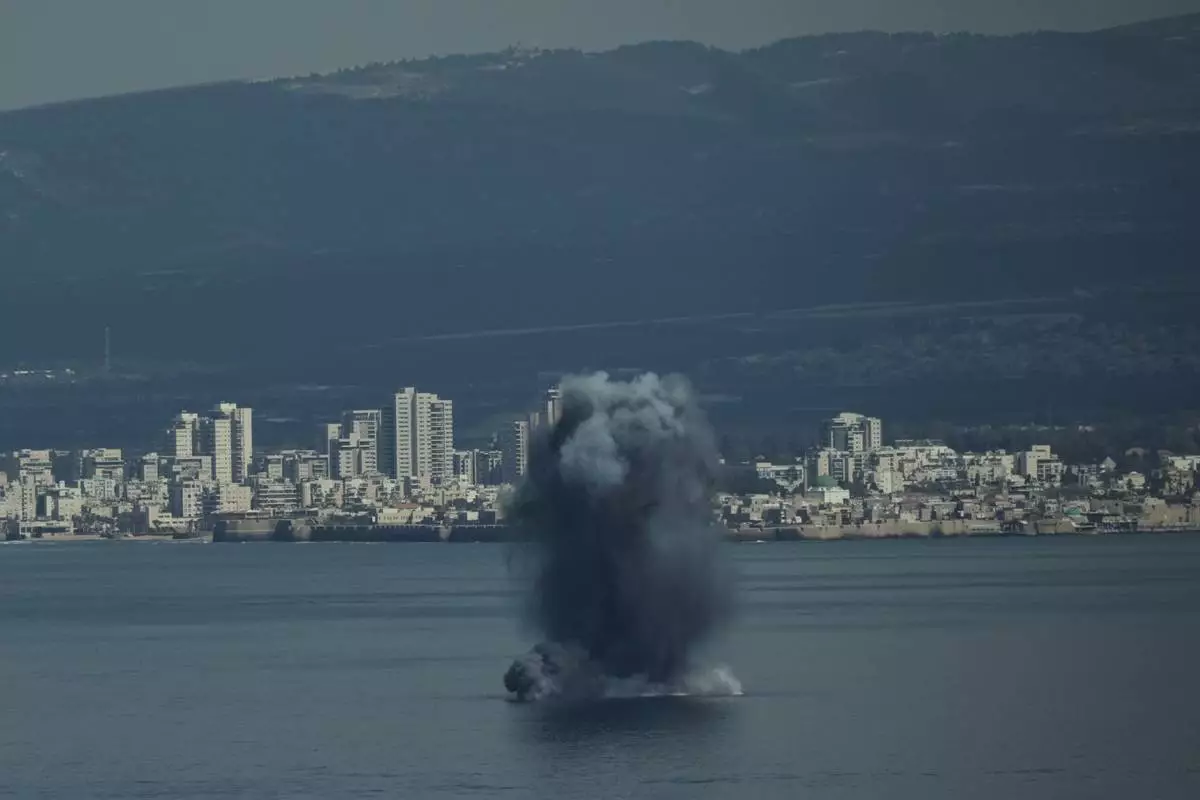
An incoming projectile explodes over the water as Israel issues a nationwide alert following its strikes on Iran, in Haifa Bay, northern Israel, Saturday, Feb. 28, 2026. (AP Photo/Leo Correa)
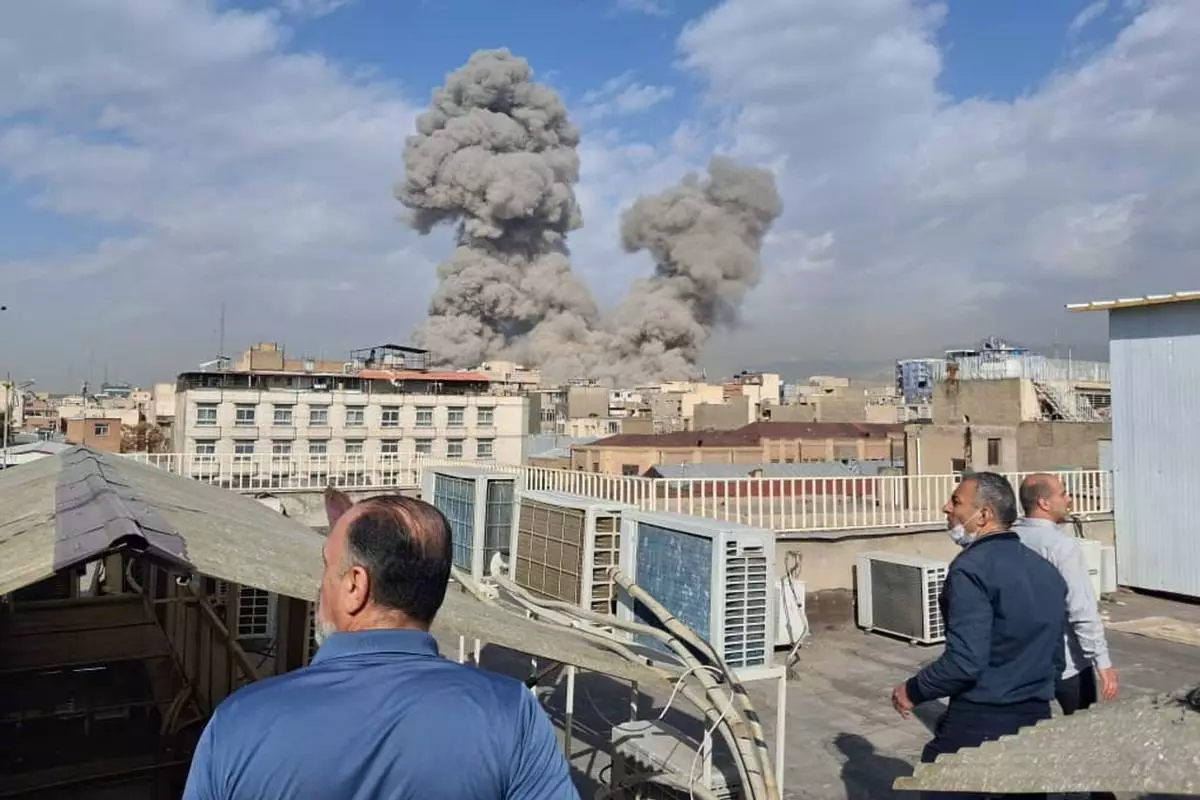
People watch as smoke rises on the skyline after an explosion in Tehran, Iran, Saturday, Feb. 28, 2026.(AP Photo)
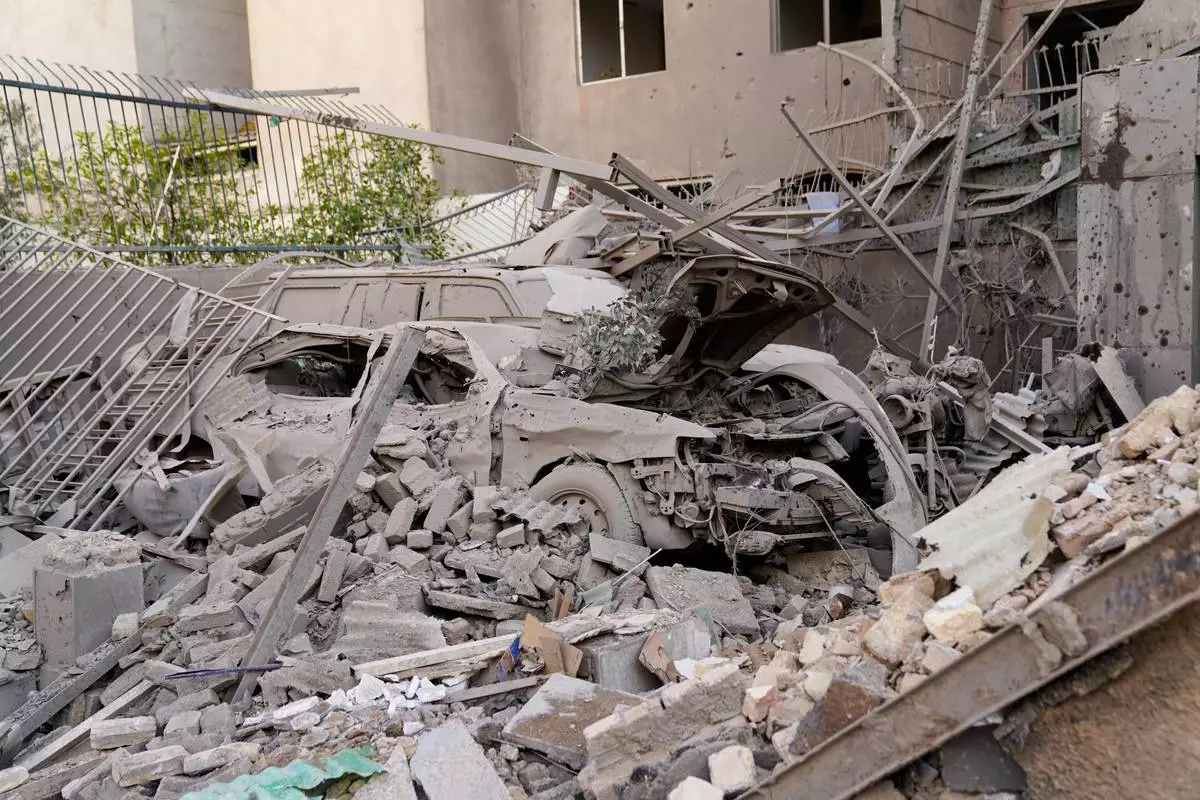
Ruins remain in the aftermath of an Israeli-U.S. strike in Tehran, Iran, Saturday, Feb. 28, 2026. (AP Photo/Amir Kholousi/ISNA)