BARCELONA, Spain--(BUSINESS WIRE)--Mar 3, 2026--
Quectel Wireless Solutions, a global end-to-end IoT solutions provider, has introduced five new small cell antennas to add further functionality and provide greater flexibility and choice for customers designing and implementing small cell deployments. The new antennas bring an additional range of form factors, mounting options and performance characteristics to the Quectel antenna range.
This press release features multimedia. View the full release here: https://www.businesswire.com/news/home/20260302915004/en/
“Whether you’re looking for an antenna to support critical wireless communications, dense stadium usage scenarios or ultimate capacity, these five new Quectel antennas have been designed to meet your needs,” says David Wei, Antenna Product Head, Quectel Wireless Solutions. “The new antennas augment our already comprehensive range of antennas, bring further choice and add capabilities for developers and engineers.”
The YECJ095JPAM is a 5G ceiling mount omnidirectional antenna that operates in the 380-6000MHz frequency band. With a diameter of 300mm and height of 139mm, the RoHS compliant antenna supports 5G, LTE, 3G, 2G and Wi-Fi. The antenna features consistent vertical polarization and a 360° omnidirectional horizontal radiation pattern to provide reliable wide-area coverage in indoor environments. Built for easy ceiling mounting, the YECJ095JPAM offers future-proof, reliable and compliant connectivity for demanding indoor wireless infrastructure deployments.
The YEMG496KPAM is a 5G 4in1 wall and pole mount combo directional antenna designed to deliver robust performance across an exceptionally wide 617-4200MHz frequency range. Offering 4x4 MIMO directional antenna capability, the YEMG496KPAM supports LTE, 5G, IoT and public safety bands, making it ideal for applications that require high-capacity connectivity. The antenna has dimensions of 590mm x 419mm x 143mm and the robust grey UPVC housing ensures durability for indoor and outdoor use.
The YEMG492WPAM is a 5G 4in1 wall and pole mount combo antenna for stadium use cases. Operating in the 1695-2690MHz and 3300-4200MHz frequency bands, the antenna measures 595mm x 419mm x143mm. Optimized for LTE and 5G networks, the YEMG492WPAM has been designed to ensure reliable connectivity and enhanced data throughput for thousands of simultaneous users. This antenna offers the capacity, reliability and performance needed for next generation, high-density wireless deployments.
The YEME491WPAM is a 4G 4in1 pole mount combo single beam lens antenna designed for advanced cellular networks and operates in the 1710-2690MHz frequency range. The antenna covers key bands for 3G, 4G and early 5G deployments, offering excellent sector precision and reduced interference. Measuring 774 × 400 × 400 mm, the antenna is engineered for harsh outdoor environments. It features a rugged UPVC radome and supports mechanical downtilt of up to 20°, making the YEME491WPAM well suited for demanding deployments.
The YEME490WPAM is a 4G 4in1 pole mount combo dual beam lens antenna that operates in the 698-960MHz frequency range and is ideally suited for LTE, NB-IoT and other mid-band applications that require robust and focused signal delivery. The antenna’s standout feature is the generation of two independent beams, each with a ±45° polarization and a beam center at ±33° in the horizontal plane, allowing for sophisticated sectorization and enhanced capacity in dense deployment scenarios. With dimensions of 850mm x 645mm x 850mm and featuring an ASA radome for durability, the YEME490WPAM is ideal for critical outdoor wireless infrastructure.
In addition to the antenna products, Quectel also provides comprehensive antenna design support such as simulation, testing and manufacturing for custom antenna solutions to meet specific application needs. Quectel has regional R&D centers across the globe to ensure it can respond rapidly to customer requirements and ensure smooth antenna integrations.
Attendees to MWC Barcelona can find out more about the complete Quectel end-to-end IoT solutions portfolio, including the antenna range, at stand 5A19.
About Quectel
Quectel’s passion for a smarter world drives us to accelerate IoT innovation. A highly customer-centric organization, we are an end-to-end global IoT solutions provider backed by outstanding support and services.
With a worldwide team of over 5,800 professionals, we lead the way in delivering end-to-end IoT solutions, spanning cellular, GNSS, satellite, Wi-Fi and Bluetooth modules, high-performance antennas, value-added services and full turnkey offerings including ODM services and system integration.
With regional offices and support across the globe, our international leadership is devoted to advancing IoT and helping build a smarter world.
For more information, please visit www.quectel.com or LinkedIn

Quectel expands small cell antennas portfolio with five new products
As the war in the Middle East intensifies, U.S. President Donald Trump said that the U.S. has “the capability to go far longer" than its projected four-to-five-week time frame for its military operations against Iran.
Across Tehran, the sound of explosions rang out through the night and into the early morning hours Tuesday, as the U.S. and Israel have continued to pound Iran since killing its Supreme Leader Ayatollah Ali Khamenei on Saturday.
Tehran and its allies have hit back against Israel, neighboring Gulf states, and targets critical to the world’s production of oil and natural gas.
The intensity of the attacks and the lack of any apparent exit plan set the stage for a prolonged conflict with far-reaching consequences. Israel and the U.S. have given conflicting answers about what exactly the war’s objectives are or what the endgame might be.
Israeli Prime Minister Benjamin Netanyahu late Monday defended the decision to go to war, contending in an interview on Fox News Channel’s "Hannity" that Iran was rebuilding “new sites, new places” that would make “their ballistic missile program and their atomic bomb program immune within months,” without providing evidence.
Satellite photos analyzed by The Associated Press showed limited activity at two nuclear sites in Iran before the war, with analysts saying it was likely Tehran was trying to assess damage from American strikes in June and possibly salvage what remained there.
Here is the latest:
Thailand is intensifying security around the U.S., Israeli and Iranian embassies as the conflict in the Middle East intensifies.
Public broadcaster Thai PBS quoted the head of the National Security Council, Chatchai Bangchua, describing the additional measures as he said authorities would also monitor sites linked to the countries.
Thailand depends heavily on tourism and is one of Asia’s most-visited countries, attracting more than 32 million foreigners last year. It is a popular destination for Americans, Israelis and citizens of Gulf countries and before recent airspace closures received dozens of direct flights from the Middle East each week.
The Israeli military says soldiers are “operating in southern Lebanon’ as it continues strikes against Hezbollah.
In a statement, it said the troops are positioned at a several points near the border in what it described as a “forward defense posture” as it battles Hezbollah militants.
It says the deployment is part of a broader effort to increase security for residents in northern Israel near the border with Lebanon. It has also beefed up troops and air defenses in the area.
The army says there are no plans to evacuate Israeli residents of border areas.
Israel has been occupying five positions in southern Lebanon since a November 2024 ceasefire ended more than a year of fighting with Hezbollah. Lt. Col. Nadav Shoshani says the new deployment is in addition to those five positions, with the aim of preventing attacks on Israeli border towns.
The U.S. State Department added Kuwait and Qatar to the evacuation list from its Mideast diplomatic outposts.
The U.S. Embassy in Kuwait is shutting down as the Middle East is grabbed in a widening war.
The embassy said in a social media post Tuesday that it is closing “until further notice” due to the war.
Iran on Tuesday held a mass funeral ceremony for 165 people killed in what it described as an attack on a girls’ school in the southern city of Minab.
Iranian state television showed thousands of people filling a public square. Men waved the Islamic Republic flag while largely standing apart from women draped in black chadors.
From the stage, a women who said she was the mother of “Atena” held up a printed image of portraits that she called “a document of American crimes.” She added, “They died in the way of God.”
The crowd erupted into chants of “Death to America,” “Death to Israel” and “No surrender.”
U.S. Central Command spokesperson Capt. Tim Hawkins said he was aware of reports that a girls’ school was struck and officials were looking into them.
An Israeli military spokesperson said Sunday he was not aware of any Israeli or U.S. strikes in the area.
Qatar Airways said it would remain grounded Tuesday over the war.
Amazon said Monday that two of its data centers in United Arab Emirates were hit by drones, while a drone strike near one of its facilities in Bahrain “caused physical impacts to our infrastructure.”
The tech giant said on its website that the strikes have caused structural damage and gotten in the way of power getting to infrastructure. The company did not say who was responsible for the strikes.
“We are working to restore full service availability as quickly as possible, though we expect recovery to be prolonged given the nature of the physical damage involved,” Amazon said.
Iran is continuing to threaten shipping in the Strait of Hormuz, the narrow mouth of the Perisan Gulf through which a fifth of all oil traded passes.
Brig. Gen. Ebrahim Jabbari, an adviser to the paramilitary Revolutionary Guard, issued the threat on Iranian state television on Monday.
“The Strait of Hormuz is closed. Anyone who wants to pass, our devotee heroes in the IRGC navy and the army will set those ships on fire,” he said. “Don’t come to this region.”
The Israeli military said Tuesday it was conducting “simultaneous targeted strikes against military targets in Tehran and Beirut,” without elaborating.
The U.S. State Department said it added Iraq to the evacuation list from its Mideast diplomatic outposts.
The U.S. State Department on Tuesday ordered the evacuation of non-emergency personnel and family in Bahrain and Jordan.
The State Department announcement online said the decision came “due to safety risks.” The department has urged Americans across the Mideast to leave over the ongoing war with Iran.
The U.S. Embassy in Saudi Arabia acknowledged coming under attack from Iranian drones Tuesday and urged Americans to avoid the diplomatic post for the time being.
The Saudi Defense Ministry earlier Tuesday said the embassy was attacked by two drones.
Across Iran’s capital, the sound of explosions rang out throughout the night into the early morning hours.
Witnesses described hearing aircraft overhead as well.
It wasn’t immediately clear what had been hit.
Iranian state television early Tuesday read a statement from the country’s paramilitary Revolutionary Guard, saying that it launched a missile and drone attack targeting an air base in Bahrain.
Israeli airstrikes hit the Lebanese capital Tuesday morning.
The Israeli military said it was targeting “Hezbollah command centers and weapons storage facilities in Beirut.”
Hezbollah also said it launched drones targeting an Israeli air base.
The Israeli military said it downed two drones.
Tokyo has told Japanese shipowners to have their ships stay away from the Persian Gulf to ensure the safety of their crew members.
Chief Cabinet Secretary Minoru Kihara told reporters Tuesday that the Transport Ministry has notified the Japanese Shipowners’ Association to do the utmost to protect crews on board the ships in the region.
Kihara said those already in the Gulf are urged to lie at anchor where it is safe to do so.
On Monday, Japan’s Foreign Minister Toshimitsu Motegi met with Iranian ambassador to Japan Peiman Seadat and conveyed Japan’s consistent stance that Iran must stop attacks on neighboring countries and other actions destabilizing the region.
Motegi also noted the importance of ensuring safety in the Strait of Hormuz, which is key to Japan’s energy security.
Iran’s top diplomat early Tuesday sought to turn the tables on the United States, describing it as entering “a war of choice on behalf of Israel.”
After Trump urged Iranians to take over their government, Foreign Minister Abbas Araghchi made the same call to Americans.
“Shedding of both American and Iranian blood is thus on Israel Firsters,” Araghchi wrote on X. “American people deserve better and should take back their country.”
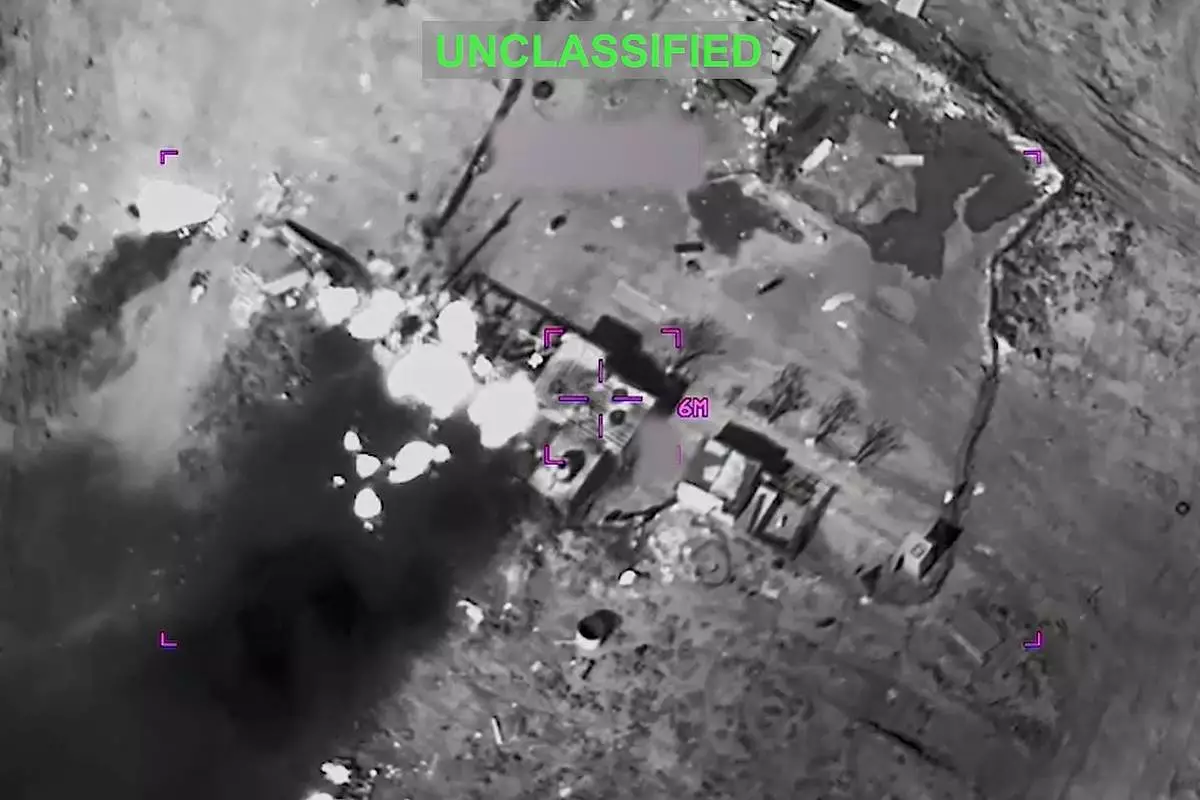
This partially redacted image from video provided by U.S. Central Command shows a complex of structures in Iran being struck by missiles fired by U.S. forces on Sunday, March 1, 2026. (U.S. Central Command via AP)

President Donald Trump walks past Defense Secretary Pete Hegseth as he exist the East Room of the White House following the Medal of Honor ceremony, Monday, March 2, 2026, in Washington. (AP Photo/Mark Schiefelbein)
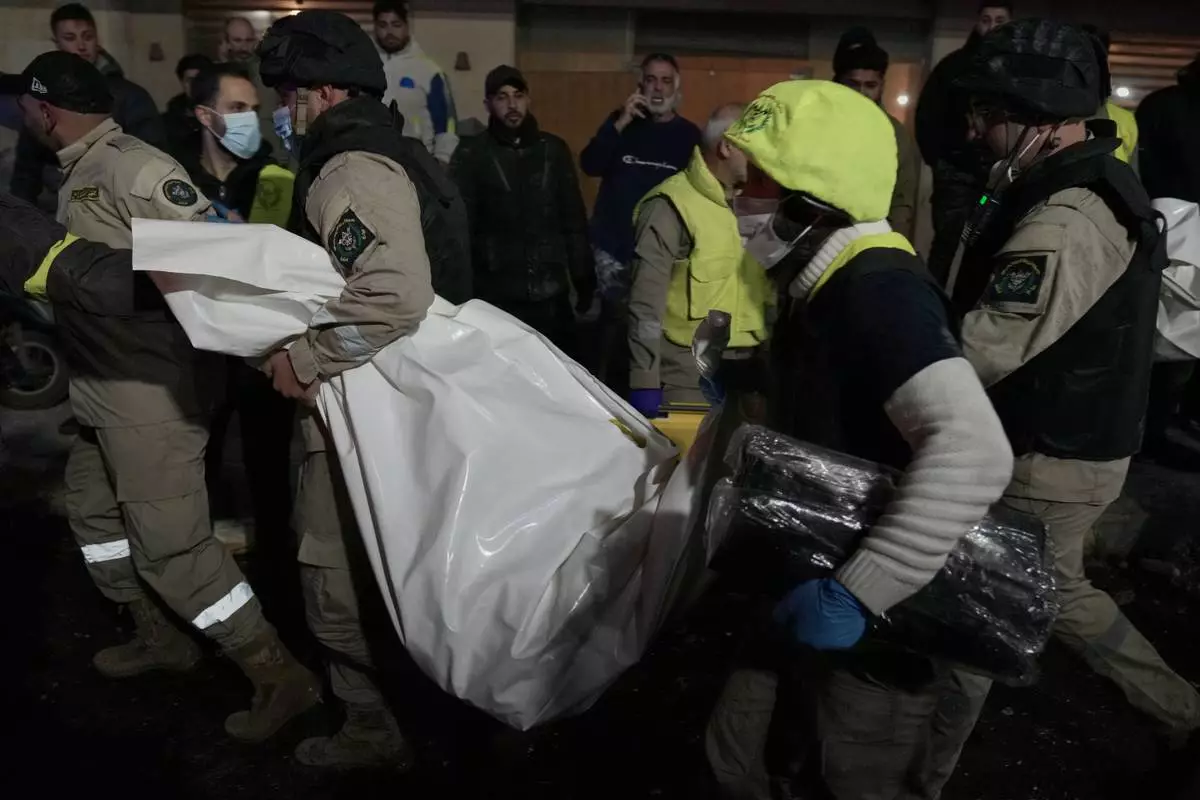
Rescue workers carry a dead body in a plastic bag from a building that was hit by Israeli strike, in Jnah neighborhood, south of Beirut, Lebanon, Monday, March 2, 2026. (AP Photo/Hussein Malla)
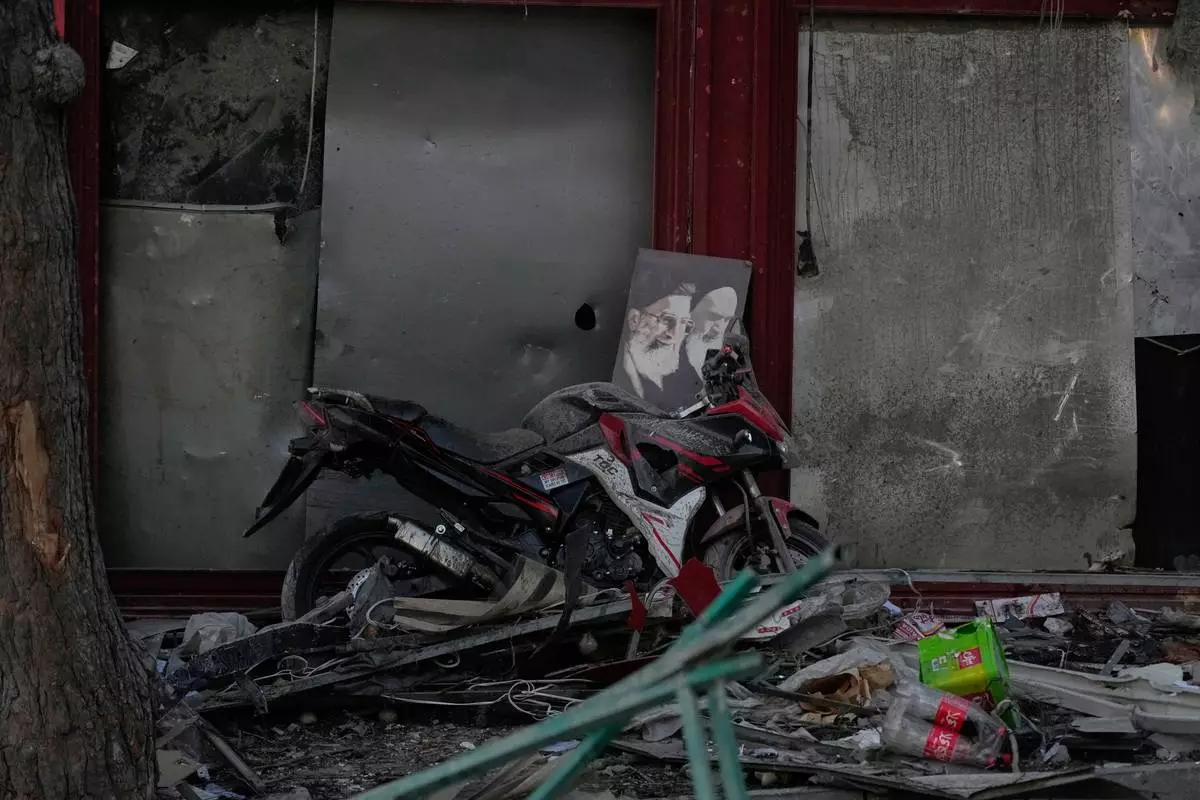
A poster of the late Supreme Leader Ayatollah Ali Khamenei, who was killed during the ongoing joint U.S.-Israeli military campaign, and the late Iranian Revolutionary founder Ayatollah Khomeini, right, lays on a motorcycle amid debris left by a strike in Tehran, Iran, Monday, March 2, 2026. (AP Photo/Vahid Salemi)
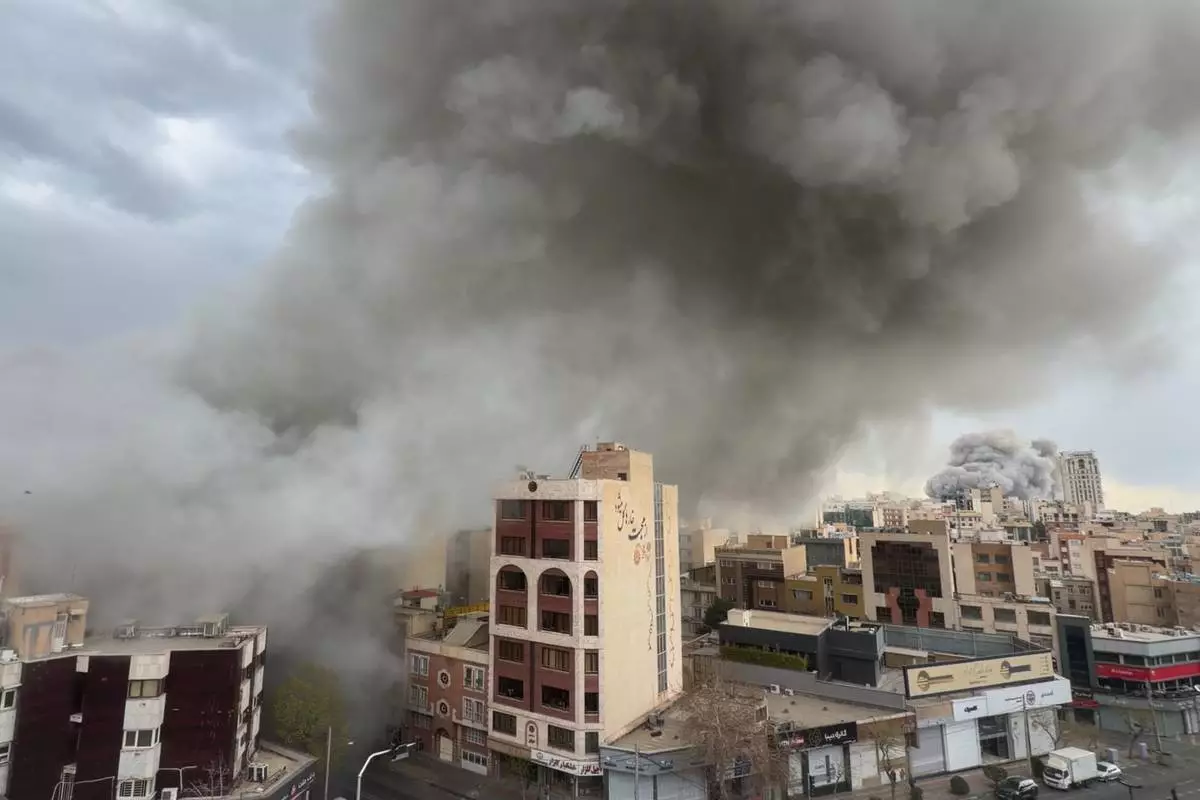
Plumes of smoke from two simultaneous strikes rise over Tehran, Iran, Monday, March 2, 2026. (AP Photo/Mohsen Ganji)