AMSTERDAM--(BUSINESS WIRE)--Mar 3, 2026--
TestGorilla, the skills-based hiring platform trusted by thousands of organisations worldwide, today announced a suite of new assessments and simulation tests purpose-built to help talent acquisition teams evaluate AI readiness and AI fluency off the back of the company’s flagship event: Hire for the AI Era.
This press release features multimedia. View the full release here: https://www.businesswire.com/news/home/20260303398545/en/
The launch coincides with a crucial shift in the hiring landscape. TestGorilla co-founder and CEO Wouter Durville shared data at the event highlighting this change: 70% of companies now report integrating AI into their core workforces, and 71% of leaders prioritize AI skills over years of experience in recruitment. Although 95% of companies cite AI literacy as an active hiring factor, most existing hiring processes remain rooted in a pre-AI reality. As Durville noted, “AI has permanently altered the signal in hiring.”
The Science Behind the Assessments: TestGorilla’s AI Fluency Framework
All new products are underpinned by TestGorilla’s proprietary five-pillar AI Fluency Framework, developed by the company’s in-house team of organisational scientists and psychologists. The framework defines AI fluency not as a single skill, but as five measurable dimensions that together determine whether a candidate can operate effectively and responsibly in an AI-augmented workplace:
“ AI fluency isn’t just prompt engineering,” said Durville. “It’s all five aspects working together and the good news is you can measure all of them.”
AI Video Interviews and Simulation Tests
TestGorilla has launched two new AI video interview assessments built directly on the framework:
In addition, over 70 existing AI video interviews have been updated to embed one to two AI fluency questions directly into role-specific evaluation. An industry first where role-level AI readiness is assessed at scale.
Five new simulation tests are also now available, using the same conversational AI technology as TestGorilla’s video interviews: Algorithmic Reasoning, B2B Account Management, Conflict Handling for Customer Success, Soft Skills for Customer Success, and Tech Collaboration.
“The resume was built for a pre-AI world,” said Durville. “Updating your hiring stack isn’t optional anymore. It’s how you restore confidence in your signal and make great hires.”
All new features are available now in the TestGorilla platform.
About TestGorilla
TestGorilla is the global talent discovery platform that helps employers source and hire based on proven skills. With a pool of 2m+ skills-tested candidates, 350+ science-backed assessments, and AI-powered sourcing and evaluation, we give organizations a faster, fairer, and smarter way to hire.
Since launching in 2020, more than 60,000 organizations have used TestGorilla, and the platform now assesses 7 million candidates annually. Our vision is to put one billion people into their dream roles through skills-based hiring.
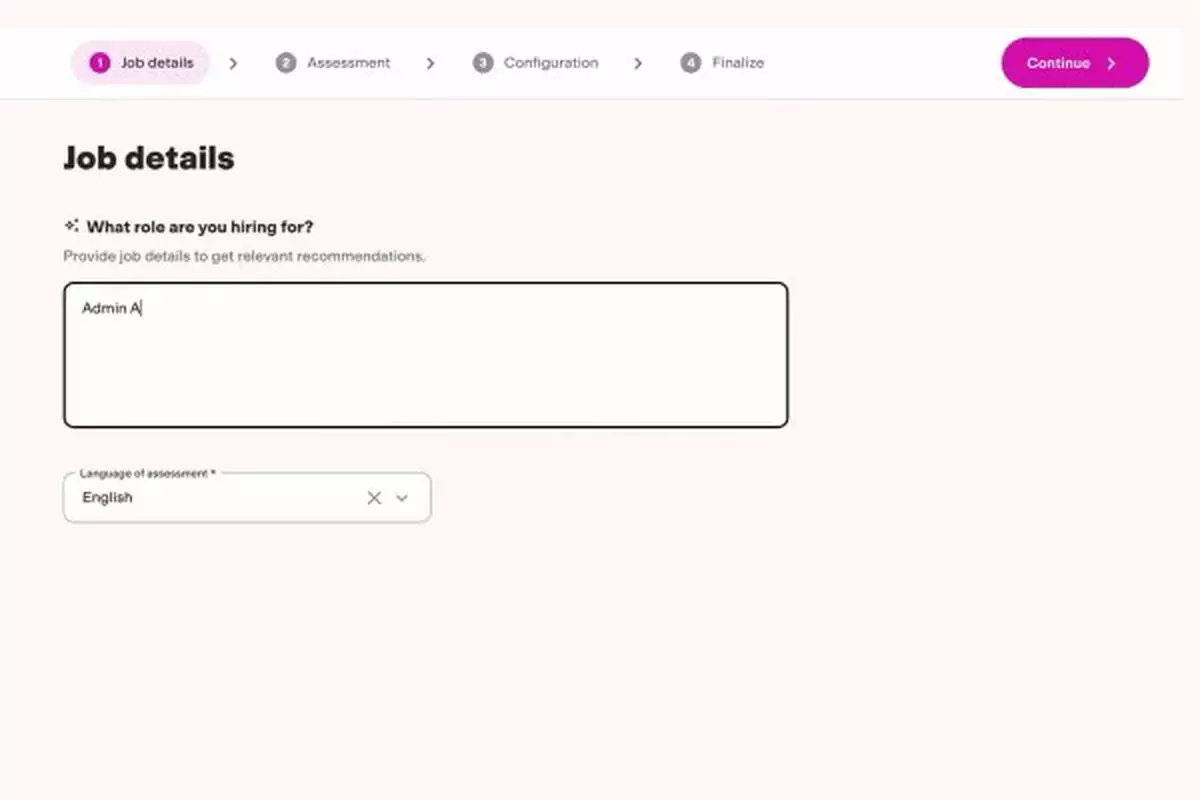
Use validated assessments and structured AI video interviews through the TestGorilla platform to measure different aspects of AI fluency across technical and non-technical roles. Inside the platform, tools are clearly labeled with AI fluency making it easy to find and build an assessment.
The Virginia Supreme Court on Friday struck down a voter-approved Democratic congressional redistricting plan, delivering another major setback to the party in a nationwide battle against Republicans for an edge in this year's midterm elections.
The court ruled 4-3 that the state's Democratic-led legislature violated procedural requirements when it placed the constitutional amendment on the ballot to authorize the mid-decade redistricting. Voters narrowly approved the amendment April 21, but the court's ruling renders the results of that vote meaningless.
Writing for the majority, Justice D. Arthur Kelsey wrote that the legislature submitted the proposed constitutional amendment to voters “in an unprecedented manner.”
“This violation irreparably undermines the integrity of the resulting referendum vote and renders it null and void," he wrote.
Democrats had hoped to win as many as four additional U.S. House seats under Virginia's redrawn U.S. House map as part of an attempt to offset Republican redistricting done elsewhere at the urging of President Donald Trump. That ruling, combined with a recent U.S. Supreme Court decision severely weakening the Voting Rights Act, has supercharged the Republicans' congressional gerrymandering advantage heading into this year's midterm elections.
Richard Hudson, chairman of the National Republican Congressional Committee said the ruling was another sign of GOP momentum heading into the midterms.
"We’re on offense, and we’re going to win,” he said in a statement.
Don Scott, the Democratic speaker of the Virginia House of Delegates, said Democrats respect the court’s opinion but lamented that it overturned the will of the voters: “They voted YES because they wanted to fight back against the Trump power grab.”
Suzan DelBene, chairwoman of the Democratic Congressional Campaign Committee, criticized the court majority for what she said was a decision that “cast aside the will of the voters,” but she said the people will have the final say.
“In November, they will, and they’ll power Democrats to the House majority,” she said in a statement.
Legislative voting districts typically are redrawn once a decade after each census to account for population changes. But Trump started an unusual flurry of mid-decade redistricting last year when he encouraged Republican officials in Texas to redraw districts in a bid to win several additional U.S. House seats and hold on to their party's narrow majority in the midterm elections.
California responded with new voter-approved districts drawn to Democrats' advantage, and Utah's top court imposed a new congressional map that also helps Democrats. Meanwhile, Republicans stand to gain from new House districts passed in Florida, Missouri, North Carolina, Ohio and Tennessee. They could add even more after the U.S. Supreme Court's ruling in the Voting Rights Act case, which has prompted some other Republican states to consider redrawing their maps in time for this year’s elections.
Virginia currently is represented in the U.S. House by six Democrats and five Republicans who were elected from districts imposed by a court after a bipartisan redistricting commission failed to agree on a map after the 2020 census. The new districts could have given Democrats an improved chance to win all but one of the state's 11 congressional seats.
The Supreme Court's majority was critical of the state’s redrawing of the congressional maps to benefit one political party. Those justices noted that 47% of the state’s voters supported GOP congressional candidates in 2024 but the new map could result in Democrats making up 91% of the state’s House delegation.
Under the Democratic-drawn map, five districts would have been anchored in the Democratic stronghold of northern Virginia, including one stretching out like a lobster to consume Republican-leaning rural areas. Revisions to four other districts across Richmond, southern Virginia and Hampton Roads would have diluted the voting power of conservative blocs in those areas. And a reshaped district in parts of western Virginia would have lumped together three Democratic-leaning college towns to offset other Republican voters.
The state Supreme Court’s seven justices are appointed by the state legislature, which has toggled back and forth between Democratic, Republican and split control over recent years. Legal experts say the body doesn’t have a set ideological profile
The case before the court focused not on the shape of the new districts but rather on the process the General Assembly used to authorize them.
Because the state’s redistricting commission was established by a voter-approved constitutional amendment, lawmakers had to propose an amendment to redraw the districts. That required approval of a resolution in two separate legislative sessions, with a state election sandwiched in between, to place the amendment on the ballot.
The legislature’s initial approval of the amendment occurred last October — while early voting was underway but before it concluded on the day of the general election. The legislature’s second vote on the amendment occurred after a new legislative session began in January. Lawmakers also approved a separate bill in February laying out the new districts, subject to voter approval of the constitutional amendment.
Judicial arguments focused on whether the legislature’s initial approval of the amendment came too late, because early voting already had begun for the 2025 general election.
Attorney Matthew Seligman, who defended the legislature, argued that the “election” should be defined narrowly to mean the Tuesday of the general election. In that case, the legislature’s first vote on the redistricting amendment occurred before the election and was constitutional, he told judges.
But, the Supreme Court said in its ruling, “this view appears to be wholly unprecedented in Virginia’s history.”
An attorney for the plaintiffs, Thomas McCarthy, argued that an “election” should be interpreted to cover the entire period during which people can cast ballots, which lasts several weeks in Virginia. If that’s the case, he told justices, then the legislature’s initial endorsement of the redistricting amendment came too late to comply with the state constitution.
The Supreme Court agreed with that argument, writing: “The General Assembly passed the proposed constitutional amendment for the first time well after voters had begun casting ballots during the 2025 general election.”
By the time lawmakers initially endorsed the constitutional amendment, statewide voters already had cast more than 1.3 million ballots in the general election, about 40% of the total votes ultimately cast, the court said.
The Supreme Court’s ruling affirms a decision by a judge in rural Tazewell County, in southwestern Virginia. The court had placed a hold on that ruling and allowed the redistricting vote to proceed before hearing arguments on the case.
In the dissent to Friday's ruling, Chief Justice Cleo Powell said the election for the purpose of considering the amendment does not include the early voting period.
“The majority’s definition creates an infinite voting loop that appears to have no established beginning,” she wrote, “only a definitive end: Election Day.”
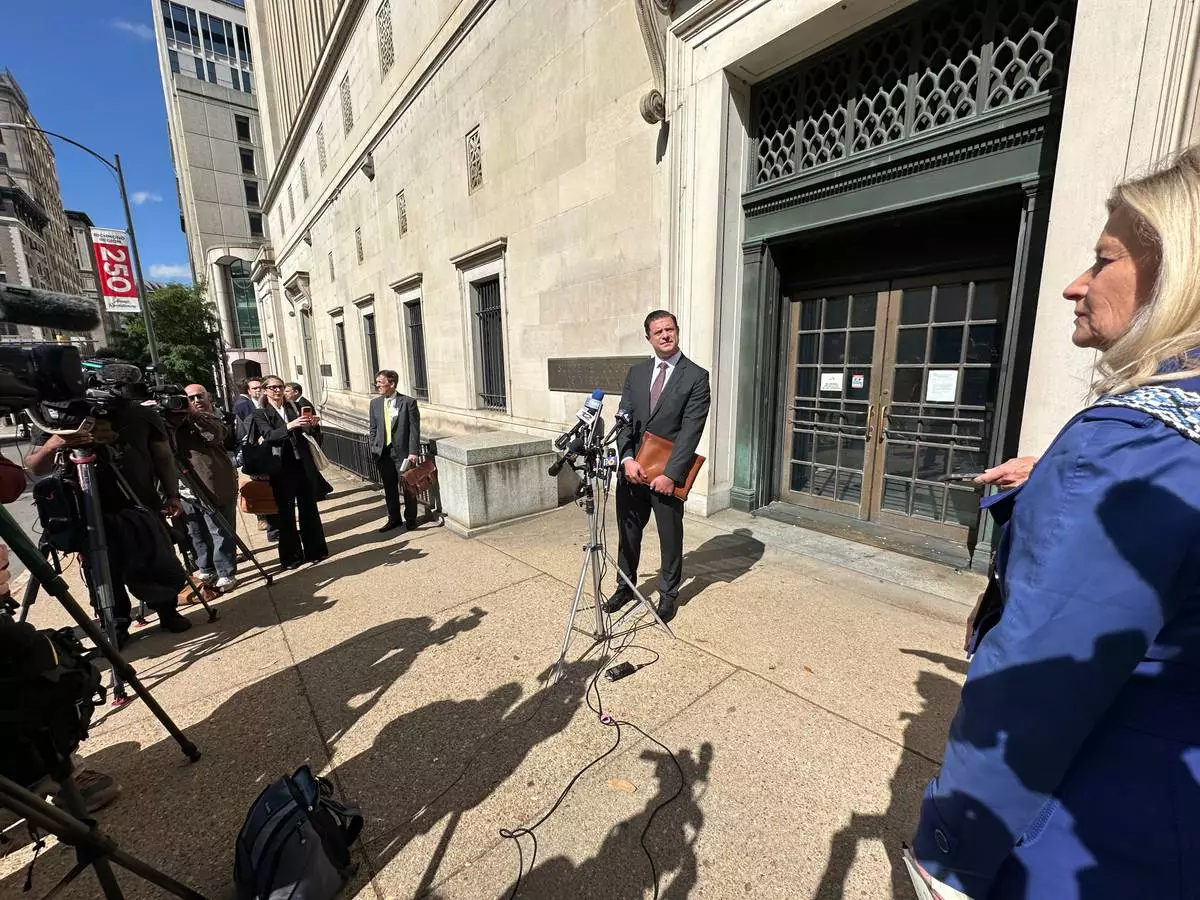
Attorney Matthew Seligman, representing Democratic state legislators, speaks with the media following a hearing on new congressional maps before the state Supreme Court in Richmond, Va., on Monday, April 27, 2026. (AP Photo/Allen G. Breed)
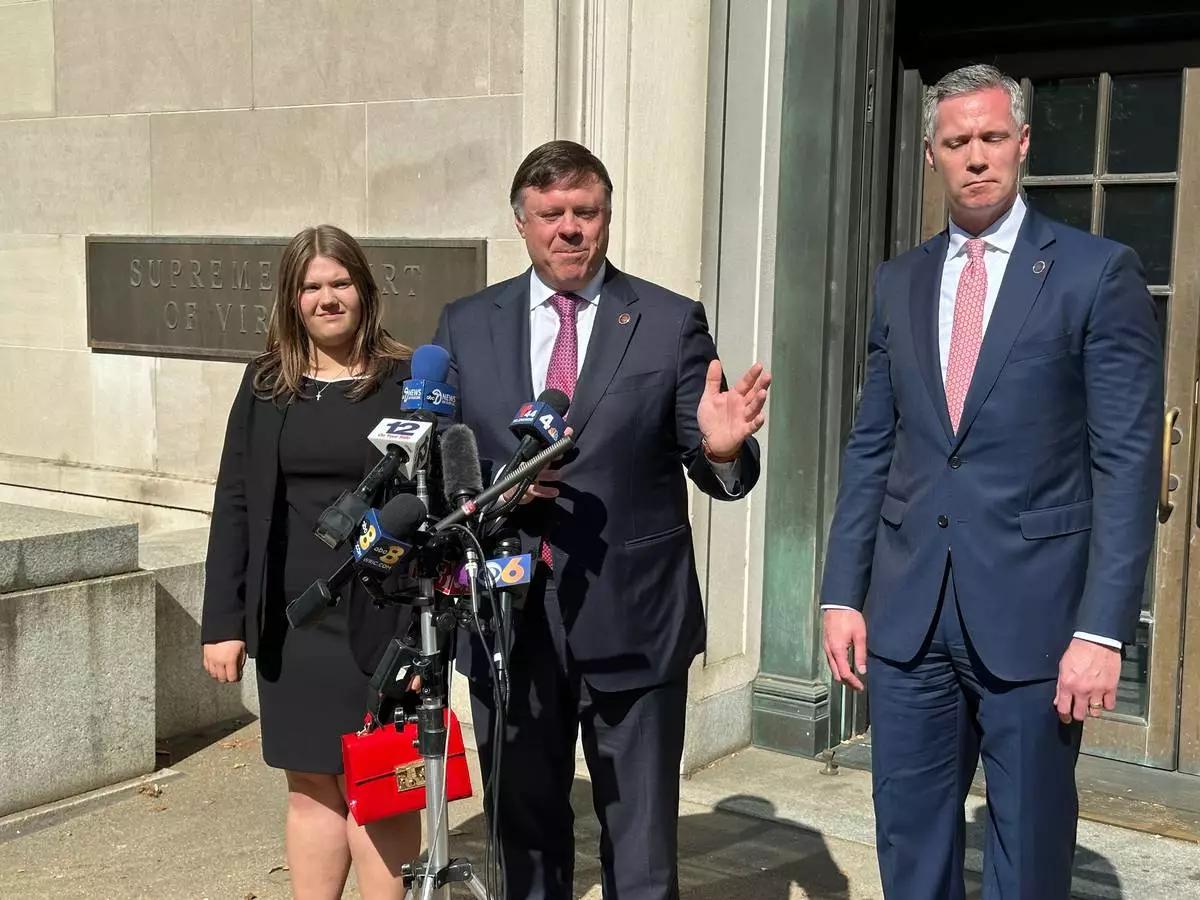
State Senate Minority Leader Ryan McDougle, center, speaks outside the Supreme Court of Virginia after arguments were heard in a redistricting-related case at the court in Richmond, Va., on Monday, April 27, 2026. (AP Photo/Allen G. Breed)