Park rangers in south China's Hainan have worked tirelessly to ensure a stable habitat for the Hainan Gibbons, a critically endangered primate with only some 42 individuals remaining.
Every member of the species resides within the trees of the Hainan Tropical Rainforest National Park. In the park's Bawangling section, rangers track them without marked trails, following in whichever direction the gibbons swing in the trees above.
"When we monitor the gibbons, there are no trails. Wherever they go, we go," said Liu Huiqin, a member of the gibbon monitoring team.
The gibbons move quickly, able to travel nearly a kilometer through the treetops in a single minute. Most of the time, rangers do not see them, but follow their calls that echo through the canopy.
"They're incredibly fast. One swing and they're gone," said ranger Huang Lubiao.
Today's population of just 42 is fragile, but it represents a remarkable recovery. In the late 1970s, after decades of logging and hunting, the population had dropped to just 7-9 individuals.
"When human disturbance damages the forest they depend on, gibbons are pushed into smaller and smaller spaces," said Liu.
As the scale of the loss became clear, ecological protection began to take priority over short-term economic gain.
In 2021, China established its first group of national parks, including Hainan Tropical Rainforest National Park, aiming to create large, connected conservation areas instead of fragmented reserves.
"We planted trees to reconnect forest patches so the gibbons can move freely," Huang said.
Conservation has also moved beyond boots on the ground. At Sun Yat-sen University, researchers developed an acoustic-AI monitoring system that identifies individual gibbons by their unique vocal patterns.
After analyzing more than 1,800 hours of recordings, the system can track family groups and detect changes over time.
"It helps us estimate the population size and determine whether new family groups have formed, or if males have been replaced. It allows for more effective monitoring of the species," said Ma Haigang, a Post PhD researcher at Sun Yat-sen University.
At the start of this year, China's National Parks Law came into effect, creating a unified legal framework for managing protected areas. The law emphasizes long-term, holistic protection as the country works toward building the world's largest national park system by 2035.
While the future of the Hainan gibbon remains uncertain, rangers continue to put their full effort into protecting the species, welcoming robust support from scientists and a growing legal framework.
"Seeing the gibbon population grow, that gives meaning to our work," said Liu.
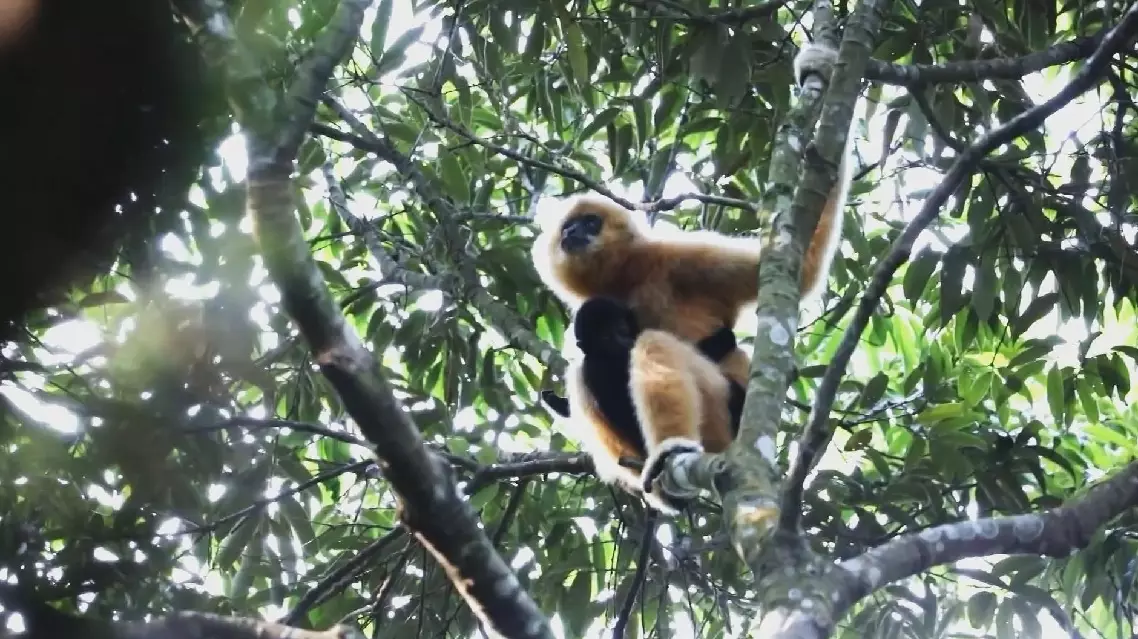
Hainan gibbon population rebounds to 42 with robust scientific, legal support