PLANO, Texas--(BUSINESS WIRE)--Mar 3, 2026--
As community supervision agencies nationwide confront rising caseloads, staffing shortages, and increasing demands for accountability, Securus Monitoring is showcasing its intelligence-driven approach to modern supervision at the American Probation and Parole Association (APPA) Winter Training Institute, held March 1 to 4 in Atlanta.
This press release features multimedia. View the full release here: https://www.businesswire.com/news/home/20260303201459/en/
With more than 20 years of partnership with probation and parole agencies, Securus Monitoring has helped shape the evolution of modern location monitoring. At APPA, the company is demonstrating how integrated hardware, real-time analytics, and 24/7 managed services combine to create a unified supervision ecosystem designed to enhance officer effectiveness, improve compliance outcomes, and strengthen community safety.
Community supervision teams are stretched thin,” said Don Burk, Vice President of Public Sector Solutions, Securus Technologies. “They are managing growing caseloads with limited resources, and that reality shapes everything they do. Effective supervision today goes beyond monitoring. It means having the right information at the right time, strong operational support, and technology that makes the job easier. We focus on delivering tools that have been tested in real-world environments and that help agencies strengthen public safety while supporting successful reentry.”
Unlike standalone monitoring providers, Securus Monitoring delivers a comprehensive supervision model that integrates devices, software, and managed services into a single operational framework. This approach enables officers to access real-time intelligence, streamline caseload management, and respond more quickly to potential risks, all while supporting individuals in maintaining employment, attending treatment, and complying with supervision conditions.
At APPA, Securus Monitoring is highlighting its comprehensive suite of monitoring and intelligence solutions, designed to support agencies across the full supervision lifecycle:
When these solutions come together, agencies get a system that helps them modernize day-to-day operations, spend less time on paperwork, and focus their energy where it has the greatest impact.
In addition to technology demonstrations at Booth #420, Securus Monitoring is supporting the APPA Career Fair and hosting sessions on second chance employment and personal brand development. These efforts reflect a clear belief: when people have access to jobs, stability, and support, supervision works better for everyone.
As agencies work to modernize supervision and strike the right balance between accountability and rehabilitation, Securus Monitoring continues to invest in innovation that delivers real world results. By combining proven technology with hands on supervision experience, the company supports officers in the field, strengthens public safety, and helps create pathways to second chances.
APPA attendees are encouraged to visit Securus Monitoring at Booth #420 or learn more about its supervision solutions here: https://cloud.e.aventiv.com/winter26APPA.
For more information, visit https://securusmonitoring.com.
About Securus Monitoring
Securus Monitoring, an Aventiv Technologies company, is the nation’s most experienced and innovative provider of electronic monitoring and facility intelligence solutions. As the original GPS monitoring pioneer, Securus introduced BLUtag®, the industry’s first one-piece GPS device, now in its eighth generation with advanced tamper detection, dual SIM technology, and seamless nationwide coverage. The company provides a combination of field-tested hardware, robust software like VeriTracks®, and 24/7 managed services via the Securus Monitoring Center. With a legacy of innovation, scale, and reliability, Securus Monitoring is the trusted partner helping agencies protect communities, enhance operations, and enable better outcomes. Learn more at https://securusmonitoring.com.

APPA 2026

APPA 2026
The midterm elections officially begin Tuesday with primaries in Texas, North Carolina and Arkansas. As war with Iran breaks out, Democrats and Republicans are figuring out who they want to lead their party into November’s general election, when control of Congress and statehouses around the country will be up for grabs.
The most hotly contested races of the day are in Texas, with fierce competition on both sides of the aisle for U.S. Senate nominations. It’s possible that the Republican campaign will continue into a runoff.
Here's the latest:
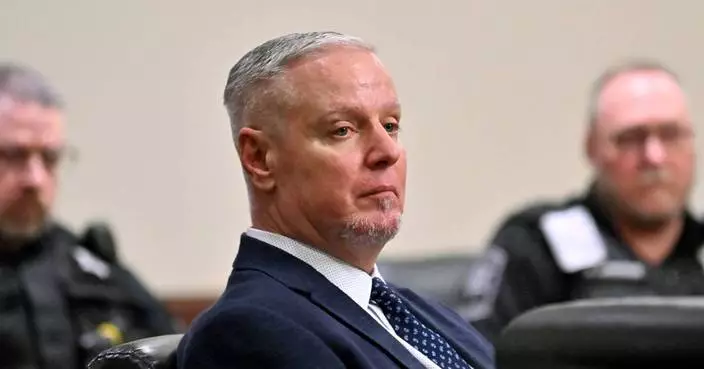
That’s because an Arkansas father accused of killing his daughter’s alleged abuser is running for sheriff while awaiting trial for murder.
Aaron Spencer, an Army veteran and farmer, is running as a Republican against Lonoke County Sheriff John Staley, whose department arrested Spencer in October 2024. A third Republican, David Bufford, also is on the ballot in that race.
Spencer’s trial was scheduled to start in January, but was delayed after the presiding judge was removed from the case.
And he argues that scenario is especially plausible if he doesn’t win the GOP primary in Texas.
“Republican voters are going to need to decide, do we want to win? Do we want to keep Texas red? If the Attorney General (Ken Paxton) is the nominee, that risks everything we’ve been working on for decades in Texas, with Republican leadership and conservative policies making Texas the envy of the nation,” Cornyn said on Fox News on Tuesday morning.
Cornyn faces a crowded field in the party primary, drawing challenges from Paxton, U.S. Rep. Wesley Hunt and five others.
Tanu Sani, a Democrat, said she had been undecided on who to vote for but ultimately chose state Rep. James Talarico, saying he “really spoke to me in the way he tries to unify.”
Andrew Kern, who said he leans Democrat, said he went the same way. Kern said he feels Talarico “is taking an approach that’s bridging some of the divisiveness.”
Sen. Tom Cotton was unopposed in his 2014 and 2020 primaries, and Sanders and Republican U.S. Sen. John Boozman won their 2022 primaries with 83% and 66% of the vote, respectively.
Cotton faces two challengers this year. Republican Gov. Sarah Huckabee Sanders, who is seeking a second term, is running unopposed in the primary.
The state’s Republican lieutenant governor, attorney general, auditor and treasurer also face no primary challengers in their reelection bids.
In almost all cases, races can be called well before all votes have been counted. The AP’s team of election journalists and analysts will call a race as soon as a clear winner can be determined.
In competitive races, AP analysts may need to wait until additional votes are tallied or to confirm specific information about how many ballots are left to count.
Competitive races in which votes are actively being tabulated — for example, in states that count a large number of votes after election night — might be considered “too early to call.” A race may be “too close to call” if a race is so close that there’s no clear winner even once all ballots except for provisional and late-arriving absentee ballots have been counted.
The AP’s race calls are not predictions and are not based on speculation. They are declarations based on an analysis of vote results and other election data that one candidate has emerged as the winner and that no other candidate in the race will be able to overtake the winner once all the votes have been counted.
The AP’s vote count brings together information that otherwise might not be available online for days or weeks after an election or is scattered across hundreds of local websites. Without national standards or consistent expectations across states, it also ensures the data is in a standard format, uses standard terms and undergoes rigorous quality control.
The AP hires vote count reporters who work with local election officials to collect results directly from counties or precincts where votes are first counted. These reporters submit them, by phone or electronically, as soon as the results are available. If any of the results are available from state or county websites, the AP will gather the results from there, too.
In many cases, counties will update vote totals as they count ballots throughout the night. The AP is continually updating its count as these results are released. In a general election, the AP will make as many as 21,000 vote updates per hour.
The 2026 midterm season begins in earnest Tuesday with two of the nation’s most consequential Senate primaries playing out in Texas, a political behemoth Democrats have been fighting to flip for decades.
Is this the year? Republican leaders in Washington openly fret that a victory by conservative firebrand Ken Paxton over four-term incumbent Sen. John Cornyn would give Democrats a rare shot of winning the seat come November. The contest has already cost Republicans tens of millions of dollars, and there will be much more spent ahead of a May 26 runoff if no one gets 50% in the three-way primary that also includes Rep. Wesley Hunt.
Democrats, meanwhile, are picking between two rising stars with conflicting styles. There’s U.S. Rep. Jasmine Crockett, who made a name for herself through confrontation, and state Rep. James Talarico, a former middle school teacher who’s working toward a divinity degree.
▶ Read more
The United States doesn’t have a nationwide body that collects and releases election results. Elections are administered locally, by thousands of offices, following standards set by the states. In many cases, the states themselves don’t even offer up-to-date tracking of election results.
The AP fills this gap by compiling vote results and declaring winners in elections, providing critical information in the period between Election Day and the official certification of results, which typically takes weeks.
Republican Gov. Greg Abbott said in January that the state should seize control of elections in Harris County, which includes Houston and is a key battleground.
His comments continued years of Republican criticism over how elections are run in the county of more than 5 million, where Hispanic and Black residents make up a majority. Democrats have controlled the county since 2018.
Abbott signed laws that eliminated Harris County’s independent elections administrator and banned drive-thru voting in Houston. And last year he waited nine months to hold a special election to fill a U.S. House seat representing Houston, saying the county needed extra time to prepare for a vote without any problems.
Democrats accused Abbott of delaying that election to help Republicans maintain their razor-thin margin in the House.
Republican incumbents, including U.S. Sen. Tom Cotton, are heavy favorites to win their primaries in Arkansas.
Cotton, who is seeking his third term in office, will face Jeb Little, an Arkansas State Police trooper, and Micah Ashby, a minister from Bradford.
Republican Gov. Sarah Huckabee Sanders, who served as President Donald Trump’s press secretary during Trump’s first term, is seeking her second term in office. She did not draw a Republican opponent.
Arkansas hasn’t elected a Democrat statewide since 2010, and Sanders and Cotton will be heavy favorites to win reelection in November.
Polls have now opened for voters in El Paso and Hudspeth counties, an area of about 1 million people on the western tip of Texas in the Mountain Time Zone.
Polls in Arkansas are open from 7:30 a.m. to 7:30 p.m., and voters are required to show photo identification before voting.
About 2,600 sites opened statewide at 6:30 a.m. ET and will close at 7:30 p.m. ET. Some ballots have already been cast by mail or during an early in-person voting period that ended Saturday.
There’s an open race for a seat in the U.S. Senate because Republican Sen. Thom Tillis decided not to seek reelection after clashing with Trump. Former Gov. Roy Cooper is seeking the Democratic nomination, while former Republican National Committee Chairman Michael Whatley is running to represent his party.
Voters are also picking nominees for U.S. House seats, including the Republican choice to challenge Democratic Rep. Don Davis in the 1st District. That district became more Republican as state legislators redrew it during Trump’s redistricting effort to help his party maintain control of the House.
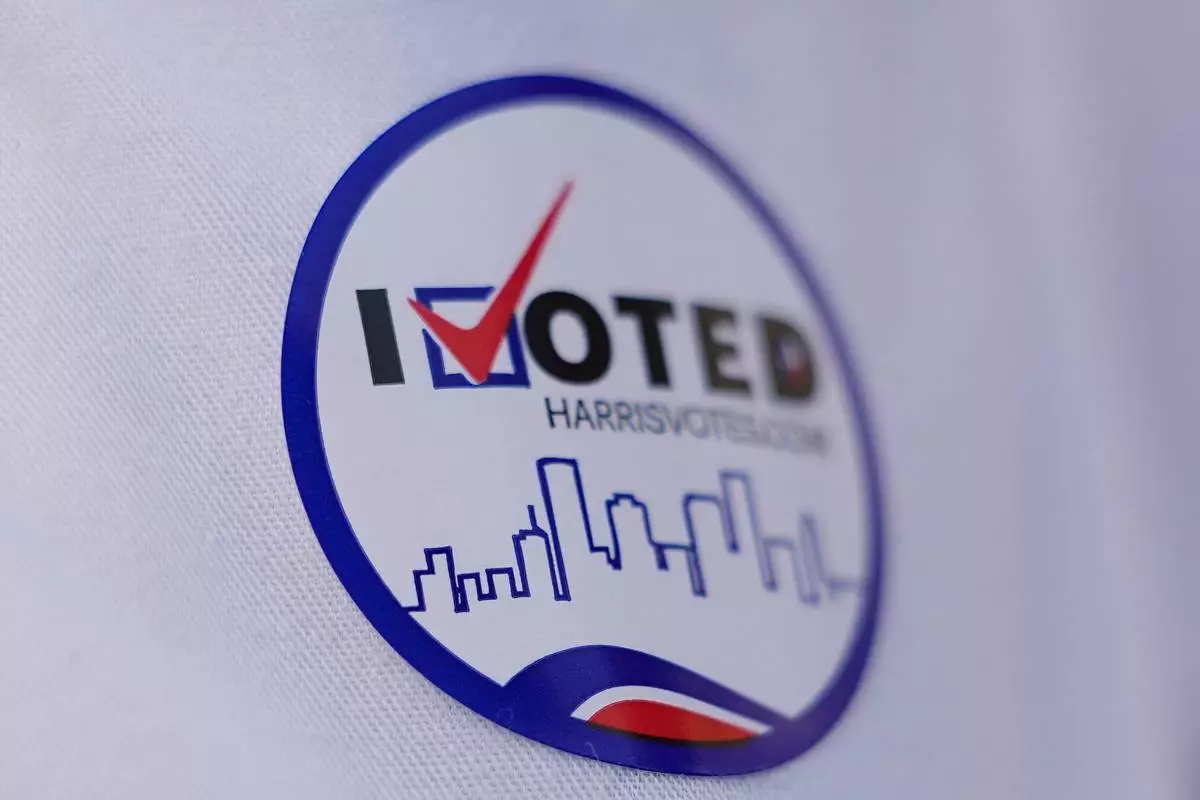
A man wears an "I voted" sticker outside a polling location Tuesday, March 3, 2026, in Spring, Texas. (AP Photo/David J. Phillip)
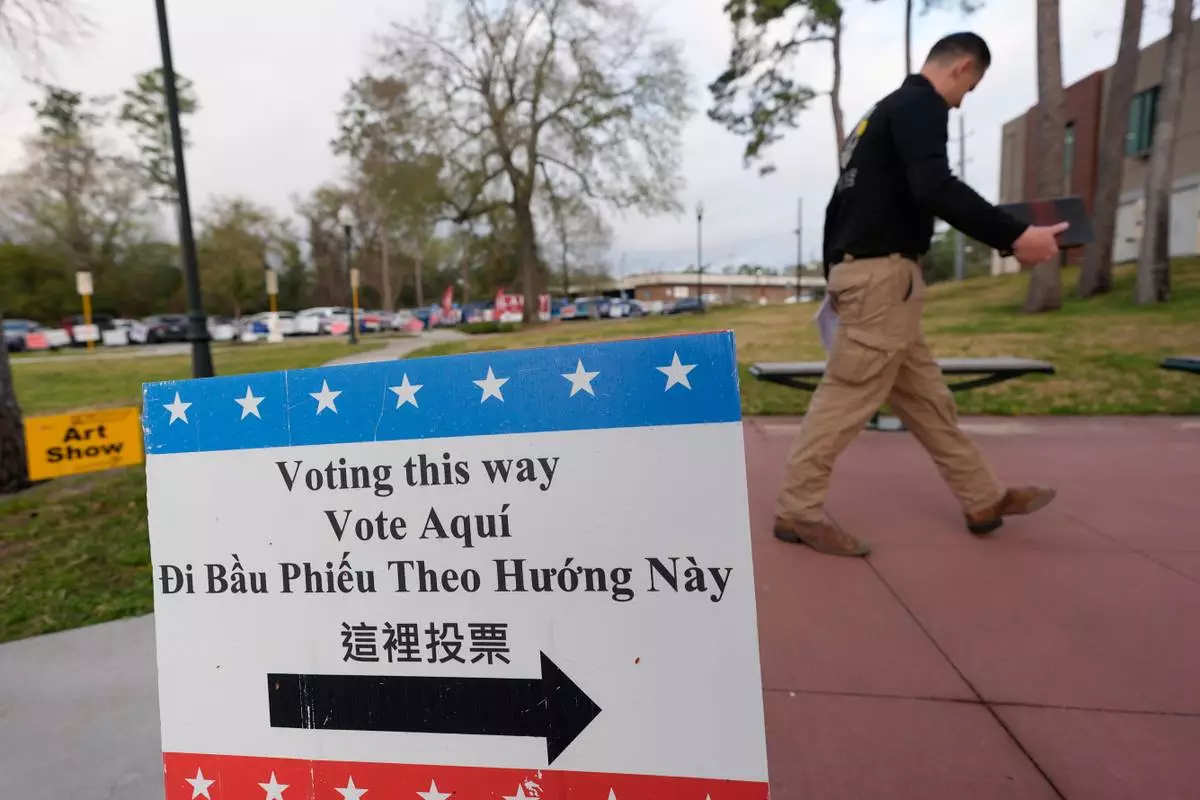
A voter makes his way into a polling location, Tuesday, March 3, 2026, in Spring, Texas. (AP Photo/David J. Phillip)
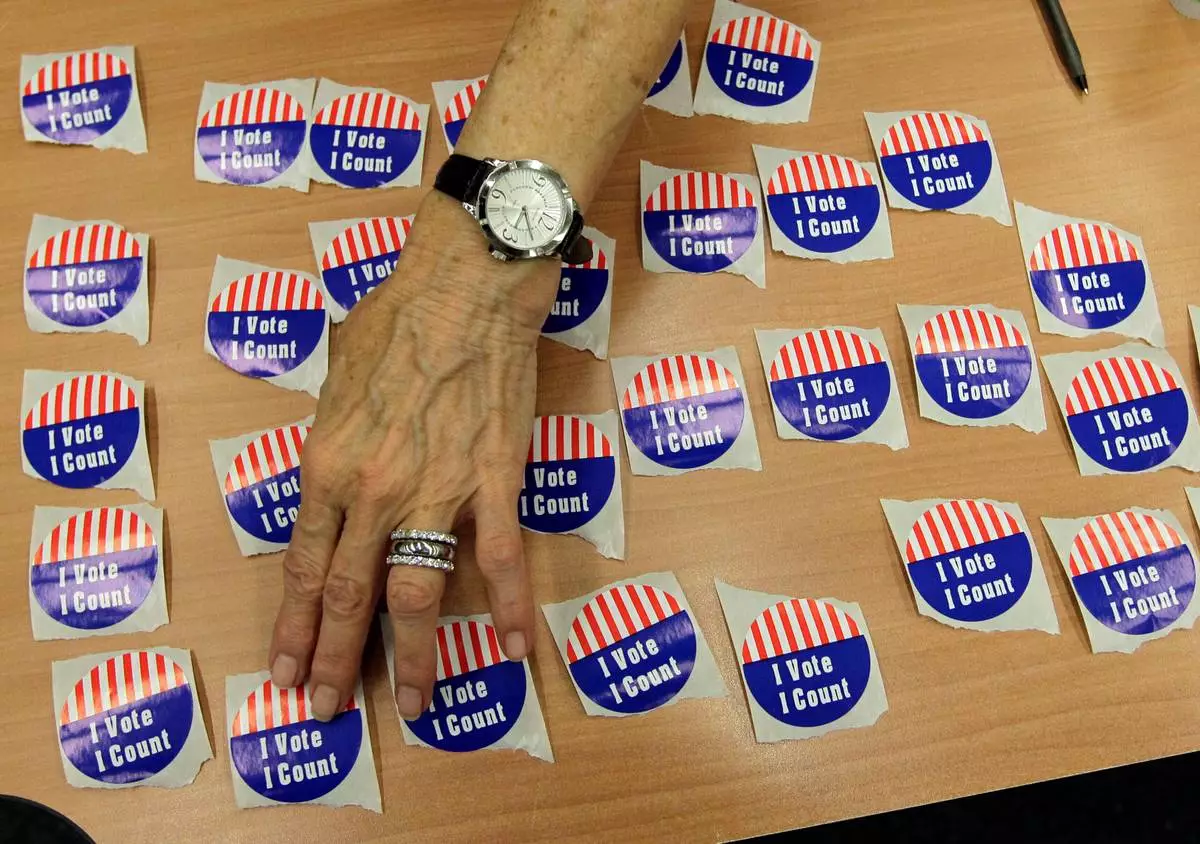
FILE - An election judge arranges "I Vote, I Count" stickers on a table in the Marion County Clerks office as voters cast early ballots in Indianapolis, Oct. 22, 2012. (AP Photo/Michael Conroy, File)