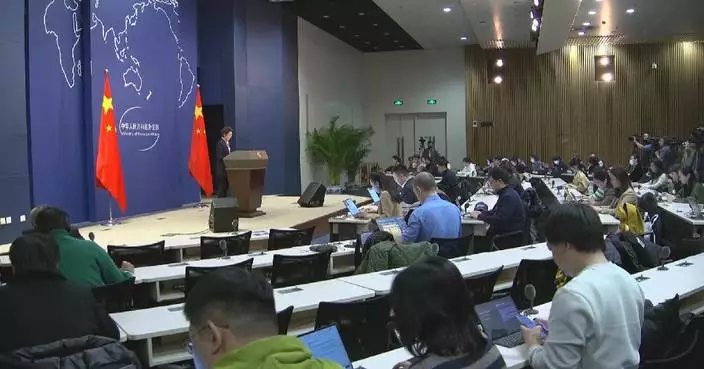
China's 15th Five-Year Plan proposal sends a strong signal of the country's commitment to upholding openness and cooperation, which will promote further development for the country and the world, said officials and scholars around the world.
The draft 15th Five-Year Plan, the blueprint that will guide the world's second-largest economy from 2026 to 2030, is central to steer China to move toward modernization amid technological disruption, demographic shifts and an increasingly fractured global order, according to the scholars.
"China's 15th Five-Year Plan is not a rigid model; it is more like benchmarks for growth targets and focal points. Chinese economists and economic decision-makers are not just focusing on qualitative growth, but also on innovative development. We're witnessing new transportation methods, robotics and artificial intelligence," said Andrey Denisov, first deputy chair of Russia's Federation Council Committee on Foreign Affairs and former Russian Ambassador to China.
"The 15th Five-Year Plan is of great importance to China's development. The country is poised to make remarkable advancements in various sectors, including artificial intelligence, high-end manufacturing and infrastructure construction. Given the shifting global context and China's transition towards high-quality development, I am confident that this plan will herald a new era for China's development," said Kamel Mansari, news director of the French-language daily Le Jeune Independent.
Scholars also noted that China's commitment to high-quality development and high-level opening-up will promote win-win results and benefit the world.
"China has emerged as a key partner for most countries worldwide, and a preferred partner due to its closeness and integration with global communities, as well as its strong humanitarian perspective. The Chinese economy has not only benefited itself; it has helped many economies worldwide flourish through its partnerships," said Dirgham Muhammad Ali, an Iraqi economic expert.
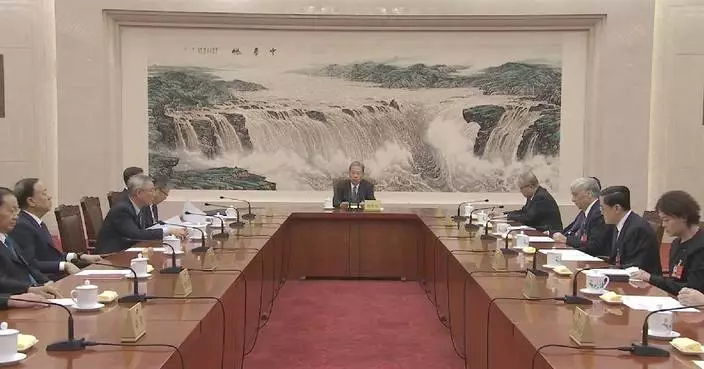
China's National People's Congress (NPC) is scheduled to open in Beijing on Wednesday, with lawmakers set to approve the 15th Five-Year Plan.
15th Five-Year Plan to guide China's development, benefit world: scholars
As China's national lawmakers and political advisors are gathering in Beijing for the annual meetings, foreign observers say that the meetings will not only set the course for China's future development, but also contribute to global economic growth.
The fourth session of the 14th National Committee of the Chinese People's Political Consultative Conference (CPPCC), China's top political advisory body, opened on Wednesday, while the fourth session of the 14th National People's Congress, China's supreme organ of state power, is scheduled for Thursday.
These meetings serve both as a review of past achievements and as a strategic compass guiding the nation's future development, as China embarks on the inaugural year of its 15th Five-Year Plan (2026-2030) period.
Marina Ragus, deputy speaker of Serbia's National Assembly, said that the meetings are important not only for China, but also for countries such as Serbia, which participates in the Belt and Road Initiative and is a part of a community of shared future with China.
"This is the first year of the 15th in a row five-year plan. What will be the significance of this is the kind of a road-map for China internally, but also globally. Not only that, if the main focal point of this five-year plan is quality, innovation, science, technology, that is kind of engine for the world's economy. We are part of the Belt and Road Initiative. We are part the community of shared future with China. So, for us as well, 'two sessions' are the most important event for a future to come," said Ragus.
Marcos Cordeiro Pires, a professor on the international political economy at Sao Paulo State University in Brazil, said that the 15th Five-year Plan is set to have far-reaching effects on the global economy.
"I would like to highlight two points [in the 15th Five-year Plan] that are of great importance for Brazil and other countries. The first is the priority placed on the green transition. The second concerns openness in global trade. China has become a new safe harbor at a time when some countries are adopting protectionist policies that hinder the integration of the world economy," said Pires.
As China's push for high-quality development is progressing steadily, international observers expect a stable and growing Chinese economy to inject more momentum and opportunities into the world economy.
Foreign observers say China's two sessions carry global significance