Sci-tech innovation is leading China's modernization and the path forward is paved with technological and industrial breakthroughs.
China will build three international centers for sci-tech innovation and turn them into world-class innovation engines, according to a government work report submitted Thursday to the country's top legislature for deliberation.
The country will implement strategic deployment in fields such as AI, quantum tech, biotechnology and new energy, according to a draft outline of the 15th Five-Year Plan (2026-2030), also submitted Thursday.
The Plan puts a premium on accelerating tech progress, cultivating new growth drivers, and enhancing the quality of development. The central challenge is bridging the gap between cutting-edge research and tangible, real-world applications.
The 14th Five-Year Plan period (2021-2025) saw China achieve a wave of scientific breakthroughs, making strides in next-gen IT, new energy, and other frontier technologies that fueled the rise of emerging industries.
In 2024, China's production and sales of new energy vehicles surpassed 12 million units, accounting for more than 60 percent of the global total. This dominance is built on a foundation of technological breakthroughs, industrial upgrading, and a relentless focus on quality.
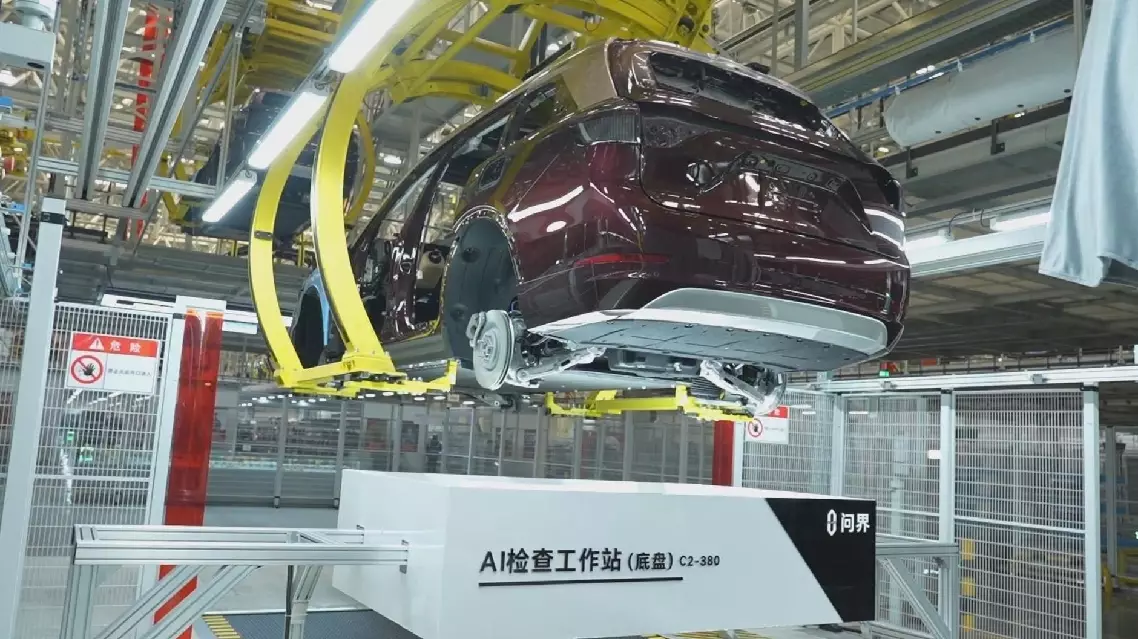
At the Seres Super Factory, a symphony of over 3,000 robots works in perfect sync, with key processes fully automated. For quality checks, an AI inspection system scans the car's under body - checking if all 80 bolts are locked in tight - all within one second.
"This AI-powered inspection system ensures deterministic management. We can now guarantee the quality of every single vehicle with absolute precision and certainty," said Cao Nan, general manager of Seres Super Factory.
Seres is a prime example of a broader trend. Sustained R and D investment and a maturing innovation ecosystem are driving a qualitative leap across the Chinese manufacturing. The 2024 Global Innovation Index ranked China as a top innovator, home to the world's largest number of science and technology clusters, 24 in the top 100.
"Building world-class manufacturing chains requires deep, long-term collaboration between government, industry, universities, research institutes, and end-users. We must solidify the enterprise's central role in innovation, fostering joint labs and testing bases with universities to ensure that technological development is precisely aligned with market demand," said Yang Huayong, dean of Faculty of Engineering at Zhejiang University.
China's tech-driven development powering up future

China will continue to implement a series of more proactive and effective macro policies in 2026 to keep driving the country's economic development, said one of the drafters of the government work report, which was submitted Thursday to the country's top legislature for deliberation.
Chen Changsheng, also deputy director of the Development Research Center of the State Council, made the remarks at a press conference held in Beijing on Thursday.
Chen said one of the reasons for continuing implementing more proactive and effective macro policies is to respond to the external environment.
In 2026, China is facing significant uncertainty both at home and abroad, and the country is also confronting strong supply and weak demand, with a gap in its aggregate demand remaining, he said.
Chen said it is necessary for the country to step up policy adjustment and use the certainty of macro policies to offset the uncertainty.
"Compared with other countries around the world, China's overall government debt ratio, particularly that of the central government, remains relatively low. There is still room for cuts in required reserve ratios and interest rates. Besides, there is also room for innovation in the policy mix. At the same time, continuing these policies also aims to send a signal to the society of continuing regulation through macro policies," said Chen.
Chen said China's macro policies will be implemented with greater intensity and wider scope in 2026.
"The deficit-to-GDP ratio remains at 4 percent, a relatively high level in history. The net increase in the deficit stands at 230 billion yuan (over 33 billion U.S. dollars). The scale of newly added government debt comes in at 11.89 trillion yuan, also a record high. Additionally, this year's general budget is expected to exceed 30 trillion yuan. More importantly, its net increase will reach 1.27 trillion yuan. All these demonstrate the stability of our macro and fiscal policies. Similarly, monetary policy will continue to be appropriately accommodative. Besides, we will flexibly employ policies such as cuts to required reserve ratios and interest rates to ensure ample liquidity. We will also implement policies such as policy-based monetary and financial tools with greater intensity and wider scope, with an aim to reduce financing costs across the whole society and support the real economy," said Chen.
The macro policies will also be more targeted and effective, he said.
"In terms of fiscal policy, special emphasis has been placed on deepening zero-based budgeting reforms, with the inefficiently and poorly used funds to be reallocated to more effective areas. The reform had been implemented for a period of time last year and had achieved some results. This year, efforts will be intensified. Additionally, we will further optimize the expenditure structure and make better use of existing funds to boost consumption, invest in people, and increase spending in people's wellbeing. Structural monetary policies will be improved to support small and medium-sized enterprises (SMEs), tech enterprises, and the expansion of domestic demand," said Chen.
China to continue implementing more proactive, effective macro policies to drive economic growth in 2026: official