Hundreds of stranded Chinese nationals arrived safely at Guangzhou's Baiyun airport in south China on Wednesday, the first group to return since Dubai International Airport resumed limited operations after Iranian attacks.
This comes as the United States and Israel launched strikes against Iran on Saturday, triggering retaliatory missile and drone attacks on U.S. bases across the Middle East. The escalation forced airlines to cancel thousands of flights after regional airspace closures.
Dubai International Airport, the world's busiest hub for international passenger traffic, was hit by massive explosions Saturday night when a terminal building took a direct strike, injuring four people. Video footage showed the interior devastated by the blast, with panicked travelers and staff fleeing for safety.
After more than 48 hours of complete shutdown, the airport announced Monday that a limited number of flights would resume.
Flight EK362, carrying 352 passengers, taxied to its stand at Guangzhou Baiyun International Airport at 22:00. Many of the travelers showed visible excitement and relief as they reunited with relatives and friends waiting to greet them.
"I was stuck at the airport for four days because flights were suspended. I'm so happy to be able to take the first flight home today. A great strong country is behind us. I'm truly grateful to our motherland," said a Chinese traveler.
"We work in Dubai and see many missiles flying over every day. We feel relieved from several days of strain after landing in China. Only after returning to China do I realize what true security is," said another traveler.
Due to ongoing tensions, it remains uncertain when regular flights between the Middle East and China will resume. For now, only Emirates Airlines has restarted limited services, prioritizing the evacuation of stranded passengers.
Flights from Dubai to Chinese cities such as Shanghai and Guangzhou are scheduled for Thursday, but several Chinese carriers have kept their Middle East routes suspended for safety reasons. "We offer full refunds for all tours to the Middle East from March 1 to mid-March, so most customers who were eligible for refunds have already received them. Currently, we have essentially closed all routes to the UAE, Bahrain, and Qatar on our system, and we will reopen them once the situation improves," said Han Chen, vice-general manager of a travel agency based in Shenzhen City.

Stranded Chinese nationals return safely to Guangzhou from Dubai
The Sudan conflict now in its fourth year has pushed millions into poverty, even forcing some families to rely on animal fodder to survive.
Fighting between the Sudanese Armed Forces and the paramilitary Rapid Support Forces (RSF) erupted in April 2023, following months of escalating tensions between Abdel Fattah al-Burhan, the army chief and head of Sudan's ruling council, and Mohamed Hamdan Dagalo, the RSF commander and al-Burhan's former deputy.
Nearly 6.9 million Sudanese were pushed into extreme poverty in 2023 alone, according to the United Nations Development Programme (UNDP). Currently, around 70 percent of the population are estimated to live in poverty in the country, compared with 38 percent before the war, said UNDP Resident Representative in Sudan Luca Renda.
At the Tawila Camp in North Darfur State, Salha Musa, a displaced widow from El Fasher, is struggling to provide her six children with minimal resources.
Water is available from wells, but other essential services are absent. Inflation and scarcity have forced families to rely on unconventional foods. Everyday staples have disappeared from local markets, leaving vulnerable families at risk of malnutrition.
"Since we arrived in Tawila a month ago, we've been suffering from a severe lack of services, except for water, which we draw from wells. We have no other services here, and we desperately need assistance. Our children aren't receiving an education, and I'm a nurse, but I can't find work," said Salha.
The UNDP warns that Sudan's economy has collapsed under the weight of the ongoing conflict, with GDP falling sharply and more than 13 million people displaced. Extreme poverty rates now surpass those of the 1980s.
"Life is incredibly difficult for us poor people. If we don't have money, what are we supposed to do? Will we starve to death? After the price of corn flour became so high, we stopped buying it. I don't know why they're raising prices or hoarding goods. Flour has completely disappeared from the markets here. After that, flour became expensive and unavailable," said Summia Ahmed, another displaced woman from El Fasher, adding that her family has even started relying on "Ombaz", a kind of animal fodder, as their food.
UNDP projections show that peace could lift millions out of extreme poverty, but delays and continued conflict risk locking the country into decades of low growth and deprivation.
For families like Salha's and Summia's, the road ahead remains uncertain, as conflict continues to dictate daily survival in Sudan.
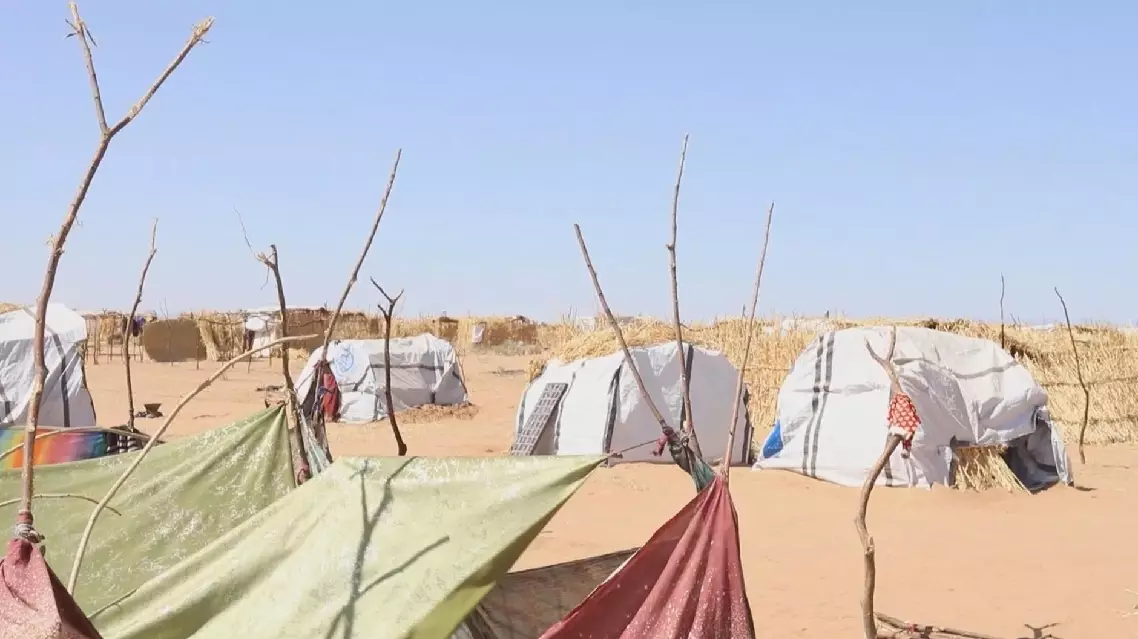
Sudan conflict pushes millions into poverty