Footage shot from the Iranian capital Tehran on Wednesday has shown supermarket shelves appearing well stocked and marketplaces still operating, with the government reportedly taking steps to ensure the supply of daily necessities amid the ongoing U.S. and Israeli strikes.
Although many residents have been forced to evacuate as missiles rain down on the city, life in much of Tehran is continuing.
Video taken by a China Global Television Network (CGTN) reporter showed markets and shops continuing to operate as usual, with efforts being made to ensure the supply of essential goods and key commodities.
Iran said on Thursday that 1,230 people have been killed in U.S. and Israeli strikes since fighting began on Saturday.
The death toll was announced by Iran's Foundation of Martyrs and Veterans Affairs in a statement on its website.

Footage from Tehran shows businesses operating, markets well stocked

Footage from Tehran shows businesses operating, markets well stocked
Linkerbot, a Beijing-based robotics startup, is at the forefront of China's efforts to accelerate the real-world deployment of humanoid robots by developing ultra-dexterous hands for embodied artificial intelligence (AI).
Founded in 2023, Linkerbot has developed a broad range of dexterous hands spanning varying degrees of flexibility, including one model that enabled a Linkerbot humanoid robot to perform precise keystrokes comparable with those of a top human pianist at the opening ceremony of the world's first-ever robotics competition, which was held in Beijing last August.
At the company's training lab, engineers teach robots to mimic all kinds of human movements from grabbing a ball and pouring a drink to treading a needle and playing the piano. The aim is to create robotic systems capable of performing tasks with increasing precision and adaptability, gradually approaching or surpassing human-like dexterity in specialized tasks.
Cao Gang, co-founder of Linkerbot, said the robot learning field, fueled by AI, has evolved in the past few years, and that his company today uses multimodal data collection and reinforcement learning to train robotic hands.
"In robot training, we first need to make plans and decide what kind of data to collect to teach it a certain task. After the data collection, the robot needs to go through algorithmic learning, before being able to make decisions on its own in performing the task. In the past, we would develop all kinds of training rules to teach the robot how to perform tasks. Now we hope to use large AI models and vast amounts of data to teach it different types of tasks," Cao said.
As China embraces embodied AI -- artificial intelligence integrated with physical agents, Linkerbot is working to develop more cutting-edge robots that can perform complex tasks in various scenarios.
"For embodied intelligence, we expect to make robotic hands capable of performing tasks in all sorts of environments, such as on factory assembly lines, or in our homes where they can help the elderly or people with disabilities," he said.
Highly intelligent and automated as the robots are, Cao believes that like all other technologies before AI, smart robots will only further empower humanity in the future, rather than completely replace human workers.
"Throughout the human history, we have invented all kinds of technologies that even we ourselves found beyond amazing. Whether it's the plane, computer, or automobile, they all have far more powerful capabilities that humans do. However, they have nowadays all become an integral part of our lives as our tools and companions," he said.
According to a government work report submitted Thursday to the country's top legislature for deliberation, China will advance and expand its "AI Plus" initiative, promote faster application of new-generation intelligent terminals and AI agents, and encourage large-scale commercial application of AI in key sectors and fields.
The country will encourage technological innovations in areas including multi-modal AI, AI agent, embodied AI and swarm intelligence, and explore development paths of artificial general intelligence, according to a draft outline of the 15th Five-Year Plan (2026-2030) also submitted on Thursday.
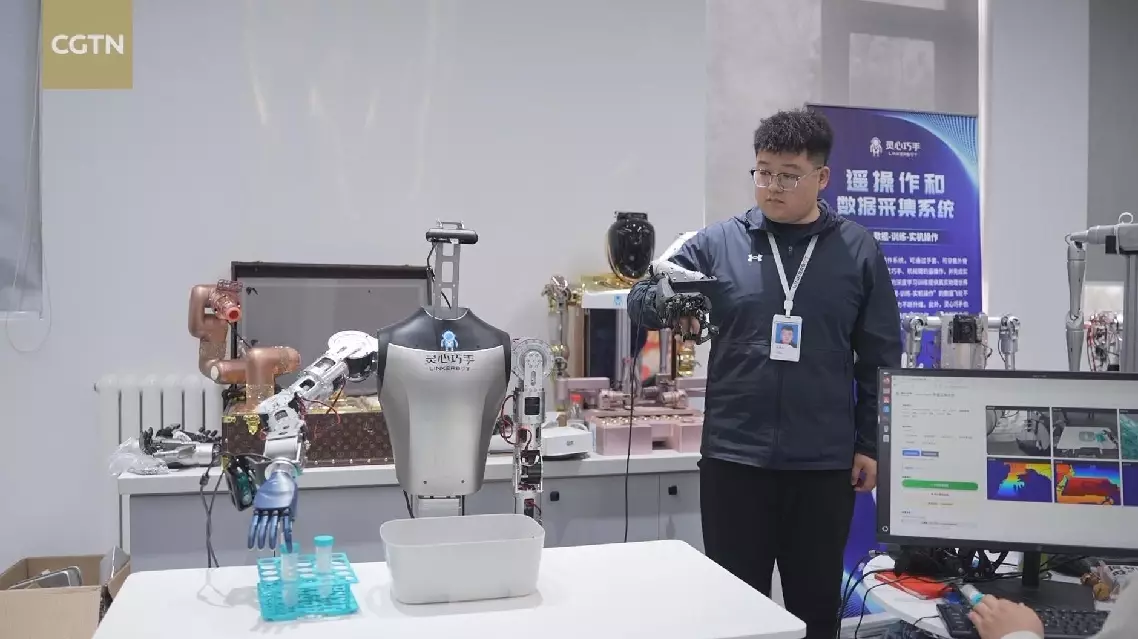
China's Linkerbot unveils AI-powered hands to advance humanoid robot deployment