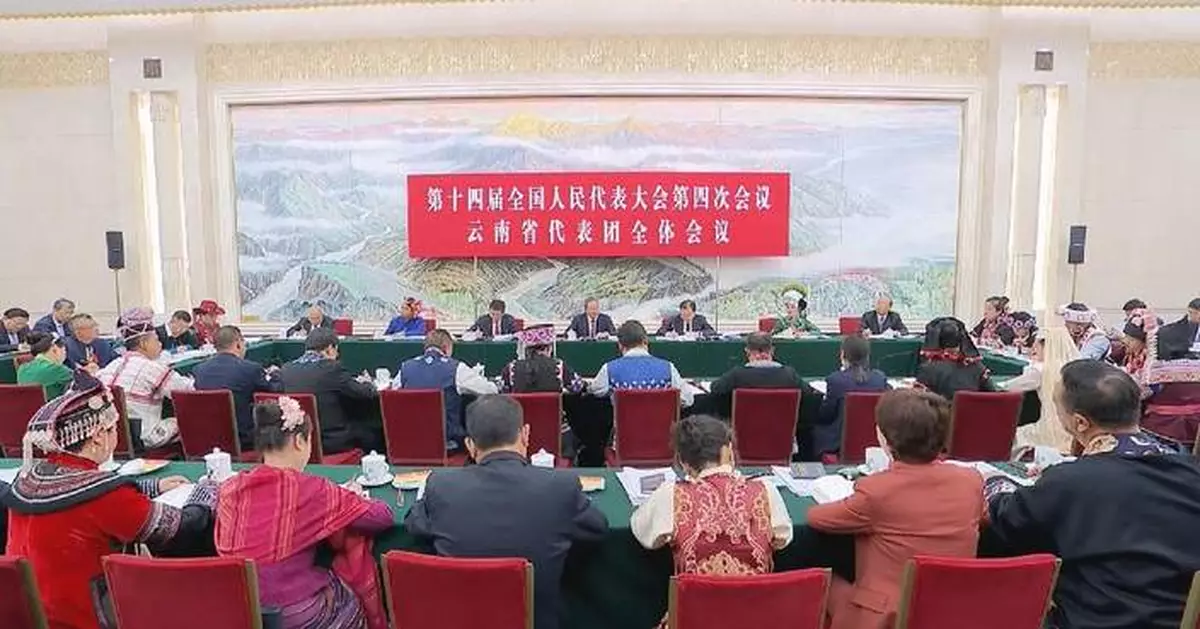
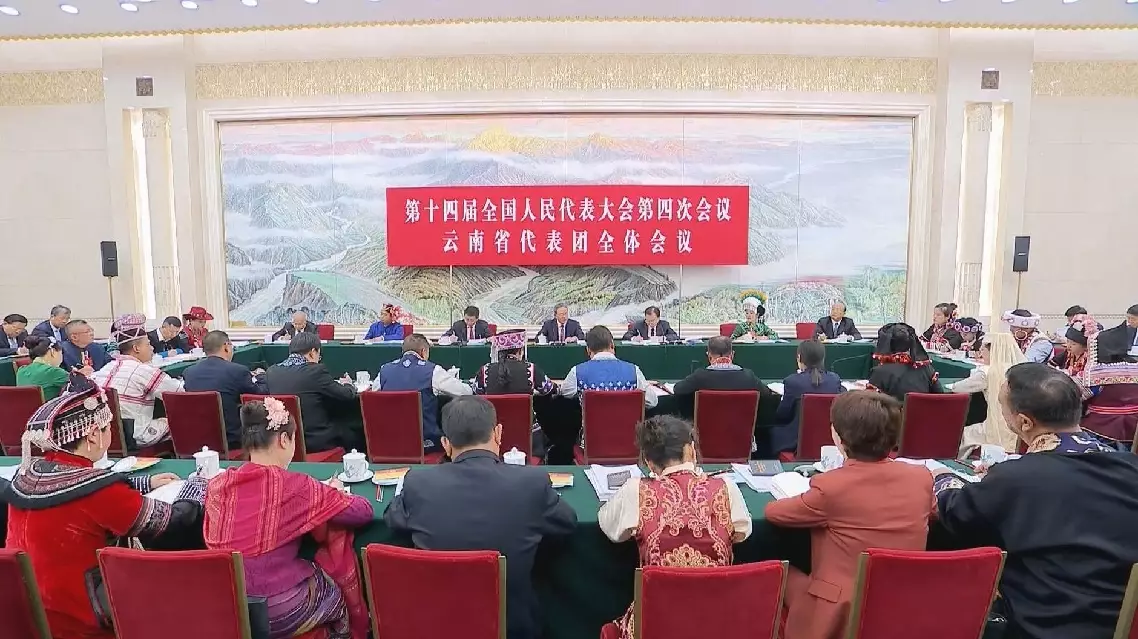
Senior Chinese leaders Li Qiang, Zhao Leji, Wang Huning, Ding Xuexiang, Li Xi and Han Zheng on Thursday attended group deliberations on this year's government work report.
The 14th National People's Congress (NPC), China's top legislature, opened its fourth session on Thursday morning at the Great Hall of the People in Beijing, during which Chinese Premier Li Qiang delivered a government work report.
When joining NPC deputies from southwest China's Yunnan Province in a group deliberation of the annual work report, Li, also a member of the Standing Committee of the Political Bureau of the CPC Central Committee, praised Yunnan's achievements over the past year and during the 14th Five-Year Plan period (2021-2025) in sustaining stable economic growth, improving people's livelihoods, and accelerating the province's development as a center with radiation effects for South and Southeast Asia.
Noting that this year marks the beginning of the 15th Five-Year Plan period (2026-2030), Li stressed the need for more proactive and pragmatic actions to effectively address various risks and challenges.
As global trade patterns and the domestic economic structure undergo profound adjustments, Yunnan's role in the country's overall development has become more prominent, the premier pointed out.
He called for vigorous development of modern services, innovation in tourism products and improvement in service quality, as well as deeper integration of culture, tourism, sports and other service sectors.
Li also emphasized every effort to guard against any large-scale lapse or relapse into poverty, and ensure sustained income growth for local residents.
When joining a group deliberation with fellow deputies from the southwestern Sichuan Province, Zhao Leji, a member of the Standing Committee of the Political Bureau of the CPC Central Committee and chairman of the NPC Standing Committee, said the government work report is a good report which contains a pragmatic and enterprising spirit, and a strong call for unity.
Zhao expressed hope that the province will effectively implement the 15th Five-Year Plan, build a modern industrial system with distinctive strengths, serve and integrate into the new development pattern, and promote coordinated economic and social progress.
Zhao emphasized the need to advance the work of people's congresses to a higher quality and ensure a solid start to the 15th Five-Year Plan.
Wang Huning, a member of the Standing Committee of the Political Bureau of the CPC Central Committee and chairman of the National Committee of the Chinese People's Political Consultative Conference (CPPCC), joined deputies from Guizhou Province in a group deliberation.
Expressing his support for the government work report, he called on the southwestern province to develop new quality productive forces in line with local conditions, and promote deep integration of sci-tech and industrial innovation.
Wang called for consolidating and expanding the achievements in poverty alleviation, accelerating all-round rural revitalization, and ensuring better protection and improvement of people's livelihoods, as well as fostering a strong sense of the Chinese nation as one community.
Ding Xuexiang, a member of the Standing Committee of the Political Bureau of the CPC Central Committee and Chinese vice premier, joined fellow deputies from northeast China's Liaoning Province to deliberate on the government work report.
Saying that he fully backs the government work report, Ding stressed the importance of advancing high-quality and sustainable development, fostering new quality productive forces and ensuring a smooth transition between traditional and emerging growth drivers.
Ding voiced hope that the province will work harder to constantly achieve new progress in economic and social development, thus taking on greater responsibility and making stronger contributions to the all-round revitalization of the northeast China region in the new era. While joining fellow deputies from the eastern Fujian Province to deliberate the government work report, Li Xi, a member of the Standing Committee of the Political Bureau of the CPC Central Committee and secretary of the CPC Central Commission for Discipline Inspection, spoke highly of the report.
He urged the coastal province to deepen reform and opening-up, and advance high-quality development in all respects, while striving to take the lead in China's modernization drive.
Li Xi emphasized that discipline inspection and supervisory organs should adopt higher standards and more concrete measures to advance full and rigorous Party self-governance, providing strong guarantees for achieving the goals and tasks of the 15th Five-Year Plan period.
While speaking with fellow deputies from east China's Shandong Province, Vice President Han Zheng said he fully endorses the government work report.
He underscored greater efforts to achieve the goals and tasks of national development set forth for 2026 and to ensure a good start to the 15th Five-Year Plan period, urging efforts to actively respond to external challenges, continue to deepen reform and opening up, and enhance the momentum and vitality for China's high-quality development.
Han called on the eastern province to make all-out efforts to do a good job in advancing reform, promoting development, and ensuring stability, and strive to write its own new chapter in China's modernization journey.
The 14th NPC is holding its annual session from Thursday through March 12.
Chinese leaders attend deliberations at annual legislative session