JERUSALEM (AP) — Tamar Biton was in the kitchen when an explosion rocked her home in the central Israeli city of Beit Shemesh, shattering the windows and collapsing the ceiling with a boom louder than anything she had ever heard.
Making her way to what was left of a window, she saw fire and destruction everywhere, she said.
Click to Gallery
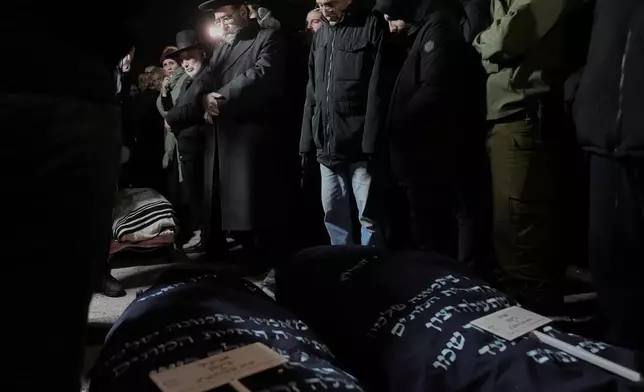
FILE - Mourners attend the funeral of Yaakov Biton, 16, and his two sisters, Avigail, 15, and Sarah, 13, who were killed in an Iranian missile attack, at the cemetery in Mount of Olives in Jerusalem, Monday, March 2, 2026. (AP Photo/Mahmoud Illean, File)
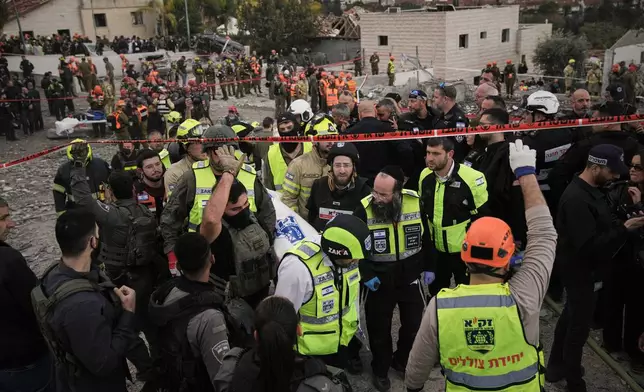
FILE - Rescue workers and military personnel carry a body of a victim from the scene where several people were killed by an Iranian missile strike in Beit Shemesh, Israel, Sunday, March 1, 2026. (AP Photo/Leo Correa, File)
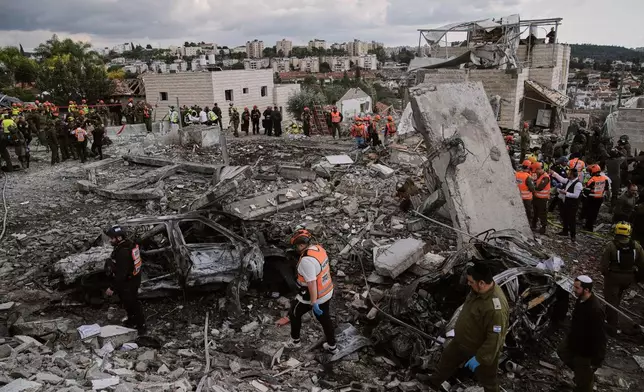
FILE - Rescue workers and military personnel operate at the scene where several people were killed in an Iranian missile strike in Beit Shemesh, Israel, Sunday, March 1, 2026. (AP Photo/Leo Correa, File)

Friends and relatives comfort Yitzhak Biton, left, whose three children, Yaakov, Avigail and Sarah, were killed earlier this week when an Iranian missile struck their home in the city of Beit Shemesh, Jerusalem, Thursday, March 5, 2026. (AP Photo/Ohad Zwigenberg)
“I couldn’t find my kids, but I was sure they would be able to rescue them from underneath the rubble,” she said.
That was not to be. It took 24 hours to identify the bodies of three of her four children: Yaakov, about to celebrate his 17th birthday that evening; Avigail, 15; and Sarah, 13.
They were among nine people killed Sunday when an Iranian missile strike demolished a synagogue and homes in Beit Shemesh. Israel’s rescue services said 65 people were hospitalized in the attack, including two seriously wounded.
It was the deadliest attack on Israel, where 11 people have died, since the war began Saturday with U.S. and Israeli strikes on Iran. The conflict has escalated each day, affecting an additional 14 countries across the Middle East and beyond. At least 1,230 people have been killed in Iran and more than 100 in Lebanon.
Tamar Biton, husband Yitzhak and their surviving daughter, 4-year-old Rachel, are observing the Jewish week of mourning in a Jerusalem hotel where they were placed after their house was destroyed.
For hours on end, as neighbors, friends and strangers gathered around, stories poured from Tamar about her three children.
Yaakov, a natural-born leader and orator, studied at the Jewish seminary her husband ran and was known for bringing friends closer to Jewish observance. Avigail was smart, sensitive and thoughtful, and Sarah was a whirlwind of activity always helping around the house and the community.
As Tamar spoke, she lit up, remembering details of each of the children she had buried Monday in a late-night funeral at Jerusalem’s Mount of Olives cemetery, one of the holiest places Jews can be buried.
But when Tamar stopped speaking, she seemed to collapse in on herself, remembering what had happened.
Yitzhak Biton had taught a class in Jewish texts that deadly morning; his son had attended along with his best friend, 16-year-old Gavriel Ravach. Both were killed in the missile attack.
Other families also lost multiple members, including volunteer paramedic Ronit Elimelech, 45, and her mother, Sara Elimelech. Penina Cohen lost her husband, Yosef, and mother-in-law, Buria, in the attack. Her son was supposed to have celebrated his bar mitzvah, the Jewish coming of age ceremony, on Monday. Instead, he buried his father and grandmother, Cohen told Israeli President Isaac Herzog when he visited her at the hospital.
When the alarms blared to warn of an incoming missile attack Sunday afternoon, Yitzhak Biton said he decided to stay in the house, but Yaakov, Avigail and Sarah went toward the shelter under the synagogue, following Israel’s guidelines for civilians.
While Yaakov was found inside the shelter, it’s unclear whether Avigail and Sarah were able to make it in time, Tamar Biton said. The impact flattened the synagogue over the shelter and homes on several surrounding streets.
As hope for her children’s survival dimmed, Tamar Biton changed her prayers.
“I said to my husband, ‘Please let something be left of them — or do you think it’s just ash and that’s why they can’t identify them?’” she said Thursday.
Yitzhak said he tried to search for his children, despite terror at what he might find.
“They started taking out bodies, and I kept saying, ‘Where are my children? Where are my children?’ When they came and asked for a DNA sample, I knew the answer,” he said.
Both parents continue to cling to their faith, telling visitors who came to pay condolences of Yaakov’s sincerity in swearing off any kind of digital devices considered forbidden by observant Jews and their daughters’ acts of kindness.
Yitzhak Biton says he hopes to open a Jewish seminary in honor of his children, aimed at encouraging unity among Israel’s youth and countering issues driving the country apart, such as baseless hatred and negativity.
“They sanctified God’s name with their life, and also after their death, they continue sanctifying his name,” Yitzhak said, a tear rolling down his cheek.
Tamar Biton said she has been able to maintain her faith because she works to cultivate it every day.
“Faith isn’t built in a day,” she said. “Faith is a gift from God, and faith is what gives you the ability to stand in front of these challenges, these experiences, in front of these waves.”
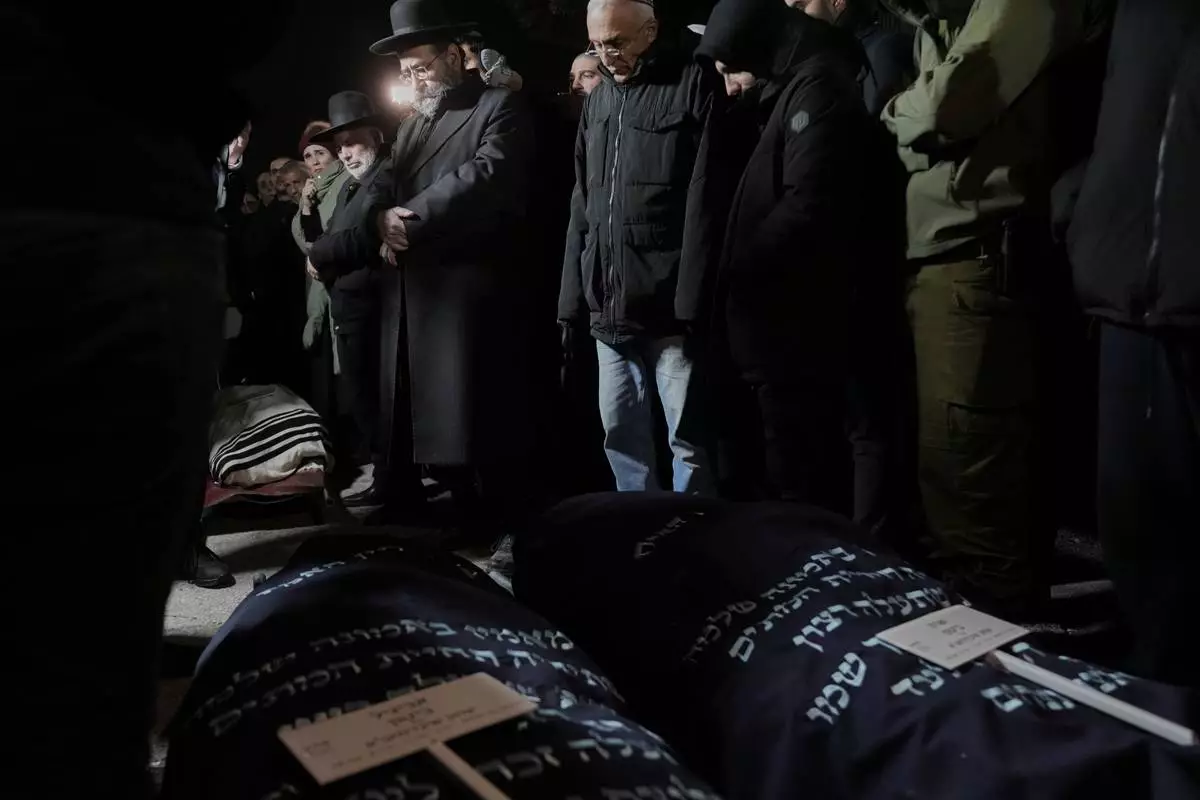
FILE - Mourners attend the funeral of Yaakov Biton, 16, and his two sisters, Avigail, 15, and Sarah, 13, who were killed in an Iranian missile attack, at the cemetery in Mount of Olives in Jerusalem, Monday, March 2, 2026. (AP Photo/Mahmoud Illean, File)
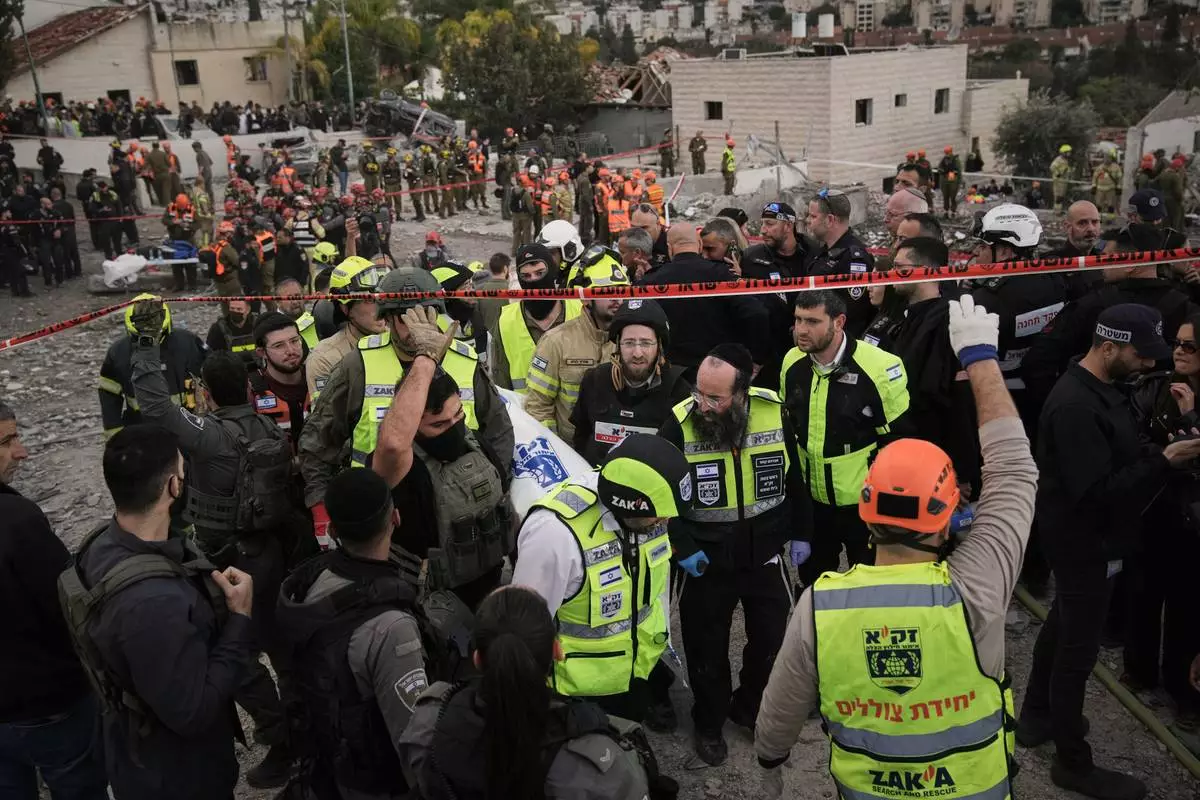
FILE - Rescue workers and military personnel carry a body of a victim from the scene where several people were killed by an Iranian missile strike in Beit Shemesh, Israel, Sunday, March 1, 2026. (AP Photo/Leo Correa, File)
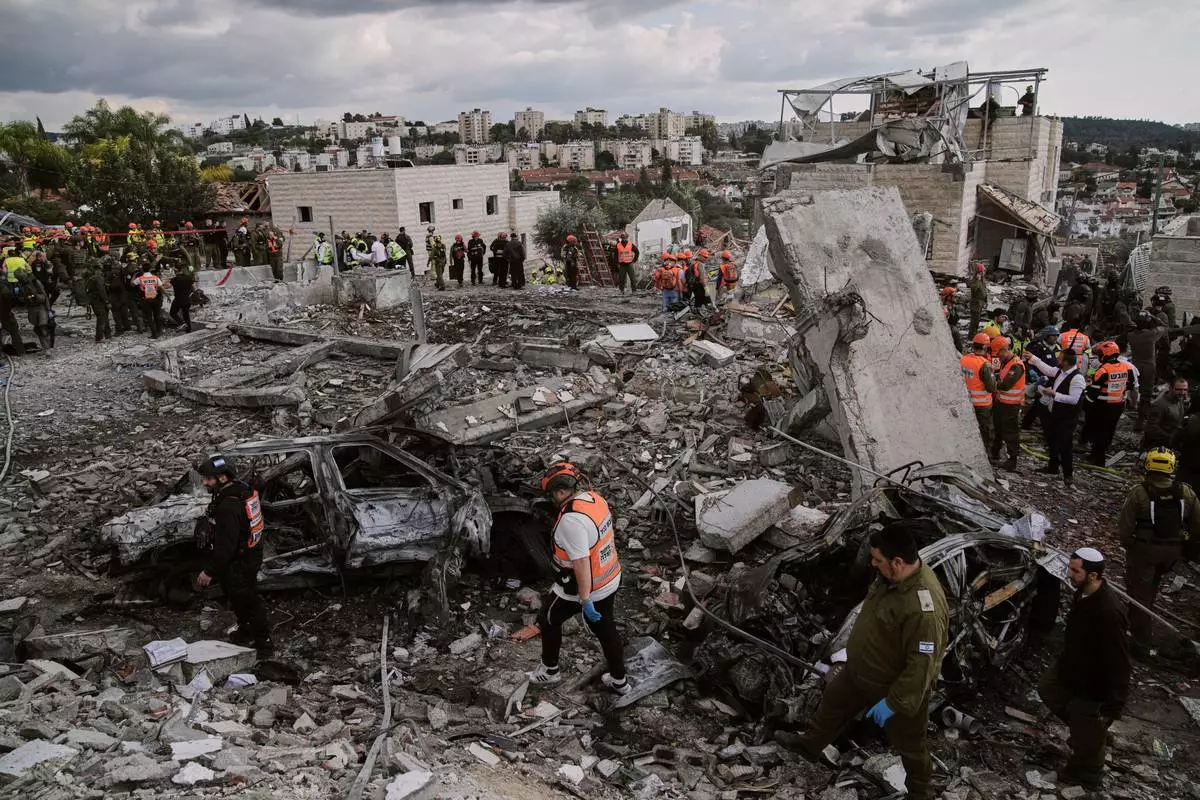
FILE - Rescue workers and military personnel operate at the scene where several people were killed in an Iranian missile strike in Beit Shemesh, Israel, Sunday, March 1, 2026. (AP Photo/Leo Correa, File)

Friends and relatives comfort Yitzhak Biton, left, whose three children, Yaakov, Avigail and Sarah, were killed earlier this week when an Iranian missile struck their home in the city of Beit Shemesh, Jerusalem, Thursday, March 5, 2026. (AP Photo/Ohad Zwigenberg)

JERUSALEM (AP) — Satellite images, expert analysis, a U.S. official and public information released by the U.S. and Israeli militaries suggest an explosion that killed scores of Iranian students at a school was likely caused by U.S. airstrikes that also hit an adjacent compound associated with the regime's Revolutionary Guard.
The Feb. 28 strike, which had the highest reported civilian death toll since the war began, has come under staunch criticism from the United Nations and human rights monitors. More than 165 people were killed, most of them of children, in the blast during school hours at Shajareh Tayyebeh Elementary School, according to Iranian state media.
Satellite images taken Wednesday and reviewed by the The Associated Press show most of the school in the city of Minab, some 1,100 kilometers (680 miles) southeast of Tehran, reduced to rubble, a crescent shape punched into its roof. Experts say the tight pattern of damage visible on the satellite photos is consistent with a targeted airstrike.
Iran has blamed Israel and the United States for the blast. Neither country has accepted responsibility. Asked about the strike at the school at a Pentagon media briefing Wednesday, Defense Secretary Pete Hegseth said, “All I can say is that we’re investigating that. We, of course, never target civilian targets. But we’re taking a look and investigating that.”
Several factors point to a U.S. strike.
One is the launching of an assessment of the incident by the U.S. military. According to the Pentagon's instructions on processes for mitigating civilian harm, an assessment is launched after a group of investigators make an initial determination that the U.S. military may bear culpability. A U.S. official told the AP that the strike was likely U.S. The official spoke anonymously because they were not authorized to comment publicly on the sensitive matter.
Another is the location of the school — next to a Revolutionary Guard base in Hormozgan Province and close to barracks for its naval brigade. The U.S. military has focused on naval targets and acknowledged strikes in the province, including one in the vicinity of the school.
Israel, which has denied conducting the strike, has focused on areas of Iran closer to Israel and hasn’t reported any strikes south of Isfahan, 800 kilometers (500 miles) away. The U.S. is operating warships in the Arabian Sea, including the USS Abraham Lincoln aircraft carrier, within range of the school.
When asked by the AP about its findings, U.S. military Central Command spokesperson Capt. Tim Hawkins said, “It would be inappropriate to comment given the incident is under investigation.”
White House press secretary Karoline Leavitt told reporters Friday that she had no updates on the investigation and did not directly answer a question about whether President Donald Trump was satisfied with the pace of the probe.
“My assumption is that probably there were some activities recently there and they detected and tracked them, but ... they weren't aware or didn't have an up-to-date database that a girls' school was there and they bombed it," said Farzin Nadimi, a senior fellow at the Washington Institute for Near East Policy who studies Iran’s military.
The school is adjacent to a walled compound labeled on maps as the Seyyed Al-Shohada Cultural Complex of the Guard. In addition to the school, satellite photos show that blasts struck at least five buildings in the Guard compound, leaving the area pocked with craters, charred holes in roofs and piles of rubble.
Iranian online map applications show a living quarters for the Assef Brigades about 150 meters (165 yards) from the school, inside the Revolutionary Guard compound. The 16th Assef Coastal Missile Group is part of the Guard's navy, Nadimi said. The 1st Naval District, which the Assef Brigades belong to, is responsible for the Strait of Hormuz, the narrow mouth of the Persian Gulf through which a fifth of all oil and natural gas traded passes. The strait has been a particular point of conflict in the war.
In the aftermath of the strike, video from Iran's state broadcaster verified by the AP using satellite imagery showed dozens of fresh graves dug at a nearby cemetery. Nadimi said it is likely the school taught daughters of Guard personnel.
The strike has drawn wide condemnation from the secretary-general of the United Nations and international human rights groups. The criticism comes amid reports that airstrikes have also hit other schools in Iran.
Targeting schools would be a clear violation of international laws governing armed conflict, said Elise Baker, a senior staff lawyer at the Atlantic Council, a Washington-based nonprofit think tank.
“Strikes can only legally target military objectives and combatants, but the school was a civilian object and the students and teachers were civilians,” Baker said. “The school’s proximity to (Guard) facilities and the attendance of children of (Guard) members at the school does not change that conclusion: It was a civilian object.”
Three experts told the AP the satellite imagery and videos from the scene strongly suggested multiple munitions hit the compound. Complicating any assessment is the lack of images of bomb fragments from the blast. No independent agency has reached the site during the war to investigate.
There are no craters or evidence of bombs hitting in the surrounding neighborhood, suggesting a great degree of accuracy, said Corey Scher, a researcher who uses satellite imagery and radar data to study landscape changes in armed conflict zones.
“All the strikes are clustered within the walled-off compound," Scher said. "That’s one level of precision at the block level. And then most of the strikes are basically leading to direct hits on buildings. That’s another level of precision.”
Scher said the school and the other buildings struck in the compound showed damage consistent with the use of air-to-surface munitions.
“They didn’t explode in the air above the building," he said. “It looks like the explosion happened at the time they hit the surface, whether it was the building or the ground."
Sean Moorhouse, a former British Army officer and explosive ordnance disposal expert, said the available satellite imagery was insufficient to determine exactly what type of munitions were used in the strike, but he said the visible damage was consistent with what would be expected with impacts from multiple 2,000-pound (900-kilogram) high-explosive warheads. He said the multiple precise impacts would undercut any suggestion that a malfunctioning Iranian missile hit the school.
N.R. Jenzen-Jones, the director of Armament Research Services, said the school and Guard compound were targeted with “multiple simultaneous or near-simultaneous strikes."
“If indeed it is confirmed that an American or Israeli strike hit the school, there are several potential points of failure in the targeting cycle,” Jenzen-Jones said. “We might be seeing an intelligence failure, likely rather early in the process, which misidentified the target or failed to update a targeting list following the building’s change in use.”
He said in videos of the school taken immediately after the strike, smoke can be seen rising from the Guard compound. There were also impacts on multiple buildings visible in satellite images and media reports citing witnesses who said they heard multiple explosions.
U.N. Human Rights Office spokesperson Ravina Shamdasani said the investigation results needed to be made public.
“The families of the little girls who were killed are entitled to the truth of how this happened," she said.
Biesecker reported from Washington. Associated Press writers Jon Gambrell in Dubai, United Arab Emirates; Konstantin Toropin and Michelle Price in Washington; Aamer Madhani in Doral, Florida; and Jamey Keaten in Geneva contributed to this report.
A Dept. of Defense map entitled, Operation EPIC FURY Timeline - First 100 Hours, is displayed during a news conference with Defense Secretary Pete Hegseth and Chairman of the Joint Chiefs of Staff Gen. Dan Caine, at the Pentagon, Wednesday, March 4, 2026, in Washington. (AP Photo/Konstantin Toropin)