Rachel Yeung is currently employed as an Assistant Quantity Survey Officer at a construction company. Her role, which she says is mainly clerical and desk-based, is focused on handling contracts.

Ongoing growth: Assistant Quantity Survey Officer Rachel Yeung says women are employed in many different areas of construction and expects the numbers to continue growing. Image source: www.news.gov.hk
Recounting her entry into the construction industry, she explained that she was laid off from a trading company a few years ago due to the COVID-19 pandemic. Encouraged by friends who worked in construction, she saw the opportunity to make a career change and enrolled in an Advanced Diploma in Quantity Surveying at the Institute of Construction.
Unique strengths
“Previously, I thought the construction industry only involved engineering, which I perceived as a male-dominated field,” she reflected. “However, after entering, I have discovered many female colleagues – in quantity surveying, in engineering teams, and even among architects – and this number is likely to continue growing.”
Elaborating on the attributes women bring to bear, she added: “Women in the industry demonstrate remarkable patience and meticulousness in handling paperwork. Given that construction involves not only hands-on work but also managing numerous backup documents, women truly excel in this area.”
Rachel’s perspective is shared by Nicole Chan, who is currently studying a building services supervision course. She believes that men and women each possess unique strengths.
“I think the biggest difference between women and men lies in physical strength” she said. “While women may be slightly less physically strong, I maintain a regular exercise routine. Additionally, women often excel in attentiveness and the ability to notice specific details. This creates a wonderful balance, with each gender complementing the other perfectly.”
In recent years, there has been a clear uptick in the numbers of women entering the construction industry. According to figures from the Census & Statistics Department, in the fourth quarter of 2025 women accounted for approximately 13% of those employed in construction, up from under 8% two decades ago.

Changing landscape: Construction Industry Council Executive Director Albert Cheng says the construction industry has shifted away from being primarily focused on manual work and labour-intensive jobs. Image source: www.news.gov.hk
Industrial transformation
Construction Industry Council Executive Director Albert Cheng commented that the construction industry has shifted away from being primarily focused on manual work and labour-intensive jobs.
“In the past, working on-site required a lot of strength and effort. Now we apply a lot of technologies so the workers do not need to spend a lot of effort. Some of the trade now, the workers need only to control robotics, and maybe use some technologies, like building information modelling or artificial intelligence for site management and control. I think because of a change of the nature of the work, a lot of females would like to join this industry.”
He also highlighted the rising proportion of female students attending the Institute of Construction. This grew from 11% of the total number of students in the 2024-25 academic year to about 17% in the current academic year. Last year, the institute launched a flexible training course that better enables students to balance family and career development. With over 150 female applicants enrolling in the course, this is helping to inject new energy into the industry.

Dual power: Institute of Construction student Nicole Chan believes that men and women possess attributes that complement each other perfectly in the field of construction. Image source: www.news.gov.hk
Jointly launched by the Development Bureau and the Construction Industry Council, the “Hong Kong Infrastructure NO. 1” campaign seeks to deepen public understanding of the city’s infrastructure projects.
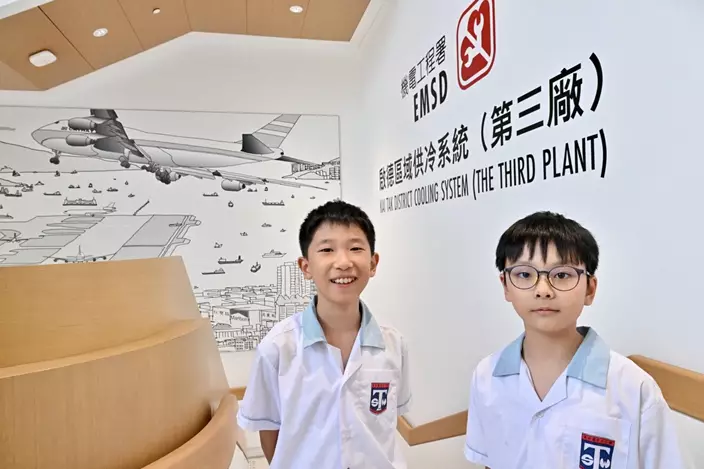
Eye-opening visit: Primary 5 pupil Horace Tang (left) says the interactive visit has broadened his horizons. Image source: www.news.gov.hk
Through guided tours, interactive workshops, exhibitions and tailored teaching materials, the campaign shares professional engineering knowledge in an engaging and accessible way, allowing young people to explore careers in the construction industry.
Awe-inspiring visit
A group of primary school pupils toured the education centre at Plant Number 3 of the Kai Tak District Cooling System, where they learnt about the climate challenges facing Hong Kong and how the cooling system works.
Interactive exhibits helped the pupils understand the technology behind the system, while a tour of the plant’s core facilities gave them a close-up view of its large-scale machinery and extensive network of pipes.
The facility completely defied the expectations of Primary 5 pupil Horace Tang.
“I was amazed by the sheer size of the plant and its enormous pipes,” he said.
“I think the district cooling system is remarkable because it helps reduce carbon emissions and save energy. The tour has inspired me to become an engineer in the future.”

New perspectives: Secondary 3 student Chui Ki-hin (left) says the workshop transformed his understanding of urban planning. Image source: www.news.gov.hk
Hands-on learning
The initiative focuses on three key areas: education, public engagement and media promotion.
On the education front, the campaign organises guided tours and engineering visits, while also providing a dedicated resource centre, interactive workshops and tailored learning and teaching materials.
The construction-themed materials integrate science, technology, engineering, the arts and mathematics, allowing students to explore subjects such as urban planning in an engaging and practical manner.
Moving beyond classroom concepts, students actively design their own communities within strict special limits and specific guidelines.
Secondary 3 pupil Chui Ki-hin said the workshop transformed his understanding of urban planning.
“I used to think urban planning was simple - that you could just arrange buildings like building blocks and connect the necessary utilities,” he said.
“However, after taking part in the workshop, I realised that it is much more complicated and that there are many constraints to consider.”
Even producing a small model required considerable thought and effort.
“It took me about 45 minutes just to complete this small model. I can only imagine how much more challenging it is to plan a real city.”

International recognition: Principal Assistant Secretary for Development (Works) Chris Ng notes that the programme’s many accolades represent significant recognition for both the team and the industry. Image source: www.news.gov.hk
International recognition
Apart from its education initiatives, the campaign reaches the community through videos, social media content, exhibitions, quizzes and other public engagement activities.
The campaign’s impact has resonated far beyond Hong Kong. At the 23rd International Business Awards, the promotional initiative triumphed across 10 different categories - capturing six Gold and three Silver awards, as well as one Bronze.
“The aim is to use interesting and heartfelt stories to help the public more easily understand the advanced technologies adopted in infrastructure projects that we see in everyday life, and appreciate the craftsmanship spirit of our construction industry professionals,” Principal Assistant Secretary for Development (Works) Chris Ng said.
He added that Hong Kong’s global standing in engineering would not be possible without the commitment and expertise of industry professionals.

Solid commitment: Construction Industry Council General Manager - Corporate Communications Hanks Lee highlights the wholehearted support of the industry. Image source: www.news.gov.hk
Construction Industry Council General Manager - Corporate Communications Hanks Lee said the trickiest part of the campaign was figuring out how to share professional engineering know-how in a down-to-earth and lively way.
“With the wholehearted support of the industry providing invaluable experience, practical examples and on-site assistance, we were able to tell the story of Hong Kong’s infrastructure.”
Looking ahead, the Development Bureau will continue to leverage digital and innovative media to showcase the technological advancement and professionalism of the construction industry. Through these efforts, it aims to deepen public understanding of the vital role infrastructure plays in Hong Kong’s economic, social and livelihood development, while attracting more young people to join the industry and carry forward the spirit of striving for excellence.
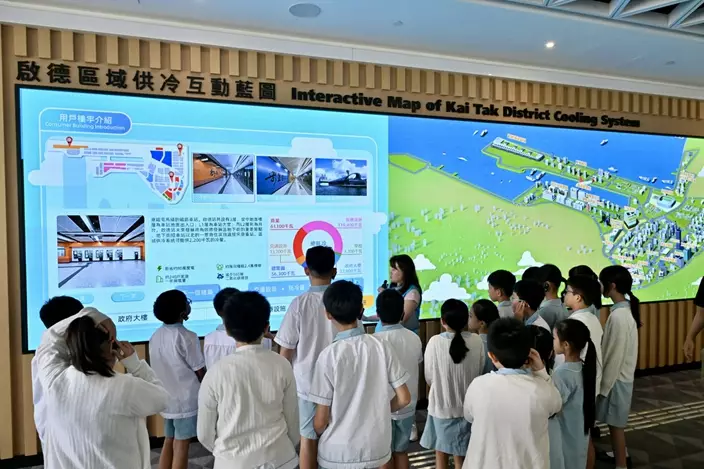
Interactive learning: Through interactive exhibits, primary pupils explore how the Kai Tak District Cooling System works. Image source: www.news.gov.hk