|
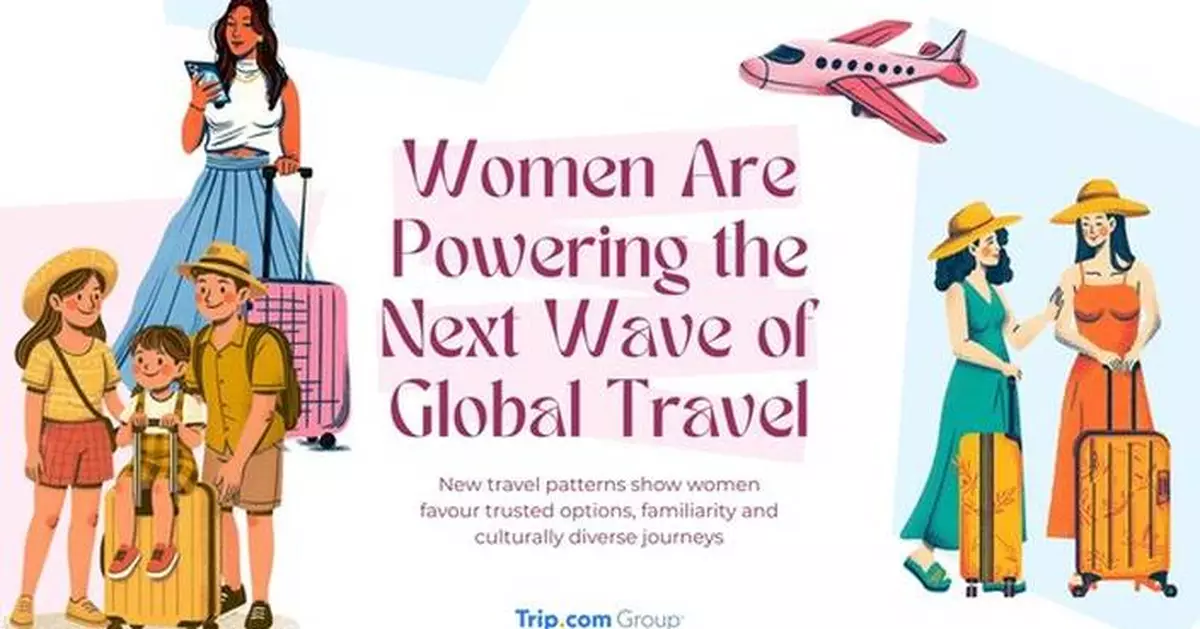
- New travel patterns show women favour trusted options, familiarity and culturally diverse journeys
- Solo women travel is surging in Southeast Asia among the Millennials, while Italy and France see a rising trend among older women
- Women are leading travel decisions, and are most willing to spend on family-inclusive experiences when travelling as a group
SINGAPORE, March 9, 2026 /PRNewswire/ -- Women today are exploring the world more than ever, whether with family, friends or individually. Increasingly, they are the central spark behind each travel journey made, shaping key travel decisions and preferences.
In celebration of International Women's Day, Trip.com Group has released new insights and survey data that reveal how women are driving global travel flows, and what matters the most to them in their journeys.
More Frequent, More Fearless: A Shift in How Women Travel
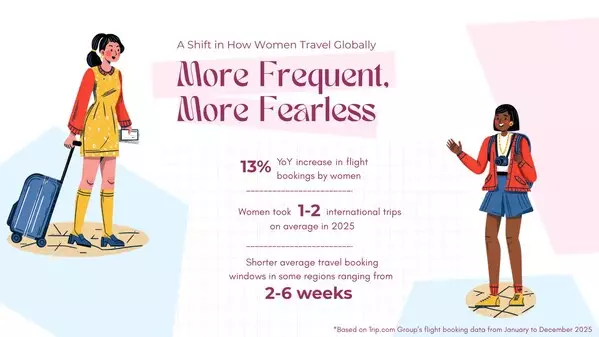
Globally, women traveller flight bookings are booming, growing 13% year-on-year (YoY), based on Trip.com Group's data. This trend is seen particularly across Southeast Asia, where in Indonesia – bookings made by women travellers have more than doubled from the previous year[1].
What this means is that women are crossing borders more than ever. The average women traveller took one to two international trips in 2025, with South Koreans being the most active group, followed by Chinese travellers.
Not only are women travelling more, they are also doing so more spontaneously with lesser planning time. The global average booking window in 2025 ranged from two to six weeks, and internal data shows that women in Europe are planning their trips later rather than earlier – indicating a gradual shift from cautious pre-planning towards spur-of-the-moment travel[2].
What Women Travellers Look Out For: Security, Familiarity and Adventure
Women travellers are widening their horizons, but on their own terms. While short-haul flights and nearer destinations are still preferred, women travellers are also venturing out to further locations for their adventures. Long-haul flights are gaining traction at a faster pace, with Asia experiencing the fastest growth[3].
European travellers are also searching up destinations as far as Bangkok and Shanghai, suggesting a stronger appetite to go beyond comfort zones to explore across a wider range of experiences.
At the same time, some overall regional trends are observed:
- Women travellers from Southeast Asian generally prefer making trips within the region, with its close proximity and diverse range of experiences.
- China is a popular getaway destination for South Korean women, especially cities like Shanghai and Qingdao, which can be reached by flight within two hours.
- While domestic travel is still a top choice for European women, interest is shifting to culturally diverse destinations such as Istanbul and Bangkok. Exotic cities such as Cairo, Bueno Aires and Lima are some of the top searched destinations among European women travellers in 2026[4].
Safety and familiarity are also key factors women take into account when choosing a travel destination. How confident they feel when they arrive late at night, walk and navigate a city, or use the public transport, regardless of whether they are travelling solo or as a group, is most important to women in the United Kingdom (UK) when it comes to making trip-related decisions, based on a recent survey commissioned by Trip.com Group.
Research also shows that destinations that prioritise women's safety and ease of transport are among the top factors that empower women in the UK to feel more confident when travelling[5].
These travel patterns and insights reflect how women value familiarity and safety when making travel decisions, while also balancing their desire for adventure and novelty.
Rise of the Solo Woman Traveller
More women are choosing to travel solo, whether it is to go on a journey of self-discovery, or to have the flexibility to explore at their own pace.
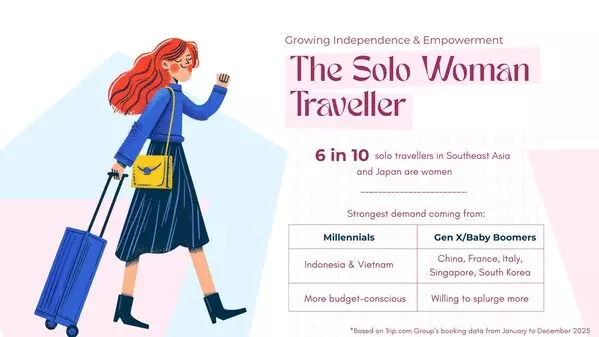
This trend is observed across all age groups, but the strongest demand for solo travel comes from women aged 25 to 34 years old, where Southeast Asian countries like Indonesia and Vietnam are leading the charge. Notably, solo travel is also showing significant gains in Italy and France among older women, where close to one in five are aged 50 and above.
For millennials, travel cost is a key consideration, with most choosing to book 3-stars and below hotels, especially those from Southeast Asia. On the other hand, slightly older women (aged 35 to 49 years old) in markets like China, South Korea and Singapore are choosing to splurge more on their solo trips, a trend observed from flights to hotels.
Interestingly, while men took more solo trips than women globally, this trend is reversed in some regions like Southeast Asia and Japan, where around 6 in 10 solo travellers are women[6].
This demonstrates a broader societal shift, as women continue to embrace independence and are empowered to explore new experiences like never before.
Women Shaping the Future of Family-Friendly Travel
Across households, women are often the ones leading travel decisions, whether it is travelling with children, parents or grandparents. Planning a trip with family can be stressful – research shows that finding flights with convenient schedules, planning attractions and activities for children, as well as managing meal options are some of the top factors that matters most to women in the UK when travelling with a child.
This has driven a rising demand for family-friendly travel, where women hope to have a less stressful experience during family trips, even if it means forking out more. Such preferences shape decisions from flight bookings, and accommodation, to even the attractions selected for the trip.
When it comes to family travel experiences, survey insights show that guaranteed family seating on a plane, all-inclusive family packages, as well as larger family suites or connecting rooms are what women in the UK are most willing to spend more on when going on vacation with a child.
Empowering Women Beyond the Workplace
At Trip.com Group, empowering women and contributing to a more supportive environment for families has always been a key commitment. Through family-friendly policies, hybrid work options, paid parental leave and childcare subsidies, till the end of 2025, 98.2% of mothers have returned to work within six months after their maternity leave. In addition, over 1,800 employees have benefitted from more than 137 million USD in childcare subsidies since its introduction in 2023[7]. This demonstrates the company's continued investment in career growth and workplace equality for women.
Beyond the workplace, Trip.com Group is also leading the industry with initiatives and thoughtful features such as having family-friendly travel recommendations and introducing a range of themed travel products catered to the older generation, for a fuss-free and pleasant travel experience for every traveller.
About Trip.com Group
Trip.com Group is a global travel service provider comprising of Trip.com, Ctrip, Skyscanner, and Qunar. Across its platforms, Trip.com Group helps travellers around the world make informed and cost-effective bookings for travel products and services and enables partners to connect their offerings with users through the aggregation of travel-related content and resources, and an advanced transaction platform consisting of apps, websites and 24/7 customer service centres. Founded in 1999 and listed on NASDAQ in 2003 and HKEX in 2021, Trip.com Group is on the mission "to pursue the perfect trip for a better world". Find out more about Trip.com Group here: group.trip.com.
Follow us on: X, Facebook, LinkedIn, and YouTube.
| [1] Based on Trip.com Group's flight booking data from January to December 2024, and January to December 2025. |
| [2] Based on Trip.com Group's flight booking data from January to December 2025. |
| [3] Based on Trip.com Group's flight booking data from January to December 2024, and January to December 2025. |
| [4] Based on Trip.com Group's search data |
| [5] Based on a OnePoll survey commissioned by Trip.com Group among women who have travelled in the last 2 years or intend to travel in the next 2 years. The survey was conducted in February 2026 and polled 3,500 women in total across Germany, Hong Kong (SAR), Japan, Singapore, South Korea, Thailand and the United Kingdom. |
| [6] Based on Trip.com Group's booking data from January to December 2024, and January to December 2025. |
| [7] Accurate as of October 2025. |
- New travel patterns show women favour trusted options, familiarity and culturally diverse journeys
- Solo women travel is surging in Southeast Asia among the Millennials, while Italy and France see a rising trend among older women
- Women are leading travel decisions, and are most willing to spend on family-inclusive experiences when travelling as a group
SINGAPORE, March 9, 2026 /PRNewswire/ -- Women today are exploring the world more than ever, whether with family, friends or individually. Increasingly, they are the central spark behind each travel journey made, shaping key travel decisions and preferences.
In celebration of International Women's Day, Trip.com Group has released new insights and survey data that reveal how women are driving global travel flows, and what matters the most to them in their journeys.
More Frequent, More Fearless: A Shift in How Women Travel
Globally, women traveller flight bookings are booming, growing 13% year-on-year (YoY), based on Trip.com Group's data. This trend is seen particularly across Southeast Asia, where in Indonesia – bookings made by women travellers have more than doubled from the previous year[1].
What this means is that women are crossing borders more than ever. The average women traveller took one to two international trips in 2025, with South Koreans being the most active group, followed by Chinese travellers.
Not only are women travelling more, they are also doing so more spontaneously with lesser planning time. The global average booking window in 2025 ranged from two to six weeks, and internal data shows that women in Europe are planning their trips later rather than earlier – indicating a gradual shift from cautious pre-planning towards spur-of-the-moment travel[2].
What Women Travellers Look Out For: Security, Familiarity and Adventure
Women travellers are widening their horizons, but on their own terms. While short-haul flights and nearer destinations are still preferred, women travellers are also venturing out to further locations for their adventures. Long-haul flights are gaining traction at a faster pace, with Asia experiencing the fastest growth[3].
European travellers are also searching up destinations as far as Bangkok and Shanghai, suggesting a stronger appetite to go beyond comfort zones to explore across a wider range of experiences.
At the same time, some overall regional trends are observed:
- Women travellers from Southeast Asian generally prefer making trips within the region, with its close proximity and diverse range of experiences.
- China is a popular getaway destination for South Korean women, especially cities like Shanghai and Qingdao, which can be reached by flight within two hours.
- While domestic travel is still a top choice for European women, interest is shifting to culturally diverse destinations such as Istanbul and Bangkok. Exotic cities such as Cairo, Bueno Aires and Lima are some of the top searched destinations among European women travellers in 2026[4].
Safety and familiarity are also key factors women take into account when choosing a travel destination. How confident they feel when they arrive late at night, walk and navigate a city, or use the public transport, regardless of whether they are travelling solo or as a group, is most important to women in the United Kingdom (UK) when it comes to making trip-related decisions, based on a recent survey commissioned by Trip.com Group.
Research also shows that destinations that prioritise women's safety and ease of transport are among the top factors that empower women in the UK to feel more confident when travelling[5].
These travel patterns and insights reflect how women value familiarity and safety when making travel decisions, while also balancing their desire for adventure and novelty.
Rise of the Solo Woman Traveller
More women are choosing to travel solo, whether it is to go on a journey of self-discovery, or to have the flexibility to explore at their own pace.
This trend is observed across all age groups, but the strongest demand for solo travel comes from women aged 25 to 34 years old, where Southeast Asian countries like Indonesia and Vietnam are leading the charge. Notably, solo travel is also showing significant gains in Italy and France among older women, where close to one in five are aged 50 and above.
For millennials, travel cost is a key consideration, with most choosing to book 3-stars and below hotels, especially those from Southeast Asia. On the other hand, slightly older women (aged 35 to 49 years old) in markets like China, South Korea and Singapore are choosing to splurge more on their solo trips, a trend observed from flights to hotels.
Interestingly, while men took more solo trips than women globally, this trend is reversed in some regions like Southeast Asia and Japan, where around 6 in 10 solo travellers are women[6].
This demonstrates a broader societal shift, as women continue to embrace independence and are empowered to explore new experiences like never before.
Women Shaping the Future of Family-Friendly Travel
Across households, women are often the ones leading travel decisions, whether it is travelling with children, parents or grandparents. Planning a trip with family can be stressful – research shows that finding flights with convenient schedules, planning attractions and activities for children, as well as managing meal options are some of the top factors that matters most to women in the UK when travelling with a child.
This has driven a rising demand for family-friendly travel, where women hope to have a less stressful experience during family trips, even if it means forking out more. Such preferences shape decisions from flight bookings, and accommodation, to even the attractions selected for the trip.
When it comes to family travel experiences, survey insights show that guaranteed family seating on a plane, all-inclusive family packages, as well as larger family suites or connecting rooms are what women in the UK are most willing to spend more on when going on vacation with a child.
Empowering Women Beyond the Workplace
At Trip.com Group, empowering women and contributing to a more supportive environment for families has always been a key commitment. Through family-friendly policies, hybrid work options, paid parental leave and childcare subsidies, till the end of 2025, 98.2% of mothers have returned to work within six months after their maternity leave. In addition, over 1,800 employees have benefitted from more than 137 million USD in childcare subsidies since its introduction in 2023[7]. This demonstrates the company's continued investment in career growth and workplace equality for women.
Beyond the workplace, Trip.com Group is also leading the industry with initiatives and thoughtful features such as having family-friendly travel recommendations and introducing a range of themed travel products catered to the older generation, for a fuss-free and pleasant travel experience for every traveller.
About Trip.com Group
Trip.com Group is a global travel service provider comprising of Trip.com, Ctrip, Skyscanner, and Qunar. Across its platforms, Trip.com Group helps travellers around the world make informed and cost-effective bookings for travel products and services and enables partners to connect their offerings with users through the aggregation of travel-related content and resources, and an advanced transaction platform consisting of apps, websites and 24/7 customer service centres. Founded in 1999 and listed on NASDAQ in 2003 and HKEX in 2021, Trip.com Group is on the mission "to pursue the perfect trip for a better world". Find out more about Trip.com Group here: group.trip.com.
Follow us on: X, Facebook, LinkedIn, and YouTube.
[1] Based on Trip.com Group's flight booking data from January to December 2024, and January to December 2025.
[2] Based on Trip.com Group's flight booking data from January to December 2025.
[3] Based on Trip.com Group's flight booking data from January to December 2024, and January to December 2025.
[4] Based on Trip.com Group's search data
[5] Based on a OnePoll survey commissioned by Trip.com Group among women who have travelled in the last 2 years or intend to travel in the next 2 years. The survey was conducted in February 2026 and polled 3,500 women in total across Germany, Hong Kong (SAR), Japan, Singapore, South Korea, Thailand and the United Kingdom.
[6] Based on Trip.com Group's booking data from January to December 2024, and January to December 2025.
[7] Accurate as of October 2025.
** This press release is distributed by PR Newswire through automated distribution system, for which the client assumes full responsibility. **
Women Are Powering the Next Wave of Global Travel, Says Trip.com Group
Women Are Powering the Next Wave of Global Travel, Says Trip.com Group
Women Are Powering the Next Wave of Global Travel, Says Trip.com Group
Two–Year Initiative Reaches Over 200,000 Parents and Children
Student Artworks Reflect Early Understanding of Gut Health
HONG KONG, March 9, 2026 /PRNewswire/ -- The gut is responsible for more than digestion and is often described as the body's "second brain." Research in recent years has highlighted associations between the gut microbiome and everyday wellbeing — including mood response, stress regulation, focus and sleep. Studies also indicate that a significant proportion of the body's serotonin is produced in the gut.
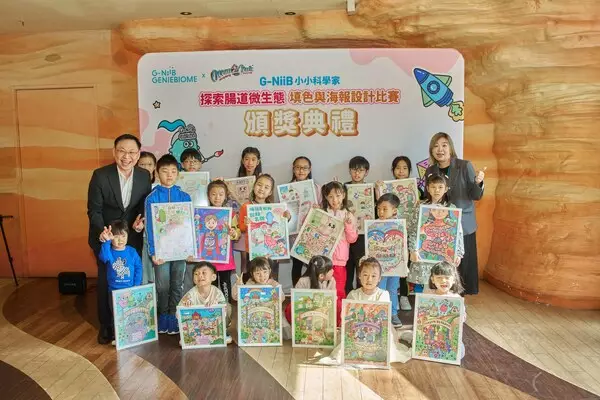
To help young parents and children build early foundational awareness of how the body functions, G–NiiB GenieBiome and Ocean Park launched the "Little Scientist: Explore the Gut Microbiome" family education programme in 2024. The programme's finale — the Colouring and Poster Design Competition Award Presentation — was held on 8 March, and the organisers today announce the outcomes of the two–year collaboration.
Centred on public education, the initiative combined interactive in–park learning, a children's picture book and ambassador–led guidance to introduce fundamental microbiome concepts to families, and to encourage parents to integrate these ideas into daily life. Since launch, the programme has reached over 200,000 park visitors. The finale competition received close to 100 entries from kindergarten, Primary 1–3 and Primary 4–6 students, expressing their understanding of the relationship between gut health and everyday habits through colour, slogans and original design.
Integrating experiential learning, reading and creativity to introduce gut microbiome concepts
The education programme was delivered across three components:
(1) Interactive in–park learning
The "Mark's Mine" space was redesigned as the G–NiiB Little Scientist Corner, allowing children to explore microbiome concepts through hands–on and scenario–based activities that illustrate the gut as a balanced ecosystem.
(2) Picture book learning at home
The children's picture book "The Adventures of Whiskers: Secrets of the Human Body — The Gut Microbiome Village" introduces the roles of different microorganisms through storytelling, explaining in simple language how gut balance relates to emotions, digestion, skin health, focus and sleep.
(3) Guided learning and family extension
Ambassadors provided on–site explanations and learning materials, helping parents translate the concepts into family conversations and everyday practice.
Through these approaches, the programme aimed to help children build early foundational awareness of how different bodily systems function, and to encourage long–term interest in health and wellbeing.
Competition showcases age–specific understanding of gut health
The G–NiiB Little Scientist: Explore the Gut Microbiome Colouring & Poster Design Competition consisted of three categories - Kindergarten (Colouring + Slogan), Primary 1–3 (Poster Design), and Primary 4–6 (Poster Design). First Place, Second Place and Third Place Awards were presented in each category.
Judges shared that younger participants tended to express basic health messages through simple slogans and colour use, while lower primary students often used exploration or adventure themes to represent the microbiome world. Senior primary students demonstrated a more integrated expression of how diet, routines and bodily states interrelate.
Tim Chan, Corporate PR and Marketing Lead, G–NiiB GenieBiome, said: "We hope to help young parents and children start learning about the gut microbiome from an early stage, as it has associations with everyday wellbeing — including mood, focus and sleep. The aim of the programme is to make complex science understandable and usable for families. Seeing students express their understanding of health through creative work shows that the educational content has successfully reached their daily lives."
He added, "Ocean Park has long promoted nature and life education. This collaboration extends the learning journey to the body's inner ecosystem, enabling families to build fundamental health awareness through play, reading and creativity."
A participating parent shared that the programme also supported learning at home: "After joining the programme, my child began proactively connecting food choices and routines with how the body feels. Abstract concepts became more concrete through the picture book and activities, giving our family more opportunities to talk about health."
Community education significance
Tim Chan added that introducing microbiome concepts through child–friendly, age–appropriate methods can help families build early awareness of physical and emotional wellbeing. The two–year collaboration demonstrates how science education can be translated into accessible public learning and contribute to long–term community health literacy.
About G–NiiB GenieBiome
G-NiiB GenieBiome is a biotechnology company founded by world-renowned clinician-scientists and supported by a multidisciplinary team of experts in microbiology, metagenomics, bioinformatics, disease biomarkers, food technology, clinical trials, IP development and commercialization. For over a decade, our team has pioneered the use of microbiome with evidence-based science to tackle a myriad of diseases, including colorectal cancer, obesity, atopic eczema, autism, and mood disorders, revolutionizing the prevention, diagnosis, and treatment of disease. Our precision portfolio includes next-generation microbiome precision formula tailored for the Asian population. Our vision is to be a game changer in human health with microbiome solutions.
About Ocean Park Corporation
Ocean Park Corporation is a non-profit statutory body and a registered charitable institution. Its vision is to create a world where we take action to conserve our environment and grow positively with nature. Since its opening in 1977, Ocean Park Hong Kong has evolved into a world-class conservation and education hub. We create fun and meaningful experiences grounded in nature, and complemented by leisure and adventure elements, to foster environmental stewardship.
** This press release is distributed by PR Newswire through automated distribution system, for which the client assumes full responsibility. **

G-NiiB GenieBiome and Ocean Park Conclude Gut Microbiome Education Programme
G-NiiB GenieBiome and Ocean Park Conclude Gut Microbiome Education Programme