MILTON, Ontario--(BUSINESS WIRE)--Mar 9, 2026--
Schneider Electric, a global energy technology leader, today published its 2025 extra-financial results, marking the conclusion of its Schneider Sustainability Impact (SSI) 2021–2025 program. Over the past five years, the Group has reported measurable progress across climate, social, and governance dimensions, supporting customers, partners, and communities in their transition toward a more sustainable and inclusive future.
This press release features multimedia. View the full release here: https://www.businesswire.com/news/home/20260309290597/en/
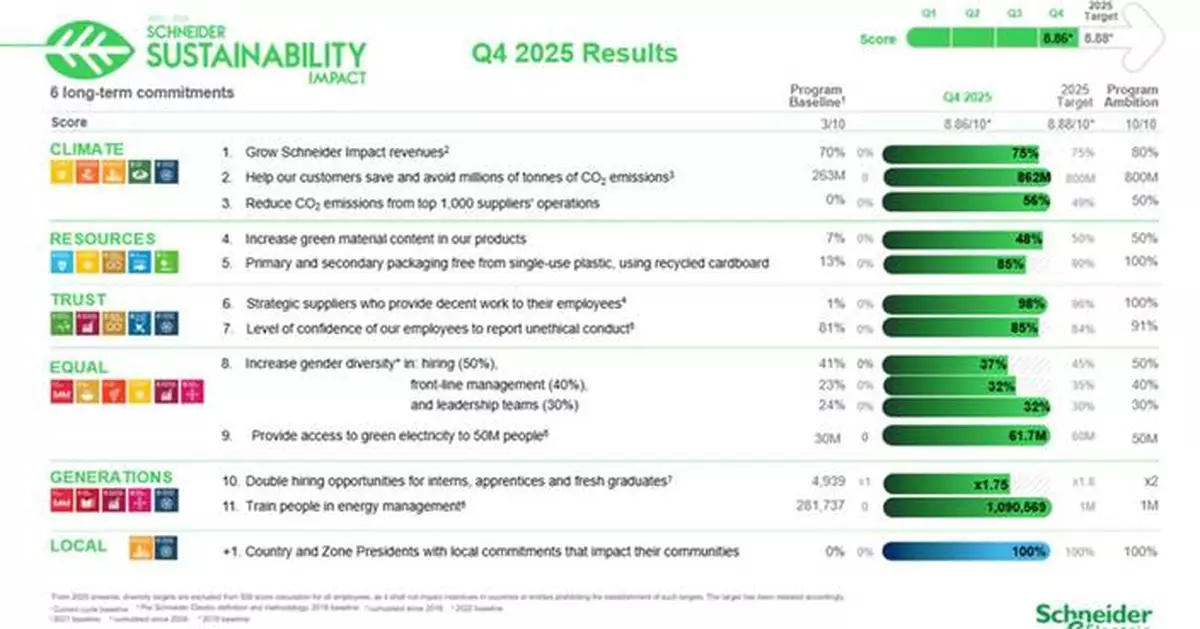
As of the end of Q4 2025, the Schneider Sustainability Impact program (SSI) achieved an overall score of 8.86/10, reflecting the scale of the sustainable transformation carried out across the Group and its value chain over the past five years. This chapter demonstrates how Schneider Electric has translated long-term ambition into measurable, global and local results, transforming its business and engaging its ecosystem.
“The completion of our five-year Sustainability Impact program reflects the deep commitment of our people, partners, and customers,” said Fredrick Morency, Vice President of Sustainability, Strategic Initiatives and Innovation at Schneider Electric Canada. “Sustainability is embedded in how we operate and how we support Canada’s energy transition. By combining technology, expertise, and strong partnerships, we are helping organizations improve efficiency, reduce emissions, and build resilience. We are proud of the progress achieved and energized by the opportunity to drive even greater impact in the years ahead.”
The Group has been playing a critical role in helping customers reduce their environmental footprint through its products and solutions. By the end of 2025, the Group enabled customers to save and avoid 862 million tonnes of CO₂ emissions, surpassing its original ambition of 800 MtCO₂.
Moreover, through the Zero Carbon Project, Schneider Electric has successfully mobilized its supply chain to take concrete action toward decarbonization. By engaging its top 1,000 suppliers, the Group contributed to a 56% reduction in suppliers’ operational CO₂ emissions.
Schneider continues to push for fair and safe working conditions across its suppliers’ ecosystem. As of 2025, 98% of strategic suppliers conform to the Group’s Decent Work requirements, reinforcing respect for human rights, ethical labour practices, and employee well-being in its value chain.
Guided by its mission to power progress for all, Schneider Electric has continued to contribute to a fair and inclusive energy transition, enabling its stakeholders to participate in and benefit from sustainable progress. Through the Access to Energy initiative launched in 2009, the group has expanded access to clean, reliable, and affordable energy for underserved communities, impacting more than 61 million people worldwide by the end of 2025, well beyond its original ambition of 50 million beneficiaries. At the same time, Schneider Electric has invested in youths’ upskilling and education to support long-term inclusion, training over one million people in energy management since 2009, and equipping individuals with the capabilities needed to build resilient communities and support the global energy transition.
Since 2021, more than 500 local sustainability initiatives have come to life in the countries where Schneider Electric operates, illustrating how the company contributes to generating impact for local communities.
“Closing SSI 2021–2025 marks an important milestone for our teams in Canada and around the world,” said Morency. “Over the past five years, we have strengthened how we measure impact, collaborate with suppliers, and support customers in reducing emissions. What stands out most is the capability we have built across our ecosystem to turn ambition into action. As we look ahead to 2030, our focus remains on accelerating decarbonization, advancing innovation, and delivering tangible results that benefit both business and society.”
In addition to these achievements, Schneider Electric’s sustainability approach has also been recognized across several top ESG ratings, such as Ecovadis Platinum medal, the placement on CDP’s Climate Change A list, and the ranking 1st in the Social Benchmark and 3rd in the Gender Benchmark in the latest World Benchmarking Alliance (WBA) assessment, among others.
For a detailed view of all indicators and progress, please refer to the full Q4 2025 Schneider Sustainability Impact report, including the latest progress dashboard:
About Schneider Electric
Schneider Electric is a global energy technology leader, driving efficiency and sustainability by electrifying, automating, and digitalizing industries, businesses, and homes. Its technologies enable buildings, data centers, factories, infrastructure, and grids to operate as open, interconnected ecosystems, enhancing performance, resilience, and sustainability. The portfolio includes intelligent devices, software-defined architectures, AI-powered systems, digital services, and expert advisory. With 160,000 employees and one million partners in over 100 countries, Schneider Electric is consistently ranked among the world’s most sustainable companies.
www.se.com.
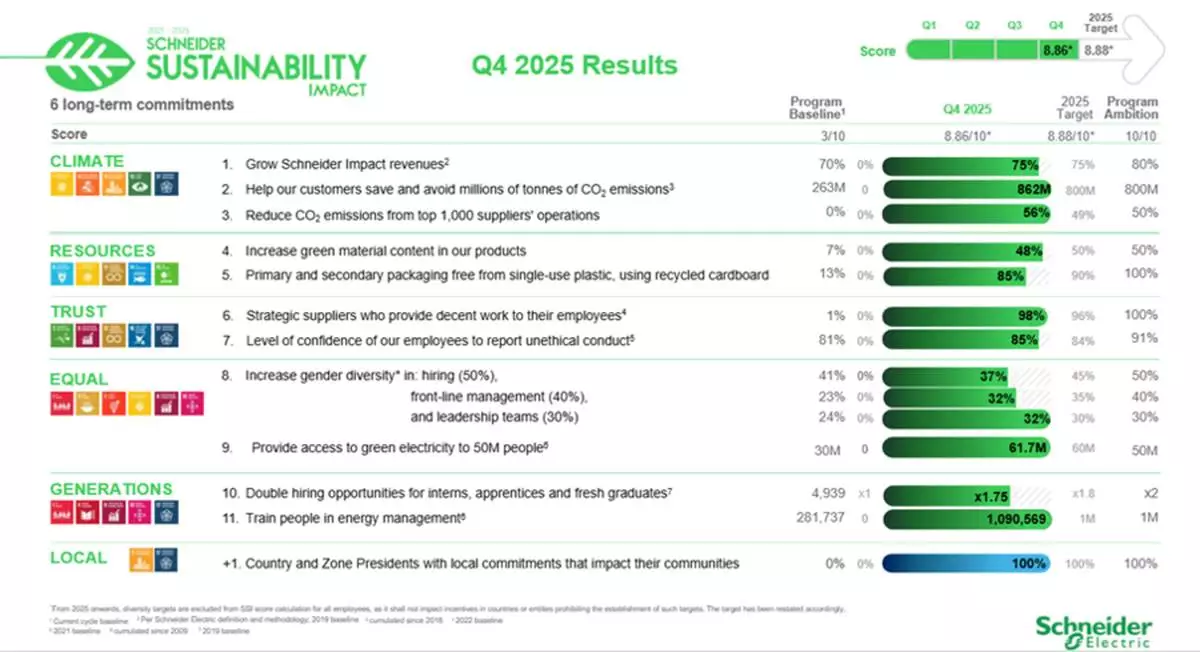
Schneider Electric completes its Sustainability Impact (SSI) 2021–2025 program, setting the stage for the next chapter
DUBAI, United Arab Emirates (AP) — Iran named Ayotollah Mojtaba Khamenei, a son of the country's late supreme leader, the Islamic Republic’s next ruler on Monday, putting a hard-line cleric in charge as the war spreading across the Middle East sent oil prices skyrocketing with Iran launching new attacks on regional energy infrastructure.
With Iran’s theocracy under assault by the United States and Israel for more than a week, the country’s Assembly of Experts chose the secretive, 56-year-old cleric with close ties to the country’s paramilitary Revolutionary Guard as the new supreme leader. The Guard has been firing missiles and drones at Israel and Gulf Arab states since the younger Khamenei’s father, Ayatollah Ali Khamenei, was killed Feb. 28 during the war’s opening salvo.
Iran's stranglehold on the Strait of Hormuz has also all but stopped tankers from using the shipping lane between the Persian Gulf and Gulf of Oman through which a fifth of the world's oil is carried. Brent crude oil, the international standard, surged to nearly $120 a barrel on Monday, about 65% higher than when the war started, before retreating slightly.
As global economic concerns grew, U.S. President Donald Trump downplayed the spike in prices.
“Short term oil prices, which will drop rapidly when the destruction of the Iran nuclear threat is over, is a very small price to pay for U.S.A., and World, Safety and Peace," Trump wrote on social media.
Iran has targeted Israel and American bases in the region since the start of the war. On Monday, a man was killed in central Israel in a missile strike, raising the country's death toll in the war to 11.
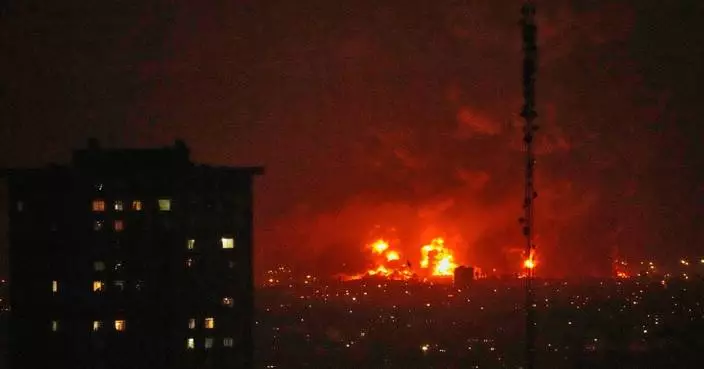
As Iran continued to hit regional energy infrastructure, a fire broke out Monday at an oil facility that was attacked in Fujairah, United Arab Emirates. Bahrain's only oil refinery was apparently also hit and Saudi Arabia said it had intercepted several drones attacking its Shaybah oil field.
Israel, meantime, claimed strikes on targets in Iran’s city of Isfahan, saying it hit command centers for the Revolutionary Guard and its volunteer Basij force, as well as a rocket engine production facility and missile launch sites. There was no immediate confirmation from Iran.
In Israel, sirens blared multiple times across the country as Iran's drones and missiles were unrelenting. A woman was wounded by debris in central Israel.
The younger Khamenei, who has not been seen in public since the war started, was long considered a potential successor — even before the Israeli strike killed his father. His wife, Zahra Haddad Adel, was killed in the same Israeli strike that killed the 86-year-old Ayatollah Ali Khamenei.
Political figures within Iran have criticized handing over the supreme leader's title based on heredity, thereby creating a clerical version of the rule of the shah, who was toppled during the 1979 Islamic Revolution. But top clerics in the Assembly of Experts likely wanted the younger Khamenei to prosecute the war.
Khamenei, who is seen as even more hard-line than his late father, will now be in charge of Iran's armed forces and any decision about Tehran's nuclear program.
While the country's key nuclear sites are in tatters after the U.S. bombed them during the 12-day Israel-Iran war in June, there's still highly enriched uranium in Iran that's a technical step away from weapons-grade levels. Khamenei could choose to do what his father never did — build a nuclear bomb.
Israel has already described him as a potential target, while Trump had called him “unacceptable.”
“We want someone that will bring harmony and peace to Iran,” Trump had said.
Both the Revolutionary Guard and the Iran-backed Lebanese militant group Hezbollah issued statements in support of Khamenei.
Top Iranian security official Ali Larijani, speaking to Iranian state television, praised the Assembly of Experts for “courageously” convening even as airstrikes continued in Tehran. He said the younger Khamenei had been trained by his father and “can handle this situation.”
Saudi Arabia lashed out at Iran following a thwarted drone attack on its massive Shaybah oil field, saying Tehran would be the “biggest loser” if it continues to attack Arab states.
The Foreign Ministry said Iranian attacks mean “further escalation which will have grave impact on the relations, currently and in the future.”
In addition to energy facilities in the UAE, authorities there said the capital of Abu Dhabi was targeted by Iranian missiles and two were hurt by shrapnel from interceptions.
Iran attacked Kuwait, Qatar and Bahrain, where it hit a residential area wounding 32 people, including several children, according to authorities. Another attack appeared to have started a fire at Bahrain's only oil refinery, sending thick plumes of smoke into the air.
Bahrain has also accused Iran of damaging one of its desalination plants, though its electricity and water authority said supplies remained online. Desalination plants supply water to millions of residents in the region and thousands of stranded travelers, raising new fears of catastrophic risks in parched desert nations.
On Monday, Bahrain's state oil company declared force majeure for its oil shipments, the state-run Bahrain News Agency reported, a legal maneuver releasing a company of its contractual obligations because of extraordinary circumstances. It insisted that local demand could still be met.
In Iraq, air defenses downed a drone as it attacked a U.S. military compound inside the Baghdad International Airport, a security source told The Associated Press, speaking on condition of anonymity because they were not authorized to speak to the press. No injuries or damage was reported. It was not immediately clear who was behind the attack but Pro-Iranian Iraqi militias have previously targeted the base.
Elsewhere, the U.S. military said a service member died of injuries from an Iranian attack on troops in Saudi Arabia on March 1. Seven U.S. soldiers have now been killed.
The U.S. State Department early Monday ordered nonessential personnel and families of all staff to leave Saudi Arabia following the escalation in attacks.
Eight other U.S. diplomatic missions have ordered all but key staff to leave: Bahrain, Iraq, Jordan, Kuwait, Lebanon, Qatar, the United Arab Emirates and the consulate in Karachi, Pakistan.
Smoke billowed over Beirut after Israel carried out airstrikes on its southern suburbs Monday.
Ahead of the strikes, the Israeli army said it would operate against targets associated with the Hezbollah-linked financial institution al-Qard Al-Hasan — which Israel said finances the militant group — and repeated its warning to residents of Beirut’s southern suburbs to flee.
The war has killed at least 1,230 people in Iran, at least 397 in Lebanon and 11 in Israel, according to officials. Another person died in Israel of an asthma attack on her way to a shelter. Israel reported its first soldier deaths on Sunday, saying two were killed in southern Lebanon, where its military is fighting Hezbollah.
Rising reported from Bangkok and Magdy from Cairo. Associated Press journalists Sam Metz in Ramallah, West Bank; Natalie Melzer in Nahariya, Israel; Sally Abou AlJoud in Beirut; Aamer Madhani in Doral, Florida, and Qassem Abdul-Zahra in Baghdad contributed reporting.
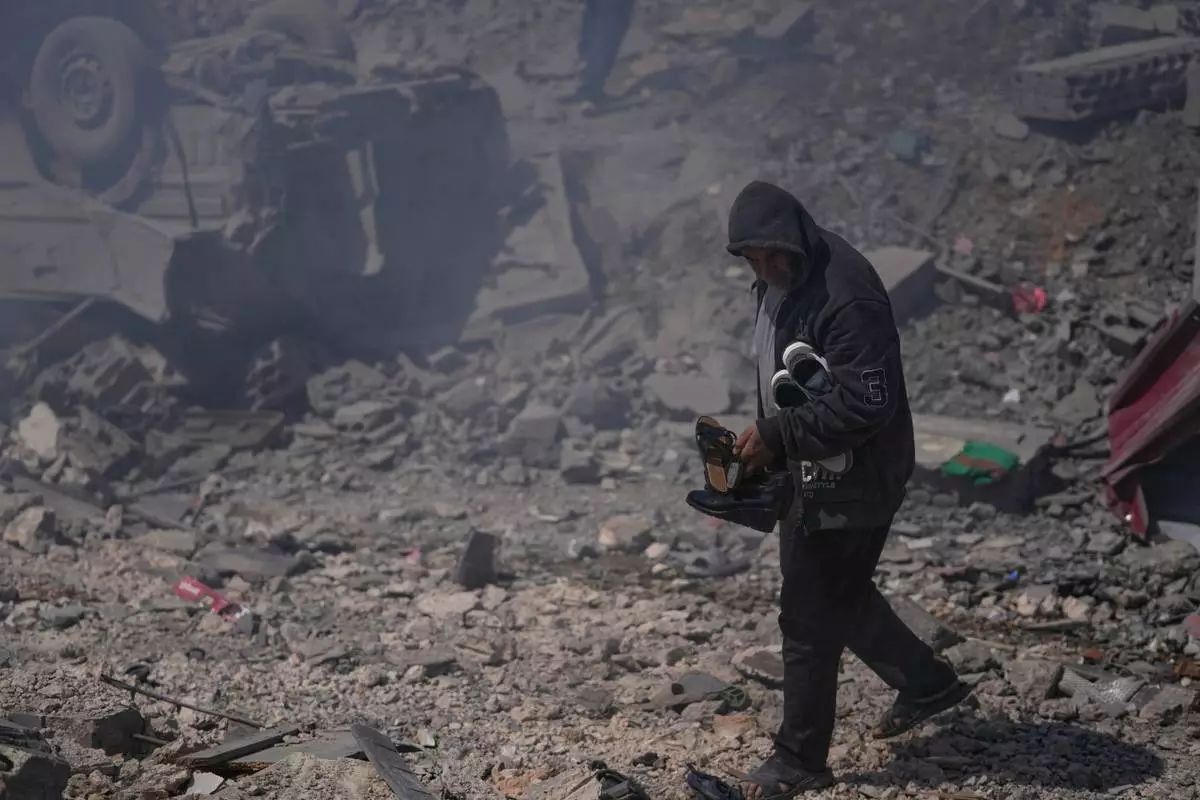
A man carries shoes from his destroyed house that was hit by Israeli airstrikes hit several houses in Sir al-Gharbiyeh village south Lebanon, Sunday, March, 8, 2026. (AP Photo/Mohammed Zaatari)
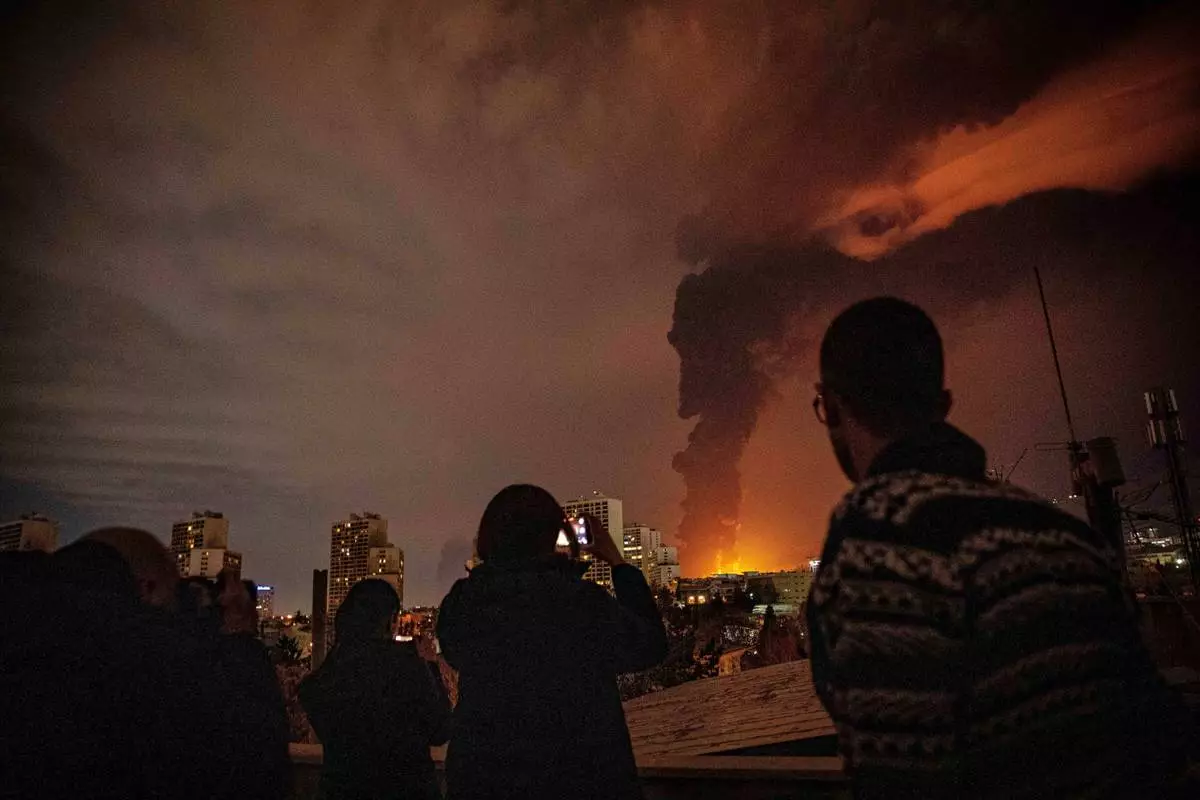
Residents look on and take pictures as flames and smoke rise from an oil storage facility struck as attacks hit the city during the U.S.–Israeli military campaign in Tehran, Iran, Saturday, March 7, 2026. (Alireza Sotakbar/ISNA via AP)
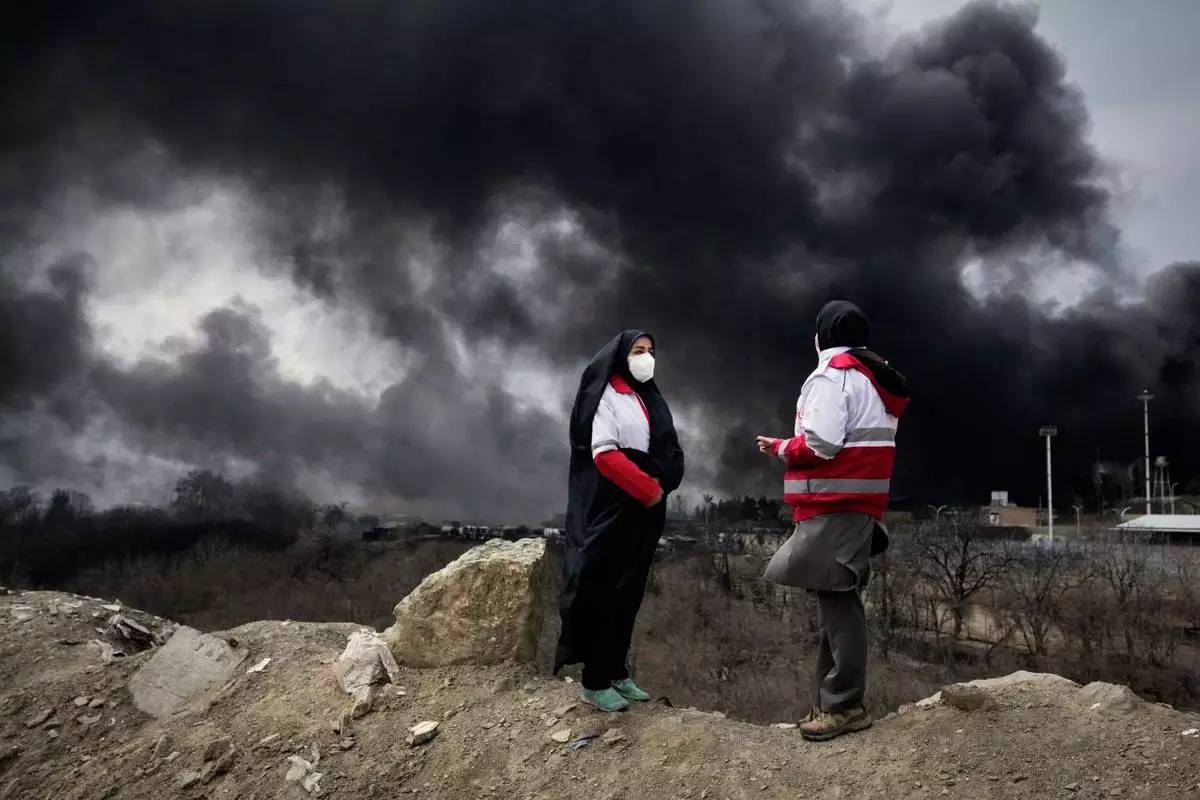
Two women from the Iranian Red Crescent Society stand as a thick plume of smoke from a U.S.-Israeli strike on an oil storage facility late Saturday rises in the sky in Tehran, Iran, Sunday, March 8, 2026. (AP Photo/Vahid Salemi)
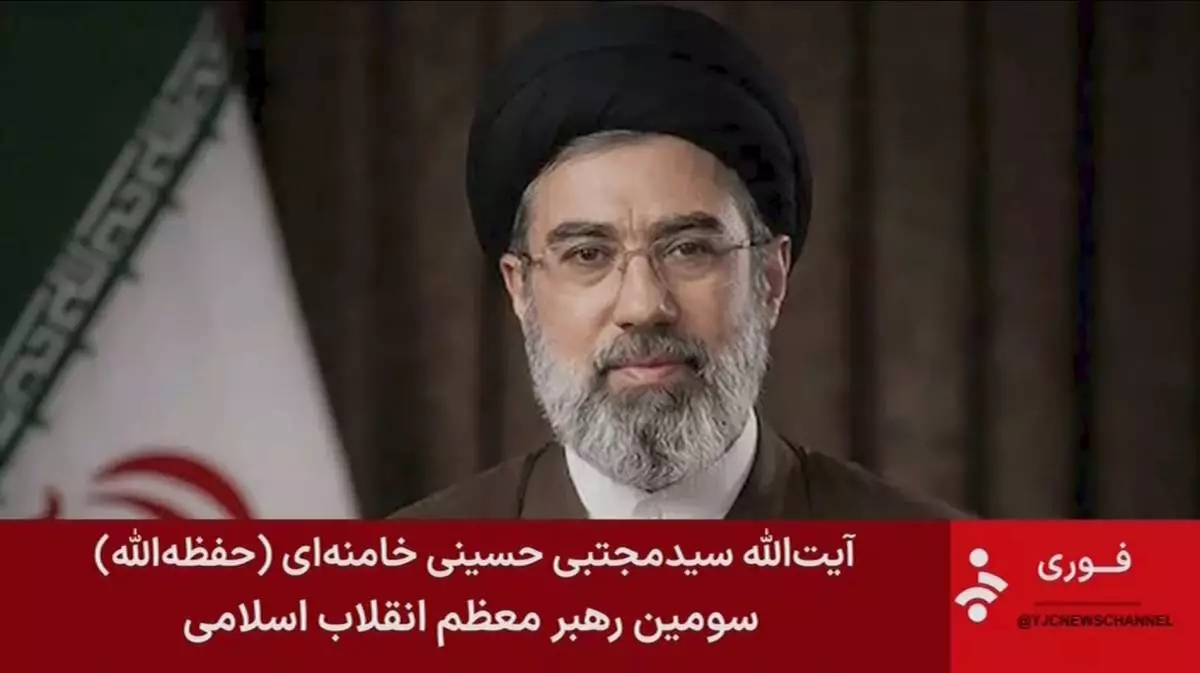
This image taken from video provided by Iran state TV shows Mojtaba Khamenei, a son of Iran's slain supreme leader, who has been named as the Islamic Republic's next ruler, authorities announced Monday, March 9, 2026. (Iran state TV via AP)