LAS VEGAS--(BUSINESS WIRE)--Mar 9, 2026--
DT Research, a U.S. leader in precision-engineered computing solutions designed for mission-critical and demanding environments, today announced the unveiling of the DT573 and DT556 All-in-One (AIO) medical computers at HIMSS 2026. This new class of compact, lightweight, and fanless medical AIOs delivers flexible deployment across stick carts, wall mounts, and kiosks - enabling consistent point-of-care computing while reducing deployment complexity and maintenance overhead. The DT573 and DT556 further expand DT Research’s comprehensive line of battery-powered and mounted medical computing solutions.
This press release features multimedia. View the full release here: https://www.businesswire.com/news/home/20260309023332/en/
“Healthcare organizations asked us for a point-of-care system that delivers the usability and screen size they need without the complexity of larger all-in-one systems,” said Daw Tsai, president of DT Research. “The DT573 and DT556 reflect direct customer input around mounting versatility and peripheral integration, offering a compact, fanless platform that supports a wide range of clinical, telehealth and specialty workflows, while maintaining the performance, hygiene, and reliability hospitals expect from DT Research medical computing solutions.”
DT Research will showcase the DT573 and DT556 medical-grade All-in-One computers at the HIMSS 2026 Global Health Conference and Exhibition in booth #1964 from March 10-12, in Las Vegas.
Compact Form Optimized for Stick Carts and Fixed Installations
For hospitals that do not require full tablet portability, the DT573 and DT556 offer a compact, lightweight alternative that is well suited for deployment on stick carts without the balance and tipping concerns associated with larger AIO systems. The fanless design and reduced footprint make the DT573 (17.3”) and DT556 (15.6”) ideal for healthcare environments where devices are mounted on stick carts, walls, arms, or kiosks rather than carried between locations.
For fixed installations, the systems can also operate while plugged in, making them well suited for patient rooms, medication dispensing areas, and in-room clinical kiosks. Both systems feature VESA mounting compatibility, enabling standardized deployment across departments while simplifying IT management and long-term lifecycle planning.
Customer-Driven Design for Seamless Peripheral Integration
A key design enhancement of the DT573 and DT556 is the rear-mounted dual battery slots, which keep the top of the unit clear for peripherals such as 360-degree cameras, larger speakers, and other clinical accessories – a critical requirement for telehealth, in-room clinician–patient–family language translation, and a broad range of specialty clinical workflows.
Hot-swappable batteries allow clinicians to maintain uninterrupted workflows during cart-based use, while AC-powered operation supports always-on deployments in fixed care settings.
Clinical-Ready Performance and Infection-Control Enclosures
Both the DT573 and DT556 feature a fanless architecture and antimicrobial enclosure, helping reduce airborne contaminants and simplify cleaning protocols in infection-sensitive environments. The systems include an IP65-sealed front bezel and IP54-rated rear enclosure, supporting safe use in demanding clinical conditions.
Powered by Intel® Core™ Ultra or Qualcomm 6490 processors, the DT573 and DT556 deliver strong multitasking performance for EMR access, imaging review, medication workflows, and everyday clinical applications. A responsive high-resolution touchscreen supports fast, intuitive interaction at the point-of-care.
Configurations include Microsoft® Windows® 11 IoT Enterprise or Ubuntu or Android 13, along with options for a dual-frequency RFID reader that reads Imprivata® badges, IR camera, smart card/CAC reader, microphone array, Wi-Fi 6E/7, and 5G connectivity - enabling secure authentication, data capture, and modern clinical workflows.
Availability
The DT573 and DT556 AIO medical computers will be available in Q2 2026 from authorized DT Research partners and resellers worldwide.
About DT Research
DT Research ™, a U.S. leader in precision-engineered computing solutions designed for mission-critical and demanding environments, delivers the world’s most comprehensive line of Rugged Tablets, Medical Computing Solutions, and Rugged Laptops. DT Research products are uniquely designed with customizable built-in options assembled in California, providing customers with rapid time-to-market solutions that are TAA compliant. The DT Research family of products is based on embedded computing platforms that power secure, reliable and cost-effective computing. DT Research systems offer computing mobility within industrial and harsh environments through durable solutions with wireless connectivity, high-quality touch displays and Windows ®, Android, and Linux operating systems. More than 200 organizations across the globe rely on DT Research solutions in industries such as government, healthcare, hospitality, logistics, military, construction and warehousing. DT Research is headquartered in Silicon Valley, California. For more information, visit www.dtresearch.com and follow @dtresearch, #MilitaryTablets, #RuggedTablets and #MedicalTablets .
DT Research and WebDT are trademarks of DT Research, Inc. All other brands and product names may be trademarks and/or registered trademarks of their respective owners.

A clinician accesses patient information using the DT573 medical All-in-One computer from DT Research, a new class of compact medical computers designed to bridge the gap between mobile tablets and traditional full-size AIO systems. The DT573 and DT556 bring flexible point-of-care computing to stick carts, wall mounts, and kiosks across modern healthcare environments.
Arson attacks on Ebola treatment centers in eastern Congo show how authorities are faced with a number of serious complications — including a backlash in local communities — as they try to stop an outbreak of an infectious disease that has been declared a global health emergency.
The burning of the centers in two towns at the heart of the outbreak shows the anger in a region beset by violence linked to armed rebel groups, the displacement of a large number of people, the failure of local government and international aid cuts that experts say have stripped health facilities in vulnerable communities.
“A devastating set of emergencies are converging," said the Physicians for Human Rights nonprofit.
Here's a look at the longstanding crises in eastern Congo that have made it home to one of the world's worst humanitarian disasters, and how they are now affecting the response to a rare type of Ebola:
Eastern Congo has seen violence by dozens of separate rebel groups for years, some of them with links to foreign countries or Islamic State.
The Rwanda-backed M23 rebels are in control of parts of the region. While the Congolese government still largely controls the northeastern Ituri Province, which is the epicenter of the Ebola outbreak, that control is tenuous. The Allied Democratic Forces, a Ugandan Islamist group linked to Islamic State, is one of the dominant rebel groups there and responsible for violent attacks against civilian targets.
Before the outbreak, Doctors Without Borders said in an assessment of the situation in Ituri that the insecurity had worsened recently, causing doctors and nurses to flee and leaving overwhelmed health facilities and “catastrophic” conditions in some parts.
Nearly 1 million people in Ituri have been displaced from their homes by conflict, according to the United Nations humanitarian office.
That means this Ebola outbreak is “unfolding in communities already facing insecurity, displacement and fragile health care systems,” said Gabriela Arenas, Regional Operations Coordinator at the International Federation of Red Cross and Red Crescent Societies.
It's a significant concern that the disease might spread to the large displacement camps near the city of Bunia, where the first cases were reported.
Authorities have announced more than 700 suspected Ebola cases and more than 170 suspected deaths, mostly in Ituri. But cases have been reported in two other eastern provinces, North Kivu and South Kivu, where M23 are in control, and also in the neighboring country of Uganda.
That means that part of the outbreak in Congo is being managed by the government and part by rebel authorities, with an array of aid agencies also helping.
Health experts say international aid cuts last year by the United States and other rich nations were devastating for eastern Congo because it has so many problems.
The cuts “reduced the capacity to detect and respond to infectious disease outbreaks,” said Thomas McHale, public health director at Physicians for Human Rights. Congo has had more than a dozen previous Ebola outbreaks.
Aid groups fighting this outbreak on the ground say they don't have the equipment they need, like face shields and suits to protect health workers from infection, testing kits, and body bags and other materials needed to safely bury the bodies of victims, which can be highly contagious.
“We have made requests to different partners, but we have not yet really received anything,” said Julienne Lusenge, president of Women’s Solidarity for Inclusive Peace and Development, an aid group operating a small hospital near Bunia.
“We only have hand sanitizer and a few masks for the nurses.”
The Bundibugyo type of Ebola virus responsible for the outbreak has no approved vaccine or treatment.
The burning of two treatment centers by people in the Rwampara and Mongbwalu areas — which have the highest case counts — show how a backlash in some communities is further complicating the response.
Colin Thomas-Jensen, director of impact at the Aurora Humanitarian Initiative, said the attacks may reflect the “built-in skepticism and anger” of people in eastern Congo over how the region has been treated, with years of violence from foreign-linked rebel groups and a failure of their government and international peacekeepers to protect them, he said.
Another source of anger has been the strict protocols around the burial of suspected victims of Ebola, which authorities are taking charge of wherever they can to prevent further spread of the disease when families prepare the bodies and people gather for a funeral.
The first burning of an Ebola center in Rwampara was by a group of local youths trying to retrieve the body of a friend who died, according to witnesses and police. The witnesses said the crowd accused the foreign aid group operating there of lying about Ebola.
Authorities in northeastern Congo have now banned funeral wakes and gatherings of more than 50 people in an effort to curb the spread, and armed soldiers and police are guarding some burials carried out by aid workers.
AP writers Mark Banchereau and Wilson McMakin contributed to this report.
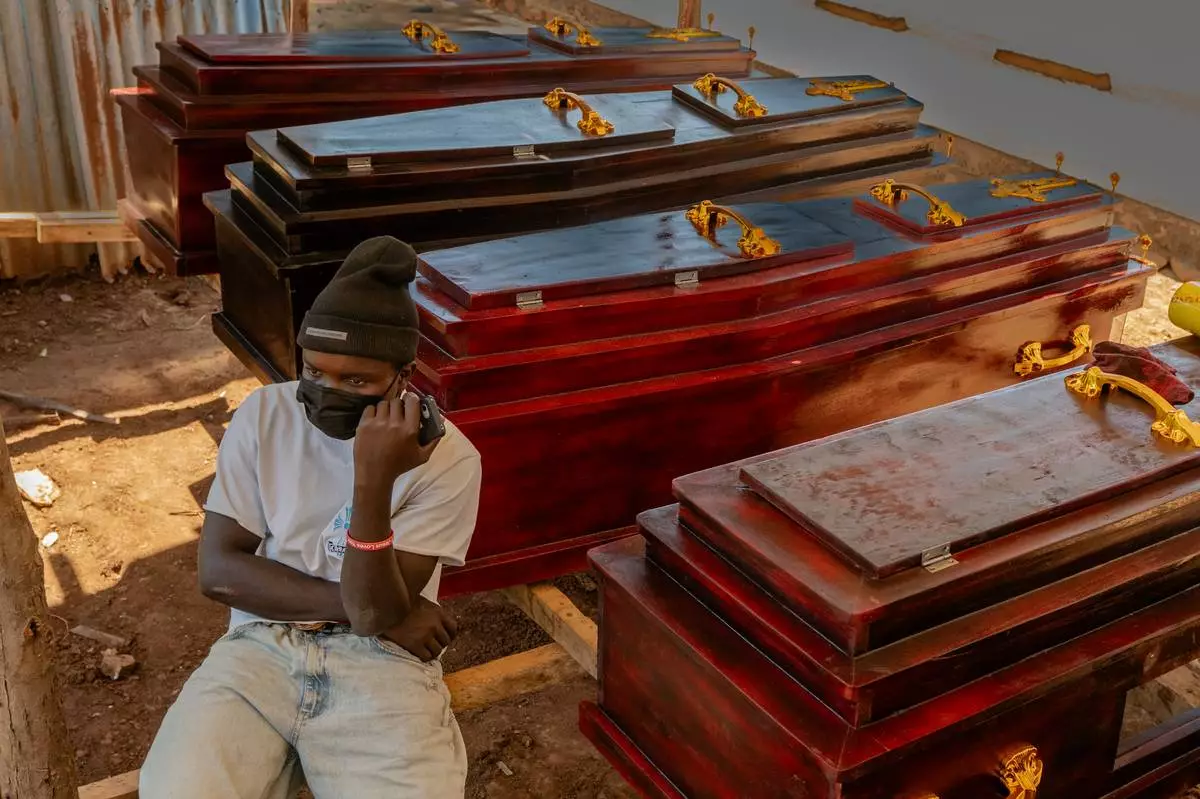
Djakisa Christian, 18, a funeral home manager, sits in front of coffins for sale at his shop in Bunia, Congo, Friday, May 22, 2026. (AP Photo/Moses Sawasawa)
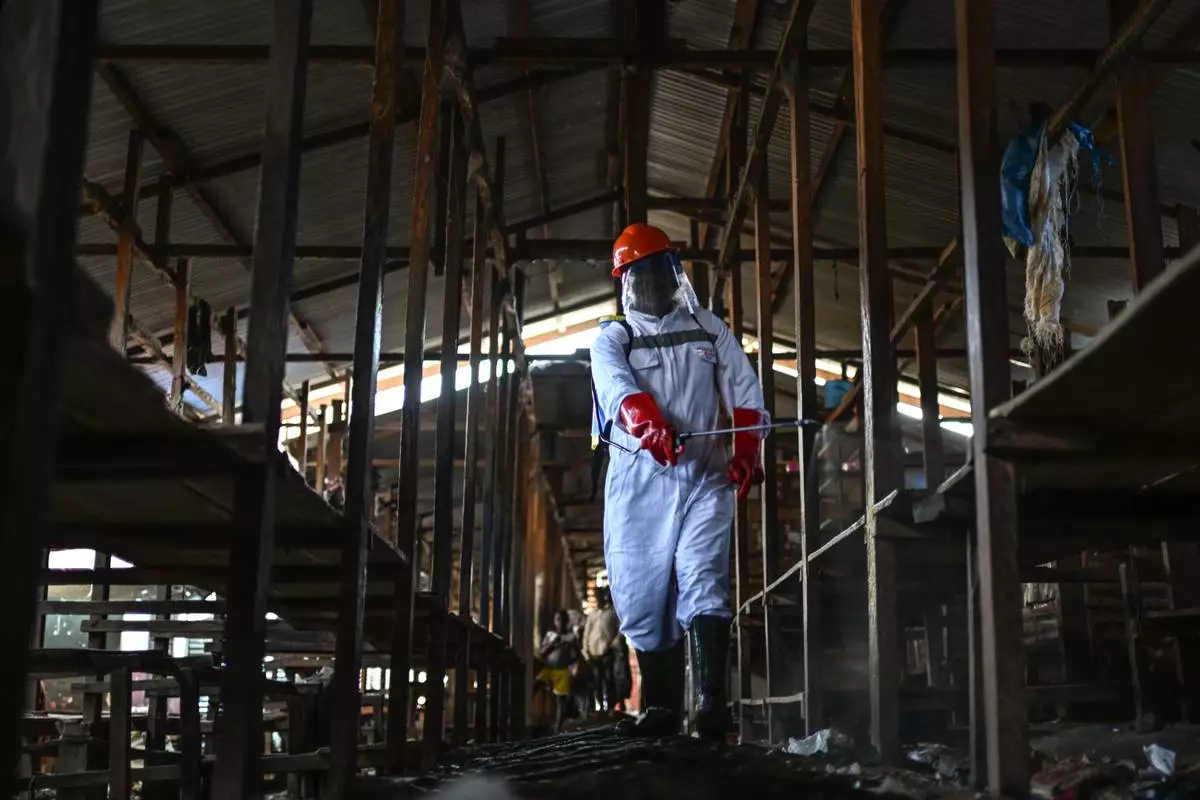
A sanitation worker from the Bunia city government sprays chlorine to disinfect the central market, as Ituri province continues to combat an Ebola outbreak, in Bunia, Congo, Saturday, May 23, 2026. (AP Photo/Moses Sawasawa)

Francois Kasereka, a member of the Congo Scouts movement, speaks to people during a public sensitisation campaign amid the Ebola outbreak in Bunia, Congo, Saturday, May 23, 2026. (AP Photo/Moses Sawasawa)
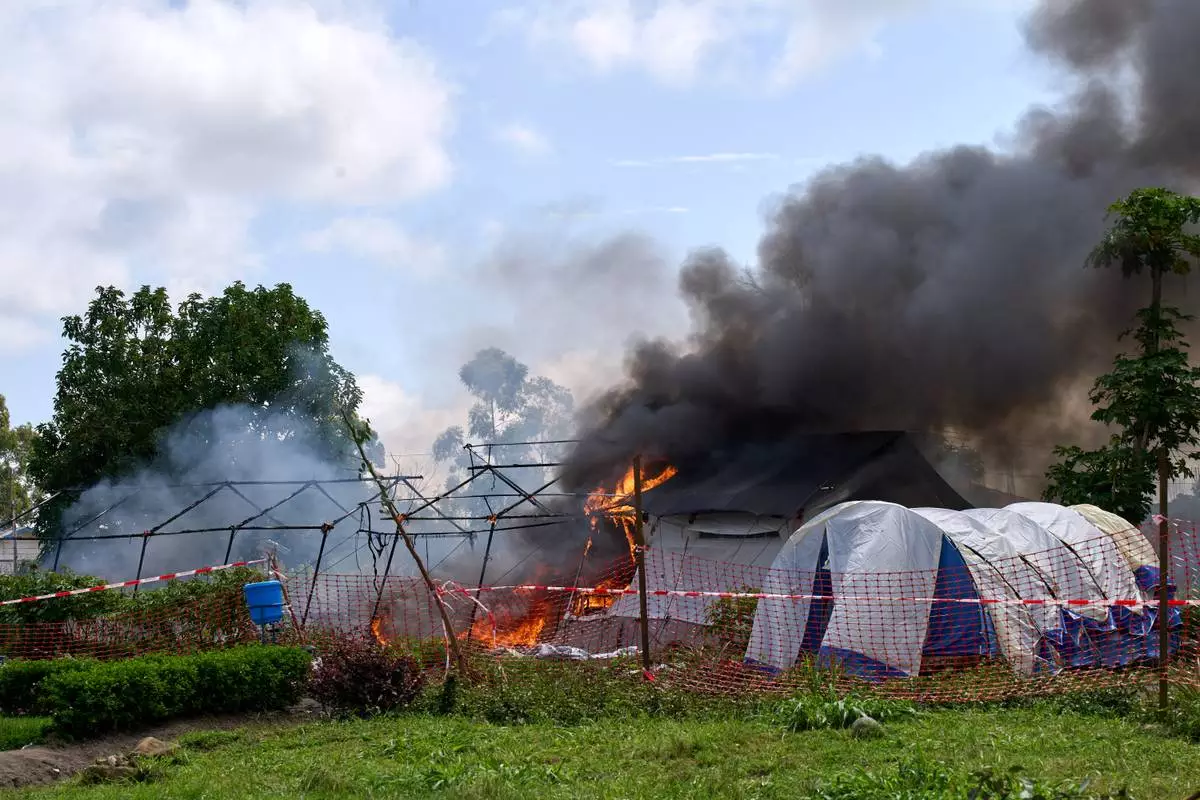
Flames and smoke rise from an Ebola treatment center in Rwampara, Congo, Thursday, May 21, 2026. (AP Photo/Dirole Lotsima Dieudonne)
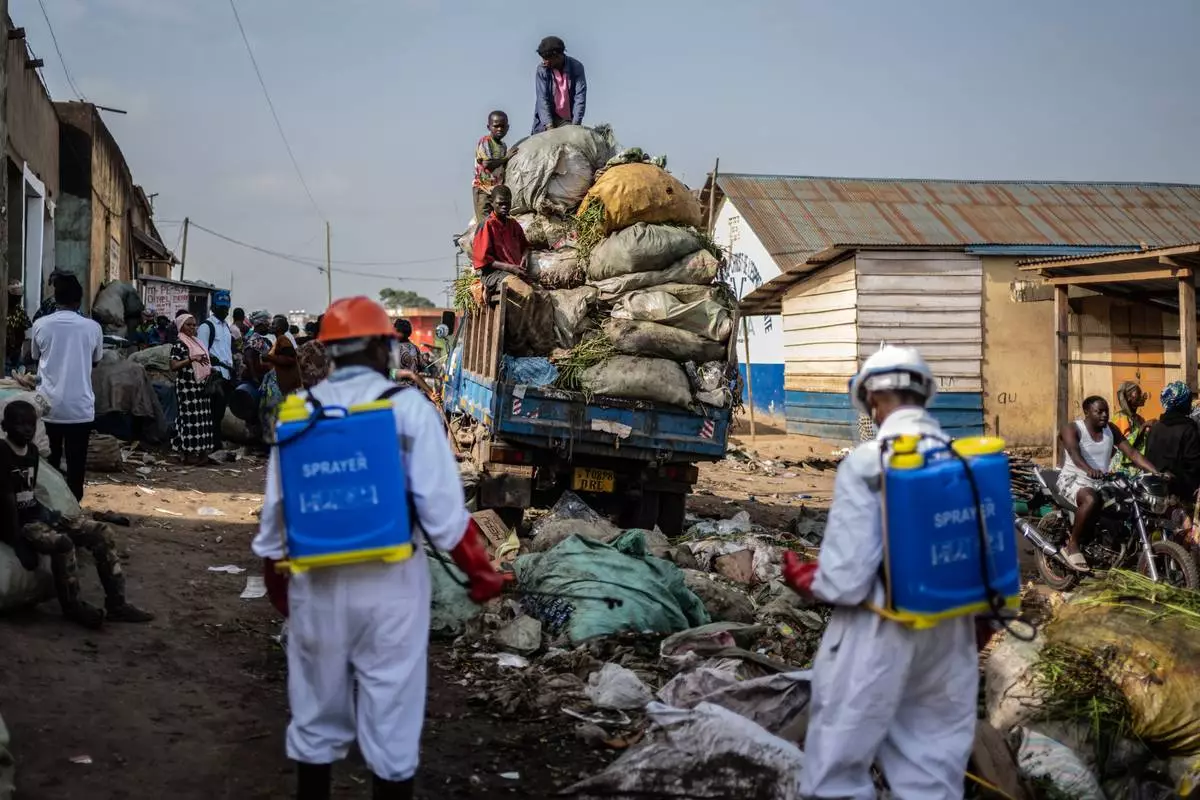
Sanitation workers from Bunia city government spray disinfectant in the central market area near a rubbish truck in Ituri province, as they continue efforts to combat the Ebola outbreak in Bunia, Congo, Saturday, May 23, 2026. (AP Photo/Moses Sawasawa)