Skip to Content Facebook Feature Image

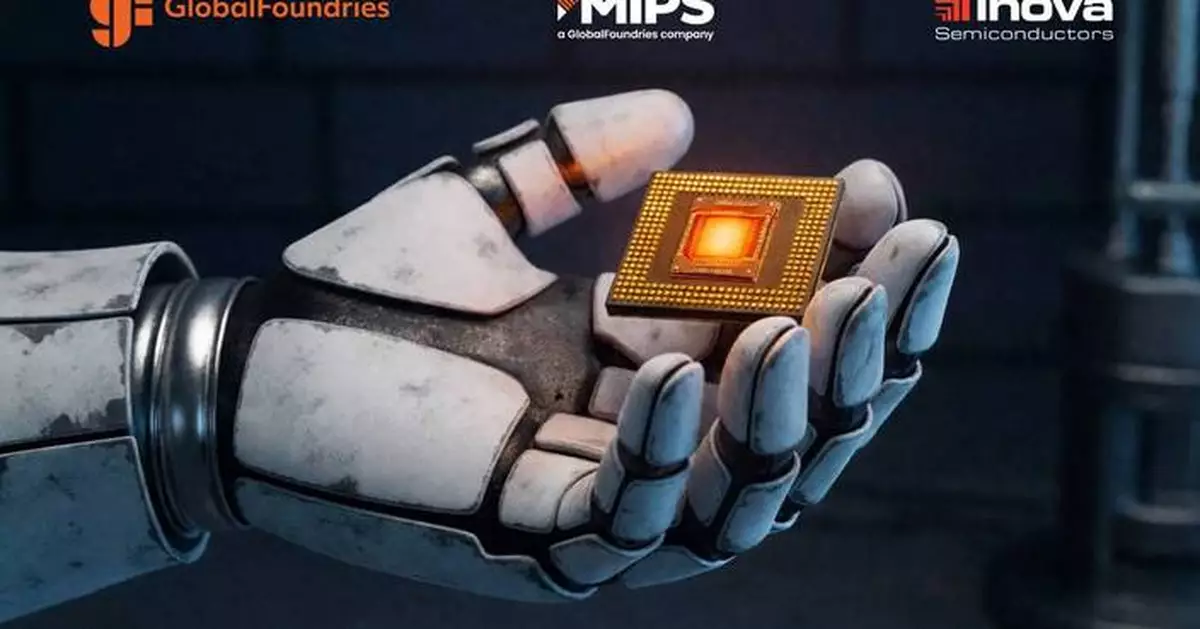
MIPS and INOVA Collaborate to put Physical AI into the palm of Robotic hands with new Reference Platform

News

MIPS and INOVA Collaborate to put Physical AI into the palm of Robotic hands with new Reference Platform
News

News

MIPS and INOVA Collaborate to put Physical AI into the palm of Robotic hands with new Reference Platform

2026-03-09 20:30 Last Updated At:20:50

SAN JOSE, Calif.--(BUSINESS WIRE)--Mar 9, 2026--

MIPS, a GlobalFoundries company, announced today a collaboration with Inova Semiconductors GmbH, to deliver a robotics control reference platform for advanced humanoids and physical AI edge platforms. Building on the strengths of Inova’s Automotive expertise in zonal architectures, the platform will enable mixed-criticality compute featuring real-time control loops and secure AI workloads, manufactured on GlobalFoundries (GF) FDX platform to deliver high quality, leading performance, and ultra-low power operation.

This press release features multimedia. View the full release here: https://www.businesswire.com/news/home/20260306846528/en/

“Together with INOVA, we’re delivering a Physical AI reference platform that simplifies robot design, reduces BOM cost, and gives builders an open, standards-based path to create whole product families with low latency and functionally safe connectivity,” said Sameer Wasson, MIPS CEO. “Robotics is moving rapidly and the leaders will scale quickly and cost-effectively. By pairing INOVA’s high-speed communication links with MIPS’ open RISC-V compute and mixed signal technologies, this scalable reference platform turns ‘sense-think-act-communicate’ into a Physical AI building block that lowers risk, lowers cost, and accelerates time to market.”

The advanced robotic arm reference platform combines the expertise of INOVA, MIPS, and GlobalFoundries to build an advanced Physical AI building block that aggregates data interfaces and enables multiple network topologies, driving fast development cycles for real-time high-performance multi-axis motion control. These features are enabled through INOVA’s innovative APXpress high-speed interface and MIPS Atlas M8500 RISC-V high-performance microcontroller processor IP, MIPS Atlas S8200 RISC-V AI processor IP, and MIPS Atlas mixed signal technologies combined with GF’s FDX® process technology to deliver ultra-low power. The platform is a custom SoC for robotics workloads and other Physical AI applications that require mission critical capabilities, on-device secure AI, security, and highly efficient performance.

“Advanced humanoids demand secure, deterministic connectivity and a scalable control backbone. INOVA together with GF & MIPS, we’re giving robot makers a zonal, RISC-V-based blueprint that cuts complexity and cost to help scale humanoids and advanced robotics from prototype to production faster,” said Robert Isele, CEO at INOVA. “The creation of a reference zonal architecture for advanced robotics will enable simpler and faster creation of humanoid and other robotic form factors.”

Early access to the platform is facilitated by MIPS Atlas Explorer, a simulation-based hardware/software co-design platform. This grants software developers access to virtual representations of the compute elements to start optimization of vision language action models preparing the foundational model for the robotics control reference architecture.

For more information on the INOVA APXpress data interconnect technology, visit the website, here. To learn more about MIPS portfolio of tools, software and IP for Physical AI, contact us. MIPS and GlobalFoundries are exhibiting at Embedded World 2026 in Nuremburg, Germany, from March 10 th to 12 th.

About MIPS

MIPS, a GlobalFoundries company, develops tools, software, and compute required for building autonomous edge computing platforms. With over 40 years of history in computing innovation and mission critical platforms, MIPS is uniquely positioned to advance the adoption of Physical AI in transportation, robotics, and other embedded markets. MIPS technology is based on the open RISC-V instruction set architecture and uses a modular, standards-based approach to build workload-focused solutions. For more information, visit MIPS.com.

About Inova Semiconductors

Inova Semiconductors GmbH is a fabless semiconductor company based in Munich. Founded in 1999, the company develops high-speed serial data communication for the automotive sector (APIX®/APXpress). Inova is also known for its SMART LED technology (ISELED®) and network connection technology for SMART LEDs and sensors (ILAS®). Under the name APXpress, the company has developed a novel high-speed data backbone for zonal architectures and software-defined vehicles. It supports up to 500 independent data channels at speeds of up to 32 Gbps with minimal latency.

Inova Semiconductors' products are manufactured by leading semiconductor manufacturers such as GlobalFoundries. For more information, visit inova-semiconductors.de.

MIPS and INOVA Collaborate to put Physical AI into the palm of Robotic hands with new Reference Platform
MIPS and INOVA Collaborate to put Physical AI into the palm of Robotic hands with new Reference Platform
DUBAI, United Arab Emirates (AP) — Iran named the hard-line Ayatollah Mojtaba Khamenei to succeed his late father as supreme leader on Monday, signaling no letup in the war launched by the United States and Israel. Oil prices surged as Iran attacked regional energy infrastructure and the U.S. and Israel bombed targets across Iran.

The secretive 56-year-old cleric has close ties to the paramilitary Revolutionary Guard, which has been firing missiles and drones at Israel and Gulf Arab states since Ayatollah Ali Khamenei, who had ruled Iran for 37 years, was killed during the war’s opening salvo.

The appointment marked a new sign of defiance by Iran’s embattled leadership after more than a week of heavy U.S. and Israeli bombardment, suggesting Tehran is not close to giving up on what it considers a fight for the Islamic theocracy's survival.

World markets plummeted and Brent crude oil, the international standard, surged to nearly $120 a barrel Monday, about 65% higher than when the war started, before retreating.

Iran's attacks in the Strait of Hormuz have all but stopped tankers from using the key shipping lane through which a fifth of the world's oil is carried. Fire broke out at an oil facility that Iran attacked in the United Arab Emirates. Bahrain's only oil refinery was apparently also hit and Saudi Arabia said it had intercepted several drones attacking its Shaybah oil field.

“There is not an oil shortage,” U.S. President Donald Trump wrote on Truth Social overnight. “Prices will drop again soon,” he added, suggesting shipments from Venezuela to the U.S. could help offset the price spike.

In Israel, sirens blared multiple times on Monday amid unrelenting Iranian drones and missiles. A man was killed in central Israel in a missile strike, the first such death in Israel in a week, and a woman was wounded.

Israel said it struck the Iranian city of Isfahan, hitting command centers for the Revolutionary Guard and its volunteer Basij force, as well as a rocket engine production facility and missile launch sites. There was no immediate confirmation from Iran.

Turkey meanwhile said NATO defenses had intercepted a ballistic missile that entered the country’s airspace for the second time since the war started.

Later Monday, Israel defense forces said they began “a wide-scale wave of strikes” on Isfahan as well as Iran’s capital, Tehran, where witnesses reported seeing new strikes, and in southern Iran.

The younger Khamenei, who has not been seen in public since the war started, was long considered a potential successor — even before the Israeli strike killed his 86-year-old father. His wife, Zahra Haddad Adel, was killed in the same strike.

Political figures within Iran have criticized handing over the supreme leader’s title based on heredity, comparing it to the monarchy overthrown in the 1979 Islamic Revolution. But top clerics in the Assembly of Experts apparently voted for continuity.

Khamenei, who is seen as even more hard-line than his late father, will now be in charge of Iran's armed forces and any decision about Tehran's nuclear program.

Though Iran's key nuclear sites are in tatters after the U.S. bombed them during the 12-day Israel-Iran war in June, it still has highly enriched uranium that's a technical step away from weapons-grade levels. Khamenei could choose to do what his father never did — build a nuclear bomb.

Israel has already described him as a potential target, while Trump has called him “unacceptable” and dismissed him as a “lightweight.”

Both the Revolutionary Guard and the Iran-backed Lebanese militant group Hezbollah issued statements in support of Khamenei.

Top Iranian security official Ali Larijani, speaking to Iranian state television, praised the Assembly of Experts for “courageously” convening even as airstrikes pounded Tehran. He said the younger Khamenei had been trained by his father and “can handle this situation.”

Saudi Arabia lashed out at Iran following a thwarted drone attack on its massive Shaybah oil field, saying Tehran would be the “biggest loser” if it continues to attack Arab states.

In the United Arab Emirates, authorities said two people were wounded by shrapnel from the interception of Iranian missiles over the capital, Abu Dhabi. By mid-afternoon, the Emirati Defense Ministry said 15 ballistic missiles and 18 drones were fired on the country on Monday, raising the total 253 missiles and 1,440 drones launched at the UAE since the war began. So far in the war, four foreign nationals have been killed in the UAE and 117 wounded, it said.

Iran also attacked Kuwait, Qatar and Bahrain, where it hit a residential area, wounding 32 people, including several children, according to authorities. Another attack appeared to have started a fire at Bahrain's only oil refinery, sending thick plumes of smoke into the air.

Bahrain has also accused Iran of damaging one of its desalination plants, though its electricity and water authority said supplies remained online. Desalination plants supply water to millions of residents in the region, raising new fears of catastrophic risks in parched desert nations.

In Iraq, air defenses downed a drone as it attacked a U.S. military compound inside the Baghdad International Airport, a security official told The Associated Press, speaking on condition of anonymity because they were not authorized to speak to the press. No injuries or damage were reported. It was not immediately clear who was behind the attack, but Iran-backed militias have previously targeted the base.

Elsewhere, the U.S. military said a service member died of injuries from an Iranian attack on troops in Saudi Arabia on March 1. Seven U.S. soldiers have now been killed.

The U.S. State Department early Monday ordered nonessential personnel and families of all staff to leave Saudi Arabia following the escalation in attacks.

Several other U.S. diplomatic missions have ordered all but key staff to leave, including Bahrain, Iraq, Jordan, Kuwait, Lebanon, Qatar, the UAE and the consulates in Karachi, Pakistan, and Adana, Turkey.

Smoke billowed over Beirut after Israel carried out airstrikes on its southern suburbs Monday.

Ahead of the strikes, the Israeli army said it would operate against targets associated with the Hezbollah-linked financial institution al-Qard Al-Hasan — which Israel said finances the militant group — and repeated its warning to residents of Beirut’s southern suburbs to flee.

The war has killed at least 1,230 people in Iran, at least 397 in Lebanon and 11 in Israel, according to officials. Another person died in Israel of an asthma attack on her way to a shelter. Israel reported its first soldier deaths on Sunday, saying two were killed in southern Lebanon, where it is fighting Hezbollah.

Rising reported from Bangkok and Magdy from Cairo. Associated Press journalists Sam Metz in Ramallah, West Bank; Natalie Melzer in Nahariya, Israel; Melanie Lidman in Tel Aviv, Israel; Sally Abou AlJoud in Beirut; Aamer Madhani in Doral, Florida, and Qassem Abdul-Zahra in Baghdad contributed reporting.

Smoke rises following an Israeli airstrike in Dahiyeh, Beirut's southern suburbs, Lebanon, Monday, March 9, 2026. (AP Photo/Bilal Hussein)

Smoke rises following an Israeli airstrike in Dahiyeh, Beirut's southern suburbs, Lebanon, Monday, March 9, 2026. (AP Photo/Bilal Hussein)

Mourners pray during the funeral of Mehdi Hosseini, a man killed in a U.S.-Israeli strike, at Behesht-e Zahra cemetery in Tehran, Iran, Monday, March 9, 2026. (AP Photo/Vahid Salemi)

Mourners pray during the funeral of Mehdi Hosseini, a man killed in a U.S.-Israeli strike, at Behesht-e Zahra cemetery in Tehran, Iran, Monday, March 9, 2026. (AP Photo/Vahid Salemi)

Relatives mourn over the flag draped coffin of Mehdi Hosseini who was killed in a U.S.-Israeli strike during his burial ceremony at Behesht-e Zahra cemetery in Tehran, Iran, Monday, March 9, 2026. (AP Photo/Vahid Salemi)

Relatives mourn over the flag draped coffin of Mehdi Hosseini who was killed in a U.S.-Israeli strike during his burial ceremony at Behesht-e Zahra cemetery in Tehran, Iran, Monday, March 9, 2026. (AP Photo/Vahid Salemi)

The coffin of Mehdi Hosseini, a man killed in a U.S.-Israeli strike, is carried for burial at Behesht-e Zahra cemetery in Tehran, Iran, Monday, March 9, 2026. (AP Photo/Vahid Salemi)

The coffin of Mehdi Hosseini, a man killed in a U.S.-Israeli strike, is carried for burial at Behesht-e Zahra cemetery in Tehran, Iran, Monday, March 9, 2026. (AP Photo/Vahid Salemi)

A man carries shoes from his destroyed house that was hit by Israeli airstrikes hit several houses in Sir al-Gharbiyeh village south Lebanon, Sunday, March, 8, 2026. (AP Photo/Mohammed Zaatari)

A man carries shoes from his destroyed house that was hit by Israeli airstrikes hit several houses in Sir al-Gharbiyeh village south Lebanon, Sunday, March, 8, 2026. (AP Photo/Mohammed Zaatari)

Residents look on and take pictures as flames and smoke rise from an oil storage facility struck as attacks hit the city during the U.S.–Israeli military campaign in Tehran, Iran, Saturday, March 7, 2026. (Alireza Sotakbar/ISNA via AP)

Residents look on and take pictures as flames and smoke rise from an oil storage facility struck as attacks hit the city during the U.S.–Israeli military campaign in Tehran, Iran, Saturday, March 7, 2026. (Alireza Sotakbar/ISNA via AP)

Two women from the Iranian Red Crescent Society stand as a thick plume of smoke from a U.S.-Israeli strike on an oil storage facility late Saturday rises in the sky in Tehran, Iran, Sunday, March 8, 2026. (AP Photo/Vahid Salemi)

Two women from the Iranian Red Crescent Society stand as a thick plume of smoke from a U.S.-Israeli strike on an oil storage facility late Saturday rises in the sky in Tehran, Iran, Sunday, March 8, 2026. (AP Photo/Vahid Salemi)

This image taken from video provided by Iran state TV shows Mojtaba Khamenei, a son of Iran's slain supreme leader, who has been named as the Islamic Republic's next ruler, authorities announced Monday, March 9, 2026. (Iran state TV via AP)

This image taken from video provided by Iran state TV shows Mojtaba Khamenei, a son of Iran's slain supreme leader, who has been named as the Islamic Republic's next ruler, authorities announced Monday, March 9, 2026. (Iran state TV via AP)

Recommended Articles