SHENZHEN, China, March 9, 2026 /PRNewswire/ -- RoboSense (2498.HK), an AI-driven robotics technology company, today announced that its cutting-edge thousand-beam-level digital LiDAR EM4 and fully solid-state digital LiDAR E1 have been selected for the Robotaxi GXR, co-developed by WeRide and Farizon New Energy Commercial Vehicle Group (a Geely subsidiary). The fleet of Robotaxi GXR is scheduled to begin rolling off the production line in Q3 2026, with a planned delivery of 2,000 units destined for both domestic and international markets.
Redefining L4 Perception with Thousand-Beam-Level Digital LiDAR
The Robotaxi GXR is equipped with the latest autonomous driving suite, GEN8. At the core of GEN8 is WeRide's self-developed Sensor Suite 8.0 (SS8.0), which includes RoboSense's thousand-beam-level digital LiDAR EM4, as the main LiDAR, and thefully solid-state digital blind-spot LiDAR E1, ensuring safety and reliability during operation.
EM4, the Main LiDAR Capable of Thousand-Beam-Level Customization: Launched in early 2025 as the world's first digital LiDAR, the EM4 is now customizable with up to 2,160 beams. With a 17x increase in point cloud density and a detection range of up to 600 meters, the EM4 enables the Robotaxi GXR to identify hazards earlier, gaining over 70% more reaction time for decision-making in high-speed driving scenario.
E1, the Fully Solid-State Blind-Spot LiDAR: Featuring a wide 120° x 90° Field of View (FoV), the E1 is the industry's only mass-produced, automotive-grade solid-state digital LiDAR specifically designed to eliminate near-field blind spots.
The "EM4 for Main LiDAR + E1 for Blind-Spot LiDAR" configuration serves as an optimal choice for Robotaxi. This setup provides a seamless blend of long-range precision and 360-degree near-field coverage, ensuring reliable performance even in extreme weather conditions like heavy rain or dense fog.
Scaling Global Autonomous Mobility
RoboSense remains committed to accelerating the global deployment of Level 4 (L4) autonomous driving. As of January 2026, WeRide's Robotaxi GXR global fleet reached 1,023 vehicles. With the 2,000 newly upgraded GXR units delivering this year - empowered by the top-of-class digital LiDAR solutions from RoboSense, WeRide's operational fleet will exceed 2,600 Robotaxis globally.
Currently, WeRide operates commercial services in major cities including Abu Dhabi, Dubai, Riyadh, Beijing, and Guangzhou.
RoboSense currently maintains a partnership coverage of over 90% among the world's leading L4 autonomous driving companies, solidifying its role as the primary perception backbone for the global Robotaxi evolution.
** This press release is distributed by PR Newswire through automated distribution system, for which the client assumes full responsibility. **

RoboSense Empowers WeRide's Next-Gen Robotaxi GXR with Thousand-Beam-Level Digital LiDAR; 2,000 Factory-Installed Units Slated for Global Deployment
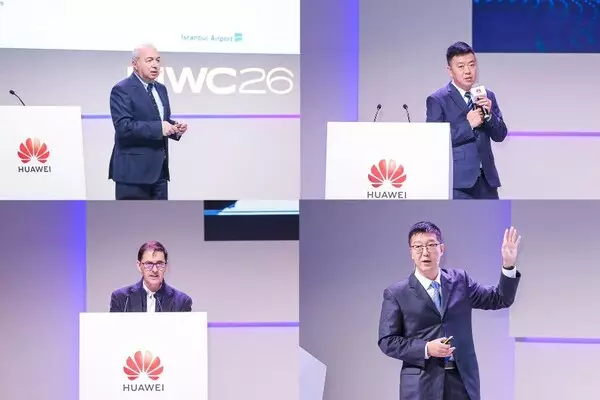
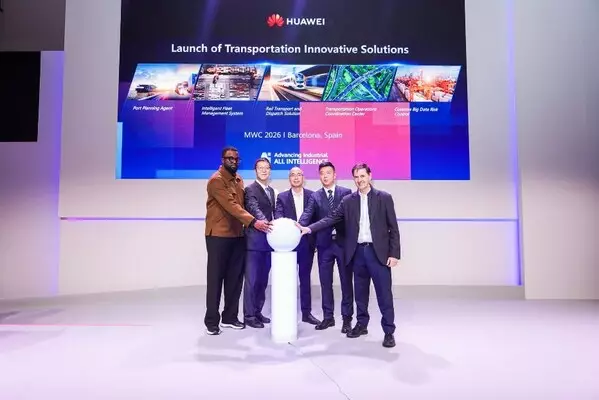
BARCELONA, Spain, March 9, 2026 /PRNewswire/ -- At MWC Barcelona 2026, Huawei hosted a forum titled Accelerate Transportation Digital Intelligence. Together with industry customers, partners, and experts, Huawei explored new paths for smart transportation, shared its latest technical achievements, and announced five innovative solutions, aimed at driving mobility and logistics into the intelligent world.
David Shi, Vice President of Huawei's ICT Marketing and Solution Sales, stated that "Huawei is dedicated to openness, cooperation, and shared success. We will work with customers and partners to build a solid digital and intelligent foundation, connecting passenger, freight, business, revenue, and information flows." According to him, Huawei will integrate AI across rail, road, logistics, aviation, and port scenarios to enhance safety and efficiency in comprehensive transportation and logistics, fostering closer ties with tourism, energy, trade, and other industries for a better future.
PhD. Reha Çetin, CIO of Istanbul Grand Airport and CEO of IST Systems, highlighted that as Europe's fastest-growing aviation hub, Istanbul Airport will continue to advance its Airport 5.0 digital transformation and deliver next-generation airport experiences, powered by Huawei's cutting-edge digital technologies and ICT expertise.
Zaiming Ren, Deputy General Manager of CRSC International, explained how FRMCS enhances train control efficiency, boosts railway transport capacity, and lowers lifecycle costs, helping futuristic railway systems operate more efficiently and safely.
AI is set to become the nerve center of intelligent transportation systems (ITSs). Carlos López Gutiérrez, Transportation BU Director at SICE, said: "SICE and Huawei are working to use AI and edge computing platforms to explore and support various transportation scenarios, greatly improving infrastructure connectivity and transportation system reliability."
Ports play a crucial role in stabilizing economic cycles and securing industrial and supply chain continuity. Yang Rong, General Engineer of Tianjin Port (Group) Co., Ltd., noted that Tianjin Port has consistently prioritized integrating ICTs like 5G, AI, cloud computing, and autonomous driving into its services. So far, they have digitally managed all port elements and deployed an intelligent horizontal transportation system, all aimed at shaping the future of world-class smart ports.
Dr. Rachad Nassar, Global Business & Strategic Partners Director of Huawei's Smart Transportation BU, announced that the company has established a comprehensive digital foundation for the global transportation industry. By deploying an integrated architecture of intelligent sensing, connectivity, digital platforms, and applications, Huawei is collaborating with ecosystem partners to launch five specialized solutions across four core scenarios. These innovations deliver the following key benefits:
- Road: Huawei unveiled the Transportation Operations Coordination Center (TOCC) Solution, built on ITS, to heighten efficiency across diverse scenarios like integrated transportation monitoring, holiday travel support, and multimodal logistics. This establishes a new model for integrated urban transportation management and control.
- Rail: Huawei has developed the Next-Gen Bearer Network for Operation and Dispatching Solution for railways. Featuring robust reliability, high bandwidth, and low latency, the solution securely, reliably, and efficiently carries operational communication services, advancing the rail industry toward digital and intelligent.
- Customs: Huawei released a big data risk control solution together with partners. Capitalizing on Huawei's leading big data platforms and partners' data governance and services, the solution efficiently integrates multi-source heterogeneous data and responds to risks within seconds. It addresses traditional risk control challenges like limited dimensions, incomplete coverage, and heavy reliance on manual processes, enabling customs authorities to enhance supervision accuracy and clearance efficiency.
- Port: Huawei has developed the industry's first all-element scheduling agent powered by the chain-of-thought (CoT) technology. This agent coordinates the entire port operation process, including berth planning alongside distribution and transportation, cutting operation planning time from hours to minutes. The intelligent horizontal transportation 2.0 solution supports efficient mixed traffic of manual container trucks and intelligent guided vehicles (IGVs). It enables large-scale scheduling of over 300 vehicles, reduces manual takeover rates to under 0.1%, and ensures precise parking alignment with the operation position within ±5 cm, boosting cargo movement efficiency.
At the forum, Huawei and Surge announced the successful commercial deployment of the world's first 1.4 GHz 5G fixed wireless access (FWA) network for railways. This milestone represents a paradigm shift in railway-driven connectivity, delivering next-generation communications networks along Indonesia's railways while achieving nationwide inclusive network coverage.
Additionally, Huawei highlighted pivotal breakthroughs realized alongside its global partners, driving forward the digital and intelligent transportation ecosystem. A prime example is the Global Smart Port Showcase launched with Shandong Port Group. By integrating big data, large models, and other cutting-edge technologies, the showcase demonstrates scenario-specific applications like digital operations and smart planning, serving as a blueprint for the modernization of the global port industry.
To date, Huawei has served more than 100 ports, more than 210 airports and airlines, over 300 urban rail lines, over 180,000 kilometers of railways, road networks extending over 200,000 kilometers, ITS projects across over 70 cities, and more than 200 logistics enterprises across the globe. Looking ahead, Huawei will continue practicing the "platform + ecosystem" strategy. The company specializes in developing transportation hubs, transportation networks, passenger/freight flows, and low-altitude air systems to establish a digital and intelligent foundation for comprehensive transportation and logistics. Huawei is committed to "driving mobility and logistics into the intelligent world," empowering smart transportation.
** This press release is distributed by PR Newswire through automated distribution system, for which the client assumes full responsibility. **
Huawei Debuts "Driving Mobility and Logistics into the Intelligent World" Vision for Transportation, Powered by Five New Solutions
Huawei Debuts "Driving Mobility and Logistics into the Intelligent World" Vision for Transportation, Powered by Five New Solutions
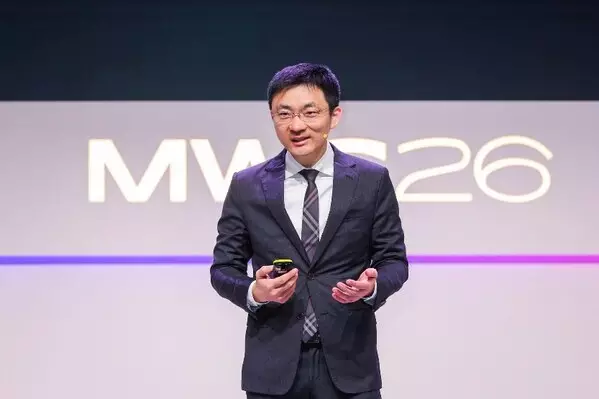
Huawei Debuts "Driving Mobility and Logistics into the Intelligent World" Vision for Transportation, Powered by Five New Solutions