Glance over the stellar lineup of teams in the Champions League's round of 16 this week and you'll find many of the super-rich aristocrats of European soccer: Real Madrid, Liverpool, Barcelona, Bayern Munich, Paris Saint-Germain, Manchester City…
And then there's Bodø/Glimt.
This homely and humble club from a fishing town of around 55,000 people in northern Norway shouldn't really be mixing with Europe's powerhouse clubs.
Well, they are — and not just that, they're beating them all.
Check out this four-win streak that has gotten Bodø/Glimt to the knockout stage of Europe's top club competition: 3-1 at home to Man City, 2-1 away to Atletico Madrid, and then home-and-away victories over Inter Milan — last season's runner-up — in the playoffs that took place during Norwegian soccer's offseason.
Next up is Portuguese champion Sporting Lisbon in the first leg of the last 16 on Wednesday.
Here's what to know about the tiny club delivering the feelgood story of this or any Champions League campaign:
Bodø is located above the Arctic Circle, more than 1,000 kilometers (620 miles) north of the Norwegian capital, Oslo. Nestled along the western coastline off the Norwegian Sea, it is farther north than soccer’s top club competition has ever previously been.
The town — which has its own airport — has less than an hour of sunlight during its shortest days, meaning players take supplements to combat a lack of sun.
It can be bitterly cold and windy in the long winters but the locals are through the latest one. The forecast temperature for kickoff against Sporting is 3 Celsius (37 Fahrenheit).
Away from soccer, Bodø gained some repute in 2024 when it was named the European Capital of Culture.
Bodø/Glimt’s Aspmyra stadium has a capacity of around 8,000 spectators, hardly built for hosting big matches in Europe's top club competition.
A new stadium — the 10,000-seat Arctic Arena — is being built on the edge of town but isn't much bigger.
Adding to the quirky feel of the Aspmyra is the fact it has an artificial field, which is criticized by some in soccer for the way the ball rolls and bounces in comparison to grass.
UEFA allows approved artificial pitches to be used up to and including the semifinals of its competitions.
Founded in 1916, Bodø/Glimt had to wait more than a century before being crowned Norwegian champion for the first time — and the change in fortune had much to do with hiring a former fighter pilot.
The team had just been relegated to Norway's second tier — underling its status as an “elevator club,” as it’s called in Norway, for going back and forth between the top two divisions — when Bjørn Mannsverk was asked in early 2017 to join the backroom staff as a mental coach.
Mannsverk had developed techniques for his squadron before bombing missions in Libya and he brought a philosophy and culture at Bodø/Glimt that made players talk openly about their feelings, change their attitudes and routines about things like preparation and nutrition, and remove the stigma around mental training.
The players and coach Kjetil Knutsen fully bought into Mannsverk's ways — like, for example, having a rotating cast of captains to share leadership duties and gathering in a circle after conceding a goal to discuss what happened and maintain solidarity — and it has helped the team grow.
Bodø/Glimt won its first Norwegian league title in 2020 and captured three of the next five, finishing runner-up last year. The team's success transferred to continental competition as it reached the Europa League semifinals last season — losing to Tottenham over two legs — and then qualified for the Champions League for the first time.
Bodø/Glimt isn't funded by a Middle Eastern sheikh or American private investment so its inexpensively assembled squad is filled with largely unheralded players from Norway and Denmark.
In Norway's most recent squad selection, there were only two Bodø/Glimt players called up.
Its star striker is Kasper Høgh, a 25-year-old Dane who has never played for his country. Its other leading attacker is Jens Petter Hauge, who returned to Bodø/Glimt in 2024 — four years after leaving for AC Milan but failing to establish himself.
Under Knutsen, who joined in 2018 and has masterminded the team's rise, Bodø/Glimt isn't just a plucky underdog that sits back and defends. It is a free-flowing, high-intensity, attacking team which, for example, outplayed Man City when Pep Guardiola's team visited Aspmyra stadium.
In 2017, Bodø/Glimt had around 40 employees and a 4.2 million-euro ($5 million) budget.
Last year, the club's revenue was 80 million euros ($93 million), boosted by making more than 26 million euros ($30 million) in the Europa League and then earnings from the Champions League. Compare that to Real Madrid, whose 2025 revenue was more than 1 billion euros, according to Deloitte.
It is budgeting for 50 million euros ($58 million) in 2026, though that figure will increase the deeper the team gets in the Champions League.
If Bodø/Glimt was to create more history and get past Sporting, it would face either Premier League leader Arsenal or Bayer Leverkusen, the German champion from the 2023-24 season, in the quarterfinals.
AP soccer: https://apnews.com/hub/soccer
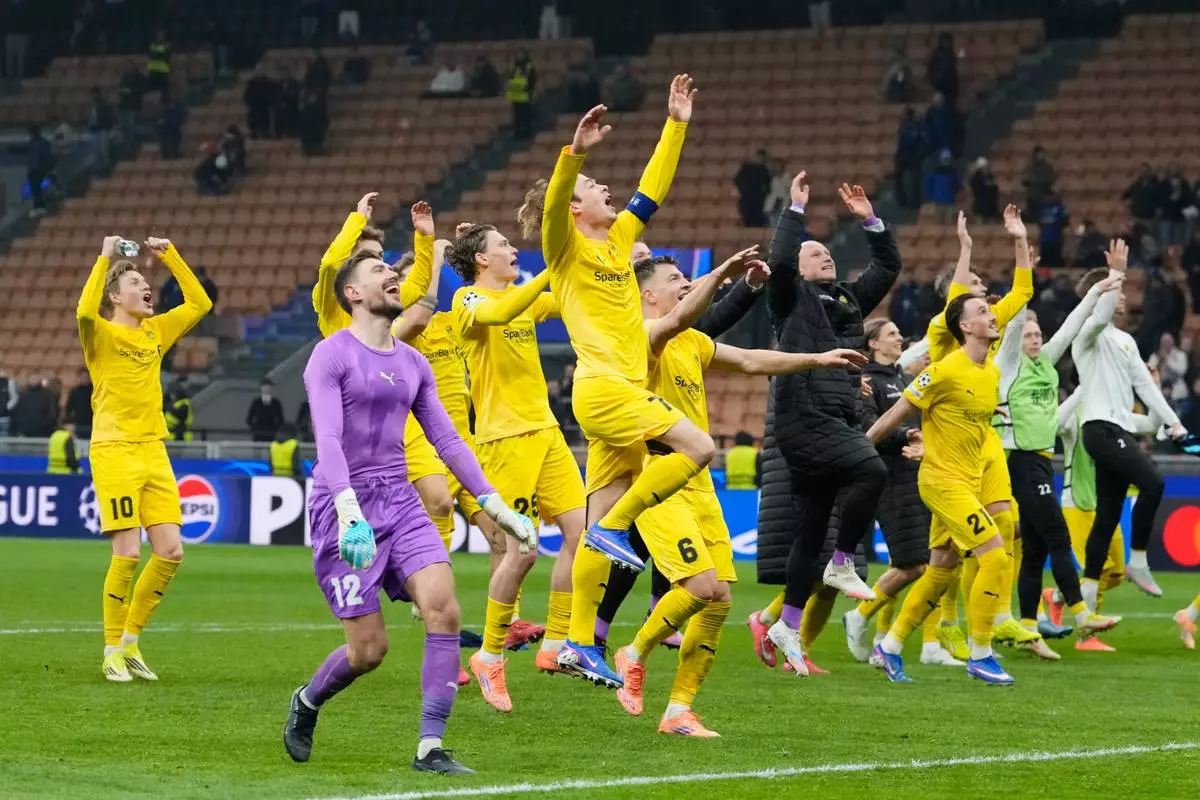
Glimt's players celebrate at the end of the Champions League playoff soccer match between Inter Milan and Bodo Glimt, at the San Siro stadium in Milan, Italy, Tuesday, Feb.24, 2026. (AP Photo/Luca Bruno)
BEIRUT (AP) — Terrified by explosions shaking their homes in Tehran and other cities, tens of thousands of Iranians have packed up and left, finding refuge in small, remote towns to wait out massive bombardment by Israel and the United States.
Pouya Akhgari, 22, is holed up in a family house with aunts and cousins in a village 200 kilometers (120 miles) from his home in the capital, Tehran. As snow falls in the mountainous countryside of Zanjan province, he mostly spends his days watching movies and TV shows and sometimes ventures out to the nearest main town.
The village has been spared strikes, but Akhgari's friends in Tehran tell him about the blasts all around them.
“It just feels so chaotic. I thought it’d be very short but it’s dragging on,” he told The Associated Press by a messaging app. ”If it goes on like this, we’ll run out of money."
The U.N. refugee agency said that in the first two days of the war, about 100,000 people fled Tehran, a city of around 9.7 million. It said that the scale of displacement is likely much higher, though it didn't have figures for the days since, or on the flight from other cities.
A 39-year-old lawyer endured a day of explosions that shook her home in the city of Ahvaz, 800 kilometers (500 miles) southeast of Tehran. The next day, on March 2, she packed up her things and hit the road with her brother, sister and their families — and their dogs Coco and Maggie.
They went to their family’s strawberry farm in a small town several hours away. She and others reached by the AP spoke on condition of anonymity to prevent reprisals, and she asked that the town not be identified.
The town doesn’t have any military bases, so it feels relatively safe. Still, southern Iran has been the target of some of the most intense bombardment. She said that the next town over — which is even smaller — saw an explosion when a strike hit an ammunition site belonging to the Revolutionary Guard, the nation's most powerful armed force.
She worries that strikes could target a gym used by Guard members a few hundred meters down the road from their farm. Airstrikes have hit a number of sports facilities around Iran, apparently because the Guard often uses such sites as gathering places. The gym is probably far enough away that it won’t affect them if it’s hit, she said, “but all the same, the danger exists.”
No one is going to work, and the kids are far from school. To pass the time and keep their minds off things, they walk the dogs, play board games and pick strawberries.
The peacefulness of the nature around them helps make the war feel distant — the clouds rolling across the green hills, the bleating of their neighbor's goats at sunset. The brightest spot, the lawyer said, was when one of the two farm dogs, Maya, gave birth to a litter of puppies.
Still, uncertainty hangs over everything.
“From morning to night, we talk about what is happening, our worries, how everything gets more expensive every day, about how far our money will stretch,” she said.
“If this situation continues, we will have problems meeting basic needs."
The U.S.-Israeli campaign has struck heavy blows to Iran's leadership, killing Supreme Leader Ayatollah Ali Khamenei and top military figures. It has also particularly targeted the paramilitary Revolutionary Guard and the all-volunteer Basij force, which are tasked with protecting the cleric-led Islamic Republic. The Basij force has led the crushing of waves of anti-government protests, including ones in January.
The leadership has kept its hold. Khamenei's son, Ayatollah Mojtaba Khamenei, was named the new supreme leader this week. The Guard and Basij have shown that their local networks are still in place so far.
The lawyer said that on the rare times she left the farm to go into town, she saw that members of the Basij were now more heavily armed in the streets.
“They are waiting for the slightest movement” showing dissent, she said.
She once campaigned against the mandatory hijab — in fact, she was briefly detained in the past — and stopped wearing it years ago. But since the war, she wears one when she leaves home for fear of provoking the Basij.
The town is traditionally considered pro-government, she said, and many residents have taken state positions or joined the Guard. Religious and patronage loyalties run deep in rural areas in particular, since the Islamic Republic brought basic services to Iran’s countryside and small towns.
Still, she has seen signs of growing discontent even here. Large crowds turned out in the town for January’s anti-government protests, she said, and observance of the state’s official mourning week for Khamenei has been muted, with few people wearing black as urged by authorities.
One man described how, before fleeing home in Tehran, explosions made his 6½-year-old son tremble in fear.
“You place him between you and your wife in bed, hoping he might feel safer,” he said, but he still screamed in his sleep. They decided it was time to leave.
As they drove through the capital, they saw cars on the roadside, their windows shattered from blasts. Leaving the city at the foothills of the Alborz Mountains north of Tehran, they saw columns of smoke rising from different parts of the city into the overcast sky.
"The scene made the city look frightening,” he said.
On the highway west out of Tehran, heavy with traffic, explosions shook their car, terrifying his son, he said. Finally they reached a family home in a small village on the other side of the mountains, northwest of the capital, overlooking the Caspian Sea.
There they spend their days in the house, surrounded by rice paddies, with snow-capped mountains in the distance. Each day, he and his wife take their son out for walks.
“Boys have so much energy, and in a village, there is not much fun for him,” he said. In the evenings, his wife’s mother and father, who also fled Tehran, visit.
Amid all the chaos, local residents show “remarkable kindness,” he said.
He said he went to the neighborhood bakery to buy bread and found a long line. When the baker realized he wasn't from the area, he called him to the front of the line, then tried to refuse payment for the bread.
“The others in line were very friendly, asking whether I had a place to stay and whether I needed anything,” he said.
Leaving home isn't an option for everyone.
One 53-year-old man in Tehran said that he can’t move his elderly parents and so is staying home. The strain is immense, he said.
“At night, I go down to the parking garage, sit inside my car and scream out loud,” he said. “I pray for calm and for quieter days.”
Radjy and Keath reported from Cairo.
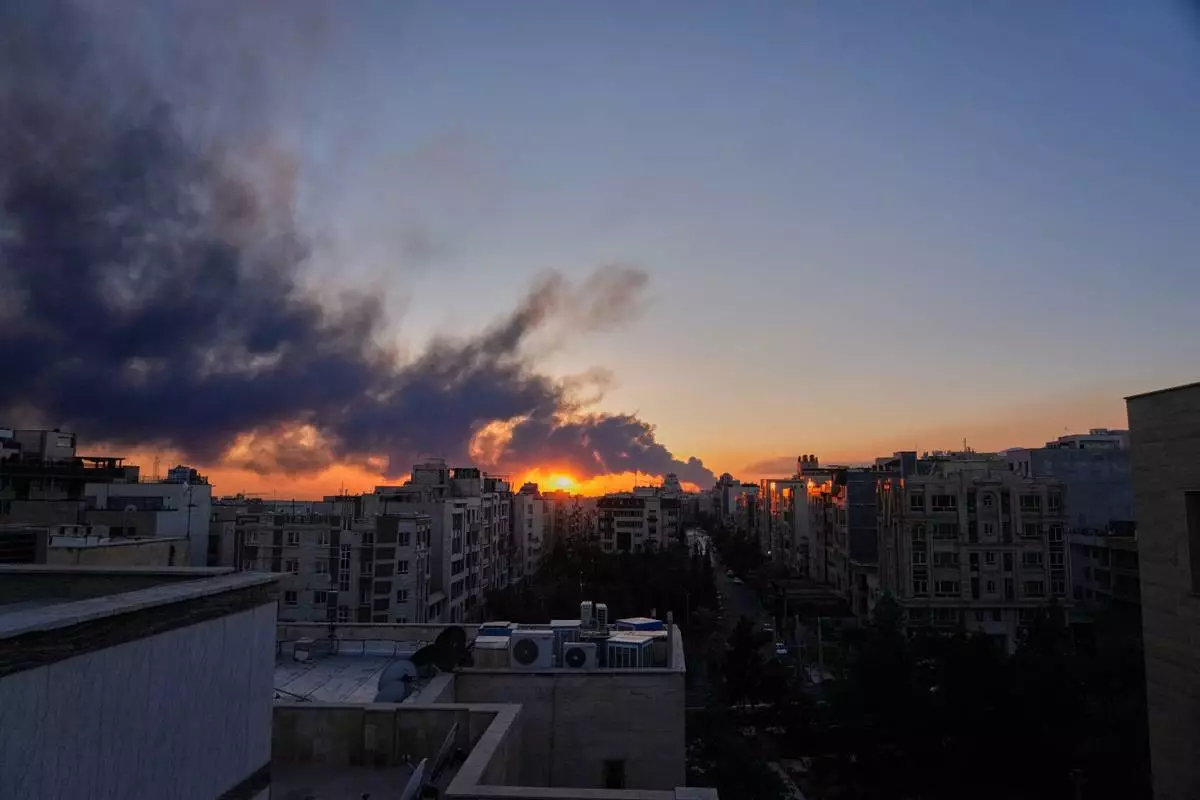
The sun sets behind a plume of smoke rising after a U.S.–Israeli military strike in Tehran, Iran, Tuesday, March 3, 2026. (AP Photo/Vahid Salemi)