A legal worker explained the part of the supreme court's work report regarding the drafting of judicial rules on artificial intelligence (AI) and data-related rights, saying this will set clear legal guardrails for the application of emerging technologies.
In its report submitted to the ongoing 4th annual session of the 14th National People's Congress, the Supreme People's Court said it is currently drafting relevant judicial policies to clarify the rules of validation for the originality of AI-generated content and the legal nature of data training activities which have aroused widespread disputes concerning whether AI-generated content constitutes an original mental product with a copyright and whether training large models using others' works constitutes infringement.
"Whether it is reasonable and rational to use others' works in AI data training, and how AI service providers should bear liability are not only highly controversial in the legal community but also have a considerable impact on the development of the AI industry. Intellectual property rights are a protective shield for innovation entities and a regulatory valve concerning public welfare. It is essential to balance the interests of multiple stakeholders, including innovators, competitors, consumers, and the public," said Li Jian, chief judge of the Supreme People's Court's Third Civil Division.
The highest trial organ emphasized that in the field of AI, courts must ensure a balanced approach that coordinates development and interests.
"The Supreme People's Court adheres to the principle of attaching equal importance to development and security, and seeks to promote the combination of innovation and law-based governance. It is currently studying and drafting relevant guiding documents to help promote the healthy and orderly development of the AI industry," Li said.
Chinese courts at all levels properly handled 908 disputes involving data ownership and transactions in 2025, marking a year-on-year increase of 25.6 percent, according to the work report of the Supreme People's Court submitted to the NPC annual session for deliberation on Monday. The Supreme People's Court said that the foundational framework for a data property rights protection system has largely taken shape. But as data protection involves all aspects of economic and social life, efforts must be strengthened collaboratively across multiple dimensions, including legislation, regulation, judiciary, and dispute resolution.
Rights of data sources providers must be fully protected in accordance with laws and regulations such as the Data Security Law and the Personal Information Protection Law, especially privacy, personal information and other sensitive data.
Furthermore, data transaction activities need to be well-regulated in terms of pricing, transaction methods, and transaction rules to foster a fair competition environment for data trading.
China's top court is drafting guidelines regarding AI, data-related rights: expert
China is charting a course for foreign-invested businesses operating in the country to weather tariff pressures, with expanded trade partnerships, stronger domestic demand and industrial upgrading highlighted as keys to stability by officials and executives commenting on the sidelines of the ongoing "two sessions."
The "two sessions" are the annual meetings of China's supreme organ of state power, the National People's Congress (NPC), and its top political advisory body, the National Committee of the Chinese People's Political Consultative Conference (CPPCC). Both bodies serve five-year terms and hold a plenary session each year.
The fourth session of the 14th NPC and the fourth session of the 14th National Committee of the CPPCC kicked off in Beijing on March 5 and March 4, respectively.
Against this backdrop, global businesses have been grappling with the impact of the United States' unpredictable tariff policy, a challenge that executives say often lies more in uncertainty than in the duties themselves.
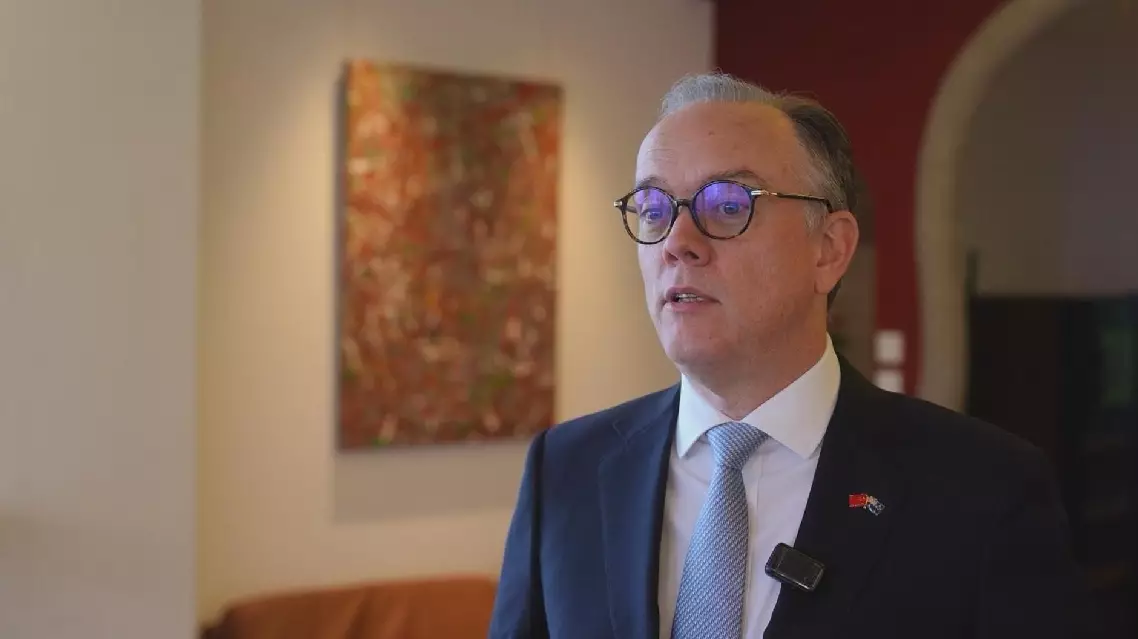
"For companies that operate across borders, the uncertainty is often more of a challenge than the tariffs themselves,” said Vaughn Barber, chairman of the China-Australia Chamber of Commerce.
"By being local in China, we obviously are working very hard that we can avoid, hopefully, tariffs going forward. But again, this is only partially true because at the end of the day, it's a global product and certain things simply come from the US, as the aviation industry is a global industry. So to a certain point, there's an element where you cannot really de-risk for, where you can just only work on the fact that the success of aviation is that it is a global industry, and we're asking everybody to recognize that," said Erik Buschmann, Global Senior Vice President of Airbus, and chief operating officer of Airbus China.
Speaking on the sidelines of the NPC session, Commerce Minister Wang Wentao said one key to stabilizing foreign trade is expanding partners, noting that China has 160 major trade partners, of which 51.9 percent are Belt and Road countries.
Wang highlighted the importance of boosting domestic demand, pointing to key areas such as transportation, housekeeping and travel. He also stressed the need to sharpen global competitiveness through technological innovation and industrial upgrading, a message that drew broad recognition from both Chinese and foreign companies
"We see the emphasis on strengthening of demand and consumption, stable economy, technological and industrial upgrading, opening up in services and innovation sectors. Those are all positive messages for business and Australian companies are definitely focused on those," said Barber.
"In terms of high-quality development, we can make technological breakthroughs that will enhance traditional medicine, if we upgrade our resources and technology in this field. China will surely usher in a better spring," said Ruan Hongxian, chairman of the Yixintang Pharmaceutical Group, a large retail chain company based in Kunming, southwest China's Yunnan Province.
China charts course for foreign businesses to weather tariff pressures: executives