China's railway sector completed 72.2 billion yuan (about 10.5 billion U.S. dollars) in fixed-asset investment in the first two months of 2026, up 5.4 percent year on year, China State Railway Group Co., Ltd. reported on Wednesday.
Since the beginning of this year, a number of key railway projects have seen significant progress in construction.
The Lanxi-Jiande section of the Jinhua-Jiande high-speed railway in Jinhua, east China's Zhejiang Province, has started commercial operation, the Shandong section of the Beijing-Xiong'an-Shangqiu high-speed railway has entered the static acceptance phase, tracklaying is underway on the Xiong'an New Area-Xinzhou high-speed railway, while tracklaying on the Xi'an-Ankang high-speed railway has been completed along the entire line. All the bridge projects on the Chongqing-Kunming high-speed railway in southwest China have been completed.
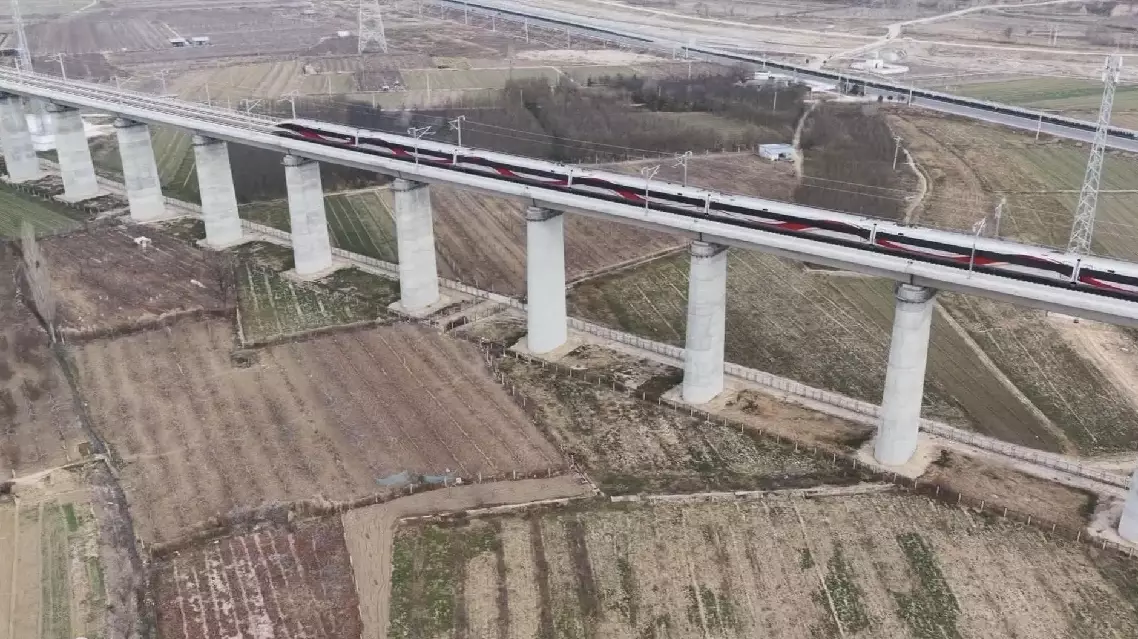
Chinese railway sector's fixed-asset investment up 5.4 pct in January-February period
"Raising lobster" has sparked heated discussions in China's AI community and become hot topics at the country's ongoing "two sessions" this year.
The term "raising lobster" originated from the open-source AI agent OpenClaw, which uses a red lobster as its icon.
It has become a buzzword adopted by Chinese users to describe the process of setting up and training this smart assistant.
OpenClaw, created by Austrian developer Peter Steinberger, is designed to allow large-language models to operate computers autonomously, controlling files, executing commands and interacting through messaging applications.
"In fact, such an AI agent has liberated us first and foremost. This liberation represents a significant technological advancement. I used to say that technology changes our way of working, but that still refers to a revolution in tools. When I see Openclaw, I could not predict whether it would ultimately endure. But when I know more about this model, my first impression is that it doesn't merely change our way of working, it transforms the very nature of work itself. That's a fundamental difference," said Wang Jian, a member of the National Committee of the Chinese People's Political Consultative Conference and an academician from the Chinese Academy of Engineering.
Many Chinese tech companies have since jumped on the trend, unleashing their own "lobsters." Tencent hatched QClaw, Minimax introduced MaxClaw, Moonshot AI unveiled KimiClaw, and Alibaba joined the feast with CoPaw.
Experts said the emergence of these AI agents enables ordinary people without coding backgrounds to develop usable apps in a short time.
"Now, more people have access to such AI tools and actively use them to genuinely enhance labor productivity across various fields. They can accomplish tasks that were previously impossible due to insufficient individual effort or resource investment," said Liu Qingfeng, a deputy to National People's Congress, China's top legislature.
But as enthusiasm grows, security concerns are becoming increasingly prominent, experts said.
In this February, China's Ministry of Industry and Information Technology issued a warning that some OpenClaw-powered deployments carry high security risks when in default or improper configuration, making them highly susceptible to cyberattacks, information leakage, and other security issues.

AI agent OpenClaw becomes hot topic at China's "two sessions"