Skip to Content Facebook Feature Image

AP WAS THERE: Kobe Bryant scores 81 points

Sport

AP WAS THERE: Kobe Bryant scores 81 points
Sport

Sport

AP WAS THERE: Kobe Bryant scores 81 points

2026-03-12 02:59 Last Updated At:03:01

EDITOR'S NOTE: When Kobe Bryant scored 81 points for the Los Angeles Lakers on Jan. 22, 2006, against the Toronto Raptors, it was the second-most points scored by a player in NBA history. The record was set by Wilt Chamberlain, who scored 100 points on March 2, 1962, against the New York Knicks. Miami Heat forward Bam Adebayo scored 83 points Tuesday night against the Washington Wizards to pass Bryant on the list of most points scored in an NBA game. The Associated Press is republishing its story from Bryant's historic performance:

By JOHN NADEL

AP Sports Writer

LOS ANGELES — Kobe Bryant kept shooting, from all over the court and from every angle.

By halftime, he had 26 points — not a bad tally for most players. By the end of the game, he had put up the second-highest total in NBA history.

The Los Angeles Lakers’ star scored a staggering 81 points Sunday night against the Toronto Raptors in a 122-104 win. Only Wilt Chamberlain’s 100-point game stands ahead of him.

“It just happened, man,” Bryant said. “It really hasn’t, like, set in for me. It’s about the ‘W,’ that’s why I turned it on. It turned into something special.

“To sit here and say I grasp what happened, that would be lying. Not even in my dreams.”

The NBA’s leading scorer left to a standing ovation with 4.2 seconds remaining, having shot 28-of-46 from the floor, including 7-of-13 from 3-point range and 18-of-20 from the foul line.

With the fans at Staples Center chanting “MVP! MVP!” Bryant made two free throws with 43.4 seconds remaining for his final points. He scored 27 points in the third quarter, 28 in the fourth.

“It feels great to put on a great show here,” he said.

Chamberlain scored 100 points for Philadelphia against the New York Knicks at Hershey, Pa., on March 2, 1962, making 36-of-63 from the field and 28-of-32 from the foul line while playing all 48 minutes.

Chamberlain had 59 points in the second half — the only player with more points in a half than Bryant’s 55 after halftime in this game.

Chamberlain’s second-highest total was 78 against the Lakers in three overtimes on Dec. 8, 1961.

Elgin Baylor held the previous franchise record of 71 points at New York on Nov. 15, 1960. Lakers assistant Kareem Abdul-Jabbar, the NBA’s all-time leading scorer, saw that game, too.

“Elgin’s game was an incredible performance, also. I don’t think there’s any comparison. Elgin did it without 3-point lines. His game was attacking the hoop and hitting jumpers inside 20 feet. Kobe’s range is unreal, and he does it his way,” Abdul-Jabbar said.

“It was a real treat. His ability to shoot from long range and also attack the hoop, split the defense and get in close for opportunities near the basket is unique. He’s made a niche for himself and he deserves it.”

Michael Jordan’s career high was 69 points, and only four players had ever scored more than 70 — Chamberlain, Baylor, David Thompson and David Robinson.

The 27-year-old Bryant made it five. His previous career high was 62 points during a 112-90 victory over Dallas last month — he sat out the fourth quarter because of the one-sided nature of the game.

“I was just determined. I was just locked in, tuned into what was going on out there,” Bryant said. “These points tonight mattered. We needed them. The points I put in the basket were instrumental. It means a lot more.”

Bryant raised his scoring average to an NBA-leading 35.9 points this season.

“I never imagined I would see history like that,” said Devean George, a teammate of Bryant’s with the Lakers for 6 1/2 seasons. “I can’t tell you where that came from. He just kept attacking, attacking, attacking — every time he got the ball.”

Bryant played nearly 42 minutes, going the entire second half until being lifted by coach Phil Jackson.

Jackson coached Jordan and the Chicago Bulls to six championships in the 1990s and the Lakers, with Bryant and Shaquille O’Neal, to three more titles, from 2000-02.

“That was something to behold,” Jackson said. “It was another level. I’ve seen some remarkable games, but I’ve never seen one like that before.”

Bryant’s performance came on the same night the NBA had its highest-scoring game in 11 years when Seattle beat Phoenix 152-149 in two overtimes. The last 300-point game in the league came when Dallas beat Houston 156-147 in two overtimes on April 11, 1995, according to the Elias Sports Bureau.

“You’re sitting and watching, and it’s like a miracle unfolding in front of your eyes and you can’t accept it,” Lakers owner Jerry Buss said. “Somehow, the brain won’t work. The easiest way to look at it is everybody remembers every 50-point game they ever saw. He had 55 in the second half.”

Lamar Odom’s 3-pointer with 7:04 remaining gave the Lakers a 100-93 lead, and Bryant scored 30 seconds later to give him 61 points and his team a nine-point advantage. The Raptors didn’t pose a serious threat after that.

Bryant scored all but 15 of the Lakers’ 42 points in the third quarter, shooting 11-of-15 including 4-of-5 from 3-point range. Six of his points came during a 12-0 run to finish the period, giving Los Angeles a 91-85 lead.

The Lakers outscored the Raptors 38-14 to finish the third quarter to go ahead for good. They trailed by as many as 18 points early in the period, angering Bryant.

“He was ticked off,” Odom said.

When asked what Bryant said at that stage, Odom replied: “Nothing. That’s when it’s bad.”

Bryant scored 51 points after the Raptors took a 71-53 lead. It was 63-49 at halftime.

“The thing about him that is most amazing is that he is relentless,” Raptors coach Sam Mitchell said. “We played man-to-man, box-in-one and zone. We tried to put smaller guys on him to deny him the ball.

“I saw that game he had against Dallas where he scored 62, what more can you say?”

Smush Parker added 13 points and Chris Mihm had 12 points and six rebounds for the Lakers.

Mike James led Toronto with 26 points and 10 assists. Chris Bosh added 18 points and eight rebounds and Jalen Rose scored 17 points for the Raptors.

Notes: Bryant scored a season-low 11 points in the Lakers’ 102-91 victory over the Raptors in Toronto last month. He had 14 in the first quarter of this game. ... Bryant has led the Lakers in scoring in the last 21 games in which he’s played. He is averaging 45.5 points in 10 games since sitting out a two-game suspension. ... Toronto C Rafael Araujo, who has made 30 starts this season, missed his second straight game and third of the season because of a sore right shoulder. ... Bryant made his first five foul shots before missing late in the second quarter, snapping his streak of consecutive made free throws at 62. Michael Williams made an NBA-record 93 straight for Minnesota in 1993. ... Bryant received a technical foul with 10:44 left — shortly after being accidentally struck above the right eye.

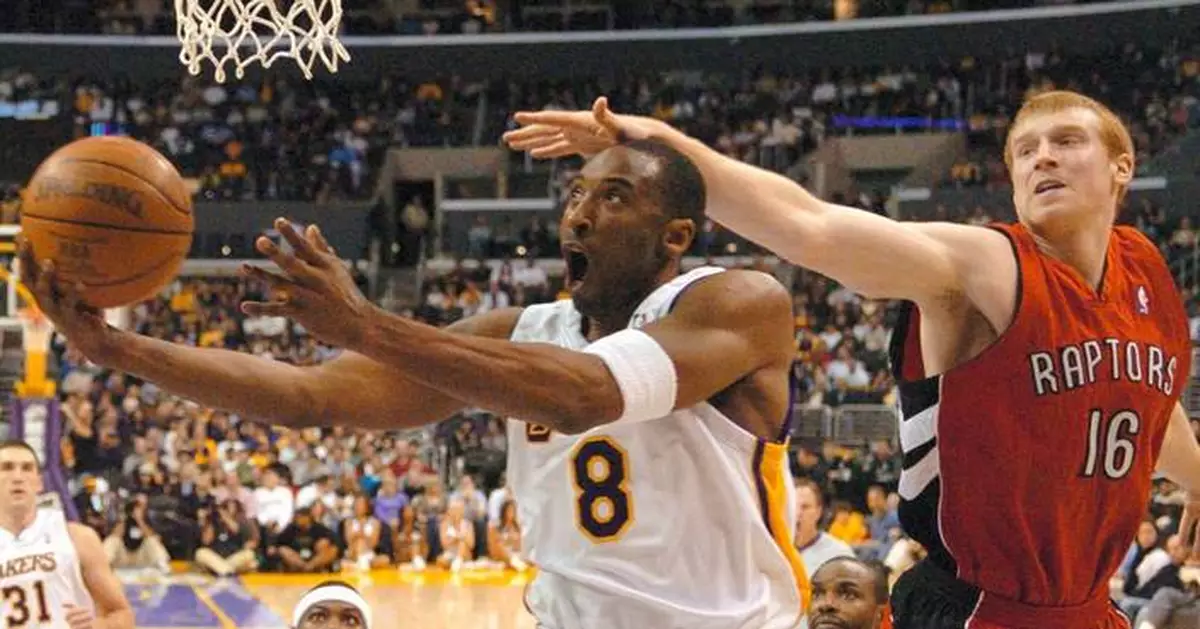
FILE - Toronto Raptors' Matt Bonner can't stop Los Angeles Lakers' Kobe Bryant from getting to the basket in the first half of NBA basketball game, Jan. 22, 2006, in Los Angeles. (AP Photo/Matt A. Brown, File)


FILE - Toronto Raptors' Matt Bonner can't stop Los Angeles Lakers' Kobe Bryant from getting to the basket in the first half of NBA basketball game, Jan. 22, 2006, in Los Angeles. (AP Photo/Matt A. Brown, File)

PARIS (AP) — A group representing many of the world's wealthiest countries agreed Wednesday to release the largest volume of emergency oil reserves in its history, in a bid to counter the effects of the Iran war on energy markets and the halt of cargo shipping through the Strait of Hormuz.

The International Energy Agency said it will make 400 million barrels of oil available from its members’ emergency reserves, which is more than double the 182.7 million barrels that the IEA's 32 member countries released in 2022 in response to Russia’s full-scale invasion of Ukraine.

“This is a major action aiming to alleviate the immediate impacts of the disruption in markets,” said Fatih Birol, executive director of the Paris-based IEA. “But, to be clear, the most important thing for a return to stable flows of oil and gas is the resumption of transit through the Strait of Hormuz.”

Iran has attacked commercial ships across the Persian Gulf in response to U.S. and Israeli strikes, escalating a campaign of squeezing the oil-rich region as global energy concerns mount and effectively stopping cargo traffic in the narrow Strait of Hormuz, through which about a fifth of all oil is shipped from the Persian Gulf toward the Indian Ocean. Iran has also targeted oil fields and refineries in Gulf Arab nations, aiming to generate enough global economic pain to pressure the U.S. and Israel to end their strikes.

According to the IEA, export volumes of crude and refined products are currently at less than 10% of prewar levels. Birol noted that the situation in natural gas markets is also very challenging, with Asia the most severely affected region.

“There are few options to replace the missing LNG cargoes from Qatar and the Emirates,” he said. “Global energy supply has been reduced by around 20%."

The IEA's announcement came a day after energy ministers from the Group of Seven — the leading industrialized nations of Canada, the United States, France, Italy, Japan, Germany and Britain — met in Paris to look at ways to bring down prices. It also came just before G7 leaders, including U.S. President Donald Trump, met Wednesday via videoconference.

During his introductory remarks during Wednesday's video call, French President Emmanuel Macron praised the IEA decision to release emergency oil stocks, saying it is “very important” to do everything possible to increase global production and that the 400 million barrels amounted to the equivalent of “20 days of the volume being exported through the Strait of Hormuz.”

The amount pledged by the G7 nations alone comprises 70% of the total, including 14.5 million barrels France will contribute, Macron said, noting that the IEA decision was prepared at the G7 level.

Maksim Sonin, an energy executive who works with Stanford University’s Hydrogen Initiative, said the release would have “a short-term stabilizing effect,” but that it would diminish if the war persists and the Strait of Hormuz remains essentially at a standstill.

“It’s not a silver bullet to solve everything,” Sonin said. “You have to solve the underlying problem.”

Neil Crosby, a vice president of oil analytics at Sparta, which tracks oil trading, said as big as the release is, it amounts to “a little Band-Aid.”

“This scenario was always written off by large parts of the industry: In case we get to the scenario of where there’s a war with Iran, the U.S. Navy will ensure that Hormuz doesn’t stay closed,” Crosby said. “And then we got there, and it’s closed. ... It’s a complete disaster.”

Oil follows snaking journeys that can take weeks to go from drill sites to gas pumps. It must pass through refineries, where it is turned to fuel, before it is shipped off via pipelines and tankers to terminals, and then on to gas stations.

Because of this, no single decision has an immediate impact.

But Kenneth Medlock, senior director of the Center for Energy Studies at Rice University, said the release of reserves will calm markets and prevent wild price swings and could lead to lower prices at the pump in the next week or so. Still, a trade-off is involved by tapping reserves.

“You’re depleting stocks now. That’s always the catch-22,” Medlock said. “You’re selling them today but that means you can’t sell them tomorrow because they’re gone.”

Germany, Austria and Japan said earlier Wednesday that they would release parts of their oil reserves in response to the IEA's request for members to release 400 million barrels.

The IEA reserves were established in 1974 following the Arab oil embargo, and IEA member countries currently hold more than 1.2 billion barrels of public emergency oil stocks, with a further 600 million barrels of industry stocks held under government obligation.

Germany’s economy ministry, Katherina Reiche, said the IEA asked Germany to release 2.64 million tons — roughly 19.7 million barrels — of its oil reserves.

She said it would take a couple of days before the delivery of the first quantities.

“Germany stands behind the IEA’s most important principle of mutual solidarity,” Reiche said.

The German government also said it will introduce a measure to allow gas stations in Germany to raise fuel prices no more than once a day. The federal government wants to introduce this as quickly as possible, Reiche said.

It wasn’t immediately clear how much oil Austria was releasing.

Starting Monday in Austria, price increases at gas stations will be allowed only three times a week, said the country’s economy minister, Wolfgang Hattmannsdorfer. He said Austria was releasing part of its emergency oil reserve and extending the national strategic gas reserve, adding: “One thing is clear: in a crisis, there must be no crisis winners at the expense of commuters and businesses.”

IEA nations have released emergency stocks on five previous occasions: During the 1990-1991 Gulf War, after Hurricane Katrina in 2005, during the Libyan civil war in 2011, and twice after the Russian invasion of Ukraine.

Grieshaber reported from Berlin. Associated Press reporters Matt Sedensky and Cathy Bussewitz in New York, and John Leicester and Sylvie Corbet in Paris contributed to this report.

Big oil tanks are pictured in front the BP refinery in Gelsenkirchen, one of the biggest fuel producers in Germany, Wednesday, March 11, 2026. (AP Photo/Martin Meissner)

Big oil tanks are pictured in front the BP refinery in Gelsenkirchen, one of the biggest fuel producers in Germany, Wednesday, March 11, 2026. (AP Photo/Martin Meissner)

Big oil tanks are pictured in front of the BP refinery in Gelsenkirchen, one of the biggest fuel producers in Germany, Wednesday, March 11, 2026. (AP Photo/Martin Meissner)

Big oil tanks are pictured in front of the BP refinery in Gelsenkirchen, one of the biggest fuel producers in Germany, Wednesday, March 11, 2026. (AP Photo/Martin Meissner)

FILE - Fishermen work in front of oil tankers south of the Strait of Hormuz Jan. 19, 2012, offshore the town of Ras Al Khaimah in United Arab Emirates. (AP Photo/Kamran Jebreili, File)

FILE - Fishermen work in front of oil tankers south of the Strait of Hormuz Jan. 19, 2012, offshore the town of Ras Al Khaimah in United Arab Emirates. (AP Photo/Kamran Jebreili, File)

Smoke rises from a building following an Israeli airstrike in Dahiyeh, Beirut's southern suburb, Wednesday, March 11, 2026. (AP Photo/Hassan Ammar)

Smoke rises from a building following an Israeli airstrike in Dahiyeh, Beirut's southern suburb, Wednesday, March 11, 2026. (AP Photo/Hassan Ammar)

Signs show the gas prices at a gas station, Tuesday, March 10, 2026, in New York. (AP Photo/Yuki Iwamura)

Signs show the gas prices at a gas station, Tuesday, March 10, 2026, in New York. (AP Photo/Yuki Iwamura)

Recommended Articles