The Iranian government on Wednesday released footage it says was of missile debris from the deadly school attack in Minab, Iran's southern province of Hormozgan, on Feb 28, providing fresh evidence that the United States military was behind the attack.
The video obtained by China Media Group (CMG) from the Iranian government shows that some of the fragments said to be from the missile are marked with detailed information, including the place of origin, manufacturer and serial number of the parts. Markings such as "Made in USA" and "Raytheon Company" can be clearly seen on the debris.
The United States has repeatedly denied carrying out the attack on the elementary school in Minab, where Iranian state media says at least 165 people were killed, most of them young girls.
Iran's Foreign Ministry spokesman Esmaeil Baghaei reiterated in an exclusive interview with CMG on Tuesday that the school was hit by missiles twice on Feb 28, with the second attack coming as rescuers gathered at the site, resulting in a large number of casualties.
Baghaei said the United States and Israel must be held responsible for such criminal acts.
The New York Times reported Wednesday that an ongoing military investigation has preliminarily determined that the deadly school attack was the result of a targeting error.
Officials briefed on the investigation told the newspaper that officers at the U.S. Central Command generated the strike coordinates using outdated intelligence provided by the Defense Intelligence Agency, leading to the targeting mistake.
The findings are preliminary, and key questions remain unresolved, including why the outdated information was not double-checked, officials quoted by the newspaper said.

Iran says new evidence proves U.S. behind deadly school attack
Iran poignantly marked the Persian Gulf National Day on Thursday with a series of commemorative events as Iranian officials stressed the country firmly opposes any actions that threaten the security of the region.
The Persian Gulf National Day is observed on the 10th day of Ordibehesht, the second month in the Iranian calendar, which this year landed on April 30.
The occasion celebrates the anniversary of Iran's 17th century reclamation of the Strait of Hormuz -- a key waterway for global trade which has become a focal point in recent weeks amid the U.S.-Israeli war on Iran -- with the event marking the end of Portugal's 115-year occupation of the Persian Gulf in 1622.
Among the many events was a concert entitled "That Persian Blue," delivered by the National Music Orchestra in Tehran, a pointed performance which underscored Iran's tradition of safeguarding the strategic Strait of Hormuz waterway and resisting foreign intervention.
Officials attending the concert said the Persian Gulf is a vital corridor of Iranian civilization and a crucial avenue for trade and security. They condemned the military interventions by external forces which have caused chaos and instability in the region and stressed Iran's resolve to oppose any attempts to undermine its national security and that of the wider Gulf region.
"If there is any enlightenment that all the recent events have brought to this region, it is that countries in this region have the ability to maintain the security of the Persian Gulf, and only the people in the region have the right to maintain regional security -- no one else can do it," said Mohsen Haji-Mirzaei, the chief of staff for Iranian President Masoud Pezeshkian.
"The Iranian people have always been ready to resist invaders and any external invading forces. They trample on humanity, attack Iran, and undermine peace and friendship. The Iranian people will confront these forces with authority and unity," said the Deputy Minister of Culture for Media Affairs Mohammadreza Norouzpour.
President Pezeshkian also issued a defiant message on the same day, saying that the presence and interference of foreign forces in the region has only served to worsen tensions and undermine lasting peace, rather than improving security in the Persian Gulf.
He said that Iran, as a guardian of the Strait of Hormuz, will continue to uphold the principles of the freedom of navigation and maritime safety, except for hostile states.
Pezeshkian also stressed these principles must be based on respecting Iran's national sovereignty, adding that any insecurity in the waters should be blamed on the United States and Israel.
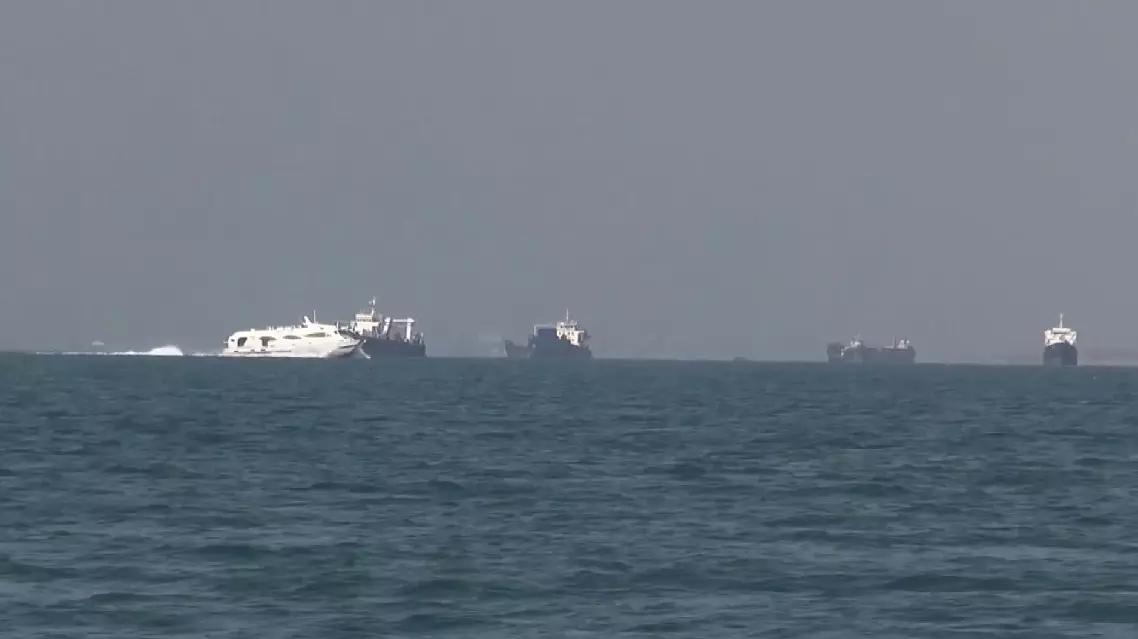
Iran poignantly marks Persian Gulf National Day with defiant call to resist foreign interference