Global investors are closely tracking China's annual "two sessions," where the government work report pledges deeper reforms in the capital market's investment and financing system, steps likely to recalibrate risk and returns for overseas funds.
Jonathan Krane, CEO of U.S.-based KraneShares, said signals of further opening-up from the sessions could prompt global investors to raise their China allocations, underscoring how policy shifts in China ripple through international markets.
"We think that its important that China further opens up its it markets for global institutional investors. So access to the mainland markets is going to be important going forward. And we believe that global institutions will increase their allocation to the China market," he said.
China's government work report pledged to accelerate fundraising for strategic tech firms, promising "green channels" for initial public offerings (IPO)s and mergers and acquisitions, measures aimed at turning innovation into investable growth.
The report also called for closer links between technological breakthroughs and industrial application, signaling China's intent to fast-track capital access for companies in key sectors.
Krane noted that such signals reinforce the strong value case for China's technology companies, highlighting rising global demand for funds tied to the STAR Market.
"We have two funds in particular that are very popular with U.S. and global investors. And one is our KraneShares SSE STAR Market fund listed on the New York Stock Exchange.And that is the only fund globally listed on a global exchange that provides investors' access into the STAR market in China. Also KWEB, that's KraneShares' flagship fund, it's our KraneShares' CSI China Internet fund. Artificial intelligence now is a big part of that sector, so we look at that as a big growth engine of China KWEB," he said. China's annual "two sessions" convene the National People's Congress (NPC) and the Chinese People's Political Consultative Conference(CPPCC), the country's highest legislative and advisory organs. As the CPPCC wrapped up Wednesday and the NPC closed Thursday, the policy signals delivered are already reverberating through international markets.

Global investors eye China’s "two sessions" as reforms signal wider market access
Multiple areas in northwest China's Xinjiang Uygur Autonomous Region have experienced a heavy snowfall, strong winds and a sharp temperature drop since Wednesday as a cold front swept through the region.
Xinjiang's northern part bore the brunt of the initial impact, with Urumqi City, the Changji Hui Autonomous Prefecture and Tacheng City recording significant precipitation, ranging from heavy snow to blizzard conditions.
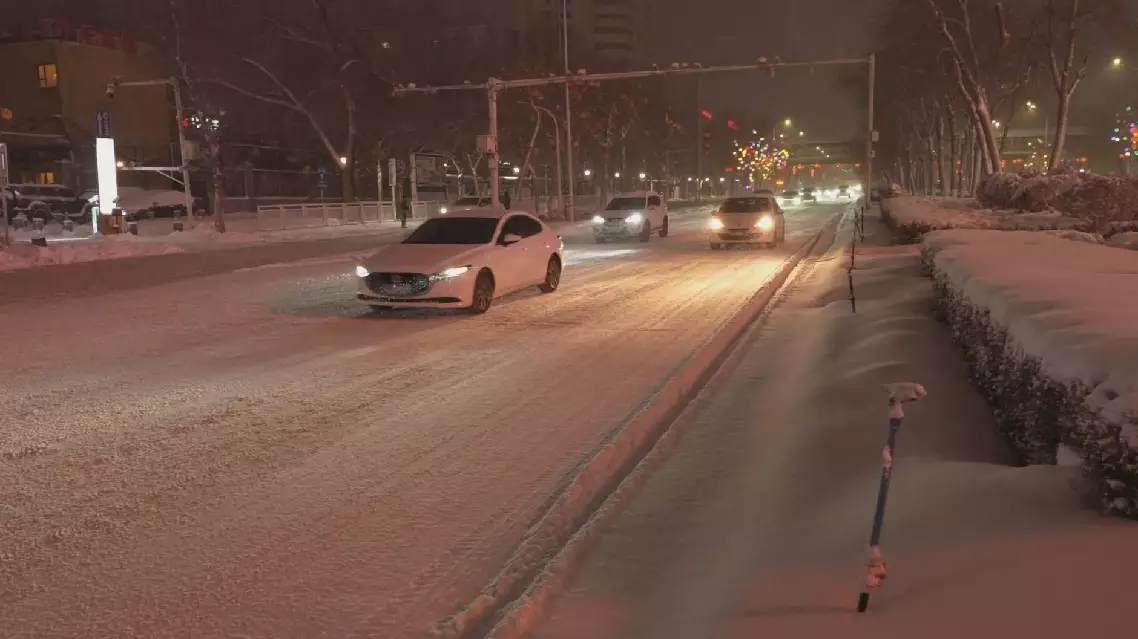
The regional capital, Urumqi, was hit by intense snowfall accompanied by strong winds on Wednesday, prompting multiple urban districts to issue a yellow alert for blizzards. By 21:00 on Wednesday, the cumulative precipitation in most urban areas had already reached blizzard levels.
China has a four-tier weather warning system, with red representing the most severe warning, followed by orange, yellow and blue.
In response, the city's sanitation department deployed a fleet of snowplows that worked in shifts to conduct continuous clearing operations on urban trunk roads and main thoroughfares to keep traffic moving.
The Turpan to Hami section of the G30 Expressway, which links Lianyungang in eastern China with Horgos on the China-Kazakhstan border experienced gale-force winds starting Wednesday morning.
Known as a "100-Li (about 50-kilometer) wind zone," the section frequently experience strong winds due to its distinctive geographic location. As the maximum gusts on this section can reach level 13 (37.0 to 41.4 meters per second) or higher, vehicles have been trapped in the Yiwanquan service area since 19:00 on Wednesday.
Because of the strong winds, local authorities implemented traffic control on the Xingxingxia to Hami section for vehicles entering Xinjiang, starting 20:00 on Wednesday. The ensuing traffic jam stretched for approximately 10 kilometers on the expressway.
As vehicles were held back, the Yiwanquan service area became a temporary shelter, housing around 300 vehicles and more than 400 stranded individuals.
Local police officers were called to manage the situation, using patrol cars to guide vehicles to safe zones like nearby service areas and parking lots. They also distributed essential supplies such as instant noodles and bottled water to the stranded travelers.
The severe weather conditions in this area are expected to continue until Thursday night.
The treacherous weather led to dangerous road conditions in another major route in Hejing County in the Bayinglin Mongol Autonomous Prefecture. Starting Wednesday morning, the Tianshan Mountain area section of the national highway 218 was hit by blowing snow, a phenomenon where strong winds lift existing snow and reduce visibility.
Visibility in some road sections fell to less than 50 meters, trapping eight vehicles. The traffic police of Hejing County responded swiftly, launching a rescue operation that lasted more than two hours. All 27 individuals stranded in the vehicles were successfully evacuated to safe locations.
The blowing snow conditions are predicted to continue until Thursday afternoon, and the affected section remains under traffic control.
Strong winds, blowing snow hit northern part of China's Xinjiang Uygur Autonomous Region