Skip to Content Facebook Feature Image

Strong winds, blowing snow hit northern part of China's Xinjiang Uygur Autonomous Region

China

China

China

Strong winds, blowing snow hit northern part of China's Xinjiang Uygur Autonomous Region

2026-03-12 16:08 Last Updated At:03-13 13:28

Multiple areas in northwest China's Xinjiang Uygur Autonomous Region have experienced a heavy snowfall, strong winds and a sharp temperature drop since Wednesday as a cold front swept through the region.

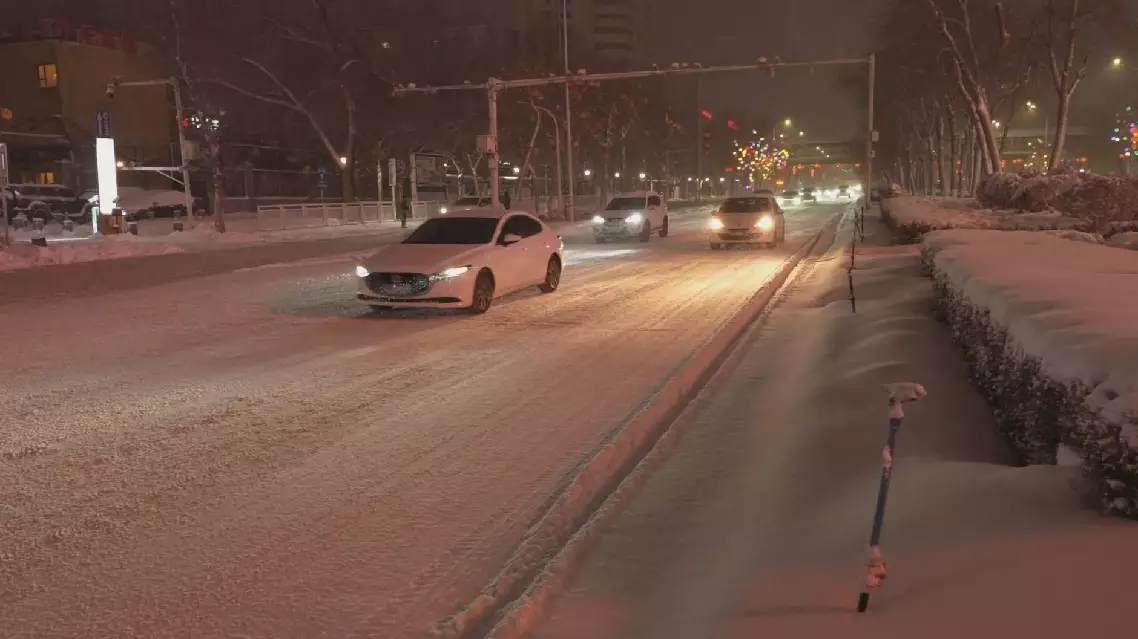
Xinjiang's northern part bore the brunt of the initial impact, with Urumqi City, the Changji Hui Autonomous Prefecture and Tacheng City recording significant precipitation, ranging from heavy snow to blizzard conditions.

The regional capital, Urumqi, was hit by intense snowfall accompanied by strong winds on Wednesday, prompting multiple urban districts to issue a yellow alert for blizzards. By 21:00 on Wednesday, the cumulative precipitation in most urban areas had already reached blizzard levels.

China has a four-tier weather warning system, with red representing the most severe warning, followed by orange, yellow and blue.

In response, the city's sanitation department deployed a fleet of snowplows that worked in shifts to conduct continuous clearing operations on urban trunk roads and main thoroughfares to keep traffic moving.

The Turpan to Hami section of the G30 Expressway, which links Lianyungang in eastern China with Horgos on the China-Kazakhstan border experienced gale-force winds starting Wednesday morning.

Known as a "100-Li (about 50-kilometer) wind zone," the section frequently experience strong winds due to its distinctive geographic location. As the maximum gusts on this section can reach level 13 (37.0 to 41.4 meters per second) or higher, vehicles have been trapped in the Yiwanquan service area since 19:00 on Wednesday.

Because of the strong winds, local authorities implemented traffic control on the Xingxingxia to Hami section for vehicles entering Xinjiang, starting 20:00 on Wednesday. The ensuing traffic jam stretched for approximately 10 kilometers on the expressway.

As vehicles were held back, the Yiwanquan service area became a temporary shelter, housing around 300 vehicles and more than 400 stranded individuals.

Local police officers were called to manage the situation, using patrol cars to guide vehicles to safe zones like nearby service areas and parking lots. They also distributed essential supplies such as instant noodles and bottled water to the stranded travelers.

The severe weather conditions in this area are expected to continue until Thursday night.

The treacherous weather led to dangerous road conditions in another major route in Hejing County in the Bayinglin Mongol Autonomous Prefecture. Starting Wednesday morning, the Tianshan Mountain area section of the national highway 218 was hit by blowing snow, a phenomenon where strong winds lift existing snow and reduce visibility.

Visibility in some road sections fell to less than 50 meters, trapping eight vehicles. The traffic police of Hejing County responded swiftly, launching a rescue operation that lasted more than two hours. All 27 individuals stranded in the vehicles were successfully evacuated to safe locations.

The blowing snow conditions are predicted to continue until Thursday afternoon, and the affected section remains under traffic control.
Strong winds, blowing snow hit northern part of China's Xinjiang Uygur Autonomous Region

Strong winds, blowing snow hit northern part of China's Xinjiang Uygur Autonomous Region

⁠⁠⁠⁠⁠⁠⁠The winners of the 2026 World Laureates Foundation Prize (WLF Prize) were announced in Shanghai on Thursday, with a total of 11 scientists honored, the most in the award's history, following the introduction of a new prize category.

Established in 2021, the WLA Prize is an international science award recognizing exceptional individuals in the fields of computer science, mathematics, life science or medicine.

Ingrid Daubechies of Duke University won the 2026 WLF Prize in Computer Science or Mathematics for her major contributions to applied harmonic analysis, wavelet theory and image compression, as well as her leadership in the international mathematics community.

Yuan Junying of the Shanghai Institute of Organic Chemistry, Wang Xiaodong and Shao Feng of the National Institute of Biological Sciences, and Vishva Dixit at Genentech Inc. won the 2026 WLF Prize in Life Science or Medicine.

They shared the award for elucidating the molecular pathways of distinct forms of programmed cell death and analyzing how those pathways govern diverse physiological functions and disease pathogenesis.

Shao was the first Chinese national to win the award.

The prize introduced a new category this year. Six young scientists under 40 won the WLF Prize for Young Scientists. 

The winners are: Raphaele Juliette Clement from the Max Planck Institute for Solid State Research for advances in solid-state systems for electrochemical energy storage and conversion; Chen Peining from Fudan University for contributions to flexible electronic materials and devices; Ding Shiqian from Tsinghua University for experimental achievements in nuclear quantum precision measurement; Wu Jiajun from Stanford University for work on embodied AI and world models; Xie Weidi from Shanghai Jiao Tong University for AI applications in rare disease diagnosis and treatment; and Zhuang Ziquan from Johns Hopkins University for fundamental contributions to K-stability and birational geometry.

While spotlighting frontier breakthroughs in basic science, this year's prize selection also actively focused on the development of disruptive technologies and the application of innovative achievements.

"The WLF Prize also encourages important contributions to theories. Many applications we see today may stem from mathematics developed decades or even a century ago. So there should be greater investments in this area, which will provide more important safeguards for the development of our large models in industrial applications, safety, and other aspects," said Hua Xiansheng, executive dean of the Institute of Engineering Intelligence, Tongji University.

The 2026 prize was organized by the WLF, with exclusive prize funding from Hongshan and support from the Shanghai Lingang Science and Technology Innovation and Development Foundation.

The formal award presentation will take place during the World Laureates Forum scheduled for Oct 30 to Nov 1 in Shanghai.

China unveils winners of prize for global scientists

China unveils winners of prize for global scientists

Recommended Articles