HERNDON, Va.--(BUSINESS WIRE)--Mar 12, 2026--
BlackSky Technology Inc. (NYSE: BKSY) has successfully commissioned the fourth Gen-3 satellite in less than one week following launch, opening general availability for its advanced, next-generation Gen-3 capabilities to all global customers. This industry-leading achievement makes daily service for best-in-class 35-centimeter imagery and AI-enabled analytics available to customers through BlackSky Spectra.
This press release features multimedia. View the full release here: https://www.businesswire.com/news/home/20260312688462/en/
“With immediate additional capacity integrated into live operations, customers experience a pivotal qualitative increase in how they see, understand, and anticipate changes at the tactical edge,” said Brian O’Toole, BlackSky CEO. "Commissioning our latest Gen-3 in just days gets critical capability into our customers’ hands quickly, increases each satellite’s operational lifespan and ultimately expands the total ROI of our on-orbit assets.”
Gen-3 general availability opens opportunities for BlackSky’s global customer base to directly task daytime, twilight, and nighttime collections to support persistent monitoring and rapid response to emerging events. BlackSky’s proprietary AI-enabled analytics give customers the ability to detect and classify vehicles, vessels and aircraft of strategic interest and observe critical pattern-of-life changes over time. The combined value of daily Gen-3 and hourly Gen-2 monitoring capabilities gives customers an immensely powerful high-cadence, time-diverse view of the operational landscape.
“BlackSky is delivering trustworthy on-orbit capability now to the most demanding military and intelligence organizations in the world at disruptive scale and economics. Our ability to develop, build and deploy Gen-3 at a rapid pace fulfills our commitment to accelerate real-world decision workflows in real time,” said O’Toole.
BlackSky’s rapid commissioning process includes establishing communications and quickly verifying system functionality for propulsion, positioning and power. The process also includes calibrating the imagery sensor payload, onboard processing systems and testing automated operations, a process that traditionally may take many months to accomplish.
The entire Gen-3 constellation has consistently delivered initial images with remarkable clarity and uniform quality, detailing vehicles, maritime vessels, and aircraft of various sizes, as well as individual people and their shadows. Sharper imagery reduces ambiguity and contributes to better analytics development with stronger insights for end users.
About BlackSky
BlackSky is a real-time, space-based intelligence company that delivers on-demand, high frequency imagery, analytics, and high-frequency monitoring of the most critical and strategic locations, economic assets, and events in the world. BlackSky owns and operates one of the industry’s most advanced, purpose-built commercial, real-time intelligence systems that combines the power of the BlackSky Spectra® tasking and analytics software platform and our proprietary low earth orbit satellite constellation.
With BlackSky, customers can see, understand and anticipate changes for a decisive strategic advantage at the tactical edge, and act not just fast, but first. BlackSky is trusted by some of the most demanding U.S. and international government agencies, commercial businesses, and organizations around the world. BlackSky is headquartered in Herndon, VA, and is publicly traded on the New York Stock Exchange as BKSY. To learn more, visit www.blacksky.com and follow us on X.
Forward-Looking Statements
Certain statements in this press release may contain forward-looking statements within the meaning of the federal securities laws with respect to BlackSky. These forward-looking statements generally are identified by the words “believe,” “project,” “expect,” “anticipate,” “estimate,” “intend,” “strategy,” “future,” “opportunity,” “plan,” “may,” “should,” “will,” “would,” “will be,” “will continue,” “will likely result,” and similar expressions. Forward-looking statements are predictions, projections, and other statements about future events that are based on current expectations and assumptions and, as a result, are subject to risks and uncertainties. Many factors could cause actual future events to differ materially from the forward-looking statements in this document. If any of these risks materialize or underlying assumptions prove incorrect, actual results could differ materially from the results implied by these forward-looking statements. In addition, forward-looking statements reflect our expectations, plans, or forecasts of future events and views as of the date of this communication. We anticipate that subsequent events and developments will cause their assessments to change. Accordingly, forward-looking statements should not be relied upon as representing our views as of any subsequent date, and we do not undertake any obligation to update forward-looking statements to reflect events or circumstances after the date they were made, whether as a result of new information, future events or otherwise, except as may be required under applicable securities laws. Additional risks and uncertainties are identified and discussed in BlackSky’s disclosure materials filed from time to time with the SEC which are available at the SEC’s website at http://www.sec.gov or on BlackSky’s Investor Relations website at https://ir.blacksky.com.

A Gen-3, unit four, very high-resolution image captured just days following launch displays the remarkable clarity and quality of the company’s best-in-class 35-centimeter imagery. Sharper imagery reduces ambiguity and contributes to better AI analytics development with stronger insights for end users. The BlackSky image details morning maritime port and railyard operations at Gqeberha, South Africa, on March 9, 2026 at 9:44 a.m.
DUBAI, United Arab Emirates (AP) — Iran sent its response to the latest U.S. ceasefire proposal to end the Iran war via Pakistani mediators on Sunday, but U.S. President Donald Trump quickly rejected it in a social media post as “TOTALLY UNACCEPTABLE!” — the latest setback to efforts to resolve the standoff in the Persian Gulf that has throttled shipping and sent energy prices soaring.
Iranian state media reported that Tehran rejected the U.S. proposal as amounting to surrender, insisting instead on “war reparations by the U.S., full Iranian sovereignty over the Strait of Hormuz, an end to sanctions, and the release of seized Iranian assets.”
Washington’s latest proposal addressed a deal to end the war, reopen the strait and roll back Iran’s nuclear program.
Trump's rejection of the Iranian response included no details. In an earlier post, he accused Tehran of “playing games” with the United States for nearly 50 years, adding: "They will be laughing no longer!"
Trump is giving diplomacy “every chance we possibly can before going back to hostilities,” the U.S. ambassador to the United Nations, Mike Waltz, told ABC earlier.
Iran's new supreme leader, Mojtaba Khamenei, who has not been seen or heard publicly since the war began, “issued new and decisive directives for the continuation of operations and the powerful confrontation with the enemies” while meeting with the head of the joint military command, the state broadcaster reported, with no details.
The fragile ceasefire was tested when a drone ignited a small fire on a ship off Qatar and the United Arab Emirates and Kuwait reported drones entering their airspace. The UAE said it shot down two drones and blamed Iran. No casualties were reported, and no one immediately claimed responsibility.
Qatar's Foreign Ministry called the ship attack a “dangerous and unacceptable escalation that threatens the security and safety of maritime trade routes and vital supplies in the region." The United Kingdom Maritime Trade Operations Center gave no details about the ship's owner or origin.
Kuwait Defense Ministry spokesperson Brig. Gen. Saud Abdulaziz Al Otaibi said forces responded to drones but did not say where they came from.
Iran and armed allied groups such as the Lebanese militant Hezbollah group have used drones to carry out hundreds of strikes since the war began with U.S. and Israeli attacks on Feb. 28.
Trump has reiterated threats to resume full-scale bombing if Iran does not accept an agreement to reopen the strait and roll back its nuclear program. Iran has largely blocked the strategic waterway that's key to the global flow of oil, natural gas and fertilizer since the war began, rattling world markets.
The U.S. military in turn has blockaded Iranian ports since April 13, saying it has turned back 61 commercial vessels and disabled four. On Friday, it struck two Iranian oil tankers it said were trying to breach the blockade. Iran’s Revolutionary Guard navy says any attack on Iranian oil tankers or commercial vessels would be met with a “heavy assault” on U.S. bases in the region and enemy ships.
Another sticking point in negotiations is Iran’s highly enriched uranium. The U.N. nuclear agency says Iran has more than 440 kilograms (970 pounds) enriched up to 60% purity, a short, technical step from weapons grade.
In an interview posted late Saturday, an Iranian military spokesperson said forces were on “full readiness” to protect sites where uranium is stored.
“We considered it possible that they might intend to steal it through infiltration operations or heli-borne operations,” Brig. Gen. Akrami Nia told the IRNA news agency.
Israeli Prime Minister Benjamin Netanyahu in an excerpt of an interview with CBS airing Sunday said the war isn't over because the enriched uranium needs to be taken out of Iran. “Trump has said to me, ‘I want to go in there,’ and I think it can be done physically,” he said.
Russian President Vladimir Putin said Saturday that Moscow’s proposal to take enriched uranium from Iran to help negotiate a settlement remains on the table.
The majority of Iran’s highly enriched uranium is likely at its Isfahan nuclear complex, the International Atomic Energy Agency director-general told The Associated Press last month. The facility was hit by U.S.-Israeli airstrikes in the 12-day war last year and faced less intense attacks this year.
Iran's deputy foreign minister warned against a planned French-British effort that aims to support maritime security in the Strait of Hormuz after hostilities are over.
“The presence of French and British vessels, or those of any other country, for any possible cooperation with illegal U.S. actions in the Strait of Hormuz that violate international law will be met with a decisive and immediate response from the armed forces,” Kazem Gharibabadi said on social media.
French President Emmanuel Macron responded by saying it won't be a military deployment but an international mission to secure shipping once conditions allow.
Several attacks against ships in the Persian Gulf have occurred over the past week, and a U.S. effort to “guide” ships through the strait was quickly paused.
South Korea announced initial findings from an investigation that said two unidentified objects struck the South Korean-operated vessel HMM NAMU about one minute apart while it was anchored in the strait last week, causing an explosion and fire. Officials have yet to determine who was responsible.
Magdy reported from Cairo. Associated Press writers Munir Ahmed in Islamabad; Melanie Lidman in Tel Aviv, Israel; Tong-hyung Kim in Seoul, South Korea; Julia Frankel in Jerusalem and Josh Boak in Washington contributed to this report.

Women walk in northern Tehran, Iran, Sunday, May 10, 2026. (AP Photo/Vahid Salemi)

A Revolutionary Guard soldier stands at the counter of a fast food restaurant in northern Tehran, Iran, Sunday, May 10, 2026. (AP Photo/Vahid Salemi)

The front page of the Sunday May 10, 2026, edition of Iranian newspaper, Jamejam, is seen with a cartoon satirizing the U.S. President Donald Trump that asks: "Open the the Strait of Hormuz" on a news stand in northern Tehran, Iran, Sunday, May 10, 2026. (AP Photo/Vahid Salemi)

Vehicles drive past banners showing portraits of the school children who were killed during a strike on a school in southern town of Minab on Feb. 28, at Tajrish square in northern Tehran, Iran, Sunday, May 10, 2026. (AP Photo/Vahid Salemi)
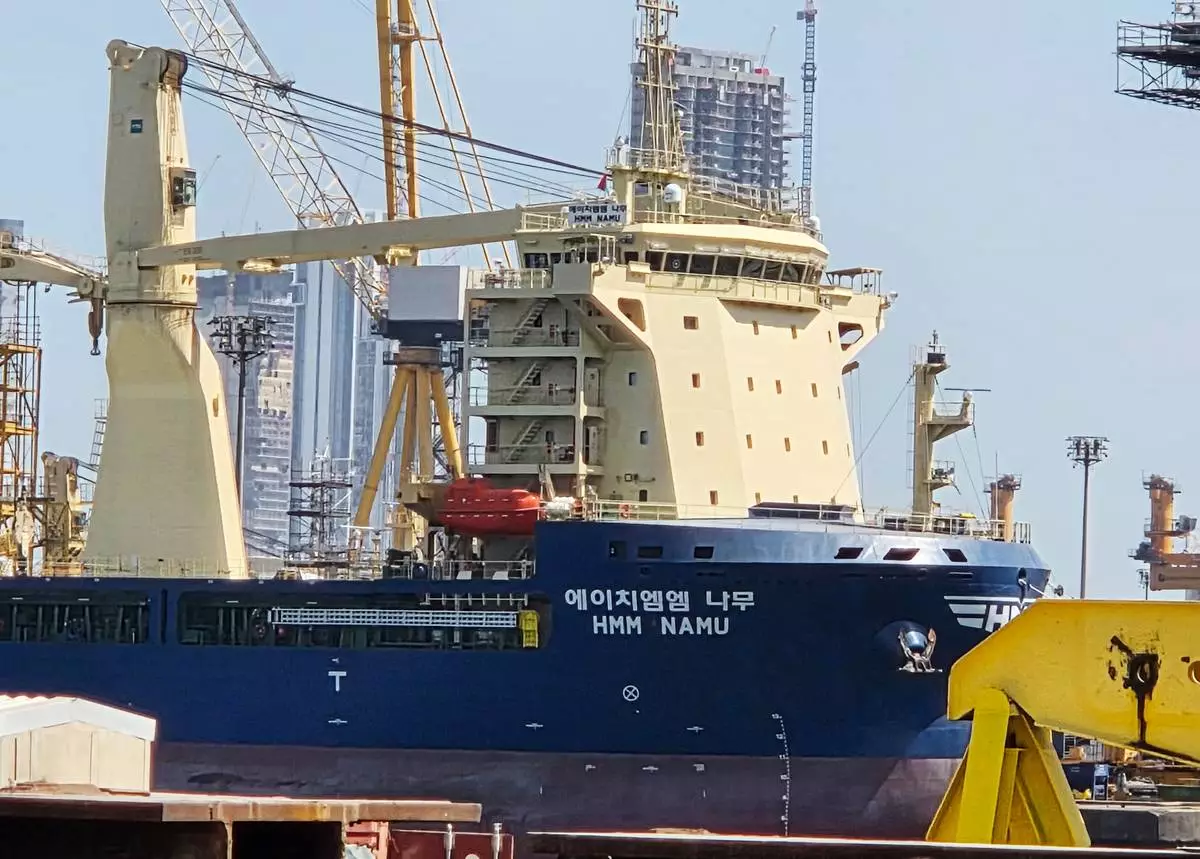
The South Korean-operated vessel HMM NAMU is docked after being damaged from a fire following an explosion in the Strait of Hormuz, at a port in Dubai, United Arab Emirates, Friday, May 8, 2026. (Kim Sang-hun/Yonhap via AP)
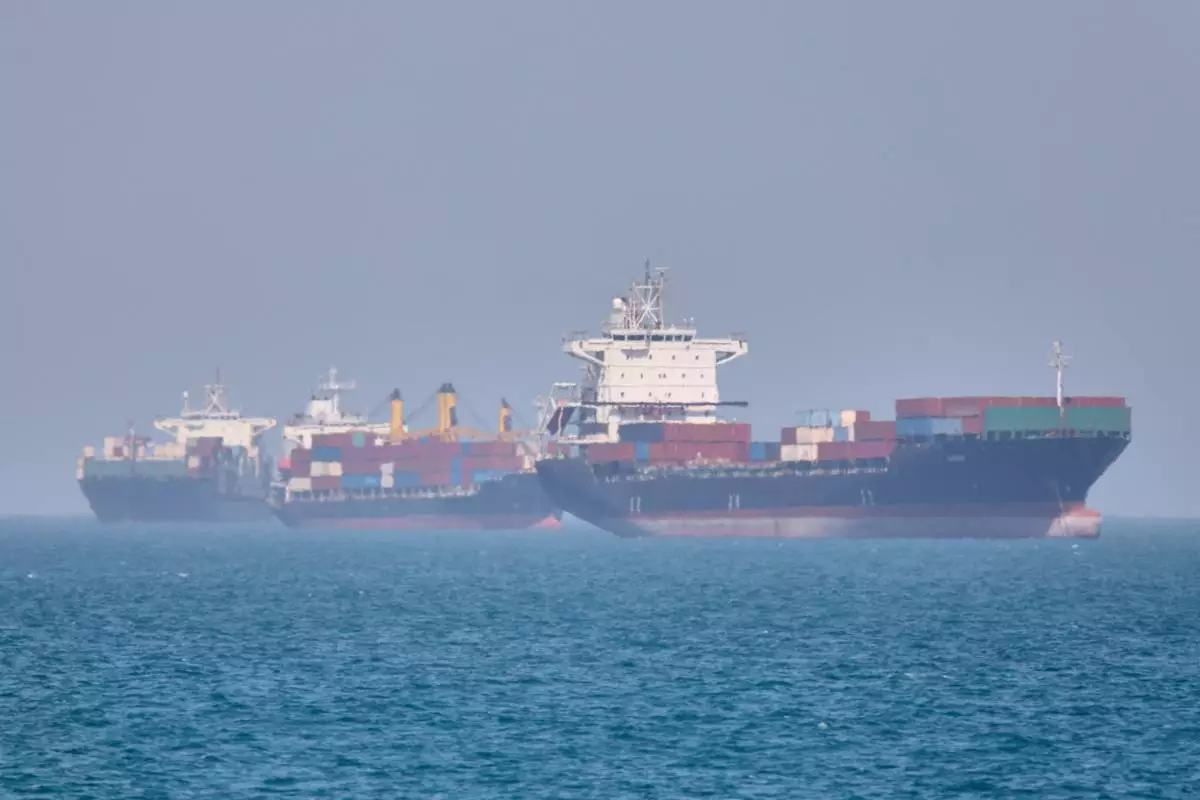
Container ships sit at anchor in the Strait of Hormuz off Bandar Abbas, Iran, Saturday, May 2, 2026.(Amirhosein Khorgooi/ISNA via AP)