Delegations of deputies from multiple provinces and autonomous regions across China opened up their group meetings to the press at the just-concluded fourth session of the 14th National People's Congress (NPC), China's national legislature, with deputies fielding questions across various topics and offering reporters greater insight into the measures being taken at the local level.
The group meetings were held during the "two sessions", a key event on China's political calendar which gathered thousands of Chinese lawmakers and political advisors in Beijing, offering a unique window into the country's development direction and policy priorities.
Members of the media were invited to a group meeting held by delegation members from Beijing, the nearby Tianjin Municipality, and the neighboring Hebei Province, where deputies shared their views on the coordinated development of the Beijing-Tianjin-Hebei region -- a mega-city cluster in north China which boasts a permanent resident population of over 100 million people.
Meanwhile, at the meetings of provincial-level regions in southern and eastern China, questions were mainly related to high-quality development and the emergence of 'new quality productive forces,' a new strategic approach which promotes sci-tech innovation and stresses advanced productivity freed from traditional economic growth models.
"In order to play a leading role in the global competition of the quantum computing industry and maintain our position, it is necessary to ensure seamless integration of the innovation chain and the industrial chain, promote the integration of general computing, supercomputing, intelligent computing and quantum computing power and build an independent and controllable industrial ecosystem, so as to drive the development of new quality productive forces," said Guo Guoping, a deputy from the delegation of east China's Anhui Province and chairman of Origin Quantum, a firm focused on quantum computing products.
Elsewhere, deputies from southwest China's Yunnan Province and the Xizang Autonomous Region as well as those from the northwestern Ningxia Hui Autonomous Region and Xinjiang Uygur Autonomous Region all shared more about the measures they have taken to enhance people's well-being and promote ecological protection.
Deputies from regions rich in tourism resources, such as northeast China's Heilongjiang Province, southwest China's Guizhou Province, northwest China's Shaanxi Province and south China's Guangxi Zhuang Autonomous Region, answered questions focusing on measures to boost local cultural and tourist consumption.
One deputy even sought to give reporters a visual representation of how his region has become a tourism hotspot.
"I want to show two pictures for everyone to take a look at. In the pictures, we can see streams of hikers walking along both banks of the Lijiang River after New Year's Day this year. They came to experience the feeling of 'wandering in a painting' as Guilin is celebrated for its stunning natural beauty," said Tang Jianwei, a deputy from the Guangxi Zhuang Autonomous Region, and deputy director of the Strategic Development Department of the Lijiang River Scenic Zone.
Deputies from east China's Jiangxi Province, northeast China's Jilin and Liaoning Provinces and northwest China's Gansu Province all elaborated on their achievements in increasing local infrastructure investment, developing heritage tours and promoting rural revitalization.
Many noted how modern technological methods are being fully utilized at the local level to boost local economies.
"Mobile phones are new farm tools and live-streaming is new farm work nowadays. As the year 2026 marks the start of the 15th Five-Year Plan, we will employ sci-tech means to help farmers increase their income. We plan to coordinate with regional e-commerce platforms to open up a new path of online ordering, offline self-pickup and cold chain delivery," said Tan Xinping, an NPC deputy and a local village committee director in Jiangxi Province.
Reporters, including those from overseas, said they were pleased to get access to these discussions and to learn more about the specific measures and grassroots programs that are taking place across the country.
"This is my third time to report the 'two sessions'. Today, I feel it's more open and more democratic. I can personally experience the changes in China, year after year. In particular, through the 'two sessions' I can gain a better understanding of the development plans, and see how they become a reality," said Olena Protchenko, a reporter from the Dubai-based China Arab TV.
The 14th NPC concluded its fourth session on Thursday.
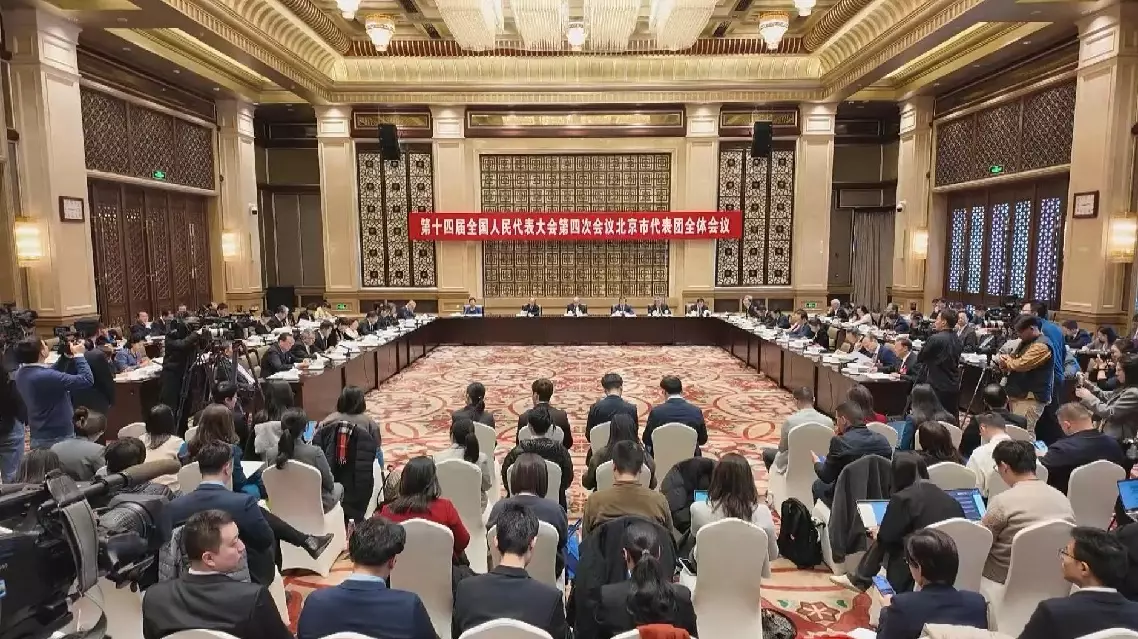
NPC delegations open up group meetings to media, offering greater local insights