With two of its big stars back, two new teams joining the fold and an expanded broadcast presence, the National Women's Soccer League is embarking on its 14th season hoping to benefit from the surge in the popularity of women’s sports and from a summer focused on soccer.
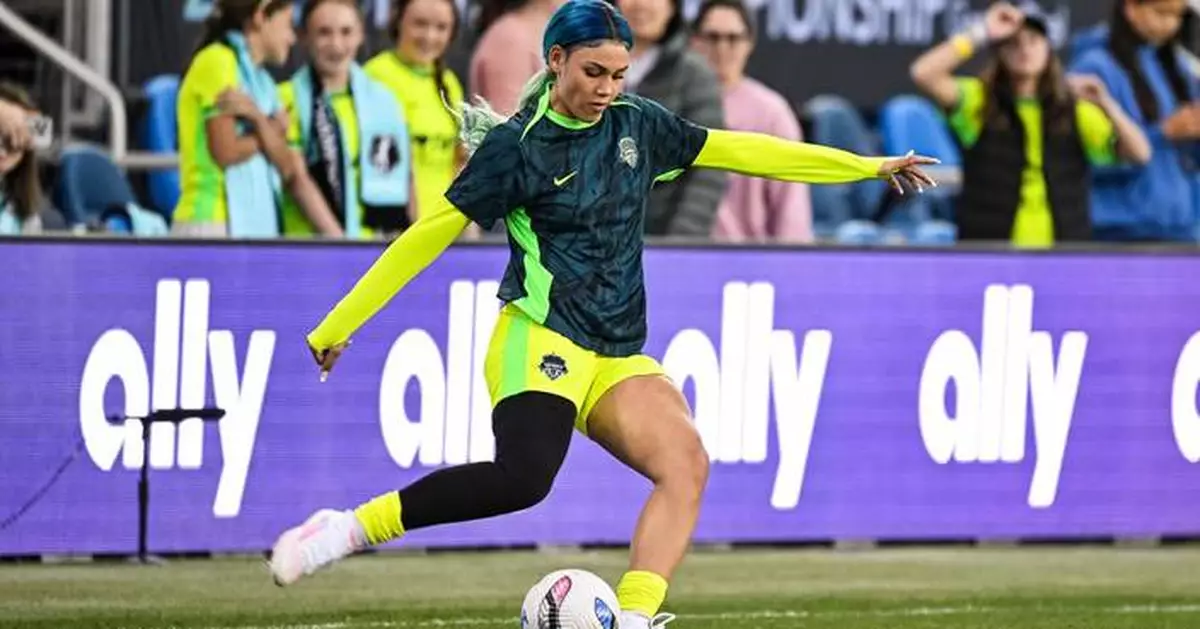
The season begins Friday with the Portland Thorns playing at the Washington Spirit, which has been billed as a showdown between Sophia Wilson and Trinity Rodman.
The two players — two-thirds of the Triple Espresso trio with Mallory Swanson that helped the United States win the gold medal at the Paris Olympics — give the league a boost with their star power.
Wilson, who plays for Portland, was on leave all last season for the birth of her daughter. She signed a one-year contract extension with the Thorns for the 2026 season.
Swanson, who plays for the Chicago Stars, is still working her way back from maternity leave but is expected to rejoin the club at some point this season.
Rodman re-signed with the Spirit after drawn-out contract negotiations that called into question the league's salary cap and resulted in a new “High Impact Player” policy.
Rodman's return was a win for the league, which saw some of its high-profile players, including Naomi Girma, Alyssa Thompson and Sam Coffey, depart last year for European clubs.
There were fears that the salary cap would prevent teams from retaining top players. The HIP rule allows teams to go $1 million over the cap to sign certain players.
The league had the option of raising the salary cap, which stands at $3.7 million for 2026, instead of adopting the more complicated rule. Commissioner Jessica Berman stood by the decision in her preseason remarks this week.
“The mechanism of the High Impact Player rule actually rewards or creates an incentive for clubs to not only go out and sign elite players, but it creates space within the salary cap to surround that player with other top talent,” Berman said.
The league welcomes two new teams this season, the Denver Summit and the Boston Legacy, bringing the NWSL to 16 teams.
Denver opens the season Saturday at Bay FC. The Summit announced that it has sold over 50,000 tickets for the team's home opener against the Spirit on March 28 at Empower Field at Mile High, home of the NFL’s Denver Broncos.
The Legacy opens Saturday at Gillette Stadium against defending NWSL champion Gotham FC. Halftime will feature a performance by hometown group New Kids on the Block.
The league has awarded a 17th expansion team to Atlanta to begin play in 2028. Berman announced this week that another expansion club for 2028 will be awarded later this season.
The NWSL’s broadcast partners include CBS, ESPN, Prime Video and Scripps-owned ION. The league expanded its media rights agreements last year, adding a new deal with Victory+ to air 57 games for free this season.
The league will also feature in ESPN's “Women's Sports Sundays” this summer.
“We will be working together with the WNBA to make sure that women's sports, and the NWSL and WNBA in particular, are showing up front and center to the way people think about and plan their weekend of sports content,” Berman said.
Berman said the league's viewership on traditional broadcast channels was up 20% last season, and up 30% on digital services.
The United States, Mexico and Canada are hosting the men's World Cup, soccer's premier tournament, this summer. The NWSL, which will pause play during a part of the tournament, faces logistical challenges in that two of its teams, the Seattle Reign and the Legacy, will be pushed out of home stadiums or otherwise impacted by the tournament.
The Reign will play three matches in Spokane, Washington, while the Legacy will play seven games in Pawtucket, Rhode Island.
But the league also hopes to capitalize on the inevitable attention on soccer.
“I hope, when we look back on the season, that the challenges it created will dwarf in comparison to the opportunities it created because of the benefit and halo effect of the men's World Cup more broadly,” Berman said. “Our strategy around the summer of soccer is going to be a key area of focus for us.”
The Kansas City Current finished atop the standings in 2025 with a historic season and won the NWSL Shield, setting regular-season records for points (65), wins (21), home wins (11), road wins (10), shutouts (16) and fewest goals conceded (13).
Gotham FC, the eighth seed in the playoffs, eliminated Kansas City with a 2-1 quarterfinal victory. Gotham went on to defeat the Orlando Pride in the semifinals before a 1-0 victory over the Spirit for the NWSL title.
AP soccer: https://apnews.com/hub/soccer
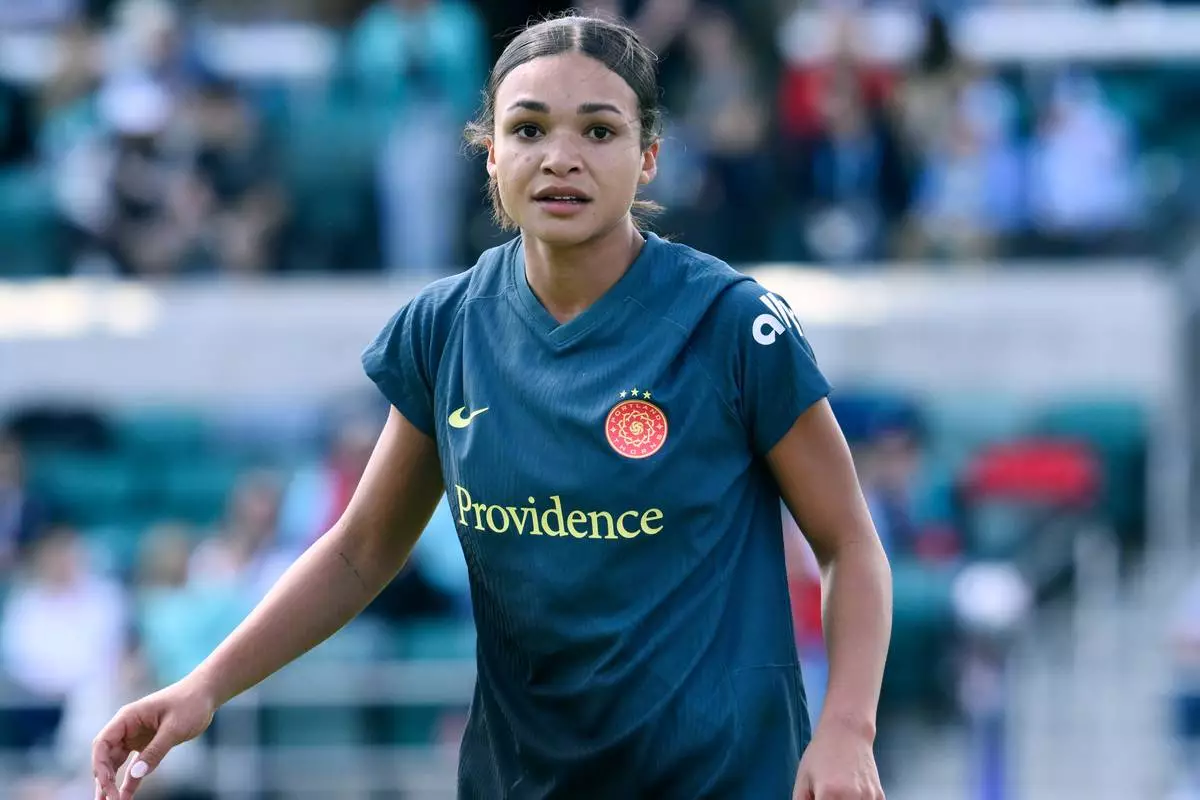
Portland Thorns FC forward Sophia Smith during an NWSL soccer match against the Kansas City Current at CPKC Stadium, Saturday, March 16, 2024, in Kansas City, Mo. (AP Photo/Reed Hoffmann)
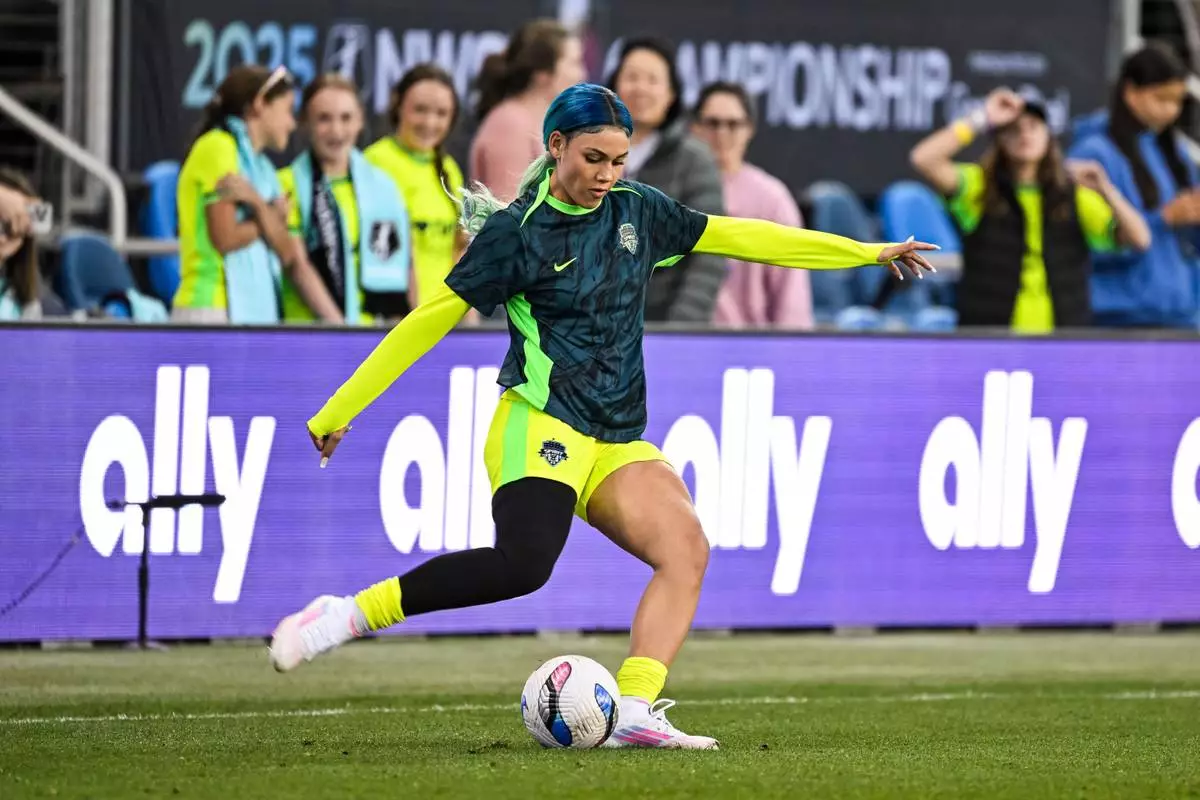
FILE - Washington Spirit forward Trinity Rodman (2) warms up before the NWSL women's championship soccer match against Gotham FC, Nov. 22, 2025, in San Jose, Calif. (AP Photo/Justine Willard, File)
KYIV, Ukraine (AP) — Ukraine's air force said Tuesday it intercepted five ballistic missiles launched by Russia in a raft of overnight attacks, although other missiles and drones got through and hit warehouses and a school in the capital of Kyiv.
It was the first time in almost two weeks that Ukraine said it had downed Russian ballistic missiles, which are harder to stop than drones or cruise missiles and have pummeled the country in Moscow's 4-year-old full-scale invasion.
Ukrainian air defenses likely used the U.S.-made Patriot surface-to-air guided missile system that is the most effective way of countering ballistic missiles, but ammunition for it has been in short supply amid the Iran war despite European efforts to make up for the shortfall.
Along the cobblestoned Champs-Elysees in Paris, crowds cheered Ukrainian troops marching in the annual Bastille Day parade, and President Volodymyr Zelenskyy received an ovation from European leaders who showed solidarity with Kyiv. Ukrainian aviators trained in France flew aboard two Mirage 2000B fighter jets alongside French air force pilots.
Zelenskyy was in France seeking a remedy to his country's air defense problem, and he announced Monday that Ukraine is joining with nine other nations to form a coalition that will build a shared ballistic missile shield for Europe. Ukraine and its partners could jointly develop a mass-produced, low-cost system in the next 12 months, he said.
The Bastille Day parade featured about 500 troops from the ″coalition of the willing″ group of countries that have pledged to help with Ukraine’s postwar security. French President Emmanuel Macron called it a ″great honor″ to welcome them to the parade.
Tuesday's attack in Kyiv caused fires at two warehouses and also damaged a school, Mayor Vitali Klitschko said.
The Russian Defense Ministry said in a statement it targeted military manufacturing facilities that produce long-range missiles and drones.
Moscow is seeking to choke off Ukrainian strikes on oil facilities deep inside Russia that have caused critical fuel shortages, frustrating the public and, Western analysts say, are hindering the Russian army’s advance on the front line.
Ukraine’s air force said one ballistic missile and 25 drones struck 17 locations, while falling debris was reported in 10 locations.
Ukraine urgently needs to improve its air defense shield before winter. Much of the country is at the mercy of Russian missiles that have hammered its power grid since 2022, making winters almost unbearable.
President Donald Trump said at the NATO summit last week that the U.S. will give Ukraine a license to make Patriot systems itself. However, they are expensive, in high demand and take a long time to produce, so it will likely be years before any Ukrainian-made systems are ready to deploy.
Ukraine, meanwhile, kept up its long-range onslaught on Russian targets, especially oil facilities.
An attack in southern Russia's Krasnodar region caused a fire at the Afipsky Oil Refinery that was later put out, authorities there said.
Zelenskyy said Ukraine also hit an oil refinery in the city of Salavat in the Bashkortostan region, some 1,400 kilometers (900 miles) from the Ukrainian border. Bashkortostan Gov. Radiy Khabirov confirmed an attack on an industrial area in Salavat, but didn’t say what was hit.
In addition, the Ukrainian navy struck four Russian tankers operating as part of Moscow's so-called shadow fleet of aging tankers of uncertain ownership and safety practices that are dodging international oil sanctions and a patrol boat, Zelenskyy said.
Ukraine claimed Monday it struck 105 Russian vessels in the Sea of Azov next to the Crimean Peninsula between July 6-13.
The Russian Defense Ministry said its air defenses overnight intercepted 288 Ukrainian drones.
Russian President Vladimir Putin has rebuffed ceasefires offered by Zelenskyy.
“This war must be brought to an end, and all reasonable diplomatic proposals are on the table,” Zelenskyy said on social media.
—-
Eva Van Dam contributed from Paris.
Follow the AP’s coverage of the war in Ukraine at https://apnews.com/hub/russia-ukraine
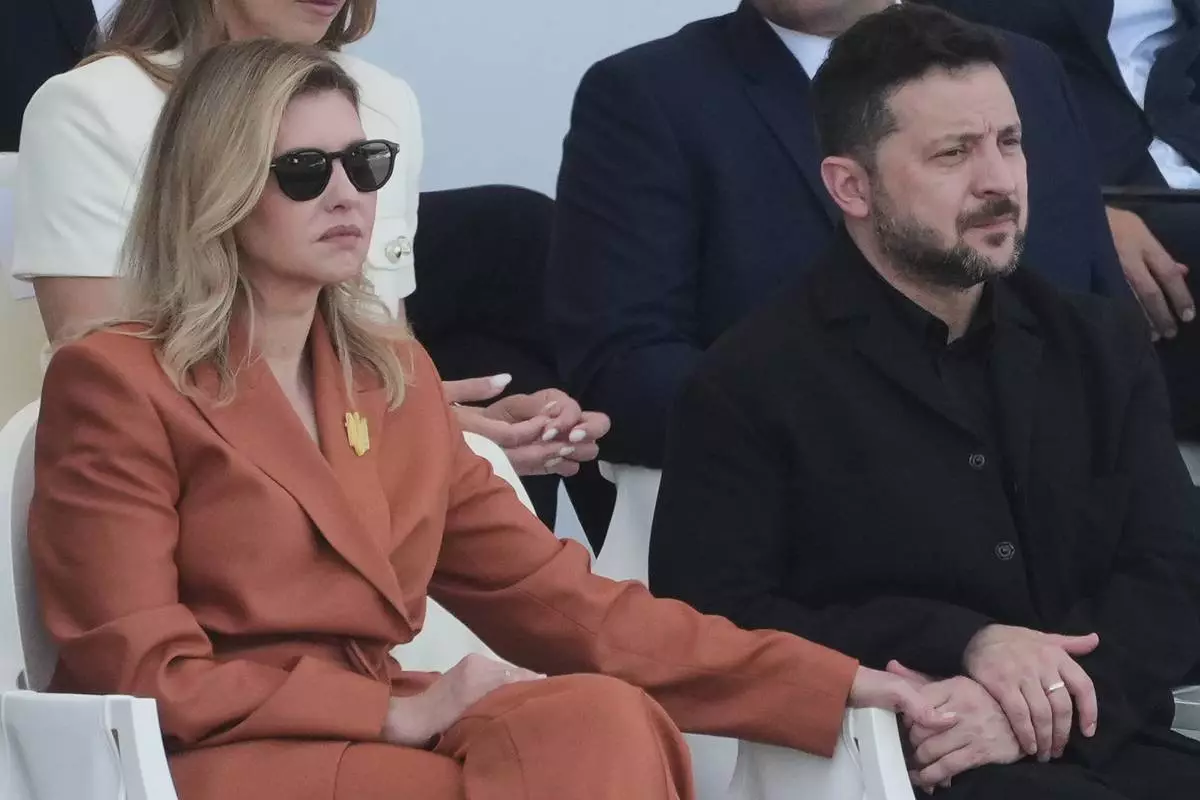
Ukraine's President Volodymyr Zelensky and his wife Olena Zelenska attend the Bastille Day military parade on the Champs-Elysees avenue, in Paris, Tuesday, July 14, 2026. (AP Photo/Michel Euler)
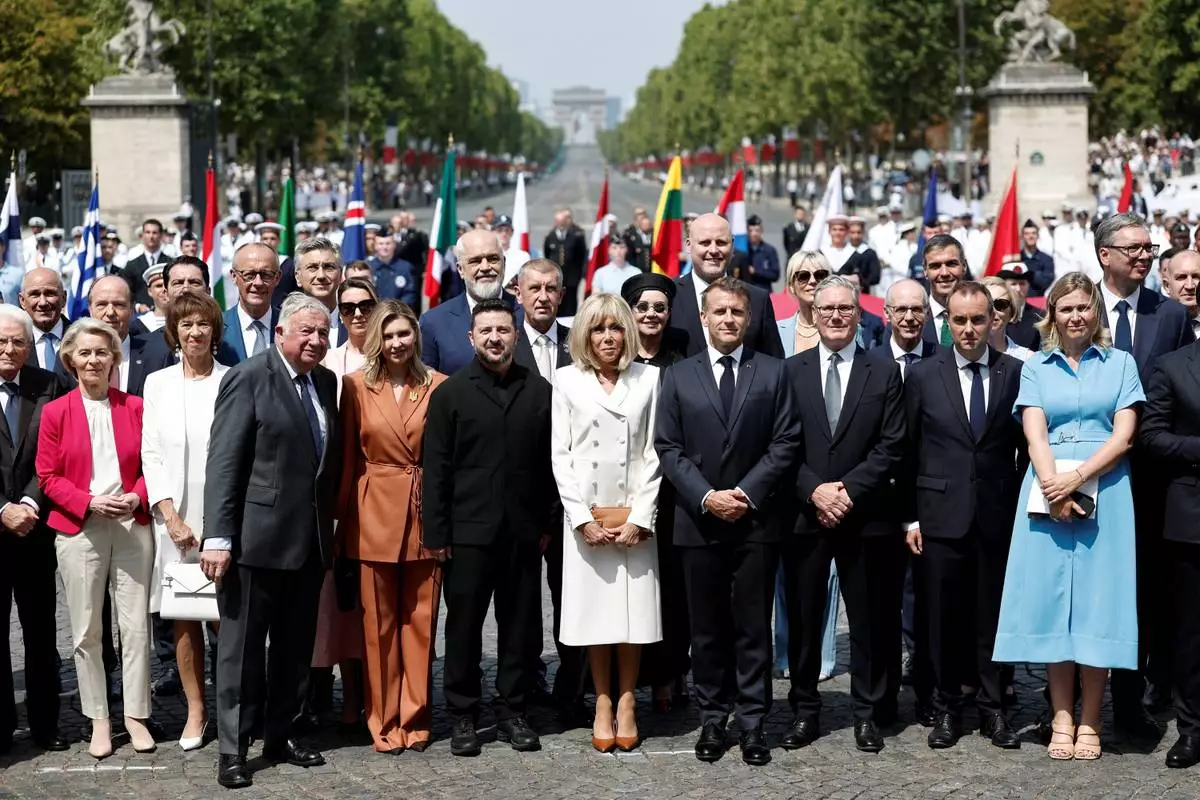
French President Emmanuel Macron, his wife Brigitte Macron, Ukraine's President Volodymyr Zelenskyy and his wife Olena Zelenska, Heads of State and Government of the Coalition of the Willing, President of the National Assembly Yael Braun-Pivet, and President of the Senate Gerard Larcher pose for a family photo after the annual Bastille Day military parade on the Place de la Concorde in Paris, France, Tuesday, July 14, 2026. (Benoit Tessier/Pool photo via AP)
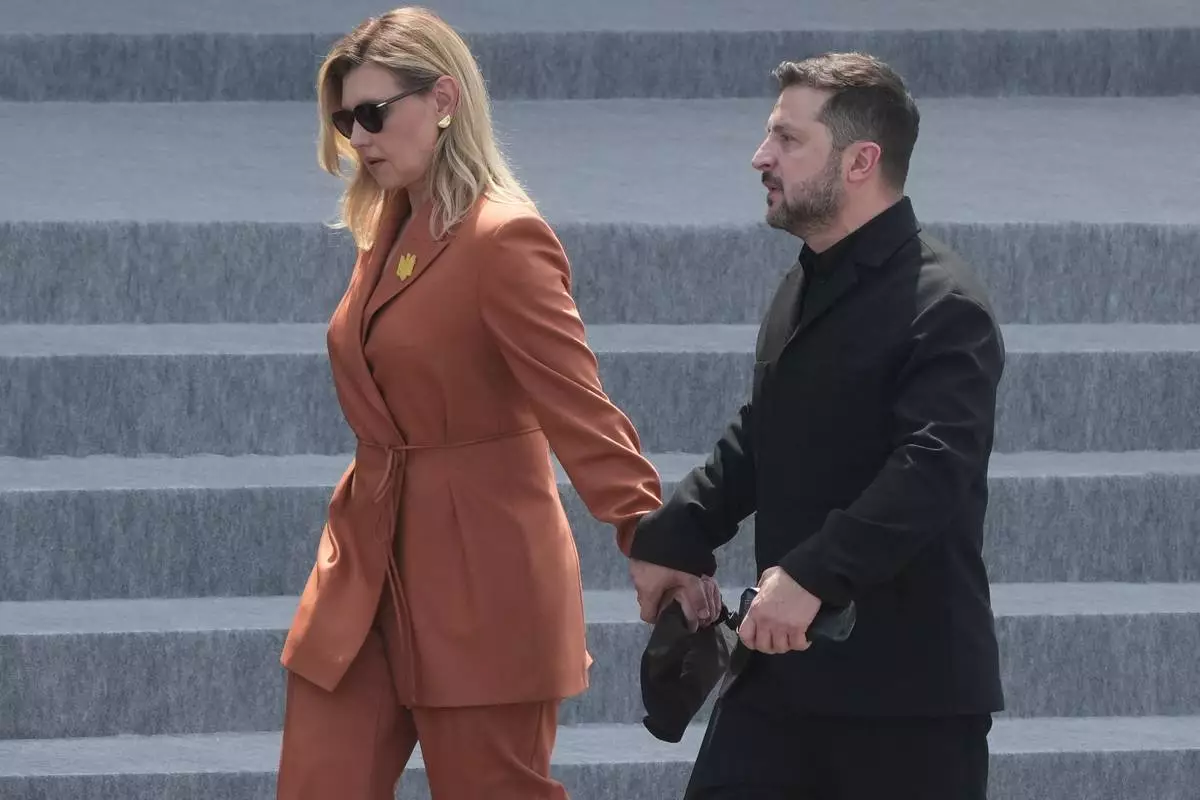
Ukraine's President Volodymyr Zelensky and his wife Olena Zelenska leave after the Bastille Day military parade on the Champs-Elysees avenue, in Paris, Tuesday, July 14, 2026. (AP Photo/Michel Euler)
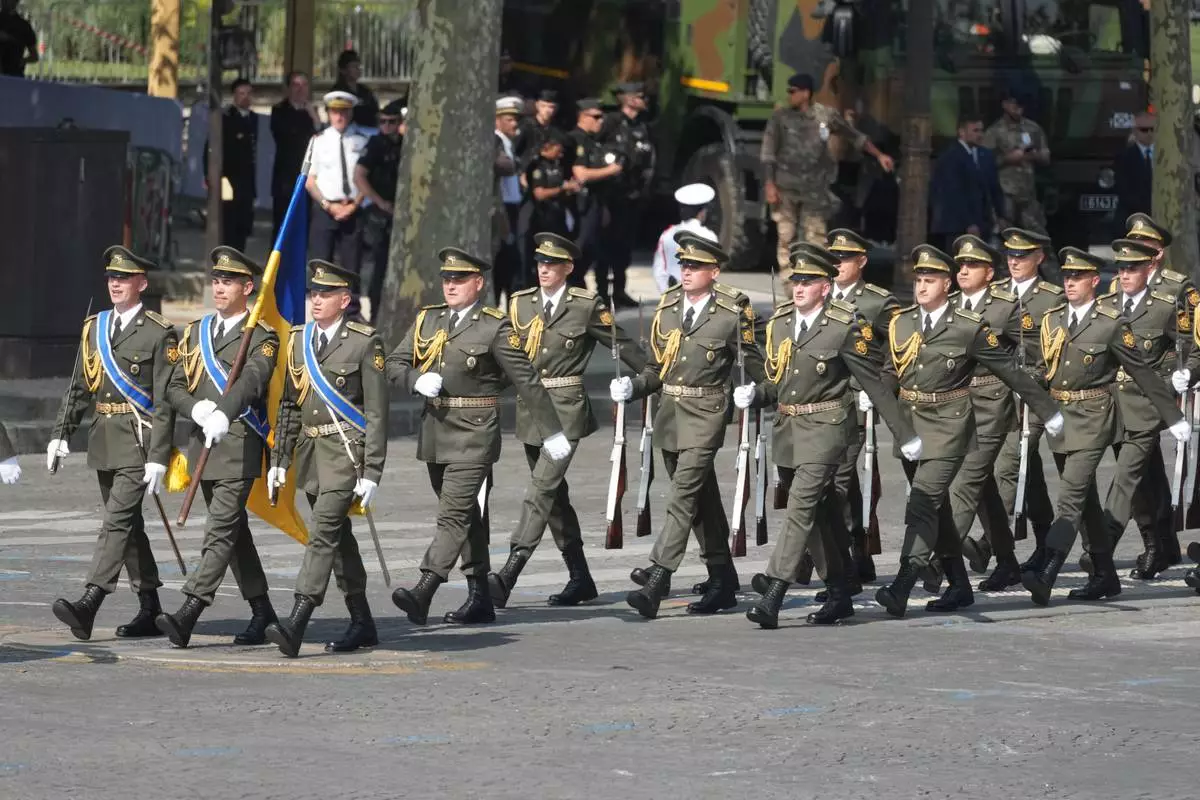
Ukrainian soldiers march during the Bastille Day military parade on the Champs-Elysees avenue, in Paris, Tuesday, July 14, 2026. (AP Photo/Michel Euler)
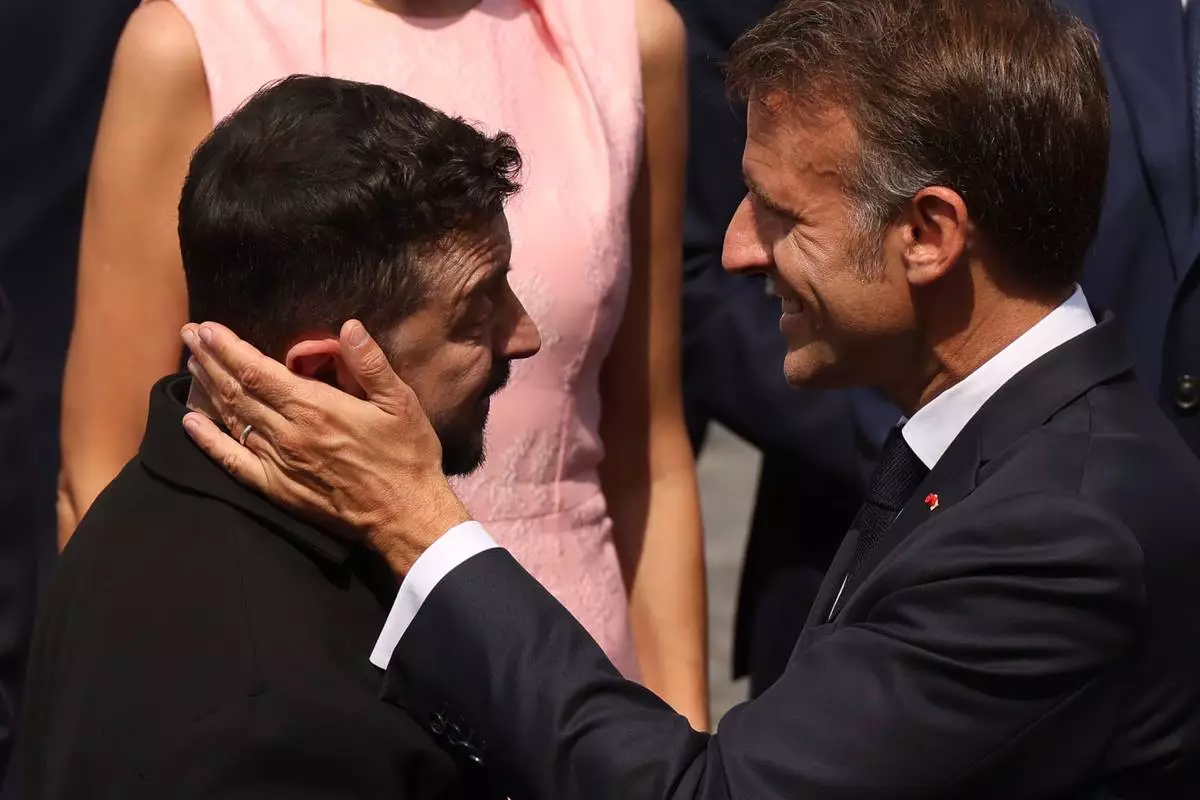
French President Emmanuel Macron, right, speaks with Ukraine's President Volodymyr Zelensky after the Bastille Day military parade on the Champs-Elysees avenue, in Paris, Tuesday, July 14, 2026. (AP Photo/Thomas Padilla)
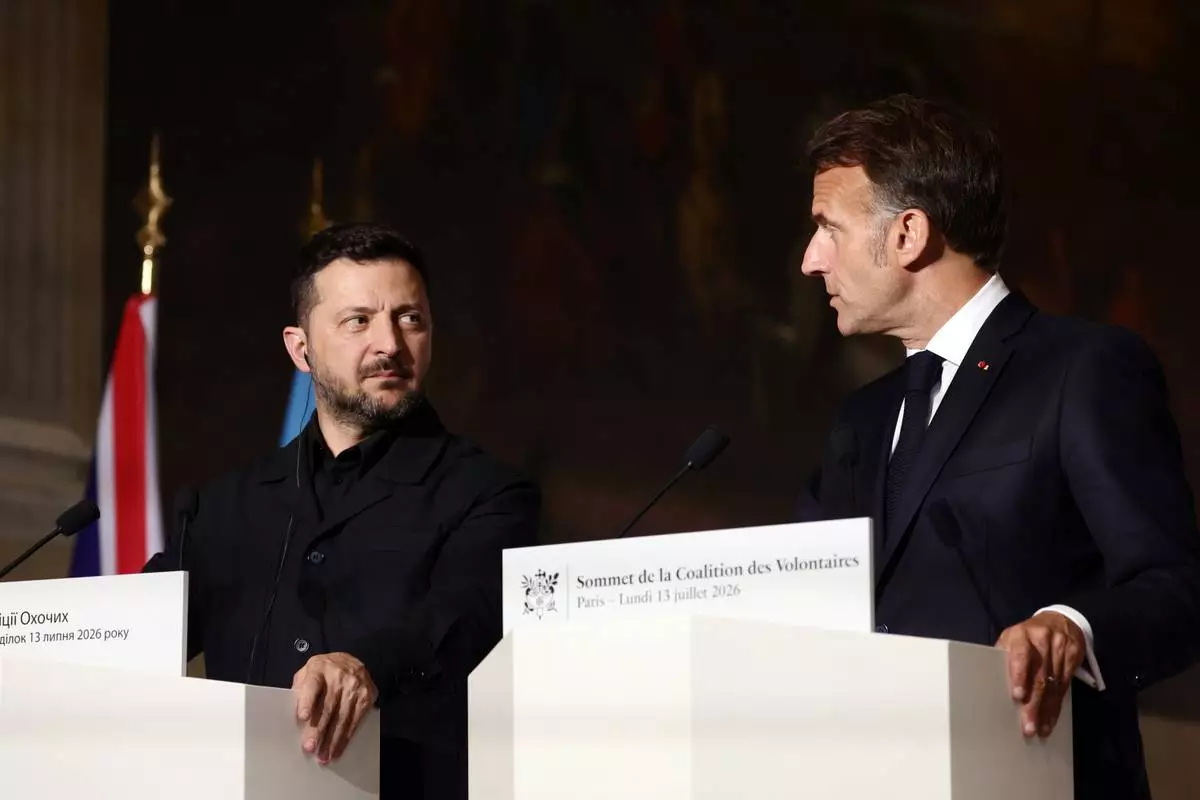
Ukrainian President Volodymyr Zelensky, left, and French President Emmanuel Macron address a press conference after the Coalition of the Willing summit on security guarantees for Ukraine in Paris, Monday, July 13, 2026. (Teresa Suarez/Pool Photo via AP)