SIEM REAP, Cambodia (AP) — Cambodia said Friday it has drafted its first law targeting online scam centers, after vowing to shut them down by the end of April.
Cambodia is a major hub for scam operations, which extort money from victims online through bogus investment schemes and feigned romances. Victims around the world are estimated to have been cheated out of tens of billions of dollars annually.
At the same time, thousands of people, especially from other Asian nations, have been recruited with false job offers and then forced to work in scam centers in conditions of near-slavery.
“This law is the most important legal instrument for Cambodia in combating scams online, fighting money laundering and demonstrating that Cambodia is not a paradise or a safe haven for criminals,” Information Minister Neth Pheaktra said in a statement.
The new legislation approved by the Cabinet sets five to 10 years in prison and a fine of 500 million to 1 billion riels ($125,000-250,000) for organizing or directing a technology fraud site. In case of human trafficking or violence, detention or confinement, the penalties rage from 10 to 20 years plus a fine of up to 2 billion riels ($500,000). In case of a death linked to a scam center, the offense is punishable by imprisonment from 15 to 30 years, or life. Workers have died when they tried to escape.
The new legislation must be approved by Parliament.
Senior Minister Chhay Sinarith, in charge of the Commission for Combating Online Scams, told The Associated Press in an interview on Wednesday that the government since July had targeted 250 locations believed to be carrying out online scams, and has shut down about 200.
Since last July, the government has filed 79 cases involving 697 alleged scam ringleaders and their associates, according to Chhay Sinarith.
Cambodia has repatriated almost 10,000 scam center workers from 23 countries, with fewer than 1,000 waiting to return home. Others who have escaped or been released from raided centers have returned on their own.
Neth Pheaktra said that the government “has made strong efforts to combat this crime in order to protect Cambodia’s reputation and economy, which have previously been damaged by online scams, and the government does not receive any revenue from these activities.”
Cambodia has launched previous crackdowns but without major effect on scam centers, and some experts are skeptical it can eliminate the criminal industry.
“The real question is whether this effort targets the system that enables the industry, not just the buildings where scams happen,” said Jacob Sims, an expert on transnational crime and a visiting fellow at Harvard University’s Asia Center. “Past crackdowns in Cambodia have often left the financial and protection networks intact, allowing operations to quickly reconstitute.”
——-
Associated Press writer Grant Peck in Bangkok contributed to this report.

Equipment confiscated in a raid by Cambodian police are laid out on a table at a scam center in Phnom Penh, Cambodia, Wednesday, March 11, 2026. (AP Photo/Heng Sinith)
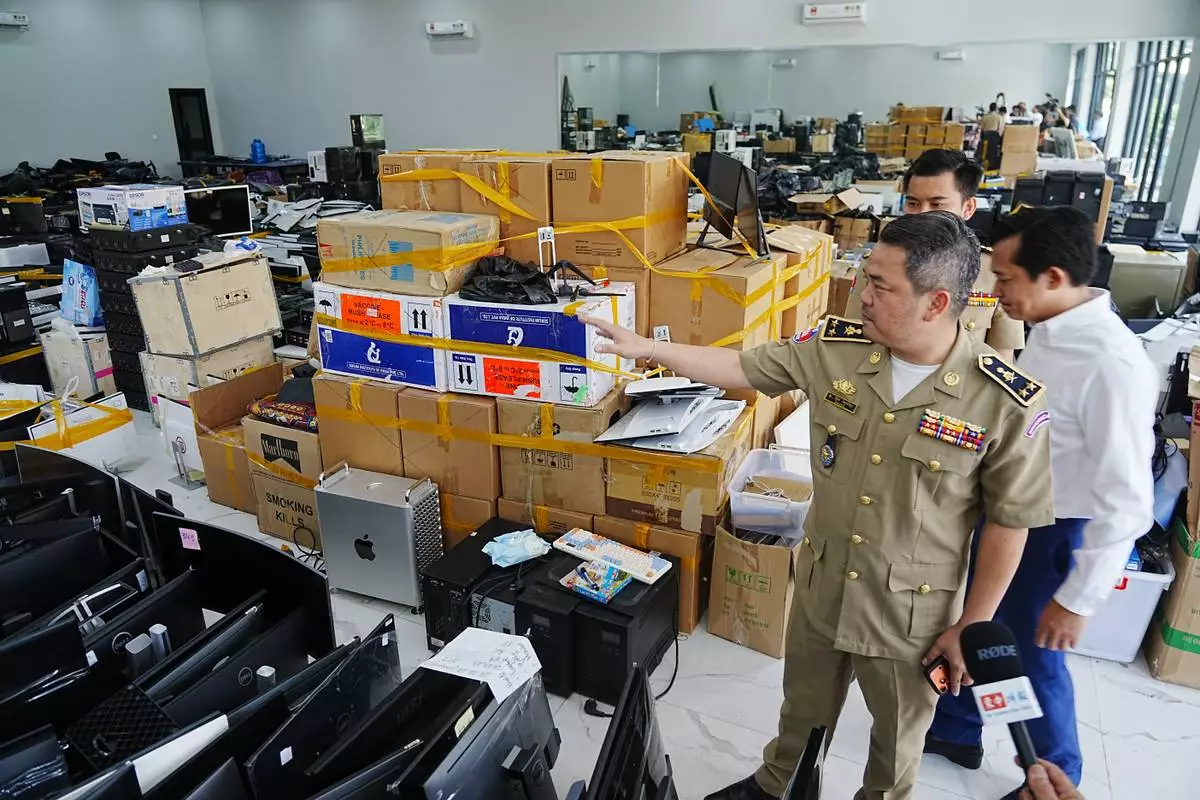
Bun Sosekha, Deputy Commissioner in charge of Security Unit, Phnom Penh Municipal Police, gives a tour of a scam center to journalists in Phnom Penh, Cambodia, Wednesday, March 11, 2026. (AP Photo/Heng Sinith)

Equipment used at a scam center in Phnom Penh, Cambodia, Wednesday, March 11, 2026. (AP Photo/Heng Sinith)
BANGKOK (AP) — Myanmar’s military has commissioned new combat aircraft to boost its air capacities, state media reported Friday, as the army steps up efforts to regain territory from resistance forces in the country’s civil war.
The state-run Global New Light of Myanmar newspaper did not specify the number or types of the newly commissioned aircraft, but photos released by the military suggest it received four jet fighters, including two Russian-made Su-30 aircraft widely used for bombing and combat missions.
It was the sixth time the miliary had commissioned new aircraft since it seized power from the elected government of Aung San Suu Kyi in February 2021, triggering armed resistance across the country.
Russia and China are major supporters and arms suppliers of Myanmar’s military government. Western nations have imposed sanctions including the prohibition of arms sales.
The newspaper cited Senior Gen. Min Aung Hlaing, head of Myanmar’s ruling military government, as saying that the air force needs to be strong to "protect the state interest effectively.”
He added the air force had demonstrated its capabilities in previous anti-insurgency and counterterrorism operations as well as missions to repel external aggression, according to the report.
The military government has lost large swaths of the country to pro-democracy People’s Defense Forces and ethnic armed groups. It has intensified efforts to retake territory and scored several battlefield gains, and its airstrikes have often caused civilian casualties.
The opposition National Unity Government, or NUG, which coordinates resistance to military rule, and the Karen National Union, an ethnic armed group fighting the army, said in separate statements Monday that about 30 to 40 people were killed when the military used drones, jet fighters and artillery during a ground offensive in villages in the lower-central Bago region between March 5 to March 7.
The powerful Arakan Army ethnic militia, based in western Rakhine state, said Wednesday that 116 captured army soldiers, including officers held in a detention camp in Ann township, were killed when eight military aircraft carried out aerial attacks on Sunday.
The military has not mentioned any attack in Bago and Rakhine. The reports could not be independently confirmed.
Nay Phone Latt, a spokesperson for the NUG, told the AP that the commissioning of new aircraft is intended to enhance continued airstrikes on civilian areas.
He said the military was “targeting civilians and continuing to carry out mass killings. It is important for the international community not to turn a blind eye to this reality.”
The Global New Light of Myanmar also said in a separate report that the military has regained control of the ancient town of Tagaung in northern Mandalay after a weekslong offensive.
Tagaung, located about 170 kilometers (105 miles) north of Mandalay, the country’s second-largest city, had been under the control of forces aligned with the NUG since August 2024.
The recapture of Tagaung, the last NUG-controlled town in Mandalay Region, marked the latest setback for opposition groups fighting the military.
Nay Phone Latt said resistance forces withdrew from the town after the military launched an offensive using large numbers of troops and heavy weapons, but they still maintain positions in areas outside it.

In this photo provided by the Myanmar Military True News Information Team, head of the ruling military government, Senior Gen. Min Aung Hlaing attends a ceremony to commission new aircraft into its air force in Meiktila township in Mandalay region, Myanmar, Thursday, March.12, 2026. (The Myanmar Military True News Information Team via AP)
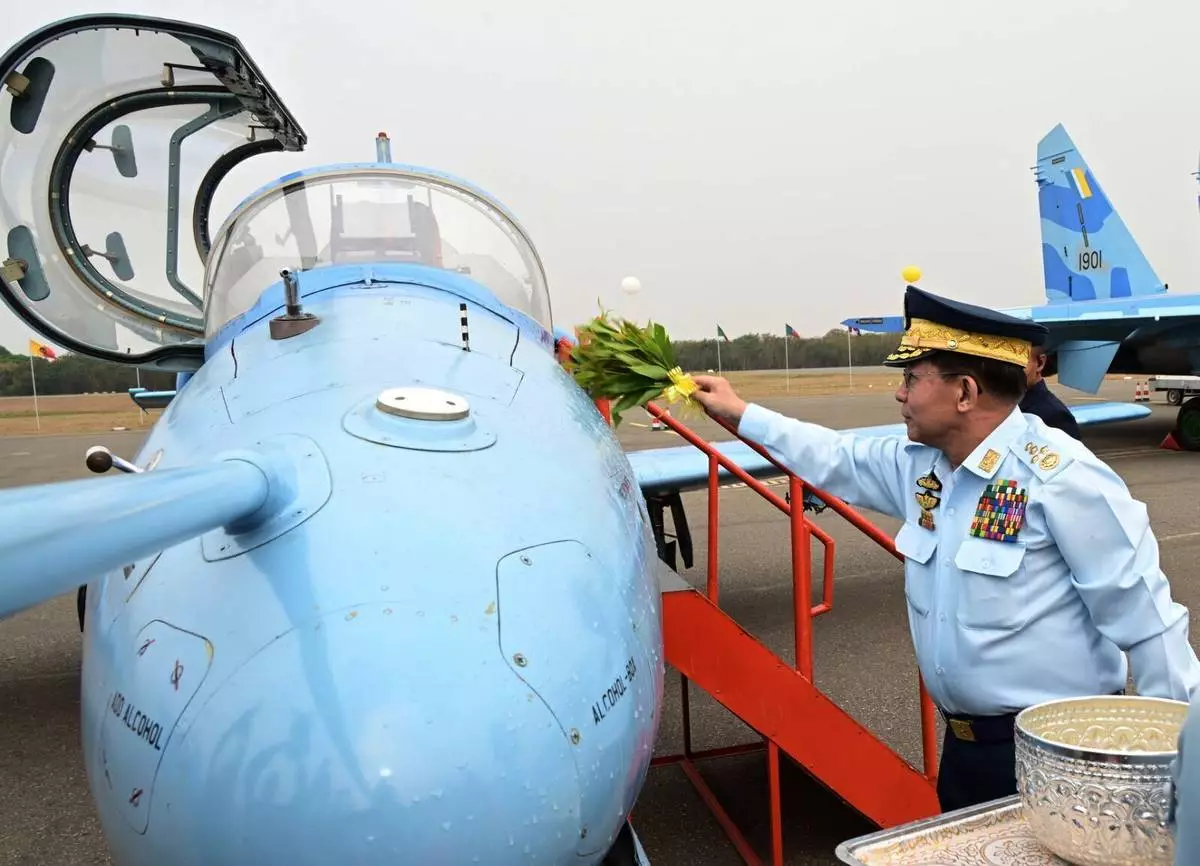
In this photo provided by the Myanmar Military True News Information Team, head of the ruling military government, Senior Gen. Min Aung Hlaing attends a ceremony to commission new aircraft into its air force in Meiktila township in Mandalay region, Myanmar, Thursday, March.12, 2026. (The Myanmar Military True News Information Team via AP)
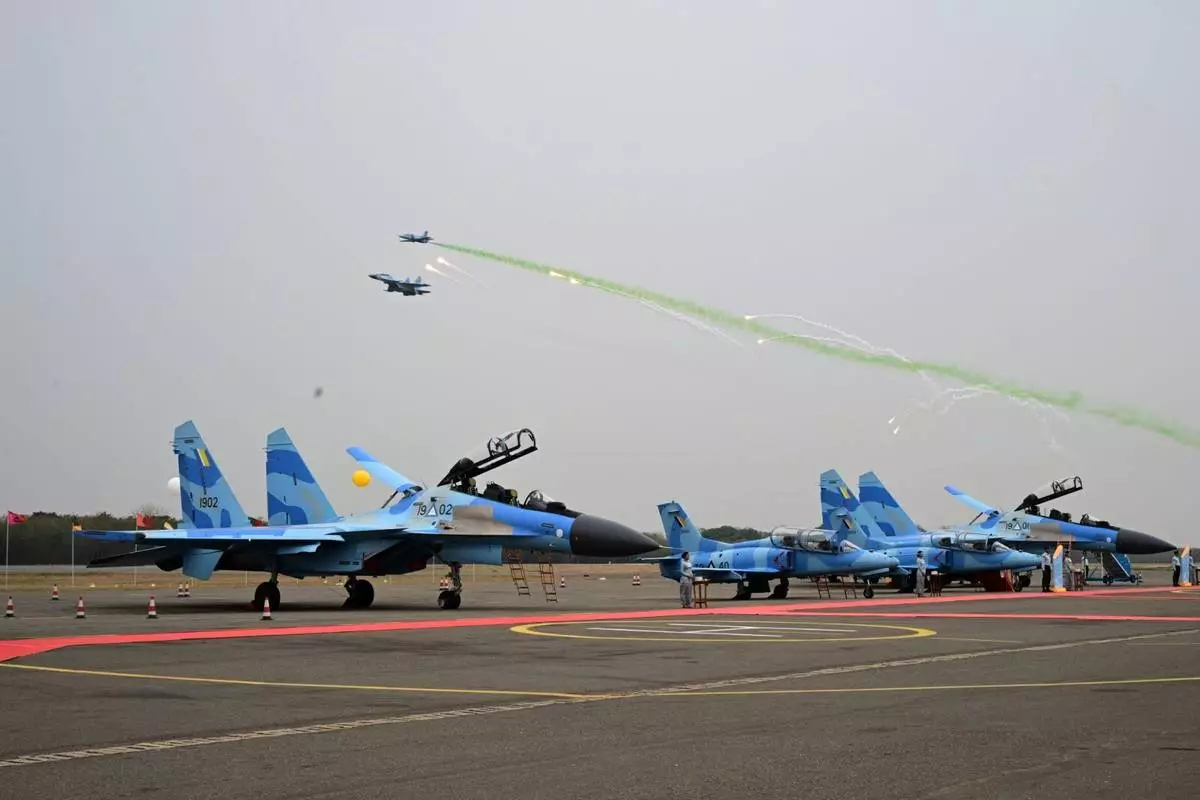
In this photo provided by the Myanmar Military True News Information Team, newly commissioned aircraft are seen at an airbase in Meiktila township in Mandalay region, Myanmar, Thursday, March 12, 2026. (The Myanmar Military True News Information Team via AP)