Skip to Content Facebook Feature Image

Could the Chicago Bears leave Illinois? Indiana makes a play for the historic franchise

News

Could the Chicago Bears leave Illinois? Indiana makes a play for the historic franchise
News

News

Could the Chicago Bears leave Illinois? Indiana makes a play for the historic franchise

2026-03-14 15:38 Last Updated At:15:50

SPRINGFIELD, Ill. (AP) — A turf war over a football team is developing between two Midwestern states with a sometimes-discordant history.

The storied Chicago Bears want to leave historic Soldier Field, where they've played for half a century. Indiana lawmakers are attempting to lure them from the Windy City with a plan to finance and build a domed stadium in Hammond, Indiana, about 25 miles (40 kilometers) from their current home on Lake Michigan's shore.

The Illinois General Assembly has responded with legislation that would give tax breaks to so-called megaprojects of at least $100 million, a plan that would encompass the Bears' proposal to build a complex in the northwest Chicago suburb of Arlington Heights, about the same distance from Soldier Field as Hammond.

Critics complain it's a bad deal for Illinois, where property taxes are already among the highest in the nation — especially when taxpayers still owe hundreds of millions of dollars on a Soldier Field renovation from two decades ago.

Here's a look at what's shaping up to be a showdown.

The Bears, one of only two remaining NFL founding members, are legend. Their nine championships, including a Super Bowl win, are second only to the rival Green Bay Packers — though recent decades have brought mostly heartbreak. The franchise carries an $8.9 billion price tag, among the most valuable of the NFL’s 32 teams, according to Forbes.

Born in the central Illinois city of Decatur in 1920, the Bears have called Chicago home for 105 years. Losing them to the Hoosier State would be a major thumb in the eye.

With 61,500 seats, it's the NFL's smallest. The Bears have always rented their facilities — the Cubs' Wrigley Field from 1921 to 1970, and Soldier Field, maintained by the Chicago Park District, since. Like most teams, they want to own a stadium, giving them control over operations, scheduling and revenue streams from ticket sales, concessions, parking, naming rights and more.

And Soldier Field is open air. An enclosed facility would allow for other marquee sporting events: Super Bowls, NCAA Final Fours or WrestleMania, for instance.

Along with the states' established cultural and economic differences and an intense college basketball rivalry, the political fissure between Democrat-dominated Chicago and conservative Indiana has widened. It amped up last year when Indiana adopted a commission to study changing the state's boundaries to include some central Illinois counties whose voters have approved ballot measures calling for secession from Chicagoland.

The Bears have threatened to leave Chicago previously. When they broached moving in 1975, then-Mayor Richard J. Daley replied, “Like hell they will.”

But the City of Big Shoulders heaved an anxious sigh in 2023 when the Bears paid about $200 million for a 326-acre (132-hectare) former horse-racing track in Arlington Heights. They have envisioned a $5 billion, taxpayer-assisted development for a domed stadium and campus of housing, hotels, entertainment and retail space.

In 2024, the Bears offered a $5 billion plan, partially taxpayer-funded, for an enclosed stadium next to Soldier Field, which garnered little interest in the capital of Springfield. Late last fall, the team turned to Indiana.

Indiana's lure creates the Northwest Indiana Stadium Authority to finance, construct and lease a domed stadium near Wolf Lake in Hammond. Indiana Gov. Mike Braun signed it into law on Feb. 26. The Bears would agree to a 35-year lease. Borrowed state money would cover the as-yet-unknown cost of construction, repaid by increased local hospitality taxes.

In Illinois, majority Democrats have advanced legislation in the House that would provide incentives for any so-called megaproject of at least $500 million — or less, down to $100 million, depending on the number of jobs created. Developers would pay property taxes frozen at the parcel's pre-construction value for as long as 45 years. During that time, they would make annual payments in lieu of taxes negotiated with local governments. There would also be a sales tax exemption on building materials for up to 15 years.

Opponents say the Illinois legislation, with its decades-long property tax freeze, would simply mean increased taxes for homeowners and other businesses — the payment in lieu of taxes would be a bonus.

Democratic Gov. JB Pritzker, who supports the plan, last week countered that the proposal would encourage development on land that isn’t producing property taxes while ensuring increased revenue for local governments.

Meanwhile, a substantial debt remains on the last accommodation. Taxpayers in 2001 put up $399 million to finance a $587 million renovation of Soldier Field. With interest, the remaining tab is $467 million, according to the state's Commission on Government Forecasting and Accountability.

The Bears' $7 million annual lease runs through 2033. Breaking it would cost the Bears a $10.5 million penalty for each year left on the agreement.
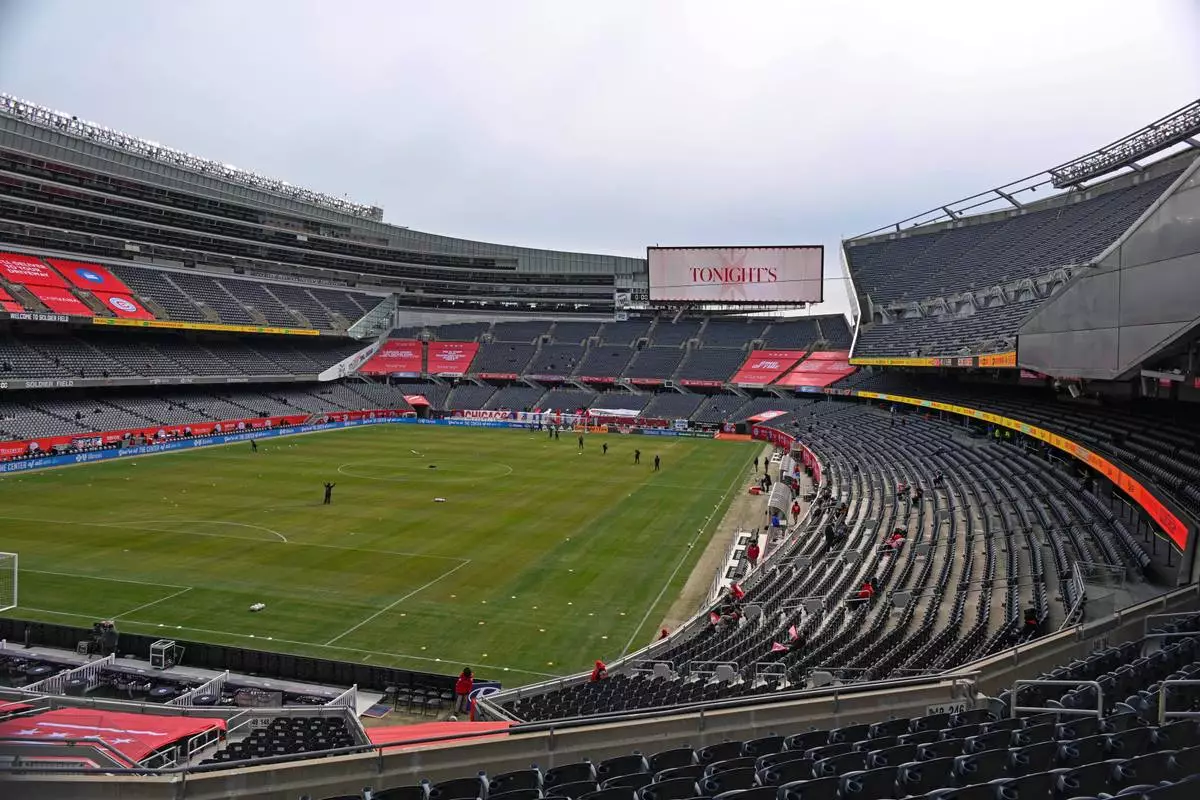
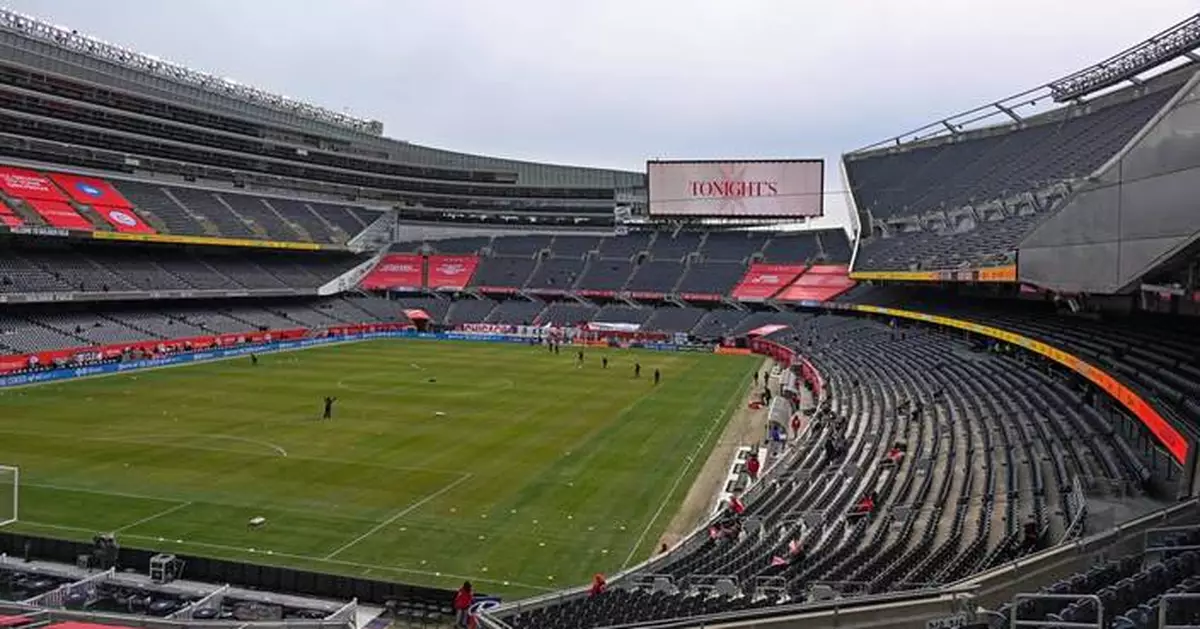
FILE - Soldier Field is seen for an MLS soccer match between the Chicago Fire and the CF Montréal, Saturday, Feb. 28, 2026, in Chicago. (AP Photo/Matt Marton, File)


FILE - Soldier Field is seen for an MLS soccer match between the Chicago Fire and the CF Montréal, Saturday, Feb. 28, 2026, in Chicago. (AP Photo/Matt Marton, File)

SEOUL, South Korea (AP) — North Korea on Saturday fired about 10 ballistic missiles toward the eastern sea, South Korea’s military said, staging its own show of force as the rival South conducts a joint military exercise with the United States.

South Korea’s Joint Chiefs of Staff said the missiles were fired from an area in Sunan, the site of Pyongyang’s international airport, and flew about 350 kilometers (220 miles).

Japanese Defense Minister Shinjiro Koizumi said the weapons landed outside the country’s exclusive economic zone and that there were no reports of damage to planes or ships.

The South’s Joint Chiefs said the military has stepped up surveillance and is maintaining readiness against possible additional launches while closely sharing information with the U.S. and Japan.

The launches came as the U.S. and South Korean militaries conduct their annual springtime exercises involving thousands of troops while the Trump administration also wages an escalating war in the Middle East.

The war has raised concerns about potential security lapses in South Korea, as local media — citing security camera footage and other images — have speculated that the U.S. is relocating some missile defense assets stationed in the country to support operations against Iran.

When asked by The Associated Press this week whether U.S. Forces Korea was moving interceptor missiles from its Terminal High Altitude Area Defense, or THAAD, system in Seongju to the Middle East, South Korean President Lee Jae Myung’s office said it could not confirm details about U.S. military operations.

The office said the potential relocation of U.S. military assets would not affect the allies’ defense posture against nuclear-armed North Korea, while also citing South Korea’s conventional military strength. It earlier gave a similar response to reports about the possible relocation of Patriot missile defense systems from South Korea.

The launches came hours after South Korean Prime Minister Kim Min-seok, Seoul’s No. 2 official after Lee, met U.S. President Donald Trump in Washington and expressed hope for renewed diplomacy between Washington and Pyongyang. Lee seeks improved inter-Korean relations, and some of his top officials have said Trump’s expected visit to China, starting March 31, may create an opening with Pyongyang.

But Saturday’s launches appeared to dim such hopes, signaling defiance by Pyongyang, which in recent months has hardened its stance toward Seoul and urged Washington to drop denuclearization demands as a precondition for talks.

North Korea has long described the allies’ drills as invasion rehearsals and often uses them as a pretext to dial up its own military demonstrations or weapons testing.

The North in previous years has conducted numerous salvo launches of missiles or artillery while describing them as simulations of nuclear attacks against targets in South Korea.

The powerful sister of North Korean leader Kim Jong Un on Tuesday criticized Washington and Seoul for proceeding with their drills at a perilous moment for global security, and warned that any challenge to the North’s safety would bring “terrible consequences.”

Without directly referring to the Iran war, Kim Yo Jong said the U.S.-South Korea drills undermine regional stability at a time when the global security structure is “collapsing rapidly and wars break out in different parts of the world due to the reckless acts of outrageous international rogues.”

North Korea’s Foreign Ministry has released separate statements denouncing the joint U.S.-Israeli attacks on Iran and expressing support for Tehran’s new supreme leader, Mojtaba Khamenei.

The 11-day Freedom Shield exercise, which runs through March 19, is one of two annual command post exercises conducted by the militaries of the United States and South Korea. The largely computer-simulated drills are designed to test the allies’ joint operational capabilities, while incorporating evolving war scenarios and security challenges. Freedom Shield will be accompanied by a field training program called Warrior Shield.

North Korea has repeatedly rejected Washington and Seoul’s calls to resume diplomacy aimed at winding down its nuclear program. Talks derailed in 2019 following the collapse of Kim Jong Un’s second summit with Trump during his first term.

Kim has made Russia the priority of his foreign policy, sending thousands of troops and large amounts of military equipment to support Moscow’s war in Ukraine, possibly in exchange for aid and military technology.

AP journalists Yuri Kageyama and Mayuko Ono contributed from Tokyo.

South Korean army's K1A2 tanks move during a joint river-crossing exercise between South Korea and the United States as a part of the Freedom Shield military exercise in Yeoncheon, South Korea, Saturday, March 14, 2026. (AP Photo/Ahn Young-joon)

South Korean army's K1A2 tanks move during a joint river-crossing exercise between South Korea and the United States as a part of the Freedom Shield military exercise in Yeoncheon, South Korea, Saturday, March 14, 2026. (AP Photo/Ahn Young-joon)

U.S. Army's armored vehicles cross a floating bridge on the Imjin River during a joint river-crossing exercise between South Korea and the United States as a part of the Freedom Shield military exercise in Yeoncheon, South Korea, Saturday, March 14, 2026. (AP Photo/Ahn Young-joon)

U.S. Army's armored vehicles cross a floating bridge on the Imjin River during a joint river-crossing exercise between South Korea and the United States as a part of the Freedom Shield military exercise in Yeoncheon, South Korea, Saturday, March 14, 2026. (AP Photo/Ahn Young-joon)

U.S. Army's armored vehicles move during a joint river-crossing exercise between South Korea and the United States as a part of the Freedom Shield military exercise in Yeoncheon, South Korea, Saturday, March 14, 2026. (AP Photo/Ahn Young-joon)

U.S. Army's armored vehicles move during a joint river-crossing exercise between South Korea and the United States as a part of the Freedom Shield military exercise in Yeoncheon, South Korea, Saturday, March 14, 2026. (AP Photo/Ahn Young-joon)

Recommended Articles