Skip to Content Facebook Feature Image

Jürgen Habermas, influential German philosopher, dies at 96

News

Jürgen Habermas, influential German philosopher, dies at 96
News

News

Jürgen Habermas, influential German philosopher, dies at 96

2026-03-14 22:57 Last Updated At:23:00

BERLIN (AP) — Jürgen Habermas, whose work on communication, rationality and sociology made him one of the world’s most influential philosophers and a key intellectual figure in his native Germany, has died. He was 96.

Habermas’ publisher, Suhrkamp, said he died on Saturday in Starnberg, near Munich.

Habermas frequently weighed in on political matters over several decades. His extensive writing crossed the boundaries of academic and philosophical disciplines, providing a vision of modern society and social interaction. His best-known works included the two-volume “Theory of Communicative Action.”

Habermas, who was 15 at the time of Nazi Germany’s defeat, later recalled the dawn of a new era in 1945 and his coming to terms with the reality of Nazi crimes as something without which he wouldn’t have found his way into philosophy and social theory. He recalled that “you saw suddenly that it was a politically criminal system in which you had lived.”

He had an ambivalent relationship with the left-wing student movement of the late 1960s in Germany and beyond, engaging with it but also warning at the time against the danger of what he called “left-wing fascism” — a reaction to a firebrand speech by a student leader that he later said was “slightly out of place.” He would later recognize the movement as having driven a “fundamental liberalization” of German society.

In the 1980s, Habermas was a prominent figure in the so-called Historians’ Dispute, in which Berlin historian Ernst Nolte and others called for a new perspective on the Third Reich and German identity. They tended to compare what happened under Adolf Hitler to atrocities carried out by other governments, such as the deaths of millions in the Soviet Union under Stalin. Habermas and other opponents contended that the conservative historians were trying to lessen the magnitude of Nazi crimes through such comparisons.

Habermas supported the rise to power of center-left Chancellor Gerhard Schröder in 1998. He was critical of the “technocratic” approach and perceived lack of political vision of Schröder’s conservative successor, Angela Merkel, complaining in 2016 of the paralyzing effects on public opinion of “the foam blanket of Merkel’s policy of sending people to sleep.”

He was particularly critical of the “limited interest” shown by German politicians, business leaders and media in “shaping a politically effective Europe.” In 2017, he praised newly elected French President Emmanuel Macron for laying out of plans for European reform, saying that “the way he speaks about Europe makes a difference.”

Habermas was born on June 18, 1929, in Duesseldorf and grew up in nearby Gummersbach, where his father headed the local chamber of commerce. He became a member of the Deutsches Jungvolk, a section of the Hitler Youth for younger boys, at 10.

He was born with a cleft palate that required repeated operations as a child, an experience that helped inform his later thinking about language.

Habermas said he had experienced the importance of spoken language as “a layer of commonality without which we as individuals cannot exist” and recalled struggling to make himself understood. He also spoke of the “superiority of the written word,” and said that “the written form conceals the flaws of the oral.”

His wife, Ute Habermas-Wesselhoeft, died last year. The couple had three children: Tilmann; Rebekka, who died in 2023; and Judith.
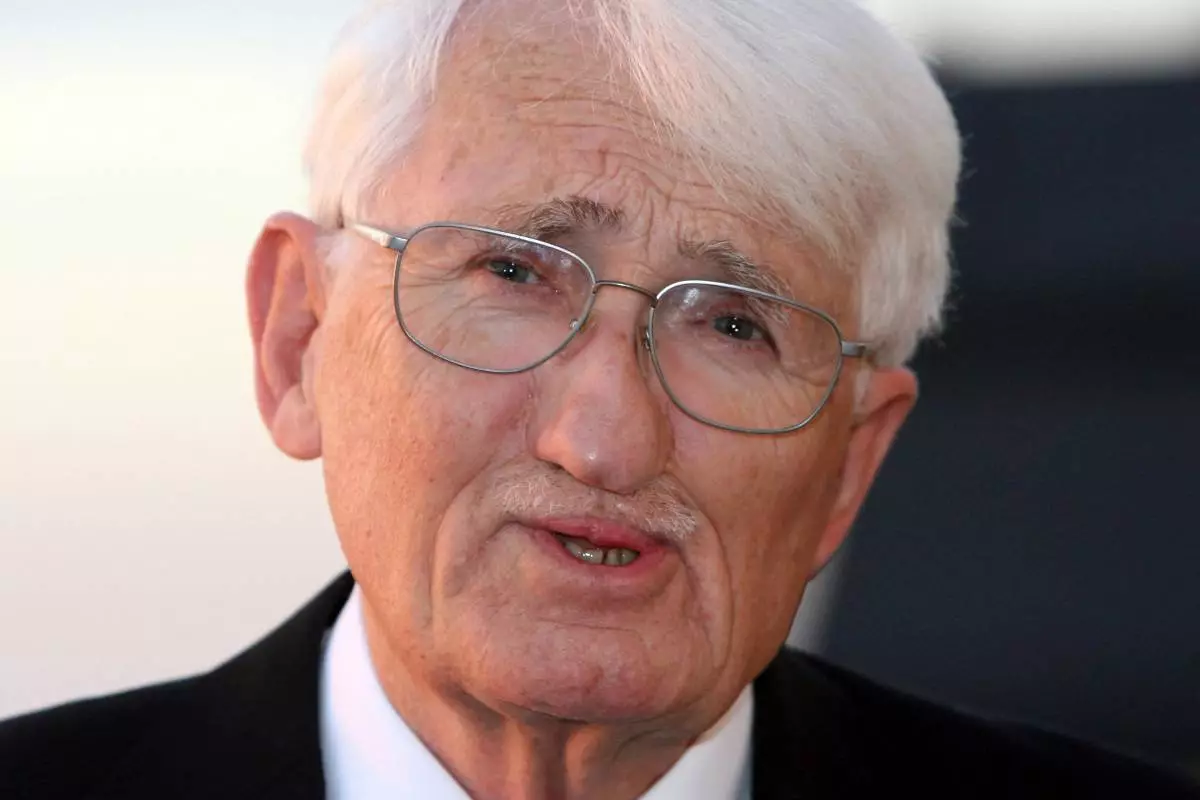
FILE - In this Nov. 7, 2006 photo German philosopher Juergen Habermas is seen in Koenigswinter near Bonn, Germany. (AP Photo/Hermann J. Knippertz, File)


FILE - In this Nov. 7, 2006 photo German philosopher Juergen Habermas is seen in Koenigswinter near Bonn, Germany. (AP Photo/Hermann J. Knippertz, File)

ÅRE, Sweden (AP) — Julia Scheib had never won a World Cup race in her eight years on the circuit before the start of this season.

Now the Austrian giant slalom specialist is a five-time winner who has locked up the discipline title with a race to spare.

Scheib won the penultimate GS of the season Saturday after first-run leader Camille Rast skied out early in her final run.

The victory gave Scheib an insurmountable lead of 189 points over her Swiss rival in the GS standings.

“It feels very special, winning the giant slalom globe has been a goal of mine for many years. To achieve it today means a lot to me," said Scheib, the ninth Austrian winner of this globe but the first since Eva-Maria Brem took it in 2016.

Mikaela Shiffrin improved from 12th following a costly mistake in the opening run to finish fifth and protect her lead in the overall standings.

Sara Hector was the only other racer who could have threatened Scheib's title, but the 2022 Olympic gold medalist from Sweden dropped out of the race after sliding off the course and into the safety netting in the first run.

Scheib denied Paula Moltzan a first career victory, finishing 0.36 seconds ahead of the American. Alice Robinson of New Zealand was 0.75 behind in third.

Limiting the damage after her first run, Shiffrin lost just five points on second-ranked Emma Aicher of Germany, who finished the race in a career-best fourth, and won 55 points on Rast.

Shiffrin now leads Aicher by 120 points and Rast by 223 and could increase her lead in Sunday’s slalom, which is the American star’s strongest event.

After this weekend, only the World Cup Finals with four races remain.

“I felt a really good mentality, both runs. In GS racing, it's so important to be willing to take the speed,” Shiffrin said. “I felt really positive things.”

Shiffrin's mishap came near the end of what might have been the fastest run by far in the opening leg.

In an all-attacking run, the American star was more than half a second ahead of race leader Rast at the last split time when she came off the course shortly before the finish and had to brake to make the next gate.

“I was just not really expecting to get like a kind of a little bit of a jump on this last roller,” said Shiffrin, who started in the 300th World Cup race of her career, a day after her 31st birthday.

“My goal this run was to be really attacking, then I had more speed than I expected,” she added. “For the rest of the run, that was the best run in GS skiing I had in a race this year. I’m so happy with that.”

Shiffrin holds the women’s record for most career GS wins with 22 but hasn’t won a race in the discipline since December 2023.

Following two crashes in a downhill and a GS in 2024, Shiffrin has been working her way back up in the discipline and got her first podium result in two years when she placed third at a race in Czechia in January.

Shiffrin's performance in GS impressed her teammate Moltzan.

“Mikaela is coming back in peak form, I think,” said Moltzan, who earned her fifth podium of the season and 10th overall, though her maiden victory is missing.

"Going into this race I wasn't so confident, I had a tough Olympics in GS, so to know that my GS skiing is still at the level in the World Cup where I left it makes me a lot more confident,” added Moltzan, who placed 15th in the Olympic GS last month.

Olympic GS champion Federica Brignone ended her season two weeks ago to continue rehab after the Italian returned from a broken leg just weeks before the Games.

AP skiing: https://apnews.com/hub/alpine-skiing

Austria's Julia Scheib celebrates winning a women's World Cup giant slalom, in Are, Sweden, Saturday, March 14, 2026. (AP Photo/Gabriele Facciotti)

Austria's Julia Scheib celebrates winning a women's World Cup giant slalom, in Are, Sweden, Saturday, March 14, 2026. (AP Photo/Gabriele Facciotti)

United States' Paula Moltzan speeds down the course during a women's World Cup giant slalom, in Are, Sweden, Saturday, March 14, 2026. (AP Photo/Marco Trovati)

United States' Paula Moltzan speeds down the course during a women's World Cup giant slalom, in Are, Sweden, Saturday, March 14, 2026. (AP Photo/Marco Trovati)

Austria's Julia Scheib speeds down the course during a women's World Cup giant slalom, in Are, Sweden, Saturday, March 14, 2026. (AP Photo/Marco Trovati)

Austria's Julia Scheib speeds down the course during a women's World Cup giant slalom, in Are, Sweden, Saturday, March 14, 2026. (AP Photo/Marco Trovati)

Switzerland's Camille Rast speeds down the course during a women's World Cup giant slalom, in Are, Sweden, Saturday, March 14, 2026. (AP Photo/Marco Trovati)

Switzerland's Camille Rast speeds down the course during a women's World Cup giant slalom, in Are, Sweden, Saturday, March 14, 2026. (AP Photo/Marco Trovati)

United States' Mikaela Shiffrin speeds down the course during a women's World Cup giant slalom, in Are, Sweden, Saturday, March 14, 2026. (AP Photo/Gabriele Facciotti)

United States' Mikaela Shiffrin speeds down the course during a women's World Cup giant slalom, in Are, Sweden, Saturday, March 14, 2026. (AP Photo/Gabriele Facciotti)

United States' Mikaela Shiffrin speeds down the course during a women's World Cup giant slalom, in Are, Sweden, Saturday, March 14, 2026. (AP Photo/Marco Trovati)

United States' Mikaela Shiffrin speeds down the course during a women's World Cup giant slalom, in Are, Sweden, Saturday, March 14, 2026. (AP Photo/Marco Trovati)

Recommended Articles