Amy Madigan won the Academy Award for best supporting actress Sunday for her role in the supernatural thriller “Weapons,” 40 years after her last nomination.
Madigan embodied the role of Gladys, giving a phenomenally creepy portrayal of the great-aunt of a young boy whose classmates go missing overnight. She won the Critics’ Choice Award and Actor Award in the same category.
Click to Gallery

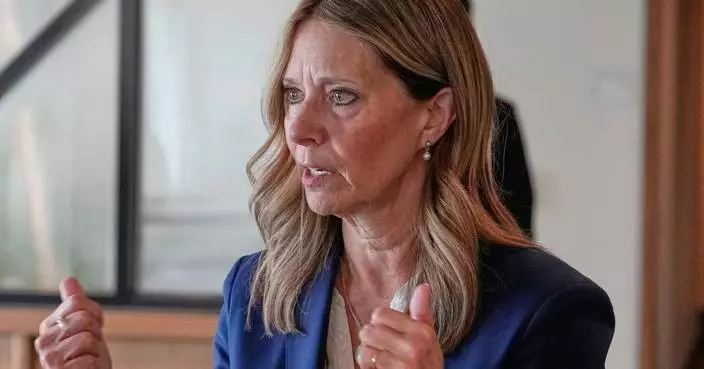
Amy Madigan arrives at the Oscars on Sunday, March 15, 2026, at the Dolby Theatre in Los Angeles. (Photo by Richard Shotwell/Invision/AP)

Ed Harris and Amy Madigan arrive at the Oscars on Sunday, March 15, 2026, at the Dolby Theatre in Los Angeles. (Photo by Richard Shotwell/Invision/AP)

Zoe Saldaña, left, presents the award for best performance by an actress in a supporting role to Amy Madigan for "Weapons" on Sunday, March 15, 2026, at the Dolby Theatre in Los Angeles. (AP Photo/Chris Pizzello)

Amy Madigan accepts the award for actress in a supporting role for "Weapons" during the Oscars on Sunday, March 15, 2026, at the Dolby Theatre in Los Angeles. (AP Photo/Chris Pizzello)

The 75-year-old let out a deep cackle as she went on stage to accept the award.
“We’re kind of advised, ’Don’t say all these names, as nobody knows who the hell these people are,’” she said. “But you’re not rattling them off. They mean something to you; that you couldn’t be here without them."
The last time she was nominated for an Oscar was for her role in 1985 family drama “Twice in a Lifetime,” setting a record for the longest gap between nominations for an actress.
“Everybody’s asking me … ‘Well it’s been 40 years, what’s different about this time?’” Madigan said. “What’s different is this little gold guy.”
Her character is so integral to one of the movie’s biggest twists that she was kept out of the press tour and early marketing for the film so as to not give away any spoilers.
“Gladys has surprised me, she’s getting a lot of love back,” Madigan said in her acceptance speech at the Annual Actor Awards. “I didn’t know y’all wanted to hang out with her.”
Her character is “kind of inspiring in a strange way,” despite being the movie's villain, she said after her Oscar win.
If given the opportunity, she would love to reprise the role in an Aunt Gladys prequel, she said.
Some of Madigan’s most notable roles in her long career were in “Field of Dreams” and “Uncle Buck” in 1989. She has also acted in Broadway and off-Broadway productions.
“Opportunities (as an older actress) are less and you just hope that something finds you so you can find it,” she said in an interview with The New York Times. “And I don’t take it for granted, because you can go up and then you can go all the way down, as we know.”
Madigan thanked director and writer Zach Cregger for writing a “dream part” for her. While horror movies have traditionally been snubbed for awards, being treated like the “little kids table at Thanksgiving,” Madigan said she was heartened by the recognition for genre films like “Weapons” and “Sinners” this year.
She also gave a shoutout to the other nominees Teyana Taylor in “One Battle After Another,” Wunmi Mosaku in “Sinners,” and Elle Fanning and Inga Ibsdotter Lilleaas in “Sentimental Value.” The category did not have a clear favorite ahead of this year’s ceremony, with a crowded field of nominees splitting the biggest awards of the season.
For more coverage of the 2026 Oscars, visit https://apnews.com/hub/academy-awards.

Amy Madigan arrives at the Oscars on Sunday, March 15, 2026, at the Dolby Theatre in Los Angeles. (Photo by Richard Shotwell/Invision/AP)

Ed Harris and Amy Madigan arrive at the Oscars on Sunday, March 15, 2026, at the Dolby Theatre in Los Angeles. (Photo by Richard Shotwell/Invision/AP)

Zoe Saldaña, left, presents the award for best performance by an actress in a supporting role to Amy Madigan for "Weapons" on Sunday, March 15, 2026, at the Dolby Theatre in Los Angeles. (AP Photo/Chris Pizzello)

Amy Madigan accepts the award for actress in a supporting role for "Weapons" during the Oscars on Sunday, March 15, 2026, at the Dolby Theatre in Los Angeles. (AP Photo/Chris Pizzello)

CAIRO (AP) — President Donald Trump said Sunday that he has “demanded” that about seven countries heavily reliant on Middle East oil join a coalition to police the Strait of Hormuz.
About one-fifth the world’s traded oil flows through the waterway.
Trump spoke while answering reporters’ questions as he flew back to Washington from Florida aboard Air Force One.
The president declined to name the countries he the administration is negotiating with for protection for the strait.
“I’m demanding that these countries come in and protect their own territory, because it is their own territory,” Trump said about the strait, claiming the vital shipping channel is not something the United States needs because of its own access to oil.
THIS IS A BREAKING NEWS UPDATE. AP’s earlier story follows below.
CAIRO (AP) — U.S. President Donald Trump's appeal to China, France, Japan, South Korea, Britain and others to send warships to keep the Strait of Hormuz “open and safe” brought no commitments on Sunday as oil prices soar during the Iran war.
Iran's Foreign Minister Abbas Araghchi told CBS that Tehran has been “approached by a number of countries” seeking safe passage for their vessels, “and this is up to our military to decide.” He said a group of vessels from “different countries” had been allowed to pass, without providing details.
Iran has said the strait, through which one-fifth of global oil exports normally pass, is open to all except the United States and its allies.
Araghchi added that “we don’t see any reason why we should talk with Americans” about finding a way to end the war, noting that Israel and the U.S. started the fighting with coordinated attacks on Feb. 28 during indirect U.S.-Iran talks on Iran's nuclear program. He also said Tehran had “no plan to recover” the enriched uranium that is under rubble following U.S. and Israeli attacks last year.
U.S. Energy Secretary Chris Wright told NBC he has been “in dialogue” with some of the countries Trump mentioned, and said he expected China “will be a constructive partner” in reopening the strait.
But countries made no promises.
Britain said Prime Minister Keir Starmer on Sunday discussed with Trump the importance of reopening the strait "to end the disruption to global shipping,” and spoke with Canada’s prime minister about it separately.
A spokesperson for China’s embassy to the U.S., Liu Pengyu, said “all parties have the responsibility to ensure stable and unimpeded energy supply” and that China would “strengthen communication with relevant parties” for de-escalation.
South Korea’s Foreign Ministry said it “takes note” of Trump’s call and that it “will closely coordinate and carefully review” the situation with the U.S.
Expectations are high that Trump will ask Japan directly when Prime Minister Sanae Takaichi meets him on Thursday at the White House.
France previously said it is working with countries — President Emmanuel Macron mentioned partners in Europe, India and Asia — on a possible international mission to escort ships through the strait but has stressed it must be when “the circumstances permit,” when fighting has subsided.
Foreign Minister Johann Wadephul of Germany, which was not mentioned in Trump's call, told ARD television: “Will we soon be an active part of this conflict? No.”
Meanwhile, emergency oil stocks “will soon start flowing to global markets,” the International Energy Agency said Sunday, describing the collective action to lower prices “by far the largest ever.”
It updated last week’s announcement of 400 million barrels to nearly 412 million. Asian member countries plan to release stocks “immediately,” and reserves from Europe and the Americas will be released “from the end of March.”
Gulf Arab states including Saudi Arabia, Kuwait and Bahrain reported new missile or drone attacks a day after Iran called for the evacuation of three major ports in the United Arab Emirates — the first time it has threatened a neighboring country’s non-U.S. assets.
Tehran has accused the U.S. of launching Friday's strikes on Kharg Island, home to Iran’s primary oil terminal, from the UAE, without providing evidence. It has threatened to attack U.S.-linked “oil, economic and energy infrastructures” if its oil infrastructure is hit.
U.S. Central Command said it had no response to Iran’s claim, and Anwar Gargash, a diplomatic adviser to the UAE president, rejected it. Gulf countries that host U.S. bases have denied allowing their land or airspace to be used for military operations against Iran.
Iran has fired hundreds of missiles and drones at Arab Gulf neighbors during the war, causing significant damage and rattling economies even as most are intercepted. Tehran says it targets U.S. assets, even as Iranian strikes are reported at civilian sites such as airports and oil fields.
Iranian strikes have killed at least a dozen civilians in Gulf countries, most of them migrant workers.
In Iran, the International Committee for the Red Cross said more than 1,300 people have been killed. Iran’s Health Ministry said 223 women and 202 children are among the dead, according to Mizan, the judiciary’s official news agency.
Iran’s government on Sunday showed journalists buildings damaged by strikes in Tehran on Friday. A police station was hit and surrounding buildings were damaged. Some apartments’ outer walls had been stripped away.
“God had mercy on all of us,” said Elham Movagghari, a resident. Other Iranians are leaving the country.
In Israel, 12 people have been killed by Iranian missile fire and more have been injured, including three on Sunday. At least 13 U.S. military members have been killed, six in a plane crash in Iraq last week.
At least 820 people have been killed in Lebanon, according to its Health Ministry, since Iran-backed Hezbollah hit Israel and Israel responded with strikes and sent additional troops into southern Lebanon. In just 10 days, more than 800,000 people — nearly one out of every seven residents of Lebanon — have been displaced.
Israel’s military said early Monday that Iran launched missiles toward Israel.
Earlier, several strikes hit central Israel and the Tel Aviv area, where they caused damage at 23 sites and sparked a small fire. Magen David Adom, Israel’s rescue service, released video showing a large crater in a street and shrapnel damage to an apartment building.
Israel’s military says Iran is firing cluster bombs that can evade some air defenses and scatter submunitions across multiple locations.
Metz reported from Ramallah, West Bank, Frankel from Jerusalem and Anna from Lowville, New York. Associated Press journalists Sally Abou AlJoud and Fadi Tawil in Beirut, John Leicester in Paris, Christopher Weber in Los Angeles, and Fatima Hussein and Tia Goldenberg in Washington contributed to this report.
This version corrects to say Araghchi was speaking to CBS, not NBC as previously reported.
People walk past tents sheltering people displaced by Israeli airstrikes at a public space along the Beirut waterfront at sunset in Beirut, Lebanon, Sunday, March 15, 2026. (AP Photo/Hassan Ammar)
People gather outside an apartment building damaged by an Iranian missile strike in Bnei Brak, Israel, Sunday, March 15, 2026. (AP Photo/Oded Balilty)
People shout slogans during an anti U.S. and Israeli rally outside the U.S. consulate in Istanbul, Turkey, Sunday, March 15, 2026. The sign reads in Turkish: "Leave NATO, close the bases." (AP Photo/Emrah Gurel)
Heavy rain falls over tents sheltering people displaced by Israeli airstrikes in southern Lebanon and Dahiyeh, Beirut's southern suburbs, along the Beirut waterfront in Beirut, Lebanon, Sunday, March 15, 2026. (AP Photo/Hassan Ammar)
Israeli air defense system fires to intercept missiles during an Iranian attack over Tel Aviv, Israel, early Sunday, March 15, 2026. (AP Photo/Ohad Zwigenberg)
Volunteers clean debris from a residential building damaged when a nearby police station was hit Friday in a U.S.-Israeli strike in Tehran, Iran, Sunday, March 15, 2026. (AP Photo/Vahid Salemi)
A cargo ship sails in the Arabian Gulf towards Strait of Hormuz in United Arab Emirates, Sunday, March 15, 2026. (AP Photo/Altaf Qadri)
Firefighters extinguish fire at a site damaged during an Iranian missile strike in Tel Aviv, Israel, Sunday, March 15, 2026. (AP Photo/Ohad Zwigenberg)
Volunteers clean debris from a residential building damaged when a nearby police station was hit Friday in a U.S.-Israeli strike in Tehran, Iran, Sunday, March 15, 2026. (AP Photo/Vahid Salemi)
Home Front Command officer works at an apartment damaged after an Iranian strike in Bnei Brak, Israel, Sunday, March 15, 2026. (AP Photo/Oded Balilty)
Smoke rises from the rubble of buildings destroyed in an Israeli airstrike in Dahiyeh, Beirut's southern suburbs, Lebanon, Sunday, March 15, 2026. (AP Photo/Hassan Ammar)
A man photographs the rubble of buildings destroyed in an Israeli airstrike in Dahiyeh, Beirut's southern suburbs, Lebanon, Sunday, March 15, 2026. (AP Photo/Hassan Ammar)
Israeli air defense system fires to intercept missiles during an Iranian attack over Tel Aviv, Israel, early Sunday, March 15, 2026. (AP Photo/Ohad Zwigenberg)
Smoke rises from the U.S. embassy building in Baghdad, Iraq, Saturday, March 14, 2026. (AP Photo/Ali Jabar)
Mourners react during the funeral ceremony for Gen. Ali Shamkhani, secretary of Iran's Defense Council and a senior adviser to the Supreme Leader who was killed in a strike, at the courtyard of the Imamzadeh Saleh shrine in Tehran, Iran, Saturday, March 14, 2026. (AP Photo/Vahid Salemi)
Two men ride their motorbike past a billboard of the Iranian Supreme Leader Ayatollah Mojtaba Khamenei in downtown Tehran, Iran, Saturday, March 14, 2026. (AP Photo/Vahid Salemi)
Fire and plumes of smoke rise from an oil facility in Fujairah, United Arab Emirates, Saturday, March 14, 2026. (AP Photo/Altaf Qadri)
A man chants slogan while the body of Gen. Ali Shamkhani, secretary of Iran's Defense Council and a senior adviser to the Supreme Leader who was killed in a strike, is being buried at the courtyard of the Imamzadeh Saleh shrine in Tehran, Iran, Saturday, March 14, 2026. (AP Photo/Vahid Salemi)