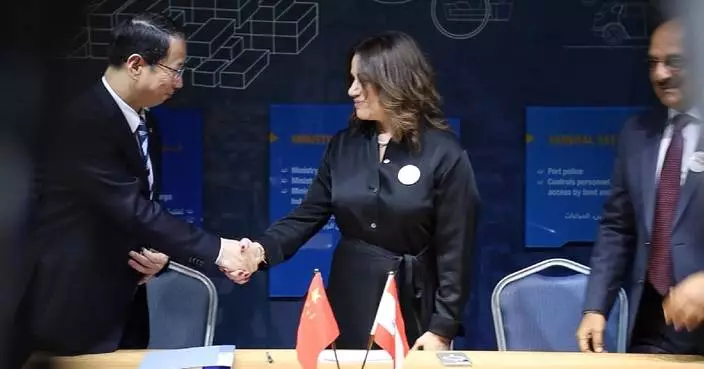
The 51st International Exhibition of Inventions of Geneva closed Sunday with China staging its largest presence yet, showcasing 237 projects and winning 90 gold medals among more than 200 inventions.
Co-organized by the Swiss government and the World Intellectual Property Organization (WIPO), among others, the expo is one of the longest-running and largest invention exhibitions in the world. This year's five-day event featured over 1,000 invention projects from 35 countries and regions, showcasing innovative achievements across different fields and industries.
The Chinese delegation organized 237 invention projects across 212 booths, marking the largest scale to date. Among the most impressive innovations on display was a technology developed by China Railway Construction Corporation (CRCC) designed to assist in subsea tunnel construction.
For subsea tunnel projects, the soft, unstable sand on the seabed presents a significant engineering challenge. This led to the invention of the "pipe curtain" method by the CRCC. A curtain of horizontal frozen pipes can provide the stability that the sand lacks while the tunnel is being built.
Wang Xuming, senior engineer at China Railway 20 Bureau Group (CR20), said that the prototype is currently under construction in Sanya Bay of south China's Hainan Province.
"The construction of large-cross-section subsea tunnels has its own unique characteristics. To address geological complexities such as high-salinity and shallow overburden environments, we have developed a range of targeted engineering solutions," said Wang.
Beyond focusing on fields including environmental protection, renewable energy, electronics, medicine and construction, the achievements brought by the Chinese delegation also featured products designed for emotional support.
The lifelike robotic cats brought by Finnox, a Chinese company dedicated to developing artificial intelligence (AI) that truly understands human emotions and interacts accordingly, drew crowds of visitors who couldn't resist petting the adorable creations.
"We're not trying to replace real pets. Actually, we're trying to give people emotional values. So, for example, when you are really tired at work and you come home and you don't want to actually spend a lot of time feeding a cat, and especially when sometimes you are on travel or something, you cannot actually feed a real cat. So you can try to use our ones to give you emotional support," said Zhao Zihe, CEO of Finnox.
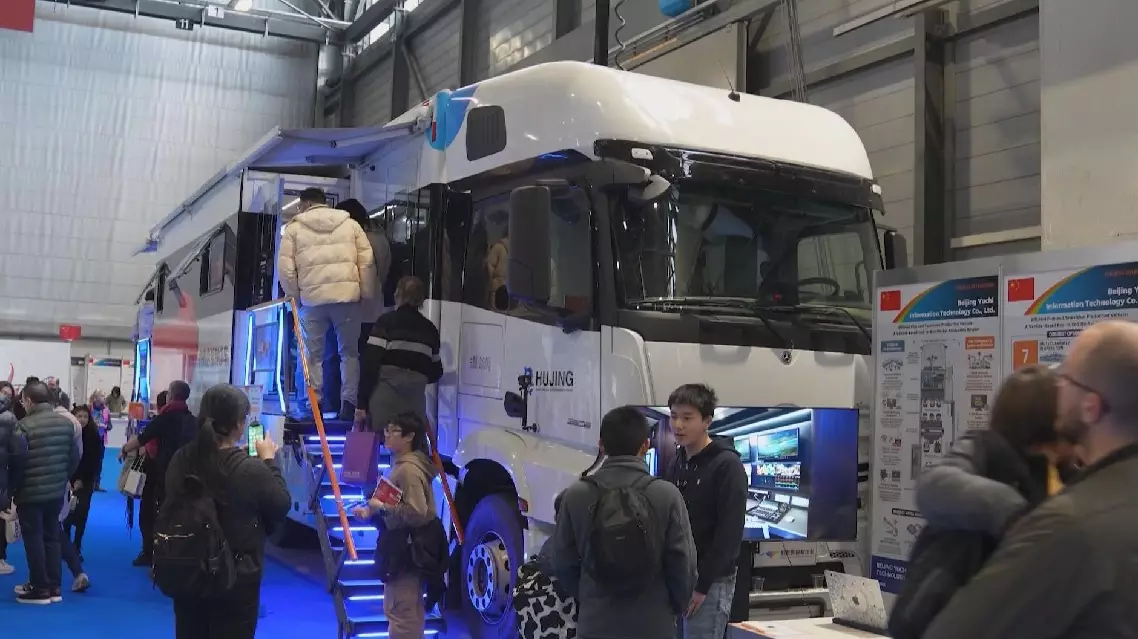
In addition, one of the most interactive displays at the event was the "Efficient Film and Television Production Vehicle." The truck, developed by Alibaba's Hujing Digital Media and Entertainment Group, features an impressive production suite, a director's area, and a living space complete with a sofa, bathroom, and kitchen. It has already been used in around 20 Chinese television series and film productions.
Chinese innovations shine at 51st Int'l Expo of Inventions of Geneva