Over the next five years, China has pledged to upgrade its traditional industries. As the world's largest shipbuilder, the country is also transforming its shipbuilding sector to enhance global competitiveness with the use of digital tools.
LNG ship, aircraft carrier and large cruise ship are the three most difficult ships to build, known as the "crown jewels" in shipbuilding. And now, China has the ability to build all three of them. But it's not enough to merely build them, and China wants to be among the best in the world.
Take a large cruise ship for example. It's the most complex ship in the world. One of these "floating cities on the sea" has more than 25 million parts, 5 times those of an airplane.
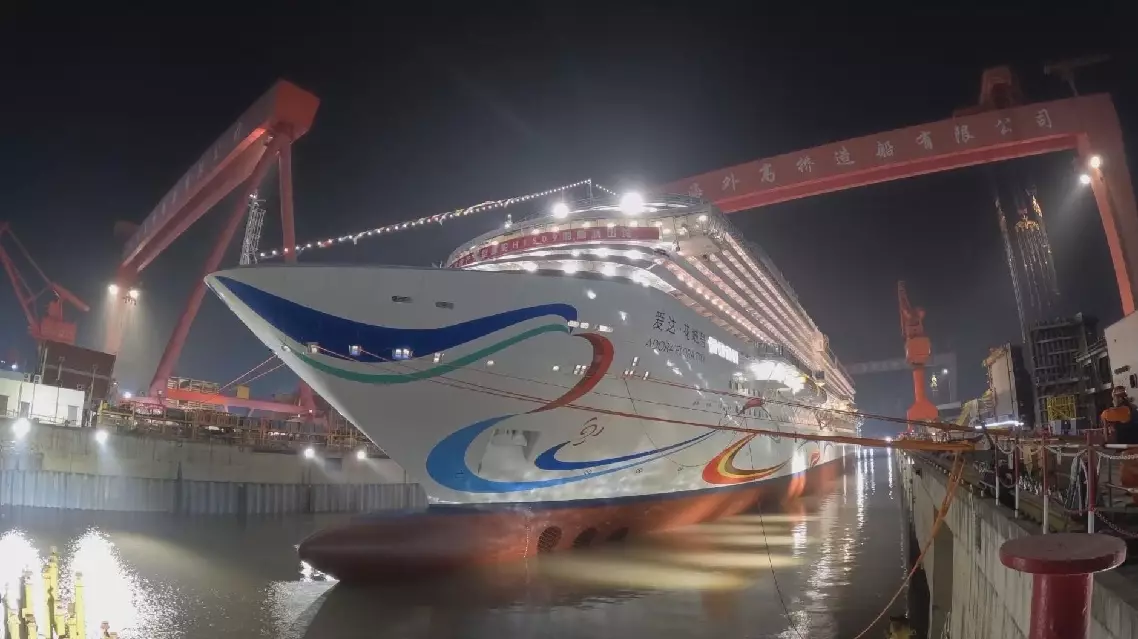
In 2023, China delivered its first domestically-built large cruise ship, Adora Magic City. The second one, Adora Flora City, docked at the mouth of the Yangtze River, is already close to completion. It is a bit larger than its predecessor, with a bigger passenger capacity. But that's not the most significant improvement.
On the early morning of March 14, the undocking process started with the waters from the Yangtze River pouring into the dock. That's the first time the ship would be taken to the near waters for a short sail. The Adora Flora City has reached this stage eight months earlier than the Magic City. And the interior is also well ahead.
"China's manufacturing sector is now undergoing digital transformation, and our factory is no exception. When tackling highly complex projects like large cruise ships, it's challenging to deliver vessels on schedule without leveraging digital tools," said Yuan Feihui, deputy dean of the Institute for Design and Research with Shanghai Waigaoqiao Shipbuilding Co., Ltd., the China State Shipbuilding Corporation.
To build a large ship that requires more than 3,000 people working simultaneously, digital management is crucial for avoiding errors.
Yuan gives the example of electric cables. For the Adora Flora City, more than 4,700 kilometers of cables are needed. That's 10 times longer than regular ships, and almost the length across half of China. In the past, cables were a big problem because workers might just randomly install them as long as they were functional. But about a month ago, they were well-organized.
"We develop our own cable system at the design stage. For each floor -- how many cables, what specifications, what models, and what types to use -- our designers have input information directly into the modeling process according to the drawing requirements," Yuan said.
That is what Yuan calls a "full-cycle management," which was tried for the first time from design to installation on the second ship.
Instead of traditional paper blueprints, engineers are making use of tablets. It helps them to visualize the constructing steps and gives details of the materials needed.
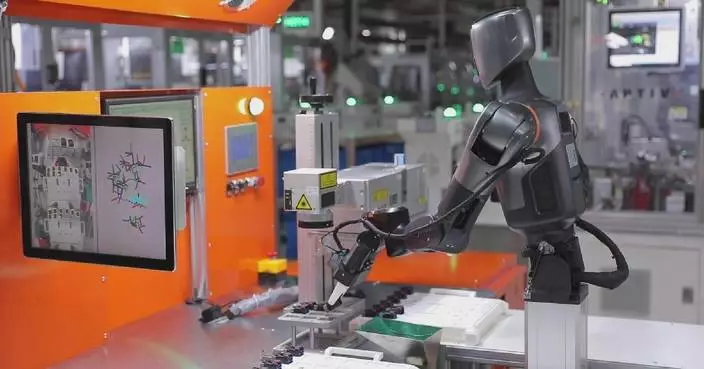
Artificial intelligence is also helping improve efficiency. In one of the warehouses, automated guided vehicles (AGVs) and robots automatically stack the materials into storage.
"For example, when I give it instructions, such as the timing for material requirements, it will grab materials based on the 'first-in, first-out' principle," said Xu Lyuzhou, director of the Distribution Center with Shanghai Waigaoqiao Shipbuilding Co., Ltd..
China's 15th Five-Year Plan (2026-2030) highlighted the need to optimize and upgrade traditional industries, including shipbuilding. And digital transformation is key to enhancing global competitiveness of China's shipbuilding sector. Now, for the country's major shipbuilding factories and ship types, digital tools like the DSP, a digital platform that connects all sectors of the ship, are continuously improving efficiency and quality.
"Our product quality has improved, rework has decreased, and material waste has been reduced. Our effective working hours have increased while ineffective hours have decreased, all of which have further driven gains in overall efficiency. Our progress has accelerated, and we have become more proficient in cruise ship construction. These are tangible benefits and valuable lessons we have gained," Yuan said.
In 2025, China's shipbuilding sector has delivered a strong performance .
China's shipbuilding industry maintained the world's largest market share in terms of three major indicators for the 16th consecutive year in 2025, according to data released by the Ministry of Industry and Information Technology.
The country's shipbuilding output reached 53.69 million deadweight tons (DWT) in 2025, up 11.4 percent year on year and accounting for 56.1 percent of the global total.
New orders reached 107.82 million DWT last year, representing a 69 percent share of the global market.
As of the end of December 2025, the sector's holding orders stood at 274.42 million DWT, up 31.5 percent from the previous year. This volume accounted for 66.8 percent of the global market share.
China upgrades traditional shipbuilding industry with digitization