LOS ANGELES (AP) — A horde of children chased host Conan O’Brien onto the Dolby Theatre stage in the opening moments of the 98th Academy Awards, and throughout an Oscar ceremony that saw “One Battle After Another” win best picture, it was like they never left.
A queasy future, both immediate and for generations to come, pervaded an Academy Awards shadowed by war, political turmoil and whatever might happen to the movies in an artificial intelligence-supercharged tomorrow. These were the high anxiety Oscars. At almost every turn, they seemed to be trying to rally a little optimism despite omnipresent storm clouds.
Click to Gallery
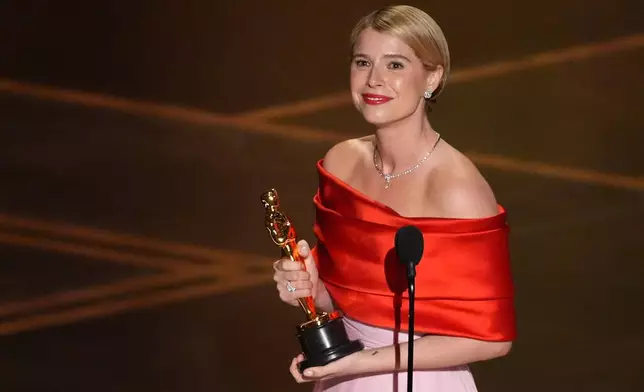
Jessie Buckley accepts the award for actress in a leading role for "Hamnet" during the Oscars on Sunday, March 15, 2026, at the Dolby Theatre in Los Angeles. (AP Photo/Chris Pizzello)

David Borenstein, from left, Alžběta Karásková, Radovan Síbrt, Pavel Talankin, center left, Robin Hessman, center right, Helle Faber accept the award for documentary feature film for "Mr. Nobody against Putin" during the Oscars on Sunday, March 15, 2026, at the Dolby Theatre in Los Angeles. (AP Photo/Chris Pizzello)

Paul Thomas Anderson, winner of the awards for writing (adapted screenplay), directing, and best picture for "One Battle After Another," poses in the press room at the Oscars on Sunday, March 15, 2026, at the Dolby Theatre in Los Angeles. (Photo by Jordan Strauss/Invision/AP)

Michael B. Jordan, left, winner of the award for actor in a leading role for "Sinners," and Ryan Coogler, winner of the award for writing (original screenplay) for "Sinners," pose in the press room at the Oscars on Sunday, March 15, 2026, at the Dolby Theatre in Los Angeles. (Photo by Jordan Strauss/Invision/AP)
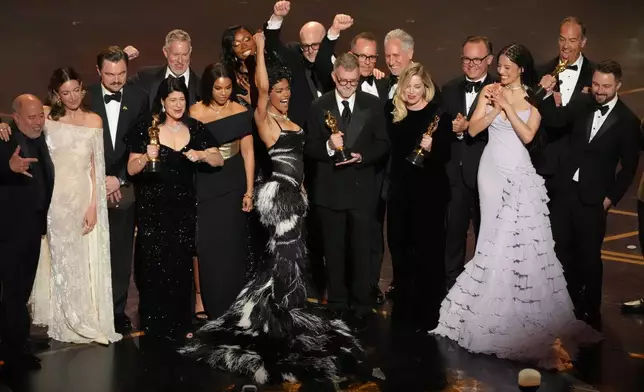
Jose Antonio Garcia, from left, Florencia Martin, Leonardo DiCaprio, Cassandra Kulukundis, Regina Hall, Shayna McHale, Teyana Taylor, Michael Bauman, Paul Thomas Anderson, Anthony Carlino, Will Weike, Sara Murphy, Chase Infiniti, Christopher Scarabosio, and Andy Jurgensen accept the award for best picture award for "One Battle After Another" during the Oscars on Sunday, March 15, 2026, at the Dolby Theatre in Los Angeles. (AP Photo/Chris Pizzello)

Host Conan O'Brien, dressed as the character Gladys Lilly from "Weapons" is chased by children during the Oscars on Sunday, March 15, 2026, at the Dolby Theatre in Los Angeles. (AP Photo/Chris Pizzello)
“We pay tribute tonight, not just to film, but to the ideals of global artistry, collaboration, patience, resilience and that rarest of qualities today — optimism,” O’Brien said in his opening monologue. “We’re going to celebrate. Not because we think all is well, but because we work, and hope for better.”
The last time the Oscars took place just after a U.S. launch of war in the Middle East was 2003. Just days after the Iraq War began, the musical “Chicago” won best picture.
But it was a different story Sunday. The night’s big winner, Paul Thomas Anderson's “One Battle After Another,” a father-daughter saga of revolution, immigrant detention and white supremacy, arrived uncommonly tailored to the times. The film, which won six Oscars, triumphed in part because it spoke to right now.
When asked about the movie’s relevancy and America’s future backstage, Anderson, still reeling from the first Oscars — including best director and best adapted screenplay — of his 30-year career, was initially caught off guard. “I thought we were supposed to be partying,” he joked
But then Anderson, who had largely avoided speaking directly about the movie’s message during the film’s near-sweep of awards season, granted that his film’s power lay partly in its timeliness.
“Our film obviously has a certain amount of parallels to what’s happening in the news every day,” Anderson said.
“In terms of where it’s going, I don’t know,” he added, shrugging his shoulders. “But I know that the end of our movie is our hero, Willa, heading off to continue to fight against evil forces, and, I think, like I said in my speech, bring at least common sense and decency back into fashion.”
The connection between what was on screen, with current events off it, made the 98th Oscars an appropriately destabilized affair. For the first time in a long time, the movies and the Oscars were almost in step with the moment. That was true not only in “One Battle After Another,” but also in the apocalyptic road movie “Sirāt,” the Iranian revenge drama “It Was Just an Accident” and Ryan Coogler’s “Sinners,” about the forces that prey on Black culture.
But if “One Battle After Another” and “Sinners” (four awards, including best actor for Michael B. Jordan and, in a first for women and Black directors of photography, best cinematography for Autumn Durald Arkapaw) maybe suggested a hopeful dawn for big-budget, original American movies, their wins also reflected the rapidly shifting ground in Hollywood.
Warner Bros., the studio behind those films, took home a record-tying 11 Oscars. David Zaslav, in a memo Monday to staff, called it “a remarkable moment for Warner Bros. Discovery.” It was also potentially a last hurrah for Warner Bros. as a standalone studio. The studio has agreed to be acquired by David Ellison’s Paramount Skydance in a deal worth $111 billion.
The film industry, which has already seen MGM gobbled up by Amazon and 20th Century Fox bought by The Walt Disney Co., knows that contraction inevitably means fewer jobs. Film production in Los Angeles has cratered in recent years.
O’Brien, himself, imagined he could be out of a job soon, calling himself “the last human host” of the Oscars, which in three years will move from ABC to YouTube. In comic bits throughout the broadcast, O’Brien focused on the difficult plight of movies today. One segment spoofed iconic widescreen films cut to fit the smartphone-friendly vertical format. Another imagined “Casablanca” — a Warner Bros. film, by the way — dumbed down with constant plot regurgitation for half-watching streaming audiences.
So it’s gotten a lot harder, on Hollywood’s biggest night, to trot out the same song-and-dance pitch for the Dream Factory. The Oscars are now more like a beleaguered pep talk to keep up the good fight. Lost in the hoopla over Timothée Chalamet's comment worrying about the movies becoming like opera or ballet was a genuine concern for the marquee pop culture medium's future.
“The theatrical experience is something that’s a little bit vulnerable right now,” director Joachim Trier told reporters backstage after winning best international film for “Sentimental Value.” “So I’m very proud that (for) our film … people have shown up.”
Many winners stayed clear of politics. Neither the word “Iran” or the name of President Donald Trump were uttered during the broadcast, though Jimmy Kimmel, a presenter, came close. Before reading the best documentary nominees, Kimmel sarcastically referenced the absence of “Melania.”
“Oh, man,” Kimmel said. “Is he going to be mad his wife wasn’t nominated for this.”
But after an awards season that often skirted politics, many were more blunt. Presenter Javier Bardem strode up to the mic and stated forthrightly: “No to war, and free Palestine.” While accepting the best documentary Oscar for “Mr. Nobody Against Putin,” Pavel Talankin, the schoolteacher in the documentary, said through an interpreter: “In the name of our future, in the name of all of our children, stop all of these wars now.”
Jessie Buckley, the best actress winner for her grieving mother in “Hamnet,” likewise cast her eye to children, specifically her eight-month-old daughter Isla “who has absolutely no idea what’s going on and is probably dreaming of milk,” Buckley said.
Buckley was more upbeat than most about the promise of the future. From the stage, she told her husband she wanted “20,000 more babies” with him. But, again and again, those who took home trophies Sunday struggled to find the right words for a time of fraying American bonds and expanding war, and instead returned to the subject of what kind of world a younger generation would inherit. Trier, in his acceptance speech, paraphrased James Baldwin.
“I want to end by paraphrasing the wonderful American writer James Baldwin, who makes us remember that all adults are responsible for all children,” he said. “Let’s not vote for politicians who don’t take this seriously into account.”
In the end, the win for “One Battle After Another” may have been all the more inevitable since it clearly represents what's on the minds of many. Anderson's film ends with its young protagonist, played by Chase Infiniti, rushing out the door to a protest, while the uplifting chords of Tom Petty's “American Girl” begin to chime.
“What happens when your parents, who are damaged, have handed quite a difficult history to you, how do you manage that?” Anderson said backstage. “That’s our story.”
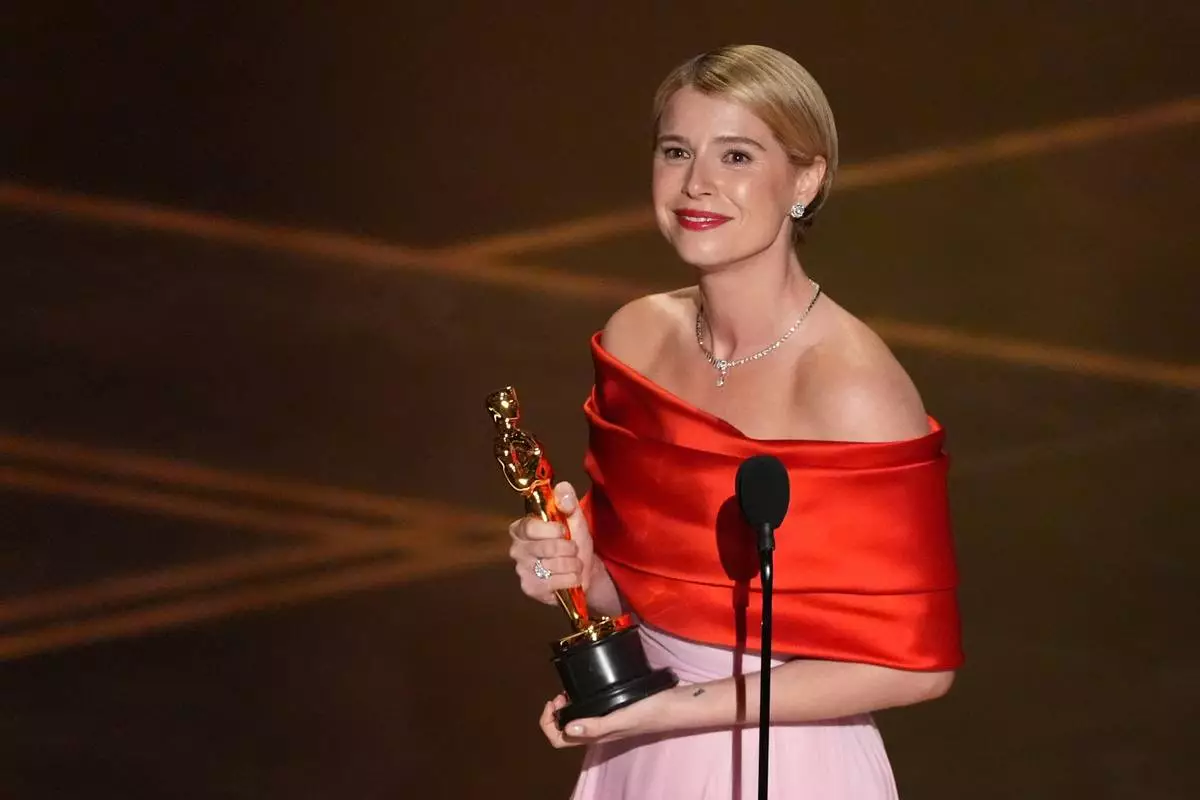
Jessie Buckley accepts the award for actress in a leading role for "Hamnet" during the Oscars on Sunday, March 15, 2026, at the Dolby Theatre in Los Angeles. (AP Photo/Chris Pizzello)
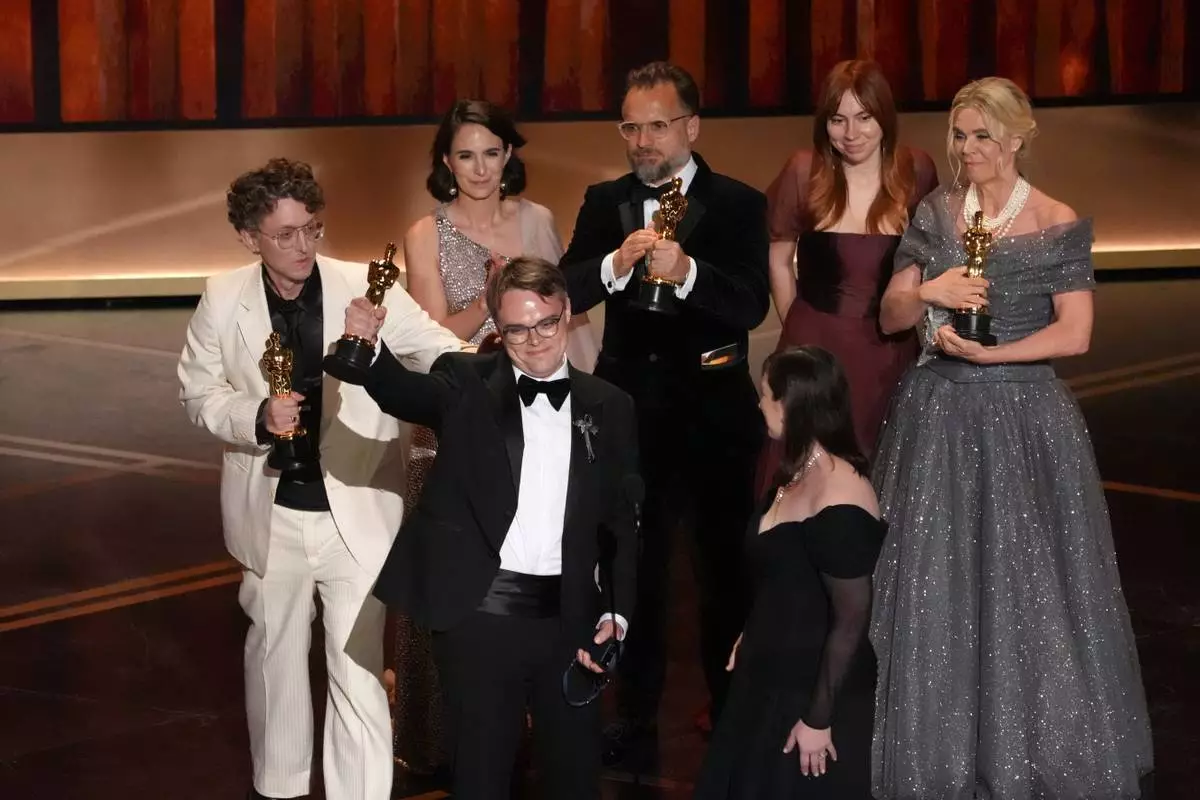
David Borenstein, from left, Alžběta Karásková, Radovan Síbrt, Pavel Talankin, center left, Robin Hessman, center right, Helle Faber accept the award for documentary feature film for "Mr. Nobody against Putin" during the Oscars on Sunday, March 15, 2026, at the Dolby Theatre in Los Angeles. (AP Photo/Chris Pizzello)

Paul Thomas Anderson, winner of the awards for writing (adapted screenplay), directing, and best picture for "One Battle After Another," poses in the press room at the Oscars on Sunday, March 15, 2026, at the Dolby Theatre in Los Angeles. (Photo by Jordan Strauss/Invision/AP)
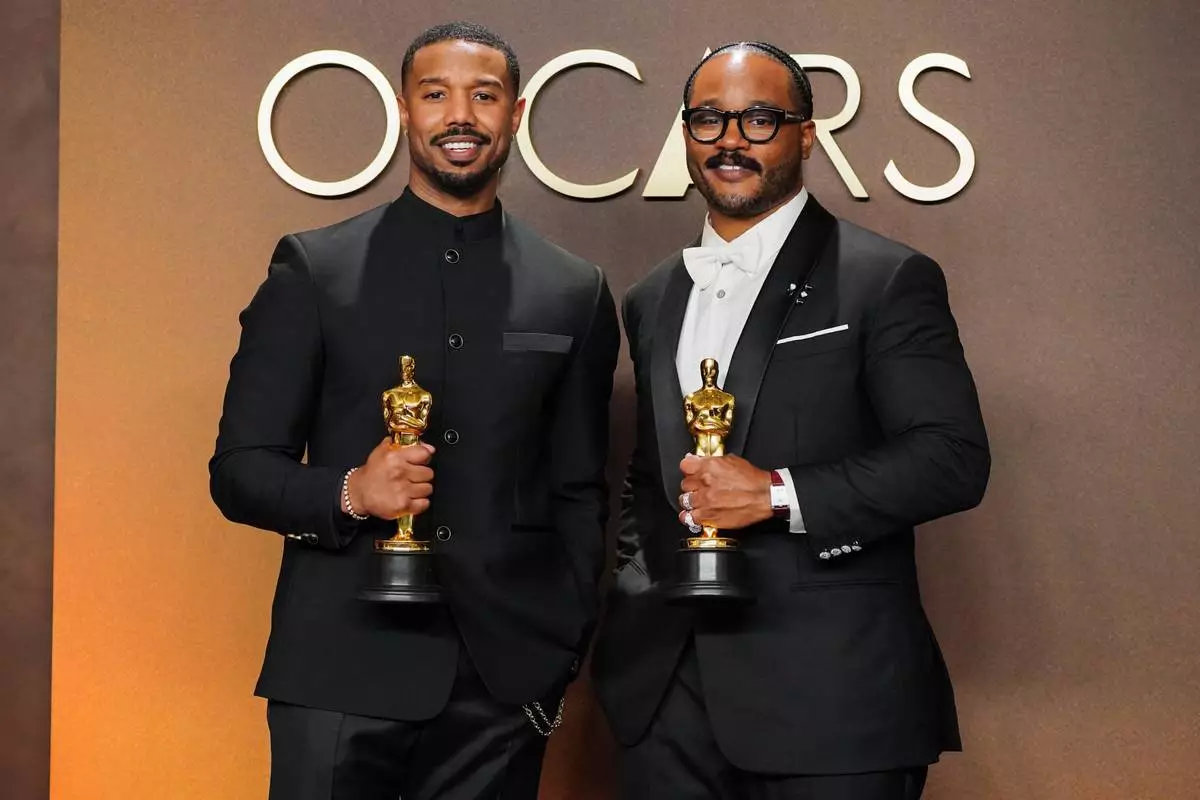
Michael B. Jordan, left, winner of the award for actor in a leading role for "Sinners," and Ryan Coogler, winner of the award for writing (original screenplay) for "Sinners," pose in the press room at the Oscars on Sunday, March 15, 2026, at the Dolby Theatre in Los Angeles. (Photo by Jordan Strauss/Invision/AP)
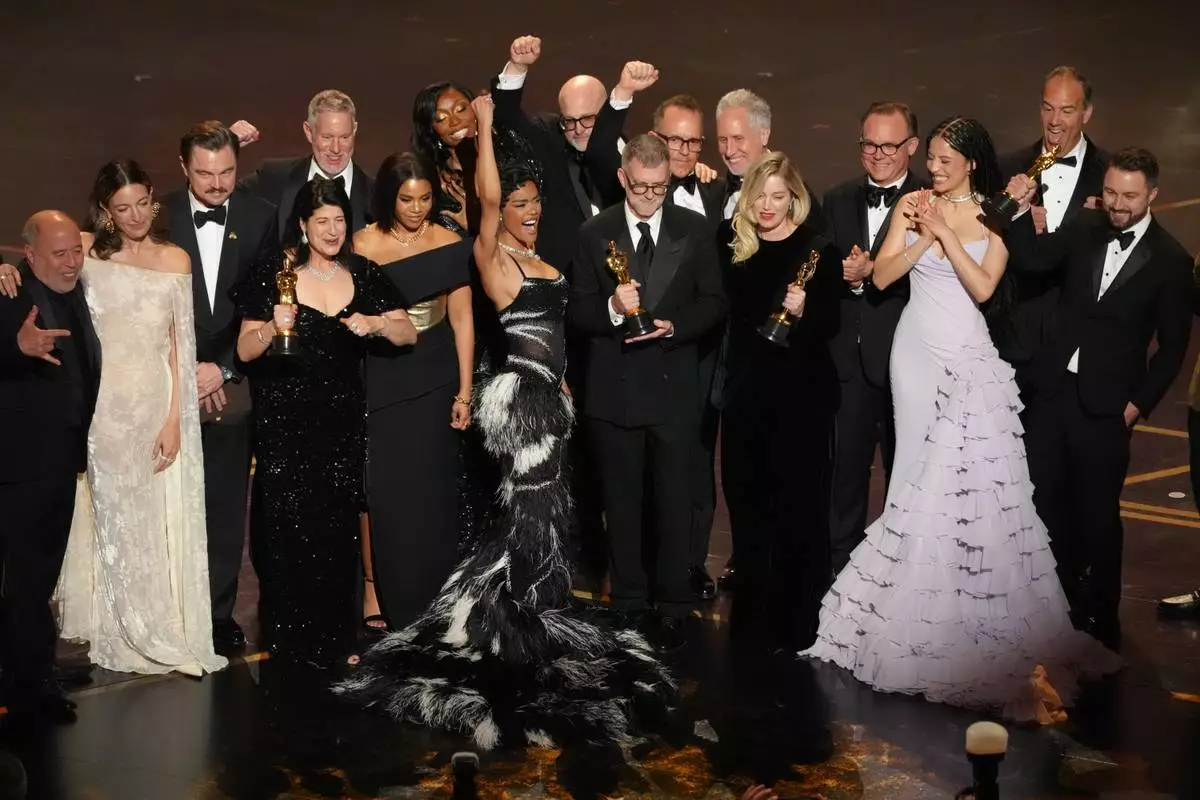
Jose Antonio Garcia, from left, Florencia Martin, Leonardo DiCaprio, Cassandra Kulukundis, Regina Hall, Shayna McHale, Teyana Taylor, Michael Bauman, Paul Thomas Anderson, Anthony Carlino, Will Weike, Sara Murphy, Chase Infiniti, Christopher Scarabosio, and Andy Jurgensen accept the award for best picture award for "One Battle After Another" during the Oscars on Sunday, March 15, 2026, at the Dolby Theatre in Los Angeles. (AP Photo/Chris Pizzello)
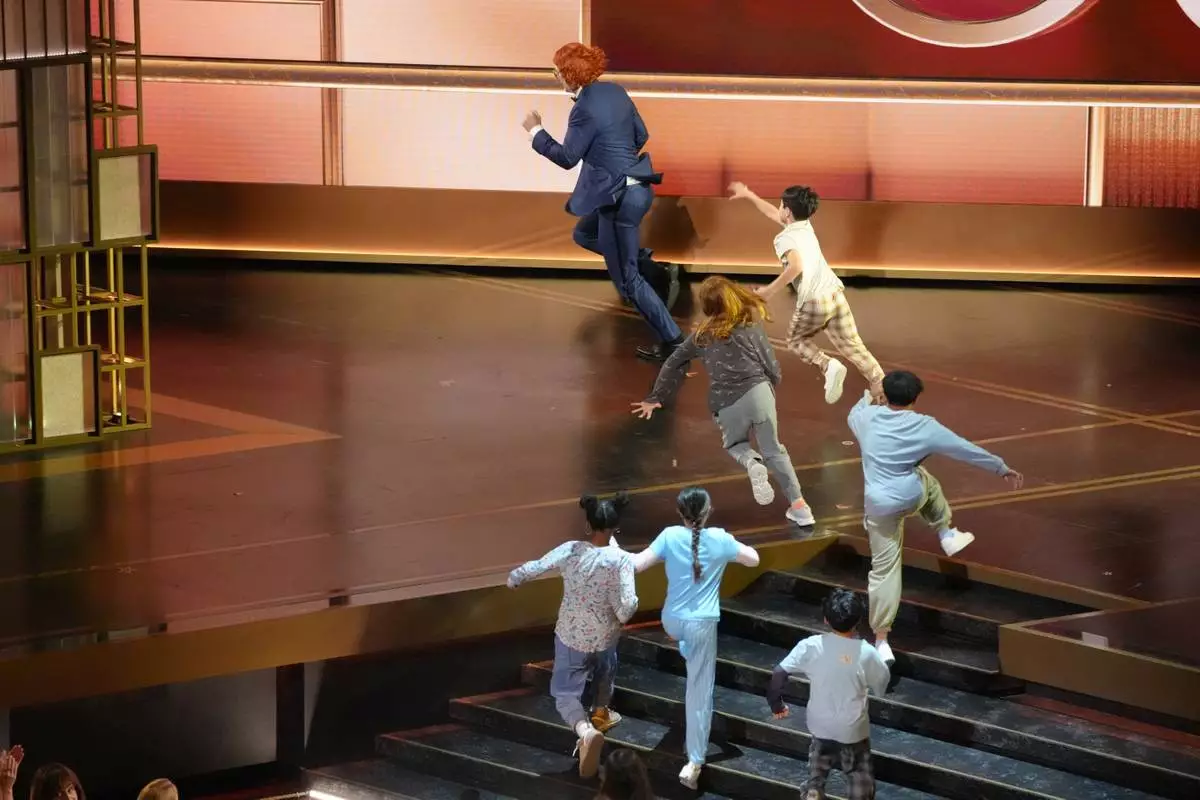
Host Conan O'Brien, dressed as the character Gladys Lilly from "Weapons" is chased by children during the Oscars on Sunday, March 15, 2026, at the Dolby Theatre in Los Angeles. (AP Photo/Chris Pizzello)