SAN JOSE, Calif.--(BUSINESS WIRE)--Mar 16, 2026--
Kioxia America, Inc. today announced the development of its Super High IOPS SSD, a new type of SSD enabling the GPU to directly access high-speed flash memory as an expansion to High Bandwidth Memory (HBM) in AI systems. The new Super High IOPS SSD, the KIOXIA GP Series, is purpose-built to meet the growing performance demands of AI and high-performance computing, providing larger GPU-accessible memory capacity for faster data access to AI workloads. Evaluation samples of KIOXIA GP Series will be available to select customers by the end of 2026.
This press release features multimedia. View the full release here: https://www.businesswire.com/news/home/20260316056420/en/
The NVIDIA Storage-Next™ initiative addresses the anticipated shift from compute-intensive to data-intensive workloads and the expanded need for GPU-accessible memory space, currently limited by HBM size. Expanding the GPU’s usable memory space allows access to larger data sets and improves GPU utilization by moving more data closer to compute resources.
The NVIDIA Storage-Next initiative calls on SSD vendors to design drives optimized for GPU-initiated AI workloads. The initiative effectively expands HBM capacity by enabling GPUs to access flash-based memory. Kioxia is supporting NVIDIA’s initiative with the KIOXIA GP Series SSDs, which utilize low-latency, high-performance KIOXIA XL-FLASH™ Storage Class Memory, and is uniquely positioned for this architecture, delivering higher IOPS, finer-grained data access (512 bytes), and lower power consumption per IO, compared with Kioxia conventional TLC SSDs.
“Kioxia fully supports the NVIDIA Storage-Next initiative and will deliver purpose-built SSDs to effectively address the need for GPU-accessible memory,” said Makoto Hamada, Senior Director of the SSD Division, Kioxia Corporation. “This collaboration is instrumental in shaping the future of AI storage architecture.”
Kioxia reaffirms its commitment to driving technological advancements in AI and high-performance computing through ongoing innovation and strategic collaborations. The KIOXIA GP Series SSD family is designed to address the evolving needs of AI workloads.
Additionally, AI models are rapidly scaling toward trillions of parameters while context windows expand to millions of tokens, driving an unprecedented growth in KV (Key Value) cache requirements. Architectures such as NVIDIA’s Context Memory Storage (CMX) recognize the need to extend the memory hierarchy beyond GPU memory using high-performance storage. The KIOXIA CM9 Series PCIe ® 5.0 E3.S SSD, offering 25.6 TB TLC capacity with 3 DWPD endurance, provides the performance, capacity, and endurance needed to support these large-scale inference environments. KIOXIA believes this class of storage will play a critical role in scaling efficient, cost-optimized AI inference infrastructure. Samples will begin shipping in Q3 2026.
KIOXIA will be demonstrating the Super High IOPS SSD emulator and other technology innovations at NVIDIA GTC, booth 3522.
For more information, please visit www.kioxia.com, and follow the company on X and LinkedIn®.
About KIOXIA America, Inc.
KIOXIA America, Inc. is the U.S.-based subsidiary of KIOXIA Corporation, a leading worldwide supplier of flash memory and solid-state drives (SSDs). From the invention of flash memory to today’s breakthrough BiCS FLASH™ 3D technology, KIOXIA continues to pioneer innovative memory, SSD and software solutions that enrich people's lives and expand society's horizons. The company's innovative 3D flash memory technology, BiCS FLASH, is shaping the future of storage in high-density applications, including advanced smartphones, PCs, automotive systems, data centers and generative AI systems. For more information, please visit KIOXIA.com.
© 2026 KIOXIA America, Inc. All rights reserved. Information in this press release, including product pricing and specifications, content of services, and contact information is current and believed to be accurate on the date of the announcement, but is subject to change without prior notice. Technical and application information contained here is subject to the most recent applicable KIOXIA product specifications.
Notes:
Product image may differ from the actual product
Trademarks:
NVIDIA and Storage-Next are trademarks and/or registered trademarks of NVIDIA Corporation in the U.S. and other countries.
PCIe is a registered trademark of PCI-SIG.
LinkedIn is a trademark of LinkedIn Corporation and its affiliates in the United States and/or other countries.
Company names, product names, and service names may be trademarks of third-party companies.
Disclaimer:
Definition of SSD capacity: Kioxia Corporation defines a kilobyte (KB) as 1,000 bytes, a megabyte (MB) as 1,000,000 bytes, a gigabyte (GB) as 1,000,000,000 bytes, a terabyte (TB) as 1,000,000,000,000 bytes, and a kibibyte (KiB) is 1,024 bytes. A computer operating system, however, reports storage capacity using powers of 2 for the definition of 1GB = 2^30 bytes = 1,073,741,824 bytes and 1TB = 2^40 bytes = 1,099,511,627,776 bytes and therefore shows less storage capacity. Available storage capacity (including examples of various media files) will vary based on file size, formatting, settings, software and operating system, and/or pre-installed software applications, or media content. Actual formatted capacity may vary.

The KIOXIA GP Series SSD family is designed to address the evolving needs of AI workloads.
PARK CITY, Utah (AP) — Prosecutors on Monday aimed to drive home their argument that a Utah woman who published a children’s book about grief after the death of her husband killed him for his money, while her defense team argued the prosecution's case leaves much to speculation.
Defendant Kouri Richins was $4.5 million in debt and falsely believed she would inherit her husband Eric Richins' estate worth more than $4 million when he died, prosecutors said during closing arguments in her murder trial.
“She wanted to leave Eric Richins but did not want to leave his money,” said Summit County prosecutor Brad Bloodworth.
Prosecutors say Richins, 35, slipped five times the lethal dose of fentanyl into a cocktail that she made for her husband, causing his death in March 2022 at their home just outside the affluent ski town of Park City.
She is also charged with fraudulently claiming insurance benefits after her husband’s death, trying to kill him weeks earlier on Valentine’s Day with a fentanyl-laced sandwich that made him black out, and other felonies, according to court documents. Richins has pleaded not guilty to all charges.
The most serious charge — aggravated murder — carries a sentence of 25 years to life in prison.
What was scheduled to be a five-week trial was cut short last week when Richins waived her right to testify, and her legal team abruptly rested its case without calling any witnesses. Richins’ attorneys said they were confident that prosecutors did not produce enough evidence over the past three weeks to convict her of murder.
“They haven't done their job, and now they want you to make inferences based on paper-thin evidence. They want you to do their job for them. Tell them, ‘No,’” defense attorney Wendy Lewis urged the jury on Monday.
The judge denied the defense's motion for a mistrial after the prosecution's closing argument. Richins listened to the prosecution’s presentation with a furrowed brow and whispered with her attorneys.
Prosecutors said Richins, a real estate agent focused on flipping houses, was deep in debt and planning a future with another man she was seeing on the side. She had opened numerous life insurance policies on her husband without his knowledge, with benefits totaling about $2 million, prosecutors alleged.
They showed the jury text messages between Richins and Robert Josh Grossman, the man with whom she was allegedly having an affair, in which she fantasized about leaving her husband, gaining millions in a divorce and marrying Grossman.
Bloodworth replayed for the jury a clip of Richins’ 911 call from the night of her husband’s death. That’s “not ‘the sound of a wife becoming a widow,’” he said, quoting the defense’s opening statement. “It’s the sound of a wife becoming a black widow.”
Lewis responded that the prosecution “looks at facts one way and sees a witch, but if you look at those facts another way, you see a widow.”
The defense focused on trying to discredit the prosecution's star witness, Carmen Lauber, a housekeeper for the family who claimed to have sold Richins fentanyl on multiple occasions.
Lewis argued Lauber did not deal fentanyl and was motivated to lie for legal protection. Lauber said in early interviews that she never dealt the synthetic opioid, but later said she did after investigators informed her that Eric Richins died of a fentanyl overdose, the defense noted.
Richins had asked Lauber for “the Michael Jackson stuff," which Bloodworth said likely refers to the drug combination that killed the singer.
“She knows she wants it because it is lethal,” he argued.
The housekeeper was already in a drug court program as an alternative to incarceration on other charges when authorities arrested her in connection with the Richins case, investigators said. She had also violated some conditions of drug court.
The defense showed a video of law enforcement warning Lauber that they could pull her drug court deal and that she could face a lengthy prison sentence.
“Give us the details that will ensure Kouri gets convicted of murder,” a man in the video said.
Lauber was granted immunity for her cooperation in the case. She testified that she felt a need to “step up and take accountability of my part in this.”
Shortly before her arrest in May 2023, Richins self-published a children’s book about grief to help her sons process the loss of their father. She promoted the book “Are You with Me?” on local TV and radio stations, which prosecutors have pointed to in arguing that Richins planned the killing and tried to cover it up.
Summit County Sheriff’s detective Jeff O’Driscoll, the lead investigator on the case, testified that Richins paid a ghostwriting company to write the book for her.
O’Driscoll said the sheriff’s office received an anonymous package shortly after Richins’ arrest that contained the book and a note: “There are two sides to every story. This is a true Kouri, a devoted wife and adoring mother. Thought you should know.”
Investigators later learned from Amazon that Richins’ mother sent the package.
Prosecutors showed the jury excerpts of a letter found in Richins’ jail cell that they said appears to outline testimony for her mother and brother. In the six-page letter, Richins instructs her brother to tell her former attorney that Eric Richins confided in him about getting fentanyl from Mexico and “gets high every night."
Defense attorneys have said the letter contains a fictional story Richins had been working on. They have argued that Eric Richins was addicted to painkillers and asked his wife to procure opioids for him.
However, Richins told police on the night of her husband's death that he had no history of illicit drug use, according to body camera footage shown in court.
The internet search history from Richins’ phone included “what is a lethal.dose.of.fetanayl (sic),” “luxury prisons for the rich America” and “if someone is poisned (sic) what does it go down on the death certificate as,” a digital forensic analyst testified.

Defendant Kouri Richins, accused of poisoning her husband in March 2022, listens to closing arguments in Third District Court, Monday, March 16, 2026, in Park City, Utah. (David Jackson/Pool Photo via AP)

Judge Richard Mrazik listens to closing arguments in the Kouri Richins trial where she is accused of poisoning her husband in March 2022, in Third District Court, Monday, March 16, 2026, in Park City, Utah. (David Jackson/Pool Photo via AP)

Defendant Kouri Richins, left, accused of poisoning her husband in March 2022, listens to closing arguments in Third District Court, Monday, March 16, 2026, in Park City, Utah. (David Jackson/Pool Photo via AP)
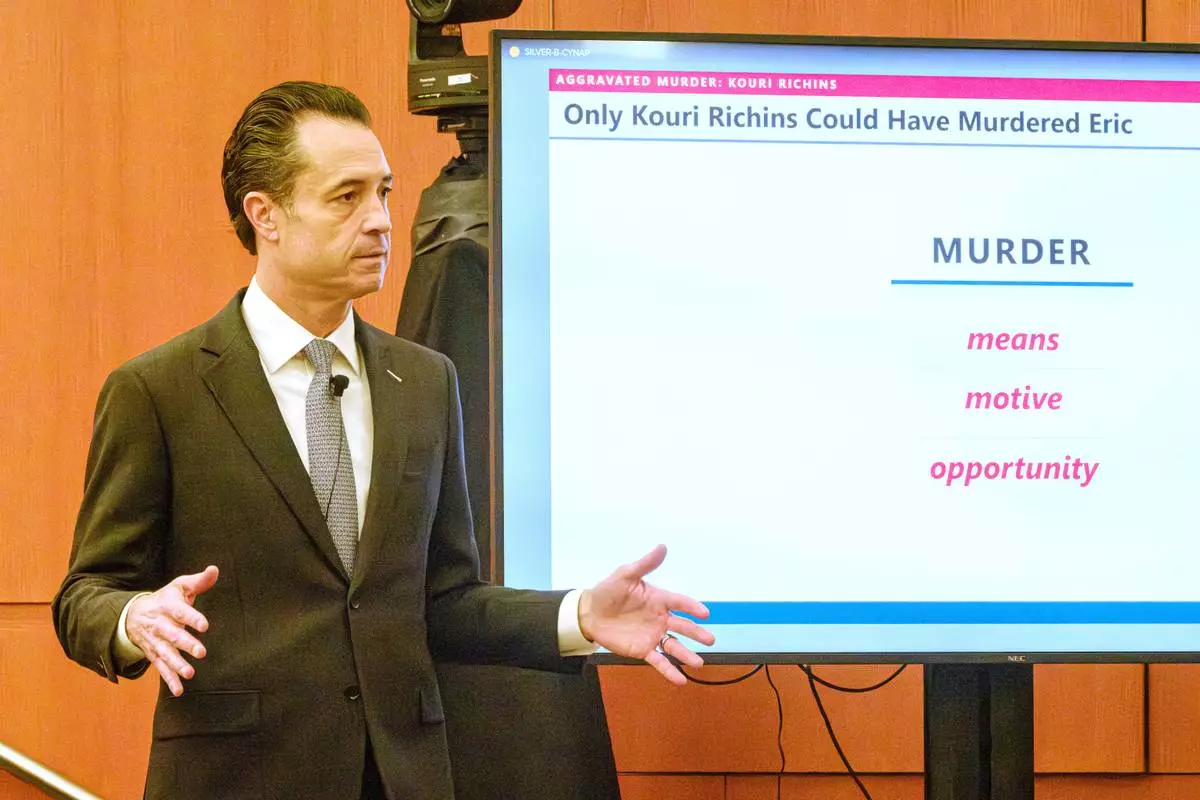
Summit County Prosecutor Brad Bloodworth presenting the state's final arguments in the trial of Kouri Richins, accused of poisoning her husband in March 2022, Monday, March 16, 2026, in Third District Court in Park City, Utah. (David Jackson/Pool Photo via AP)

Defendant Kouri Richins, left, accused of poisoning her husband in March 2022, listens to closing arguments in Third District Court, Monday, March 16, 2026, in Park City, Utah. (David Jackson/Pool Photo via AP)